





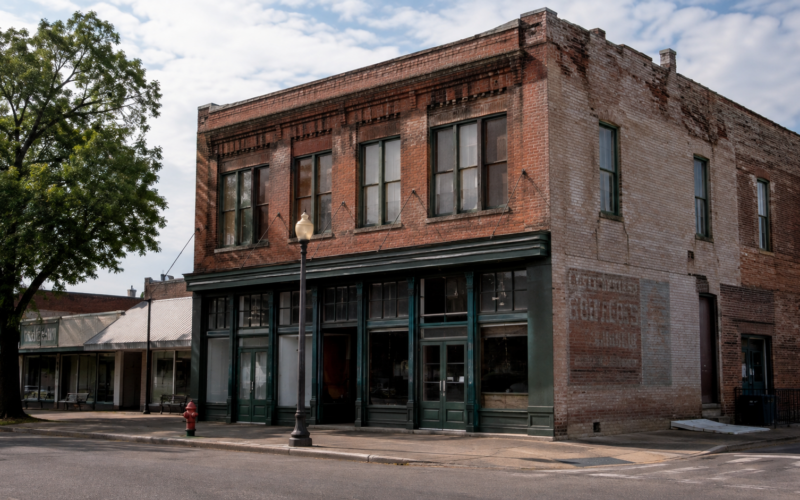
Higher Purpose Hub is preparing to break ground on a $3 million regional economic opportunity center in Clarksdale, Mississippi, moving a long-planned community investment project from fundraising and design into physical construction. The nonprofit said the August 6, 2026 groundbreaking would begin the redevelopment of a historic downtown building into a shared center for entrepreneurship, workforce development, preventive healthcare, food access, arts and community programming. More than $2.2 million of the project cost is being supported by the Delta Regional Authority, with foundations and donors funding the remaining amount. The central test is whether concentrating multiple services in one location can create measurable business formation, employment and household wealth outcomes across a region where economic opportunity remains persistently uneven.
The facility at 238 Issaquena Avenue is expected to include a regional entrepreneurship and community development center, a bookstore and a public art gallery. Higher Purpose Hub plans to provide business education, workforce training, technical assistance and connections to capital, while also making space available for wellness services, fresh food, cultural activities and community gatherings. The project therefore represents more than a conventional nonprofit office expansion. It is an attempt to build a physical economic-development platform that brings together services often fragmented across separate organisations, funding programmes and locations.
Why is Higher Purpose Hub investing $3 million in a regional economic center in Clarksdale?
Higher Purpose Hub’s investment responds to a structural problem facing many rural communities: entrepreneurs may possess viable ideas and local market knowledge but lack convenient access to financing, professional advice, training, suitable workspaces and institutional networks. A business owner who must approach multiple organisations for each form of assistance can lose time, incur transportation costs and abandon an expansion before capital becomes available.
The proposed Clarksdale center seeks to reduce that friction by placing several forms of support under one roof. Higher Purpose Hub intends to connect business education and technical assistance with workforce development and access-to-capital services. That combination matters because training without finance can leave entrepreneurs better informed but still unable to invest, while financing without operating support may increase the possibility that a young business struggles to deploy capital effectively.
The center is also intended to serve communities beyond Clarksdale. Higher Purpose Hub describes itself as a regional nonprofit intermediary working to improve intergenerational economic opportunity across the Mississippi Delta. Its wider ambition is to connect local residents and organisations with state, regional and national partners rather than limit the facility to a single-city programme.
The strategic value of the building will consequently depend on its reach. A successful regional center must attract entrepreneurs from surrounding counties, establish referral networks with local institutions and ensure that programmes remain accessible to residents who cannot visit frequently. The building creates a visible anchor, but regional impact will require a service model capable of extending well beyond its walls.
How does the Delta Regional Authority grant change the project’s financial credibility?
The Delta Regional Authority’s grant of more than $2.2 million covers roughly three-quarters of the stated $3 million project cost. The remainder is expected to come from foundations and donors, giving the development a blended public-philanthropic funding structure rather than requiring Higher Purpose Hub to carry the full capital burden.
That funding mix gives the project greater financial credibility because the largest portion of the redevelopment cost has already been linked to an established federal-state economic development institution. The Delta Regional Authority was created in 2000 to coordinate investment across the lower Mississippi River region and Alabama Black Belt. Its territory covers 255 counties and parishes across Alabama, Arkansas, Illinois, Kentucky, Louisiana, Mississippi, Missouri and Tennessee.
The authority invests in transportation, public infrastructure, workforce training and business development. Its support for the Higher Purpose Hub project indicates that the center is being treated as regional economic infrastructure rather than simply a cultural venue or charitable programme.
However, securing renovation funding is only the first financial hurdle. Capital grants can build facilities, but sustainable operations require recurring resources for staffing, maintenance, programming, outreach and participant support. Higher Purpose Hub will need to demonstrate that the facility can maintain an active programme calendar and attract additional funding after the construction phase concludes.
The project’s long-term economics will therefore be determined less by the initial $3 million investment than by how effectively the organisation converts the property into a continuously used regional platform. A renovated building that hosts occasional events would deliver a different economic return from a center that regularly supports entrepreneurs, facilitates financing and connects residents with employment opportunities.

Why does combining entrepreneurship, health, food and culture matter for economic mobility?
Higher Purpose Hub’s model recognises that household economic mobility is not shaped by business finance alone. Health conditions, food access, workforce skills, social networks and cultural participation can influence whether residents are able to start businesses, remain employed or invest in their communities.
The planned combination of entrepreneurship support, preventive healthcare, fresh food and cultural programming may appear unusually broad for a $3 million redevelopment. Yet that breadth reflects the interconnected nature of regional disadvantage. A small-business owner’s ability to grow can be affected by workforce availability, employee health, family responsibilities and the availability of professional networks as much as by demand for a product.
The integrated model could also increase footfall. A facility serving only entrepreneurs would naturally appeal to a narrower audience. By including a bookstore, gallery, food-related services, wellness programming and gathering space, Higher Purpose Hub may be able to draw residents into the building for different reasons and then introduce them to business or workforce resources.
This creates the potential for what might be described as an economic opportunity funnel. A visitor attending an arts event could learn about a training programme. A food producer could discover technical assistance. A worker seeking career support could encounter information about starting a business. The more services reinforce one another, the stronger the facility’s case as shared regional infrastructure.
Breadth also creates execution risk. Each programme area requires specialised partners, staff and funding. Higher Purpose Hub will need to avoid spreading its resources so widely that no single service achieves sufficient depth. The strongest operating model would likely use the organisation as a coordinator while relying on qualified partners to deliver specialist services.
Can the Clarksdale center overcome the Mississippi Delta’s persistent economic barriers?
The scale of the challenge is considerably larger than the project’s construction budget. Recent United States Census Bureau estimates place Clarksdale’s poverty rate at approximately 40.3%, with median household income of about $36,382 during the 2020 to 2024 period. The United States Department of Agriculture has continued to identify the Mississippi Delta as one of the parts of the rural Southeast where severe and persistent poverty is concentrated.
A $3 million center cannot independently reverse regional poverty, population loss, infrastructure weaknesses or limited access to large employers. It can, however, address a narrower and potentially important gap by improving the support infrastructure surrounding local entrepreneurs, workers and community organisations.
That distinction matters. Community-development projects are sometimes judged against problems far larger than their funding and authority. A more realistic assessment would examine whether the Higher Purpose Hub increases the number of residents receiving business assistance, expands the flow of capital to locally owned companies, improves workforce credentials and creates stronger institutional partnerships.
The project could also strengthen downtown Clarksdale by bringing an underused historic property back into productive use. Successful adaptive reuse can increase pedestrian activity, support nearby businesses and preserve the character of a commercial district. These benefits are not automatic, but they expand the project’s relevance beyond the programmes delivered inside the building.
Clarksdale’s identity as a centre of Delta blues heritage gives the cultural component additional economic significance. Arts programming, a public gallery and community events may complement tourism and local commerce, particularly when connected with entrepreneurship support for artists, food businesses, retailers and other locally rooted enterprises.
What must Higher Purpose Hub deliver after the August 2026 groundbreaking?
The groundbreaking ceremony is scheduled for August 6 at 11 a.m. and will also mark the beginning of Higher Purpose Fest, which runs through August 8. The annual event highlights music, food and wellness, giving Higher Purpose Hub an immediate opportunity to connect the construction milestone with residents, public officials, nonprofit partners and prospective programme participants.
After the ceremony, attention will shift to construction execution. Higher Purpose Hub has not disclosed a completion date in the announcement, making the construction timetable, final project scope and opening schedule important next disclosures. Renovating a historic building can involve design adjustments, permitting requirements and unforeseen costs, so maintaining control over the remaining budget will be important.
The organisation will also need to define how entrepreneurs access its services. Key operating questions include whether assistance will be offered free of charge, how businesses will qualify for financing connections, which training partners will participate and how outcomes will be tracked across the wider Delta region.
Measurement will be particularly important because the facility combines social, cultural and economic objectives. Attendance figures may demonstrate community engagement but reveal little about economic mobility. More meaningful indicators would include businesses launched or expanded, capital secured, jobs created or retained, workers completing training, contracts awarded to participating companies and the survival rate of supported enterprises.
Higher Purpose Hub will also need to demonstrate that its services reach people who have historically faced barriers to conventional financial and business-development systems. That will require sustained outreach, trusted local partnerships and programmes designed around the practical realities of rural residents rather than the convenience of funders or service providers.
Could Higher Purpose Hub become a model for rural community investment elsewhere?
The project has the potential to become a replicable model because many rural regions face a similar problem: support exists, but it is dispersed across agencies, nonprofits, lenders, colleges and government programmes. A trusted local intermediary can create value by coordinating those resources and making them easier to navigate.
Higher Purpose Hub’s approach could be especially relevant in places where conventional economic-development strategies centred on recruiting a single large employer have produced limited results. Supporting locally owned enterprises may generate smaller individual investments, but it can also diversify economic activity and keep more decision-making within the community.
Replication would depend on evidence. Other regions will want to know whether the Clarksdale center increases business survival, attracts outside capital, improves workforce outcomes and generates enough activity to justify its operating cost. They will also examine whether the combination of entrepreneurship, wellness, food and culture creates useful synergies or simply increases organisational complexity.
For the Delta Regional Authority, the project offers a chance to test whether place-based community infrastructure can complement its investments in transportation, utilities, workforce training and business development. A positive outcome could encourage similar investments across its eight-state service region.
Higher Purpose Hub enters the construction phase with substantial public funding, a defined downtown property and an ambitious regional mission. What has improved is the organisation’s ability to turn a long-discussed concept into a funded physical asset. What remains unresolved is whether the center can produce sustained economic outcomes at a scale that reaches beyond individual programmes and events.
The next measurable proof points will be construction progress, a confirmed opening timetable, operating partnerships and a transparent framework for tracking business, workforce and community results. The project’s ultimate significance will not be determined by the groundbreaking ceremony or the renovation alone. It will be determined by whether residents repeatedly use the center to obtain skills, capital, connections and opportunities that translate into stronger businesses and more resilient household incomes.
What are the key takeaways from Higher Purpose Hub’s $3 million Clarksdale project?
- Higher Purpose Hub plans to begin construction on its $3 million regional economic opportunity center on August 6, 2026.
- The center will redevelop a historic property at 238 Issaquena Avenue in downtown Clarksdale.
- The Delta Regional Authority is providing more than $2.2 million, with foundations and donors funding the balance.
- Planned services include entrepreneurship education, workforce training, technical assistance and connections to capital.
- The facility is also expected to include wellness services, fresh-food access, a bookstore, a public art gallery and gathering spaces.
- The integrated model could reduce the fragmentation entrepreneurs face when seeking finance, training and professional support.
- The project may also contribute to downtown activity by returning a historic building to productive use.
- Its biggest challenge will be converting capital investment into sustainable programmes and measurable economic outcomes.
- Important indicators will include businesses supported, capital raised, jobs created, training completions and regional participation.
- Construction progress, the opening schedule and confirmed operating partnerships are the next major proof points.
Discover more from Business-News-Today.com
Subscribe to get the latest posts sent to your email.
