


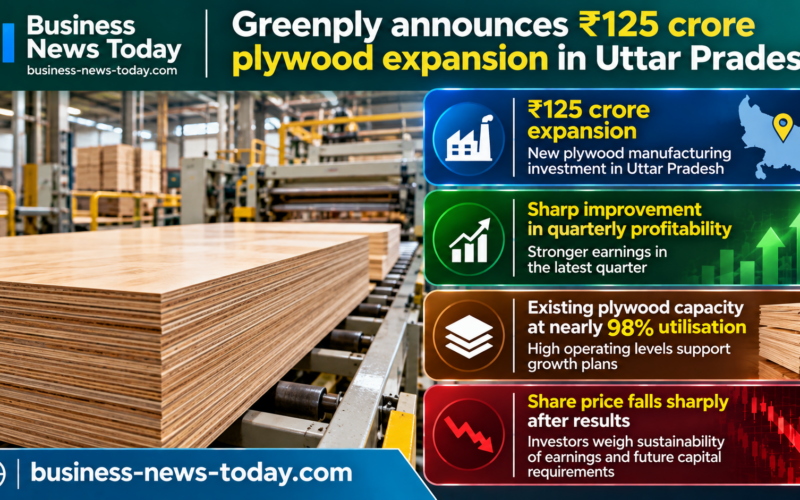
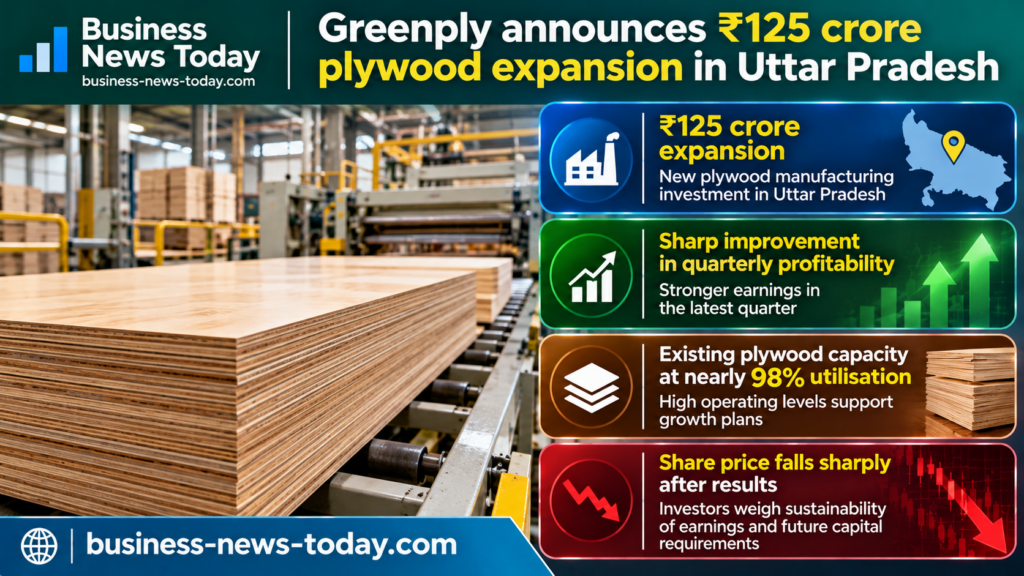
Greenply Industries Limited (NSE: GREENPLY, BSE: 526797) has outlined a ₹125 crore expansion of plywood manufacturing capacity at Sandila in Uttar Pradesh, adding 15 million square metres of annual production capability by the fourth quarter of FY28. The announcement on 29 October 2026 coincided with consolidated second-quarter results showing a 167.3% increase in profit after tax to ₹42.7 crore and 16.1% revenue growth to ₹799.7 crore. The investment responds to exceptionally high utilisation across the company’s existing plywood manufacturing facilities, which are operating at nearly 98% of their disclosed annual capacity. However, Greenply shares declined approximately 7% during morning trading on 30 October despite the earnings improvement, drawing attention to the commercial returns, funding requirements and profitability assumptions underpinning its expanding manufacturing portfolio.
The proposed Sandila investment forms part of a broader capacity development programme that includes an additional plywood facility under construction in Odisha and a second medium-density fibreboard manufacturing line in Gujarat. Together, these developments could substantially increase Greenply’s production capabilities over the next two financial years. The central investment question is whether demand growth, selling prices and operating margins can support this larger manufacturing base without placing disproportionate pressure on the balance sheet.
Why is Greenply Industries investing ₹125 crore in its Sandila plywood manufacturing facility when utilisation is already near 98%?
Greenply’s proposed investment involves its wholly owned subsidiary, Greenply Sandila Private Limited, which operates a plywood and allied products manufacturing facility in Sandila, Hardoi district, Uttar Pradesh. The planned expansion will introduce an additional 15 million square metres of annual manufacturing capacity, with completion targeted by the fourth quarter of FY28, ending March 2028. Management expects demand for plywood and related products to exceed the group’s existing available production capability, providing the stated commercial rationale for the project.
The latest exchange disclosure places current aggregate installed plywood manufacturing capacity at 52.8 million square metres annually, excluding the separate Odisha facility under construction. With utilisation at nearly 98%, the existing manufacturing network has relatively limited unutilised capacity available to accommodate additional production demand. The proposed Sandila project would increase that currently operational capacity base by approximately 28.4%, assuming the existing facilities continue operating at their disclosed capacities.
Sandila already accounts for 13.5 million square metres of annual capacity within Greenply’s manufacturing network. Adding another 15 million square metres at the location would increase its planned capacity to approximately 28.5 million square metres annually, more than doubling the facility’s existing production capability. The project therefore represents a significant expansion at an established manufacturing location rather than a completely new geographical manufacturing operation.
Greenply Sandila Private Limited has also demonstrated improving financial performance. According to the subsidiary’s audited financial information disclosed with the investment proposal, total income increased from ₹249.13 crore in FY25 to ₹289.76 crore in FY26, while profit after tax rose from ₹11.28 crore to ₹18.51 crore. The approximately 64% increase in annual profit provides evidence of improving subsidiary-level earnings before the new capacity investment.
These results support the decision to expand at Sandila, although they do not establish the profitability of the proposed additional production lines. The incremental economics will depend on construction expenditure, manufacturing efficiency, product mix, selling prices and the rate at which additional output enters commercial distribution.
How will the Sandila and Odisha expansions change Greenply Industries’ total plywood manufacturing capacity by FY28?
The Sandila project is not Greenply’s only active plywood manufacturing expansion. The company is also developing an additional 13.5 million square metres of annual production capacity at Koraput in Odisha, which remains under construction according to its latest investor presentation. The combined projects would add 28.5 million square metres to the existing operational capacity base of 52.8 million square metres, assuming both are completed as planned.
That would raise total annual plywood manufacturing capacity to approximately 81.3 million square metres, an increase of roughly 54% from the currently operational base. The calculation includes both the 13.5 million square metres already under construction in Odisha and the newly proposed 15 million square metres at Sandila. It does not treat the Odisha project’s capacity as already operational.
The company’s current manufacturing footprint includes Bamanbore in Gujarat, with 20.2 million square metres of annual capacity; Sandila in Uttar Pradesh, with 13.5 million square metres; Kriparampur in West Bengal, with 11 million square metres; and Tizit in Nagaland, with 8.1 million square metres. These facilities provide regional production coverage across different parts of India, supporting distribution into geographically dispersed construction and furniture markets.
The Odisha investment would extend that network, while the Sandila expansion would deepen production capacity in northern India. The geographic distribution could offer operational flexibility in serving different regional markets, although actual logistical benefits will depend on raw material sourcing, transportation costs and customer demand.
The timing of the investments introduces an important commercial consideration. A manufacturer operating close to full capacity can face constraints in meeting additional demand, but commissioning multiple facilities increases the amount of production that must subsequently be sold. Greenply’s ability to maintain utilisation and pricing across an 81.3-million-square-metre capacity base will depend on market demand when the projects become operational.
Although existing capacity utilisation supports management’s expansion rationale, it should not be interpreted as a guarantee that every additional square metre will generate sales immediately. The transition from construction to commissioning, stable production and profitable capacity utilisation will determine the investments’ ultimate financial contribution.
What do Greenply Industries’ Q2 FY27 results reveal about the strength of its plywood business?
Greenply’s latest quarterly financial performance provides a more immediate explanation for its manufacturing ambitions. Consolidated revenue increased 16.1% year on year to ₹799.7 crore during the quarter ended 30 September 2026, compared with ₹688.6 crore in the corresponding period of FY26. Core earnings before interest, tax, depreciation and amortisation increased 57.2% to ₹89.2 crore from ₹56.8 crore.
The consolidated core EBITDA margin expanded from 8.2% to 11.2%, an improvement of approximately 300 basis points. Profit after tax increased to ₹42.7 crore from ₹16 crore a year earlier, representing growth of 167.3%. The substantially faster increase in earnings than revenue indicates that improved operating profitability played a major role in the reported performance.
The plywood business, comprising Greenply’s standalone operations and subsidiaries, generated revenue of ₹625.7 crore during Q2 FY27, compared with ₹541.7 crore a year earlier. Revenue growth of 15.5% reflected both higher volumes and stronger selling prices. Reported plywood sales volume increased 6.1% year on year to 23 million square metres, while average realisation increased approximately 9% to ₹264 per square metre.
The distinction between volume growth and price realisation is commercially important. Higher prices contributed materially to the revenue increase, indicating that Greenply’s performance was not driven solely by the sale of more plywood. Stronger realisations can support margins when they offset input costs and manufacturing expenditure, although future pricing will depend on competitive conditions and customer acceptance.
Plywood core EBITDA increased 40.8% year on year to ₹62.9 crore, while the segment’s core EBITDA margin expanded from 8.24% to 10.05%. Reported plywood business profit after tax rose 46.9% to ₹38.1 crore. The improvement suggests that the existing manufacturing and distribution model generated better profitability before the next round of expansion expenditure.
The company must now preserve these gains while increasing capacity. If new production lines achieve adequate utilisation and maintain a favourable product mix, Greenply could benefit from a larger manufacturing base. If selling prices weaken or production ramps up more slowly than planned, the additional fixed costs associated with expansion could constrain margins.
Why is Greenply Industries’ MDF business becoming increasingly important to consolidated earnings?
Although the latest capacity announcement concerns plywood, medium-density fibreboard has become an important contributor to Greenply’s financial performance. The MDF business generated revenue of ₹173.9 crore during Q2 FY27, an increase of 18.4% from ₹146.8 crore in the corresponding quarter of FY26. Sales volume increased 16.1% to 54,605 cubic metres, while average realisation rose 2.1% to ₹31,816 per cubic metre.
Core MDF EBITDA increased from ₹12.1 crore to ₹26.4 crore, representing growth of approximately 117.7%. The segment’s core EBITDA margin improved to 15.2% from 8.3% a year earlier, a gain of 690 basis points. Its reported quarterly profit after tax reached ₹11.2 crore, compared with a loss of approximately ₹4 crore in the year-earlier period.
The year-on-year improvement was substantial, but the sequential comparison offers a more nuanced picture. MDF revenue declined 11.1% from the June quarter, while sales volume fell 5.5% and realisation declined 5.1%. The core EBITDA margin also moderated from 17.3% in Q1 FY27 to 15.2% in Q2 FY27.
These movements suggest that the business has improved considerably from the previous year’s lower profitability base while remaining exposed to short-term changes in demand, product mix and selling prices. Sustained MDF profitability will require Greenply to maintain competitive manufacturing costs and sales realisations as production capacity expands.
Greenply’s latest investor presentation identifies an additional MDF manufacturing line under development at Vadodara in Gujarat, with planned annual capacity of 210,000 cubic metres. This would supplement the existing 300,000-cubic-metre annual capacity at the same location. The investment introduces a separate capacity expansion cycle from plywood, with its own commissioning timetable, funding requirements and market absorption considerations.
A larger MDF portfolio could provide a broader contribution to consolidated earnings if the additional production is sold at commercially attractive margins. The latest results demonstrate the segment’s earnings potential, but its sequential performance also shows why future profitability should not be extrapolated mechanically from one strong reporting period.
How will Greenply Industries finance the ₹125 crore Sandila expansion, and what does its existing debt position reveal?
The Sandila expansion is expected to require approximately ₹125 crore of investment, funded through bank term loans, equity contributions from Greenply Industries Limited and internal accruals. The company has separately approved an additional investment of up to ₹30 crore in Greenply Sandila Private Limited through subscription to equity shares. That investment may be made in one or more tranches by the fourth quarter of FY28.
The ₹30 crore equity infusion forms part of the broader funding framework and should not be added to the ₹125 crore project estimate as though it represents a separate manufacturing investment. It is equivalent to approximately 24% of the estimated project outlay, although the eventual financing mix will depend on actual equity deployment, borrowings and internally generated funds. Greenply Sandila will remain a wholly owned subsidiary following the proposed capital infusion.
At 30 September 2026, Greenply reported consolidated gross debt of ₹577 crore, compared with ₹516 crore a year earlier. Net debt stood at ₹544 crore, while consolidated equity increased to ₹969 crore. Despite higher absolute borrowings, the net debt-to-equity ratio improved to 0.56 from 0.60 in September 2025.
The balance-sheet figures reflect the group’s existing funding commitments rather than debt attributable exclusively to the newly proposed Sandila project. According to the investor presentation, the MDF business accounted for approximately ₹401 crore of gross debt, while the plywood business accounted for ₹176 crore. The debt distribution illustrates the capital intensity of Greenply’s wider manufacturing expansion strategy.
Working capital performance provides some evidence of improved operating efficiency. Consolidated working capital days declined from 51 in September 2025 to 43 in September 2026, although the figure increased marginally from 42 days in June. A shorter working capital cycle can reduce the amount of cash tied up in inventory, receivables and operating transactions, potentially supporting internal funding of capital expenditure.
The proposed Sandila project will nevertheless require additional financial resources before generating a full contribution to earnings. The return on the investment will depend on capital expenditure remaining close to estimates, commissioning taking place within the intended period and manufacturing utilisation reaching commercially sustainable levels.
How does the proposed Greenply Samet joint venture restructuring fit into the company’s plywood and MDF expansion strategy?
Greenply’s capital allocation strategy also involves a proposed restructuring of Greenply Samet Private Limited, its furniture hardware joint venture with Samet B.V. The arrangement, announced on 11 September 2026, is intended to allow the joint venture partner to provide additional capital while Greenply concentrates financial resources on plywood and MDF manufacturing.
Under the preliminary terms, Samet B.V. is expected to invest approximately US$30 million to US$40 million into the joint venture over two to three years. The proposed structure would increase Samet’s voting interest to approximately 81% and reduce Greenply’s voting interest to approximately 19%. Greenply has indicated that its initial economic interest would be approximately 43%, declining over time as the structure evolves.
The transaction was expected to be completed by January 2027, subject to the necessary documentation and other requirements. Until completion, the proposed ownership changes should not be treated as an accomplished restructuring. The arrangement is intended to reduce Greenply’s future funding commitments to the furniture hardware business and support greater concentration on its core manufacturing portfolio.
The financial relevance is visible in the latest quarterly results. Greenply reported a ₹6.3 crore share of loss from its equity-accounted joint venture investment during Q2 FY27, compared with ₹5.9 crore in the year-earlier period. For the first half of FY27, its share of joint venture losses reached ₹12.1 crore.
The proposed restructuring could change Greenply’s future exposure to those losses and its requirement to fund additional joint venture expenditure. However, the eventual accounting and cash-flow consequences will depend on transaction completion and the final ownership and contractual arrangements. The restructuring should therefore be evaluated as a potential capital allocation improvement rather than an already realised financial benefit.
Its connection with the Sandila and MDF investments is commercially clear. Greenply is attempting to direct a larger proportion of its financial resources towards established manufacturing businesses where it already has distribution networks, operating capabilities and demonstrated sales demand. Whether that concentration produces better returns will depend on the profitability of the additional capacity, not simply the reduction in exposure to a non-core venture.
Why did Greenply Industries shares fall nearly 7% despite strong Q2 earnings and a new manufacturing investment?
Greenply Industries shares declined sharply during morning trading on 30 October 2026, following the previous day’s financial results and capacity expansion disclosures. The stock was quoted at approximately ₹279.95 at 10:31 a.m. IST, down about 6.9% from the previous National Stock Exchange close of ₹300.80. The decline occurred despite substantial year-on-year growth in consolidated profit and operating earnings.
The market reaction also coincided with unusually active trading. Earlier in the morning, trading volume had increased substantially compared with recent reference levels, indicating heightened market participation around the results. However, elevated trading activity does not establish whether buyers or sellers held a particular view about the expansion or earnings outlook.
The shares had previously traded near ₹334.40, their reported 52-week high, while the corresponding 52-week low stood at ₹176.42. At approximately ₹280, the stock was around 16% below that high and substantially above the year’s low. The latest decline therefore occurred within a wider trading range rather than representing a new annual low.
The combination of stronger earnings and weaker share performance creates an unresolved valuation question. Greenply’s profitability improved, but the results also showed sequential moderation in MDF earnings, higher absolute debt and continued losses associated with its furniture hardware joint venture. The capacity programme introduces additional future growth potential alongside further financial commitments.
These factors are relevant to investor assessment, although the available market evidence does not establish that any individual concern caused the decline. Share prices can respond to expectations formed before results, broader market conditions, valuation levels and subsequent interpretations of management disclosures.
The broader investment case depends on whether Greenply can maintain the improved plywood margins, sustain MDF profitability and complete its manufacturing projects without placing excessive pressure on cash generation. The nearly 7% morning decline shows that stronger reported earnings and announced expansion plans did not produce an immediately positive market reaction, but it does not establish a definitive long-term assessment of the strategy.
What financial and operational milestones will determine whether Greenply Industries’ expansion creates lasting shareholder value?
The next phase of Greenply’s development involves converting existing high utilisation and improving profitability into a larger, commercially productive manufacturing network. Its planned plywood capacity additions could increase annual manufacturing capability by approximately 54%, while the Vadodara MDF expansion would add another significant production line in a separate business segment. These projects create multiple opportunities for revenue growth, although their financial contributions will emerge according to their respective construction and commissioning schedules.
The first measurable indicators will include progress at the Odisha plywood facility and the additional MDF line at Vadodara. Updates on equipment installation, project expenditure, commissioning schedules and initial production will help establish whether the investments remain on track. The proposed Sandila expansion has a longer stated completion horizon extending to Q4 FY28, making near-term capital deployment and execution milestones more informative than immediate revenue expectations.
Greenply’s existing operations must also continue generating earnings while new facilities are being developed. The Q2 results demonstrated that stronger realisations and improved manufacturing margins can produce substantial profit growth, but the sequential MDF figures showed that performance can vary between quarters. Maintaining adequate margins while managing raw material costs and changing product demand will influence the resources available for expansion.
The company’s reported net debt of ₹544 crore and working capital cycle of 43 days provide additional financial reference points. Future results showing stable leverage, controlled project expenditure and stronger operating cash generation would support the argument that the manufacturing programme can be financed without materially weakening financial flexibility. Conversely, significant cost overruns, weaker margins or slower utilisation of commissioned capacity would reduce the expected returns.
Greenply Industries has stronger operating evidence supporting its expansion strategy than a manufacturer relying solely on projected demand. Existing plywood utilisation is nearly full, quarterly earnings have improved and the company has identified specific capacity additions within its established product portfolio. Yet the nearly 7% share-price decline on 30 October demonstrates that financial markets can remain cautious even when headline earnings and growth plans appear favourable.
The most persuasive evidence of long-term value creation will be a combination of successful commissioning, sustained volume growth, profitable utilisation and disciplined debt management. If Greenply can preserve its current operating improvements while bringing new capacity into production, the expansion could reinforce its competitive position in India’s plywood and engineered wood products market. The next measurable test will be whether subsequent quarterly results sustain the improved margins and cash conversion while providing concrete progress on the Odisha, Vadodara and Sandila manufacturing investments.
Key takeaways from Greenply Industries’ Q2 FY27 results, ₹125 crore Sandila expansion and share-price decline
- Greenply Industries Limited has outlined a ₹125 crore plywood capacity expansion at Sandila in Uttar Pradesh, adding 15 million square metres of annual manufacturing capability.
- The project is targeted for completion by Q4 FY28 and will be funded through bank borrowing, equity investment and internal accruals.
- Existing operational plywood manufacturing capacity stands at 52.8 million square metres annually, with utilisation reported at nearly 98%.
- A separate 13.5-million-square-metre plywood facility remains under construction in Odisha, meaning the combined projects could eventually raise annual capacity to 81.3 million square metres.
- Consolidated Q2 FY27 profit after tax increased 167.3% to ₹42.7 crore, while revenue rose 16.1% to ₹799.7 crore.
- The plywood business recorded 15.5% revenue growth, supported by higher sales volumes and a 9% improvement in average realisation.
- MDF core EBITDA more than doubled year on year, although sequential revenue and margins weakened from the preceding quarter.
- Consolidated net debt stood at ₹544 crore at September 2026, with the company carrying additional manufacturing investment commitments.
- Greenply’s proposed furniture hardware joint venture restructuring could reduce future funding obligations, but the transaction remains subject to completion.
- Greenply shares fell approximately 6.9% during morning trading on 30 October, placing greater attention on future margins, capital expenditure and operating cash generation.
Discover more from Business-News-Today.com
Subscribe to get the latest posts sent to your email.