



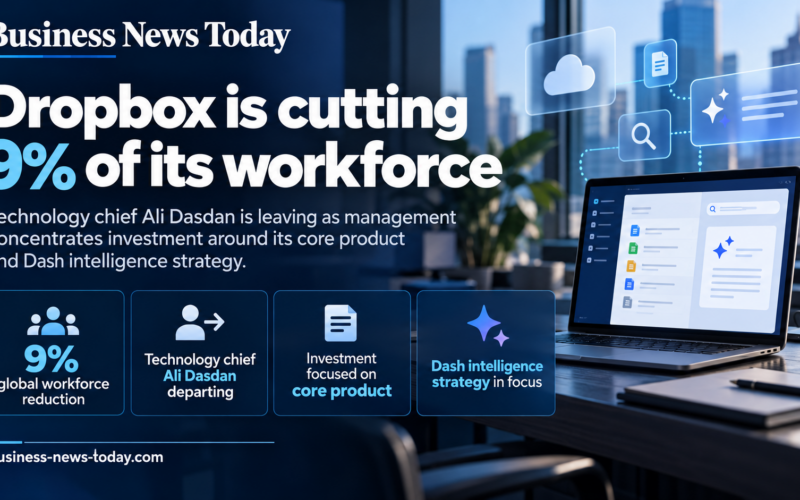
Dropbox, Inc. (NASDAQ: DBX) is reducing its global workforce by approximately 9% and will lose Chief Technology Officer Ali Dasdan on November 18 as the cloud software company restructures teams around its highest-priority products and growth initiatives. The company expects $27 million to $33 million of cash expenditure related primarily to severance and benefits, while $20 million to $25 million of incremental expense is expected to be recognised largely in the fourth quarter. The action comes despite Dropbox simultaneously disclosing that preliminary third-quarter revenue, constant-currency revenue and non-GAAP operating margin are expected to be in line with or above the guidance ranges issued in August. The unresolved question is therefore not whether Dropbox faces an immediate financial crisis, but whether management believes a smaller organisation can accelerate the transition from mature file storage toward a more AI-driven product model built around Dropbox and Dash.
Why is Dropbox cutting 9% of its workforce when its third-quarter outlook has not deteriorated?
Dropbox’s October 28 filing explicitly said preliminary third-quarter results are expected to meet or exceed previously communicated ranges for revenue and non-GAAP operating margin. The workforce action therefore cannot be explained as an emergency response to a sudden earnings miss.
The company’s growth profile is still modest. Second-quarter revenue increased only 0.9% to $631.5 million, although growth excluding FormSwift reached 1.7%. Total annual recurring revenue was $2.566 billion, also up around 1%.
Dropbox has succeeded in returning paying users to growth. It ended June with 18.19 million paying customers, an increase of 96,000 sequentially and the third consecutive quarter of paying-user growth. Average revenue per paying user also improved to $139.68 from $138.32.
Management appears to be using that stabilisation to change the organisation before faster growth is required. Roles and teams that supported the earlier Dropbox product structure may not align with a strategy increasingly focused on integrating Dash intelligence directly into the core platform.
How significant are the restructuring costs compared with Dropbox’s cash generation?
Dropbox expects $27 million to $33 million of cash expenditures from the 9% workforce reduction. The company anticipates recognising $20 million to $25 million of incremental severance and related expense, with most payments occurring during the fourth quarter and remaining amounts flowing into 2027.
Those costs are manageable relative to Dropbox’s cash generation. Second-quarter operating cash flow reached $238.5 million and unlevered free cash flow was $283.5 million. Cash, equivalents and short-term investments ended June at approximately $1.114 billion.
That financial position makes the layoffs fundamentally strategic rather than liquidity-driven. Dropbox can afford its current workforce in an accounting sense, but management evidently believes the return generated by some roles is lower than alternative uses of the same capital.
The economic benefit has not yet been fully quantified because Dropbox did not provide an annualised savings target with the October filing. Investors therefore know the upfront cost but still need the November 5 results to understand how materially the programme changes future operating expenses.
Why does CTO Ali Dasdan’s departure make this more than an ordinary cost-cutting programme?
Dasdan will leave Dropbox on November 18, shortly after the company announced a restructuring that directly affects its product and technology investment priorities. Dropbox has not stated that his departure resulted from a disagreement, and his separation arrangements follow disclosed contractual terms.
He will receive a prorated bonus of $515,000, an approximately $1.3 million lump-sum payment and additional benefits. Those terms make the leadership change financially visible even though the company has not characterised the exit as contentious.
Technology leadership is particularly important because Dropbox is attempting to reposition around artificial intelligence. Dash is intended to bring search and organisational intelligence into the broader Dropbox experience, potentially allowing the company to sell more value to an installed base exceeding 18 million paying users.
A CTO departure during that transition raises an execution question rather than automatically indicating a problem. Investors need to see who assumes the technical responsibilities and whether product releases, AI integration and infrastructure investment continue without disruption.
Can Dash create enough growth to justify another organisational reset?
Dropbox’s core storage and collaboration product remains large but mature. Revenue growth near 1% illustrates why management needs another source of expansion if the company is to move beyond being valued principally as a cash-generative software business.
Dash is designed to help users search, organise and retrieve information across work environments. Integrating that intelligence into Dropbox could increase product engagement and create additional monetisation opportunities without requiring the company to build an entirely separate customer base.
The advantage is distribution. Dropbox already serves more than 18 million paying users and hundreds of millions of registered accounts, giving it a route to introduce new capabilities to existing customers at relatively low acquisition cost.
The risk is competition. Microsoft, Google, Box and numerous AI-native software companies are all adding intelligent search, document summarisation and workplace agents. Dash needs to provide sufficiently differentiated utility to justify higher spending or stronger retention rather than becoming another feature customers increasingly expect to receive as standard.
What does Dropbox’s stock performance suggest about investor expectations?
Dropbox shares closed at approximately $35.91 on October 30, down around 1% for the session and below the $37.73 closing price recorded on October 26. The stock reaction around the restructuring has therefore been muted rather than resembling the dramatic repricing sometimes seen after large software layoffs.
That makes sense because the 9% reduction arrives before formal third-quarter results on November 5. Investors have preliminary reassurance that headline performance should be in line with or above prior guidance, but they do not yet have updated full-year expectations or a quantified savings target.
The next earnings call becomes unusually important because management can explain whether the workforce reset is intended primarily to protect margins, increase Dash investment or simplify product development. Those objectives can coexist, but their financial effects differ.
Dropbox has already demonstrated strong non-GAAP profitability, with a 39.7% second-quarter non-GAAP operating margin. Cutting another 9% of employees raises the bar for what that profitability is supposed to fund. A credible answer requires faster product momentum rather than simply another improvement in adjusted margins.
What are the key takeaways from Dropbox’s 9% workforce reduction and CTO exit?
- Dropbox is reducing its global workforce by approximately 9%.
- The programme is intended to align investment with priority products and growth initiatives.
- Cash restructuring expenditure is expected at $27 million to $33 million.
- Incremental expense is expected at approximately $20 million to $25 million.
- CTO Ali Dasdan will leave Dropbox effective November 18.
- Preliminary Q3 revenue and non-GAAP operating margin are expected to be in line with or above prior guidance ranges.
- Q2 revenue was $631.5 million, up 0.9%.
- Dropbox had 18.19 million paying users at the end of Q2.
- Q2 unlevered free cash flow reached $283.5 million.
- November 5 results should clarify the savings, leadership structure and role of Dash in Dropbox’s next growth phase.
Discover more from Business-News-Today.com
Subscribe to get the latest posts sent to your email.