


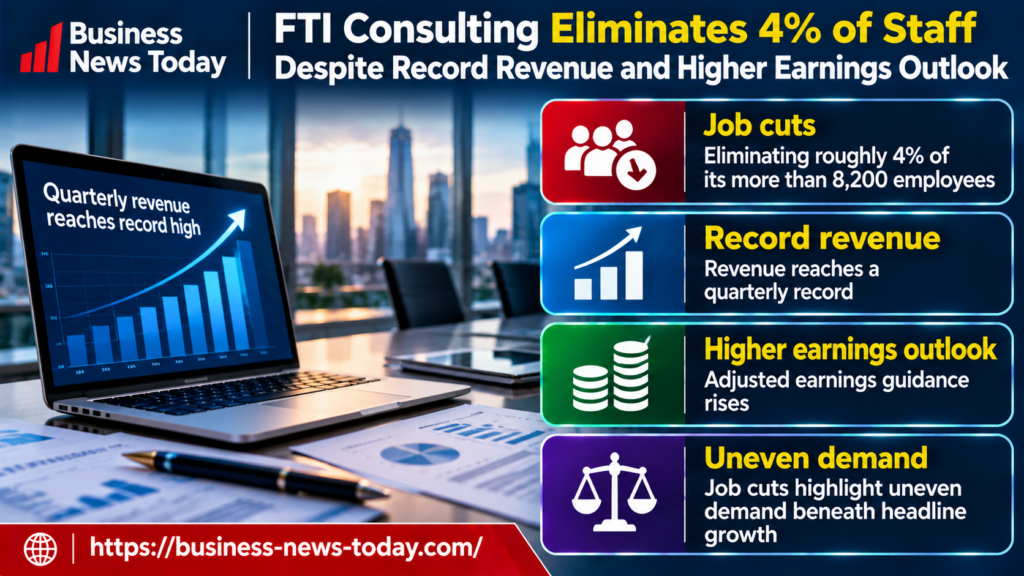
FTI Consulting, Inc. (NYSE: FCN) is eliminating approximately 4% of its workforce as the global advisory firm aligns staffing with client demand despite reporting record third-quarter revenue of $1.013 billion. With more than 8,200 employees at September 30, the disclosed percentage implies roughly 330 affected positions, although the company has framed the action through the percentage rather than publishing a separate final headcount number. The programme generated a $46 million special charge in the third quarter and is expected to produce another approximately $7 million charge in the fourth quarter, while management estimates about $80 million of annualised cost savings. The tension is unusually sharp for a professional-services business: revenue grew across all five operating segments and adjusted EPS guidance increased, yet management concluded that parts of the workforce were still misaligned with the work clients are actually buying.
Why is FTI Consulting reducing headcount when all five business segments reported revenue growth?
Third-quarter revenue increased 5.9% from $956.2 million a year earlier to a record $1.013 billion, demonstrating that the workforce action is not being driven by group-wide contraction. Corporate Finance generated $424.4 million, Forensic and Litigation Consulting produced $195.1 million, Economic Consulting reached $189.3 million, Technology generated $103.2 million and Strategic Communications contributed $100.6 million. Every business therefore reported year-on-year growth, but the pace and quality of demand differed considerably between practices.
The important clue is utilisation. FTI Consulting’s economics depend heavily on having the right number of professionals in the right specialisms because under-utilised consultants still carry salary and benefit costs even when billable demand is weaker. Corporate Finance reported 58% utilisation and Forensic and Litigation Consulting 54%, while Economic Consulting was stronger at 61%. Management can therefore experience record consolidated revenue while still identifying excess capacity in specific teams, geographies or skill categories.
Corporate Finance also showed the difference between headline growth and underlying demand. Revenue rose 4.8%, helped by higher success fees and realised bill rates, but the company reported lower demand for turnaround and restructuring and transactions services. Success fees can boost a particular quarter without creating the recurring utilisation required to support every existing position.
The workforce programme consequently looks more like targeted capacity management than a rejection of the overall growth strategy. FTI Consulting is trying to remove areas where expected client demand no longer justifies staffing while continuing to expand practices where billable opportunities remain strong.
How much does FTI Consulting expect to save from the restructuring?
Management expects approximately $80 million of annualised savings from the staffing and real-estate actions taken during the third and fourth quarters. The savings cover salary, benefits and property-related expenditure, meaning the programme is broader than employee departures alone.
The cost of getting there is substantial. FTI Consulting recognised a $46 million special charge during the third quarter, including $45.5 million related to salaries and benefits and $0.5 million of non-cash real-estate costs. Another approximately $7 million charge is expected during the fourth quarter, taking the estimated combined 2026 special charge to around $53 million.
On a simple run-rate basis, the expected annual savings exceed the one-time restructuring cost. The economics become more attractive if the removed costs genuinely relate to under-utilised capacity and do not need to be rebuilt when demand improves. If the firm subsequently has to rehire large numbers of experienced professionals at higher compensation, part of the apparent saving could prove temporary.
Professional-services restructuring is particularly sensitive to that risk because experienced advisers carry client relationships and sector expertise that cannot always be recreated quickly. FTI Consulting therefore needs to lower fixed compensation without damaging the practices capable of winning higher-value assignments.
Why did adjusted earnings improve while reported net income declined?
Third-quarter net income fell to $63.4 million from $82.8 million a year earlier because the $46 million special charge and higher operating expenses weighed on reported profitability. Earnings per share declined to $2.35 from $2.60.
Adjusted performance told a different story. Adjusted EBITDA increased to $153.7 million from $130.6 million, lifting the adjusted EBITDA margin to 15.2% from 13.7%. Adjusted EPS reached a record $3.84, significantly above the prior-year $2.60.
Management consequently raised its full-year adjusted EPS guidance to $9.50 to $10.00 from the previous $9.10 to $9.70 range. Reported EPS guidance was reduced to $7.55 to $8.05 because the restructuring and litigation-related expenses remain real accounting costs even though management excludes them when assessing underlying performance.
This divergence gives investors a straightforward test. The restructuring is financially productive if the one-time charges create recurring expense reduction and stronger future GAAP profitability. Frequent restructuring charges that repeatedly sit outside adjusted earnings would make the adjusted measure less useful as an indicator of sustainable economics.
Why did FTI Consulting shares surge after results despite the workforce reduction?
FTI Consulting shares jumped 14.3% to $181.24 on October 29 after the earnings announcement and closed at $182.84 on October 30. The stock had traded at $158.59 immediately before the results, making the two-session repricing substantial.
The reaction coincided with record revenue, stronger adjusted profitability and the increase in adjusted EPS guidance rather than the layoffs alone. The $80 million annualised savings target added another potential source of future operating leverage, but investors were simultaneously evaluating stronger earnings performance across several businesses.
The shares were trading close to their 52-week high after the move. That increases expectations around the restructuring because a higher valuation leaves less room for execution disappointments if utilisation remains weak in selected practices.
FTI Consulting now needs to show that the reduced cost base can coexist with continued revenue expansion. Evidence of stronger utilisation and sustained margins during 2027 would make the staffing action look like disciplined capacity management rather than late-cycle cost cutting.
What should investors watch after FTI Consulting removes around 4% of its workforce?
Utilisation across Corporate Finance and Forensic and Litigation Consulting should provide the clearest operational evidence. If staffing falls while utilisation improves and client demand remains stable, the economics behind the reduction become easier to defend.
Billable headcount also deserves attention because FTI Consulting continues to grow in selected areas. Corporate Finance billable headcount increased 6.3% year on year before the restructuring effects were fully reflected, while Strategic Communications increased 5.5%. That means the company is not pursuing a uniform contraction across every revenue-producing team.
The second proof point is whether the $80 million savings reach earnings. Management has given investors a specific annualised target, allowing future expense growth and margins to be compared against the promised benefit.
FTI Consulting’s record revenue means the restructuring cannot be explained simply by weak business conditions. The more precise interpretation is that management believes its current mix of people is more expensive than the current mix of demand requires. The success of the programme will be visible if revenue continues growing with fewer under-utilised positions and a structurally higher level of profitability.
What are the key takeaways from FTI Consulting’s 4% workforce reduction?
- FTI Consulting is eliminating approximately 4% of its workforce of more than 8,200 employees.
- The percentage implies roughly 330 affected positions.
- All affected employees had been notified by October 29, subject to applicable notice periods.
- Third-quarter revenue reached a record $1.013 billion, up 5.9%.
- Revenue increased across all five operating segments.
- FTI Consulting recorded a $46 million third-quarter special charge related largely to the workforce action.
- A further approximately $7 million special charge is expected in the fourth quarter.
- Management expects approximately $80 million in annualised savings.
- Adjusted EPS guidance increased to $9.50 to $10.00.
- FCN shares jumped 14.3% immediately after results, putting greater pressure on management to deliver the promised productivity gains.
Discover more from Business-News-Today.com
Subscribe to get the latest posts sent to your email.