




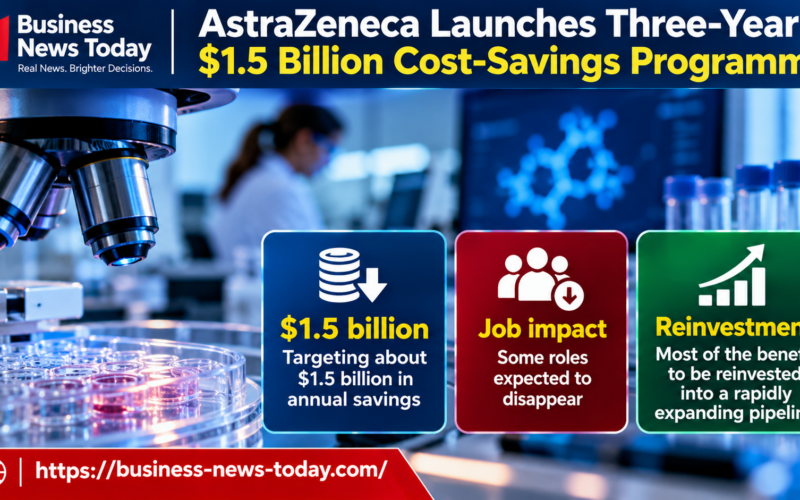
AstraZeneca PLC (LSE: AZN; Nasdaq: AZN) has launched a three-year programme intended to deliver approximately $1.5 billion of annual savings while redirecting most of that capacity toward a research pipeline containing more than 180 projects. The pharmaceutical group has indicated that the programme could involve restructuring across departments and redundant research and development roles, although management expects the organisation to continue generating net employment growth overall as investment moves toward higher-priority medicines and technologies. The announcement accompanied third-quarter revenue of $16.21 billion, up 7% at constant exchange rates, and core earnings per share of $2.79, up 19% at constant exchange rates. AstraZeneca is therefore not pursuing conventional contraction: it is attempting to remove cost from mature or lower-priority activities quickly enough to fund a pipeline that management believes can sustain growth well beyond its $80 billion 2030 revenue ambition.
Why is AstraZeneca cutting costs when revenue, earnings and its pipeline are still expanding?
AstraZeneca’s first nine months of 2026 produced $46.88 billion of revenue, representing 7% constant-currency growth. Core operating profit increased 14% to $16.4 billion and core earnings per share increased 14% to $8.00, leaving the group on track with its full-year outlook.
The stronger businesses are concentrated in strategic therapy areas. Oncology revenue increased 16% at constant exchange rates to $21.9 billion during the first nine months and now accounts for almost half of group revenue. Rare Disease grew 11%, while Respiratory and Immunology increased 10%.
Other parts of the portfolio are moving in the opposite direction. Cardiovascular, Renal and Metabolism revenue declined 14% as products including Farxiga faced loss-of-exclusivity pressure, while mature medicines and procurement changes in China also created headwinds. Resources tied to products with declining economics become harder to justify when newer assets require expensive late-stage development.
The savings programme is therefore an internal capital reallocation mechanism. AstraZeneca wants to remove spending associated with older products, duplicated infrastructure and programmes with weaker expected returns while directing investment toward oncology, rare disease and other late-stage assets.
How does AstraZeneca plan to use the $1.5 billion of annual savings?
Management has indicated that most of the savings will be reinvested rather than allowed to flow directly into near-term earnings. That makes the programme different from a straightforward margin-expansion plan in which shareholders would expect the majority of lower costs to become higher operating profit.
AstraZeneca currently has more than 180 projects in its pipeline, including 116 new molecular entities or major life-cycle programmes in Phase II or Phase III. Twenty new molecular entities are already in late-stage development and two are under regulatory review.
The company also expects a particularly important group of clinical readouts during 2027. Management has said those programmes collectively carry more than $20 billion of potential peak-year revenue, although such estimates remain dependent on successful trials, regulatory approval and commercial adoption.
Reinvestment therefore makes strategic sense if the pipeline assets ultimately earn returns above the cost of the development spending being redirected toward them. The harder issue is selection. A very large pipeline creates opportunity, but it also increases the risk of funding too many projects simultaneously rather than concentrating resources on programmes with the strongest evidence.
Will AstraZeneca’s restructuring translate into large net job losses?
The company has not announced a global workforce-reduction figure comparable with the large quantified layoff programmes being implemented by some other multinational companies. Executives have acknowledged that individual departments may shrink and some R&D positions could become redundant as priorities change.
At the same time, management expects net employment to grow as investment increases elsewhere. AstraZeneca employed roughly 95,000 people before the new programme, and expansion in manufacturing, clinical development and growth markets continues to require specialist staff.
The restructuring should therefore be understood as workforce reallocation rather than a confirmed group-wide employment contraction. Some employees may leave while the company recruits different skills in oncology, data science, advanced modalities, manufacturing and commercial functions.
For the workforce, that can still be disruptive. Net employment growth at group level does not protect individual roles whose work is attached to projects or products receiving lower investment. The relevant question is not simply how many people AstraZeneca employs in total, but how rapidly its skills mix changes as the pipeline becomes more technically complex.
Why did AstraZeneca shares rally so sharply after the October 30 results?
AstraZeneca’s London-listed shares closed at 13,960 pence on October 30, up 6.96%, while the US-listed ADRs closed at $186.65, up 7.02%. The move was one of the company’s strongest single-session performances of 2026.
The rally coincided with better-than-expected quarterly results, reaffirmed full-year guidance and management’s positive presentation of the late-stage pipeline. The savings programme also reinforced the view that AstraZeneca can fund more innovation without allowing the existing cost base to expand indefinitely.
A single day’s market reaction should not be treated as proof that the restructuring will succeed. Investors were responding to several pieces of information at once, particularly the 2027 clinical pipeline and stronger current earnings.
The stock remained below its 52-week high even after the rally. Further rerating will require clinical programmes to convert projected opportunity into positive Phase III data, regulatory approvals and eventual sales rather than remaining large theoretical peak-revenue figures.
How much financial risk comes with a restructuring that could cost up to $2 billion?
AstraZeneca expects one-off restructuring costs of as much as approximately $2 billion over the programme. That means the savings will require significant upfront expenditure before the annual benefit reaches its full run rate.
The financial trade-off is manageable for a business producing more than $46 billion of nine-month revenue and $16.4 billion of core operating profit, but the cost remains relevant. Restructuring charges should not be ignored simply because management excludes some items from core performance measures.
The longer-term economics depend on whether the $1.5 billion annual saving is genuinely recurring. If the company repeatedly launches additional restructuring programmes to maintain efficiency, investors would need to question how much of the apparent saving represents permanent structural improvement.
The stronger scenario is one in which AstraZeneca absorbs the transition cost, permanently lowers spending in mature activities and directs those resources toward assets that subsequently generate higher-margin revenue. The 2027 clinical readouts provide the first major test of that strategy.
What are the key takeaways from AstraZeneca’s $1.5 billion savings programme?
- AstraZeneca is targeting approximately $1.5 billion of annual savings through a three-year programme.
- Management expects to reinvest most of the savings in higher-priority pipeline assets.
- Some departmental reductions and R&D redundancies are possible.
- AstraZeneca nevertheless expects overall employment to continue growing.
- Third-quarter revenue reached $16.21 billion, up 7% at constant exchange rates.
- Q3 core EPS increased 19% at constant exchange rates to $2.79.
- Nine-month revenue reached $46.88 billion.
- AstraZeneca has more than 180 projects in its pipeline.
- Management expects important 2027 readouts with potential peak sales exceeding $20 billion, subject to successful development and commercialisation.
- AZN shares rose around 7% after the October 30 results, making clinical execution the next major test.
Discover more from Business-News-Today.com
Subscribe to get the latest posts sent to your email.
