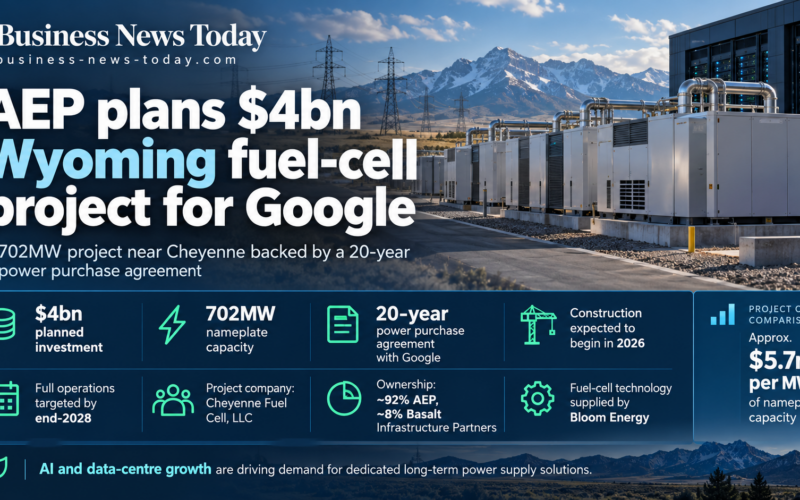
American Electric Power Company, Inc. (NASDAQ: AEP) announced plans on October 14, 2026, to invest approximately $4 billion in a 702-megawatt fuel-cell generation project near Cheyenne, Wyoming, to supply electricity to Google under a 20-year power purchase agreement. The development will use fuel-cell technology supplied by Bloom Energy Corporation (NYSE: BE), with construction expected to begin during 2026 and full operations targeted by the end of 2028. The project represents a significant expansion of American Electric Power’s involvement in supplying large technology customers beyond its traditional regulated utility service territories.
The proposed facility will be developed through Cheyenne Fuel Cell, LLC, an entity approximately 92% owned and controlled by American Electric Power. Funds advised by Basalt Infrastructure Partners will hold the remaining interest of approximately 8%. Google’s long-term agreement creates a commercial foundation for the investment, although the announcement does not disclose electricity pricing, expected annual revenue or the project’s anticipated financial returns.
The agreement highlights a wider change in the relationship between technology companies and electricity suppliers. As artificial intelligence computing infrastructure expands, the availability of reliable power is becoming an increasingly important consideration in data centre investment decisions. The Wyoming development illustrates how dedicated generation projects can emerge alongside conventional utility infrastructure when customers seek to secure large electricity supplies over extended periods.
Why is Google turning to a 702MW fuel-cell project for its Wyoming operations?
Google’s parent company, Alphabet Inc. (NASDAQ: GOOGL; NASDAQ: GOOG), has been investing heavily in data centres supporting cloud computing, artificial intelligence and other digital services. These facilities require substantial electrical capacity, particularly where advanced computing equipment operates at high power densities. Securing dependable energy supply has consequently become a strategic requirement rather than a routine operating expense.
The planned Wyoming facility is designed to provide power for Google’s expanding operations in the greater Cheyenne area. Its 702-megawatt capacity represents a substantial electricity generation installation, equivalent to 0.702 gigawatts of nameplate power capacity. Actual energy production will depend on operating conditions, availability and project performance, making it important not to treat the headline capacity as electricity generated continuously under every circumstance.
The project follows separate agreements between Google and Black Hills Corporation that became effective on September 30. Together, these developments indicate that Google is assembling a broader power infrastructure strategy in the Cheyenne region rather than depending on a single generation source. However, the October announcement does not establish the exact relationship between the different agreements or how much of Google’s future electricity demand each will ultimately satisfy.
For a technology company, long-term power procurement can reduce uncertainty around infrastructure development and support planning for new computing capacity. However, securing electricity under a power purchase agreement is not equivalent to owning the generating equipment or guaranteeing that every planned data centre expansion will proceed. The financial benefits depend on contract terms, operational performance and the commercial value of the computing services supported by the energy supply.
How does Bloom Energy’s fuel-cell technology differ from conventional power generation?
The project will use fuel cells developed by Bloom Energy, which produce electricity through electrochemical reactions rather than conventional combustion. This distinction can provide operational advantages, including modular deployment and the ability to generate electricity close to large electricity consumers. Such systems can be particularly relevant where customers face lengthy timelines for new transmission connections or conventional generating facilities.
American Electric Power has emphasised the technology’s potential for relatively rapid deployment and reliable, on-demand electricity generation. Fuel-cell installations can be developed through multiple modules, allowing capacity to be increased as equipment is installed and commissioned. However, deployment speed depends on equipment availability, site construction, fuel supply and regulatory requirements, meaning modular technology does not eliminate infrastructure execution risks.
An important qualification concerns the environmental characteristics of the proposed facility. American Electric Power stated that the fuel cells will generate electricity without the combustion of natural gas and that the project includes plans to integrate carbon capture technology. The absence of conventional combustion does not mean the installation will automatically operate without greenhouse gas emissions, particularly when natural gas remains part of the fuel supply.
The company has described the proposed configuration as capable of providing reliable, near-zero-emissions electricity through the planned carbon capture integration. That objective remains dependent on the final technology design, capture performance and operational configuration. Investors and customers should therefore distinguish the announced environmental ambition from independently verified operating emissions at a facility that has not yet been constructed.
What does the $4bn investment mean for American Electric Power’s growth strategy?
American Electric Power has traditionally been associated with regulated electricity generation, transmission and distribution operations across the United States. The Google agreement demonstrates how the company is seeking opportunities to serve large industrial and technology customers through arrangements that may differ from conventional regulated utility investments. A dedicated generation project supported by a long-term corporate customer can provide a different source of revenue growth, alongside a distinct set of commercial and financing risks.
The company has outlined a wider capital expenditure programme of approximately $78 billion from 2026 through 2030, focused on upgrading electricity infrastructure and meeting growing customer demand. The Wyoming project adds a substantial development to its infrastructure portfolio, although the October announcement does not clarify whether every dollar of the proposed $4 billion investment is incremental to previously communicated capital plans. Investors should avoid automatically adding the project estimate to the existing programme without confirmation from the company.
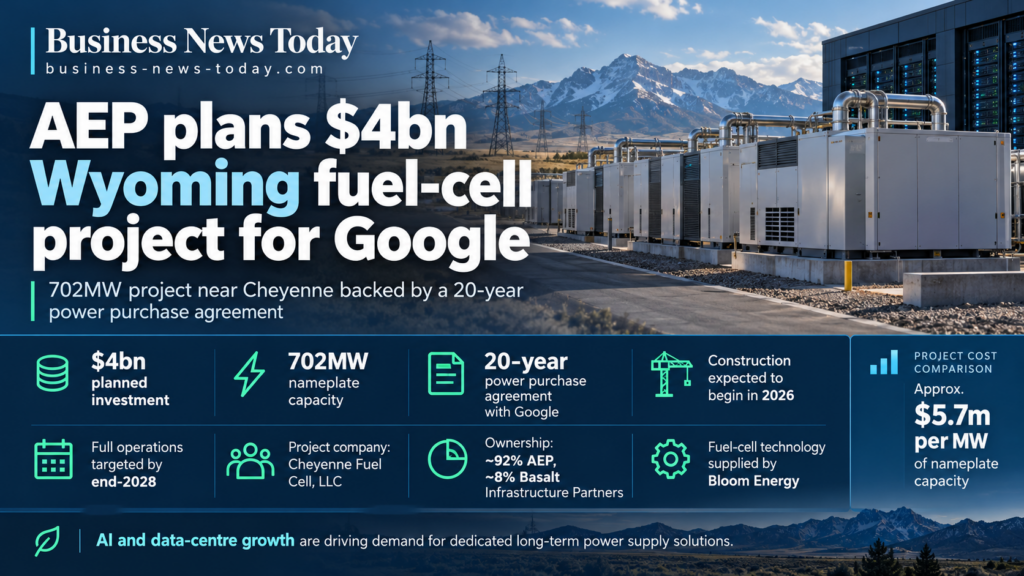
At approximately $4 billion for 702 megawatts, the headline project estimate implies capital expenditure of about $5.7 million per megawatt of nameplate generating capacity. This is a simple project-cost comparison rather than a complete assessment of the eventual cost of delivered electricity. Financing costs, fuel expenses, maintenance, equipment replacement, carbon capture infrastructure and plant utilisation will all influence the project’s economic performance.
The 20-year power purchase agreement is especially relevant because infrastructure assets generally require substantial upfront expenditure before generating operating cash flow. A long-term customer arrangement may improve revenue visibility and support financing, depending on the contract’s pricing and risk allocation. However, the agreement’s value cannot be calculated reliably without information about contracted output, tariff structures, cost adjustments and other commercial provisions.
Could the Wyoming project create a new commercial opportunity for Bloom Energy?
Bloom Energy’s participation highlights the growing commercial interest in fuel-cell systems for data centres and other electricity-intensive industries. As demand for reliable power rises, customers may evaluate technologies capable of supporting new installations without waiting for extensive grid infrastructure development. The Wyoming project provides a significant reference opportunity for Bloom Energy, although its specific equipment revenue and margin contribution were not disclosed in American Electric Power’s announcement.
Reuters reported that American Electric Power had previously agreed to purchase up to 900 megawatts of Bloom Energy fuel cells through a separate arrangement valued at approximately $2.65 billion. The new Wyoming project should not automatically be treated as an entirely additional equipment order on top of that earlier commitment, because the relationship between the arrangements requires careful interpretation. The project investment also includes broader development and construction expenditure rather than representing Bloom Energy’s equipment revenue alone.
For Bloom Energy, a large commercial installation could strengthen its position in a market increasingly focused on deploying dependable electricity generation close to major computing facilities. Scale may support manufacturing efficiency and supplier development if orders convert into sustained production. However, project-specific profitability will depend on contractual pricing, manufacturing costs, installation obligations and any long-term service commitments.
The competitive landscape remains challenging because large customers can evaluate several approaches to meeting their electricity requirements. These include conventional grid supply, gas-fired generation, nuclear power contracts, renewable generation supported by storage and other distributed energy technologies. Fuel cells may offer advantages in certain circumstances, but their commercial attractiveness depends on the cost and reliability of alternatives available at each location.
What risks could affect the project’s 2028 completion target?
American Electric Power expects construction to begin during 2026, with the facility becoming fully operational by the end of 2028. This creates a relatively compressed development schedule for a project involving substantial electrical capacity and a multibillion-dollar capital commitment. Successful delivery will require coordination between equipment suppliers, construction contractors, fuel infrastructure providers and the customer’s operating requirements.
Fuel availability is a major consideration because large-scale natural-gas-based electricity generation depends on reliable feedstock supply. The project may require suitable pipeline arrangements, fuel contracts and related infrastructure to support sustained operations. Changes in gas prices could also affect the economics of power generation, depending on how fuel costs are allocated under the agreement with Google.
Carbon capture integration creates another layer of technical and commercial complexity. The proposed environmental configuration will need to operate effectively alongside the fuel-cell technology without imposing unacceptable costs or reducing reliability. Any delay in the deployment or performance of carbon capture infrastructure could affect the project’s ability to deliver its intended emissions profile.
The development also raises questions about permitting, interconnection requirements and construction execution. Although modular equipment can be deployed more rapidly than some traditional generation technologies, the full project must operate as an integrated power supply system. The anticipated 2028 completion date should therefore be understood as a development target rather than a guaranteed operational milestone.
How could dedicated data centre power change electricity investment across the United States?
The strategic significance of the agreement extends beyond the specific Wyoming location. Technology companies are becoming increasingly influential participants in electricity infrastructure planning because their computing investments can create exceptionally large and concentrated power requirements. Utilities and independent power developers are responding by evaluating generation and transmission projects tailored to these customers.
Dedicated arrangements can help establish commercial demand for new infrastructure, potentially reducing uncertainty for investors and lenders. However, the structure also raises questions about the allocation of costs between large corporate customers and existing electricity users. Regulators and utilities must ensure that infrastructure developed for major technology facilities does not create inappropriate financial burdens for other customers.
American Electric Power’s participation demonstrates how established utilities may seek growth beyond their conventional operating territories. The company brings engineering, project development and financial capabilities to a market where technology customers increasingly require sophisticated energy solutions. Yet these opportunities may carry different risk profiles from traditional regulated assets, particularly where commercial returns depend on individual contracts.
The financial market response will ultimately depend on whether American Electric Power can demonstrate attractive returns from the proposed investment. Investors should monitor project financing, construction expenditure, fuel arrangements, the eventual operating profile and any disclosure of expected earnings contributions. Until those details become available, the agreement supports the company’s strategic positioning but does not establish a quantified increase in future profit.
Google’s Wyoming power agreement illustrates how artificial intelligence infrastructure is changing the economics of electricity supply. The proposed 702-megawatt installation combines a major technology customer, long-term contractual demand and a new generation configuration within a $4 billion development. Its success will depend on whether the partners can deliver reliable electricity on schedule and at costs that justify the substantial capital commitment.
Discover more from Business-News-Today.com
Subscribe to get the latest posts sent to your email.