




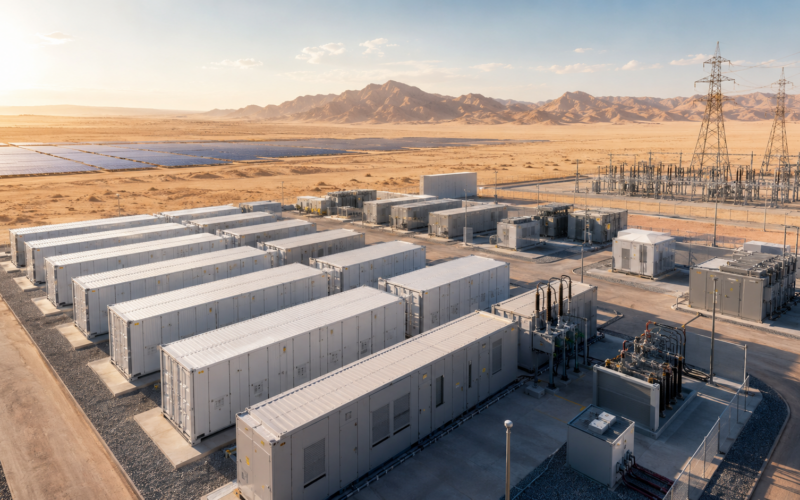
AMEA Power, the Dubai-based renewable energy developer owned by Al Nowais Group, has signed engineering, procurement and construction contracts for two standalone battery energy storage system projects in Egypt with a combined capacity of 1,500MWh. The contracts cover the 500MWh Horus battery storage project at Zafarana and the 1,000MWh Nefertiti battery storage project at Benban, moving both assets from capacity agreement stage toward physical delivery. China Energy Engineering Corporation Limited (HKEX: 3996; SSE: 601868) is tied to the EPC execution, while Gotion High-Tech Co., Ltd. (SZSE: 002074) is linked to the parallel battery manufacturing component. The immediate relevance is strategic rather than cosmetic: Egypt is trying to convert renewable energy ambition into dispatchable grid capacity, and battery storage is becoming the missing piece between policy targets and power system reliability.
Why do AMEA Power’s 1.5GWh Egypt storage contracts matter for grid flexibility and renewable dispatch?
The main change is that Egypt’s battery storage pipeline is moving from headline ambition into implementation architecture. Solar and wind projects can expand installed capacity, but without storage, the grid still faces intermittency, curtailment risk, peak demand pressure and continued reliance on thermal backup. AMEA Power’s Horus and Nefertiti projects therefore matter because they target the operational layer of the energy transition rather than only the generation layer.
The 500MWh Zafarana project and the 1,000MWh Benban project also sit in geographies with different strategic meanings. Zafarana is associated with the Gulf of Suez renewable corridor, where wind integration and grid balancing are central. Benban, already known as one of Egypt’s major solar hubs, gives the Nefertiti project a different role: absorbing solar generation variability and supporting smoother dispatch from a region that has become symbolically important to Egypt’s renewable power story.
For AMEA Power, the EPC contracts reduce development uncertainty. Capacity purchase agreements create the revenue framework, but EPC contracts begin to define execution credibility, contractor accountability and technology delivery. That is the point at which a project starts to become bankable in a more practical sense, even if final debt approvals, construction timelines and commissioning risk still matter. In grid storage, a signed agreement is useful; delivered megawatt-hours are where the real bragging rights begin.

How could the Horus and Nefertiti BESS projects change Egypt’s clean power investment model?
Egypt has spent years positioning itself as a renewable energy hub, but its power system still needs storage, transmission investment and flexible dispatch capacity to support higher renewable penetration. The Horus and Nefertiti projects point to a shift in the country’s procurement logic. Egypt is no longer only buying generation capacity. It is increasingly procuring the ability to store, shift and release power when the grid actually needs it.
That distinction matters for investors because storage contracts can create a different kind of infrastructure asset. A solar plant produces power when irradiation allows. A storage asset monetises system value: capacity, reliability, balancing, reduced curtailment and potentially avoided fuel costs. If Egypt can develop a repeatable model for standalone battery storage capacity agreements, it could create a new investment category for private developers, lenders and equipment suppliers across North Africa.
The execution risk is also clear. Battery storage requires more than containers, cells and power conversion systems. It depends on grid interconnection quality, operating protocols, degradation management, warranties, fire safety standards and revenue certainty over the contract life. If Horus and Nefertiti perform well, they could help Egypt attract further private capital into utility-scale storage. If they suffer delays or underperform technically, the sector may still grow, but lenders will price the next wave with a colder stare.
What does China Energy Engineering Corporation’s EPC role signal about competition in Middle East and North Africa storage projects?
China Energy Engineering Corporation Limited’s role reinforces how Chinese infrastructure groups are embedding themselves deeper into the Middle East and North Africa renewable energy supply chain. The company is not merely chasing conventional power construction. It is positioning across solar, wind, storage, engineering services and complex grid-linked project delivery, which allows it to compete for integrated clean energy infrastructure mandates.
For Egypt, this creates a practical advantage and a strategic dependency. Chinese EPC groups can bring scale, execution capacity and cost competitiveness, particularly in capital-intensive infrastructure where speed and supplier coordination matter. However, reliance on a narrow set of foreign contractors and technology suppliers can create long-term exposure around procurement concentration, spare parts, warranty enforcement and geopolitical perception.
From a listed-company sentiment standpoint, the Egypt contracts are unlikely to transform China Energy Engineering Corporation Limited’s earnings profile on their own. Its Hong Kong-listed shares recently traded around HK$1.22, below the mid-point of their 52-week range, while its Shanghai-listed A-shares were also trading below their annual high. That suggests investors still view the group through the lens of broad construction margins, order conversion and China-linked infrastructure risk, not one Egypt battery storage win. Still, international BESS mandates add credibility to the company’s new-energy contracting narrative, which is becoming more valuable as traditional infrastructure cycles mature.
Why is Gotion High-Tech’s role in local battery manufacturing strategically important for Egypt?
The linked battery manufacturing agreement may be the most strategically interesting part of the development because it moves the discussion beyond imported systems. Egypt does not only want battery storage projects installed on its grid. It wants part of the battery energy storage value chain located inside the country, with a proposed annual production capacity of 3,000MWh.
That ambition fits a broader pattern across emerging energy markets. Governments are increasingly reluctant to treat renewable infrastructure as a pure import story. They want local assembly, jobs, technical skills, domestic supply resilience and a stronger industrial base. For Egypt, local battery manufacturing could support future storage projects, reduce procurement friction and create an export-oriented platform if the country can scale quality, financing and logistics.
Gotion High-Tech Co., Ltd. brings a different investor signal from China Energy Engineering Corporation Limited. Gotion High-Tech Co., Ltd. is exposed to both power batteries and energy storage systems, which means the Egypt opportunity fits its broader push beyond electric vehicle batteries. Its shares recently traded at CNY 28.76, down on the day and well below the upper end of the 52-week range, showing that investors remain sensitive to battery-sector pricing pressure and margin competition. The Egypt manufacturing angle is strategically useful, but the financial upside will depend on production localisation, offtake visibility and whether regional demand grows fast enough to absorb capacity.
How does this deal fit into Egypt’s broader push for 42 percent renewable electricity by 2030?
Egypt’s policy challenge is not whether it can announce renewable projects. It has already attracted major developers and suppliers across solar, wind, storage and hydrogen-adjacent infrastructure. The harder question is whether the country can build the grid flexibility needed to lift renewables toward its 2030 electricity mix target while managing demand growth, fuel import exposure and fiscal constraints.
Battery storage directly addresses that bottleneck. Without storage, more renewable capacity can create operational stress if generation peaks do not align with demand peaks. With storage, Egypt gains a tool for absorbing excess solar and wind power, reducing curtailment and strengthening reliability during demand spikes. In simple terms, BESS is the difference between having clean electrons and being able to use them when they are most valuable.
The timing also matters because Egypt has been working to attract foreign capital into energy infrastructure while navigating pressure on fuel costs and energy security. Storage projects can help reduce the need for thermal generation at certain periods, but they do not remove all power system constraints. Transmission upgrades, dispatch reforms, tariff structures and currency stability will still influence whether Egypt’s renewable buildout becomes a durable investment story or an impressive project list with recurring bottlenecks.
What are the financing and execution risks investors should watch in AMEA Power’s Egypt BESS rollout?
The biggest near-term questions are financial close, construction schedule and integration quality. Senior debt support from development finance institutions can improve project bankability, but lenders will still examine contract structure, technology warranties, counterparty risk and currency convertibility. Battery storage projects are capital-intensive, and their risk profile is different from conventional renewables because long-term performance depends on degradation assumptions and operational discipline.
Construction timelines also matter because Egypt’s grid needs flexibility sooner rather than later. Delays could weaken the strategic value of the projects, especially if new renewable capacity comes online before enough balancing infrastructure is available. In storage, late delivery can be more damaging than in some generation projects because it affects the reliability value of the entire renewable portfolio around it.
The manufacturing element carries its own execution risk. A 3,000MWh annual battery production target sounds attractive, but local manufacturing is not automatically local value creation. Egypt will need supplier depth, workforce training, quality control, battery safety governance, and a credible demand pipeline. Otherwise, the factory could become dependent on imported components and narrow project cycles rather than developing into a competitive regional battery manufacturing base.
Could AMEA Power’s Egypt storage strategy reshape competition among regional renewable developers?
AMEA Power is using Egypt to demonstrate that renewable developers can compete not only on capacity additions but also on system-level relevance. That matters in a region where renewable energy markets are becoming more sophisticated. Developers that can combine solar, wind, storage, financing relationships and government alignment will have an advantage over players that remain focused on single-asset generation bids.
This could raise the bar for peers active in the Middle East and North Africa. Developers such as Scatec, ACWA Power, Masdar and other regional infrastructure players are increasingly competing in markets where storage, grid services and localisation are becoming part of the value proposition. Egypt’s procurement direction suggests that future bids may reward developers that can offer integrated solutions rather than just low generation tariffs.
The risk for AMEA Power is that early leadership creates expectations. If Horus and Nefertiti are delivered cleanly, AMEA Power strengthens its position as a serious storage and renewable energy platform in Egypt. If delivery slips, performance disappoints or manufacturing localisation proves thin, the company may still retain a strong project pipeline, but the strategic halo around its storage execution would fade. In infrastructure, reputation compounds beautifully until one weak project asks for the bill.
What happens next if Egypt’s battery storage buildout succeeds or stalls?
If the AMEA Power projects succeed, Egypt could gain a template for scaling standalone BESS procurement across other renewable zones. That would support additional solar and wind capacity, reduce pressure on gas-fired balancing, and improve the credibility of Egypt’s 2030 renewable energy ambitions. It would also create more room for local manufacturing, technology partnerships and development finance participation.
Success would also send a regional signal. North African and Middle Eastern grids face similar issues as renewable penetration rises. Egypt could become a reference case for how emerging markets pair private-sector renewable generation with standalone storage, capacity agreements and localisation measures. That would make the Horus and Nefertiti projects more than asset-level developments. They would become proof points for a replicable grid flexibility model.
If the rollout stalls, the impact could be equally instructive. Delays would expose the difficulty of turning storage ambition into bankable infrastructure. Financing gaps, interconnection delays, technology risks or unclear operating frameworks could make future lenders and contractors more cautious. The result would not end Egypt’s clean energy transition, but it would make the next wave slower, more expensive and more dependent on public-sector support.
Key takeaways on how AMEA Power’s Egypt BESS contracts could influence renewable energy, grid investment and battery manufacturing
- AMEA Power’s 1,500MWh battery storage EPC contracts move Egypt’s BESS agenda from agreement stage toward implementation, with Horus at Zafarana and Nefertiti at Benban becoming key test cases for standalone utility-scale storage.
- The projects matter because Egypt’s renewable energy challenge is shifting from installed generation capacity to dispatchability, grid balancing and the ability to integrate intermittent solar and wind power without adding reliability stress.
- China Energy Engineering Corporation Limited’s EPC role reinforces the competitive strength of Chinese infrastructure groups in Middle East and North Africa clean energy projects, particularly where cost, speed and engineering integration are decisive.
- Gotion High-Tech Co., Ltd.’s manufacturing involvement could become strategically important if Egypt succeeds in converting battery imports into domestic industrial capacity, skills development and regional supply chain relevance.
- The proposed 3,000MWh annual battery manufacturing capacity gives Egypt a localisation angle, but the real test will be whether domestic and regional demand can support the factory beyond a narrow set of flagship projects.
- Listed supplier sentiment remains mixed, with China Energy Engineering Corporation Limited and Gotion High-Tech Co., Ltd. trading below their 52-week highs, suggesting investors still need clearer evidence of margin impact and order conversion.
- The projects support Egypt’s push toward a higher renewable electricity share by 2030, but battery storage must be matched by transmission upgrades, bankable contracts and strong operating rules to deliver full system value.
- Financing support from development institutions could improve bankability, but lenders will remain focused on currency risk, technology warranties, degradation assumptions, safety standards and long-term offtaker reliability.
- For AMEA Power, successful delivery would strengthen its positioning as a renewable energy developer capable of building grid-relevant infrastructure, not just solar and wind generation assets.
- If the Horus and Nefertiti projects face delays or technical underperformance, Egypt’s storage market will still advance, but future projects may face higher financing costs, stricter lender scrutiny and slower procurement momentum.
Discover more from Business-News-Today.com
Subscribe to get the latest posts sent to your email.

