





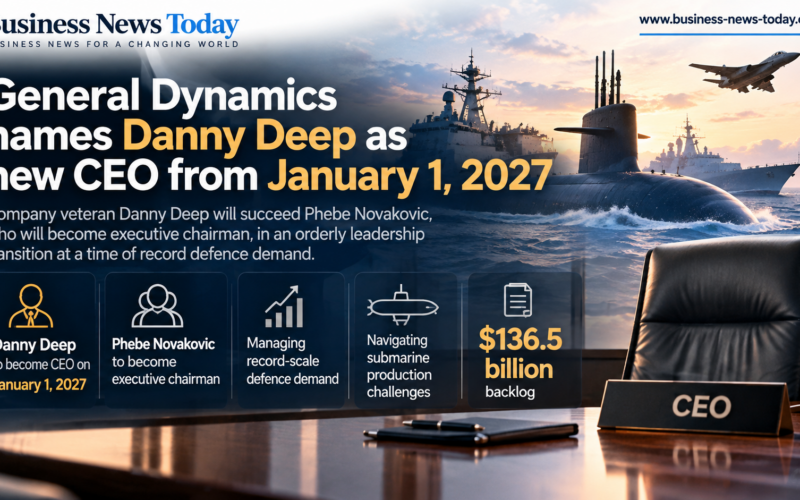
General Dynamics Corporation (NYSE: GD) has elected President Danny Deep as its next Chief Executive Officer, effective January 1, 2027, setting up a carefully staged transition from Phebe Novakovic after nearly 14 years of leadership. Novakovic, who has served as Chief Executive Officer since 2013, will remain closely involved by moving into the executive chairman position rather than immediately leaving the company.
Deep is a 25-year General Dynamics veteran whose career has included leadership of Land Systems, Combat Systems, Global Operations and, most recently, the presidency of the entire company. His promotion therefore continues General Dynamics’ preference for internal succession and gives the company a leader who already understands its businesses from combat vehicles to Gulfstream aircraft and nuclear-powered submarines.
The timing is strategically significant because General Dynamics is not changing leaders during a downturn. Second-quarter 2026 revenue grew 8.1% to $14.1 billion, diluted earnings per share climbed 13.4% and company-wide backlog reached $136.5 billion. The challenge awaiting Deep is therefore less about finding demand and more about converting enormous demand into production, cash flow and acceptable margins.
Why did General Dynamics choose Danny Deep rather than an external CEO?
Deep’s operating experience appears particularly well matched to the problems General Dynamics needs to solve. The company already has strong franchises and massive order books, but several businesses need to increase output quickly enough to satisfy government and commercial customers.
Before becoming President in December 2025, Deep served as Executive Vice President of Global Operations. Earlier, he led Combat Systems and General Dynamics Land Systems, giving him direct experience with complex manufacturing programmes and government customers.
That background becomes valuable when production capacity is one of the defence industry’s biggest constraints. Western governments are rebuilding inventories after years of lower defence spending, while demand for munitions, armoured vehicles, submarines and military technology has increased sharply.
Hiring an external leader might have introduced a different strategic perspective, but it would also have created a learning curve around highly specialised defence programmes. By promoting Deep, the board appears to be prioritising execution continuity.
Novakovic’s continuing presence as executive chairman further reduces transition risk. Deep will gain formal operational authority while still having access to an executive who shaped General Dynamics’ strategy for more than a decade.
What business is Danny Deep actually inheriting?
General Dynamics is far more diversified than many investors associate with a defence contractor. Its Aerospace division produces Gulfstream business jets, while Marine Systems builds nuclear-powered submarines and other naval vessels. Combat Systems supplies armoured vehicles, weapons and munitions, while Technologies provides information technology and mission systems.
That portfolio generated $14.1 billion of second-quarter revenue, with growth across all four operating groups. Operating earnings increased 11.9% to approximately $1.5 billion and operating margin expanded by 40 basis points to 10.4%.
Orders were even stronger. General Dynamics recorded approximately $20 billion of orders during the quarter, producing a company-wide book-to-bill ratio of 1.4 times. Backlog stood at $136.5 billion, while management estimated another $50.4 billion of potential value from unfunded indefinite-delivery contracts and unexercised options.
Those figures illustrate the opportunity. Deep does not need to manufacture demand for General Dynamics products. He needs to ensure factories, shipyards and supply chains can convert that demand into deliveries.
Why are submarines likely to be one of Deep’s biggest operational tests?
The United States is investing heavily in submarine programmes, particularly the Columbia-class ballistic-missile submarine and Virginia-class attack submarines. General Dynamics Electric Boat occupies a central role in those programmes, making Marine Systems one of the company’s most strategically important businesses.
Submarine construction is extraordinarily difficult to accelerate. Nuclear shipbuilding requires highly specialised welders, engineers, suppliers and secure facilities, while years of underinvestment across the industrial base have created bottlenecks that cannot be solved simply by adding capital.
General Dynamics has been investing to expand output, but labour productivity, supplier readiness and programme scheduling remain major issues for the wider United States submarine enterprise. Those problems will demand the operational experience Deep has accumulated across manufacturing businesses.
The stakes extend beyond General Dynamics earnings. Delays can affect United States Navy fleet planning and international security commitments, particularly as the United States, United Kingdom and Australia pursue the AUKUS submarine partnership.
Deep’s performance will therefore be measured partly by whether General Dynamics can increase throughput without allowing costs to outrun contract economics.
What happens to Phebe Novakovic after the CEO transition?
Novakovic will become executive chairman on January 1 rather than retiring. That arrangement preserves continuity while still giving Deep the Chief Executive Officer position and day-to-day control.
The structure resembles a controlled handover rather than an abrupt succession. It can be particularly useful at companies with long-cycle contracts because strategic decisions made years earlier continue affecting financial performance long after a new leader takes office.
Novakovic’s tenure has produced substantial shareholder value and a disciplined approach to portfolio management. Under her leadership, General Dynamics strengthened Gulfstream, expanded its technology exposure and maintained a major position across United States defence programmes.
Keeping her involved could reassure customers, employees and investors while Deep establishes authority. The risk is that executive-chairman structures can occasionally blur decision-making if the former Chief Executive Officer remains too involved. General Dynamics will need clear lines between board oversight and executive management.
There is no immediate indication that the company expects such conflict. Deep and Novakovic have worked closely together, and the succession has been announced months before taking effect.
How are General Dynamics shares responding to the CEO succession?
General Dynamics shares closed at approximately $331.27 on October 9, gaining about 0.9% during the session. The stock has pulled back from its July 52-week high near $400, despite continuing strength in orders and revenue.
The leadership announcement has therefore not produced a dramatic market reaction, which is often positive in a succession context. Investors appear to view Deep’s appointment as orderly rather than disruptive.
The larger factors influencing the share price remain defence budgets, execution, Gulfstream deliveries, submarine margins and expectations around the future political environment for military spending. A new Chief Executive Officer matters, but General Dynamics’ near-term results will still be heavily determined by programmes already under contract.
That makes Deep’s promotion a particularly pure execution story. The strategic assets are already in place, government demand remains strong and backlog provides unusually long revenue visibility. The next Chief Executive Officer needs to deliver what the company has already sold.
What will define the Danny Deep era at General Dynamics?
The first measure will be production. Defence companies are being asked to build faster after decades in which many programmes prioritised efficiency over surge capacity. Deep’s operations background gives him credibility, but shareholders will want proof that investment translates into higher deliveries and margins.
The second will be labour. General Dynamics employs more than 120,000 people worldwide and needs skilled manufacturing workers at a time when welders, engineers and other technical occupations are in intense demand. Recruitment, retention and training could become as important as capital expenditure.
The third will be capital allocation. Strong cash generation gives General Dynamics flexibility to invest in capacity, reduce debt, pay dividends and potentially repurchase shares. Deep will need to balance those uses while supporting unprecedented customer demand.
General Dynamics is therefore undertaking succession from a position of strength, something many companies would envy. The test for Danny Deep is whether he can turn a $136.5 billion backlog from evidence of demand into evidence of execution.
Discover more from Business-News-Today.com
Subscribe to get the latest posts sent to your email.
