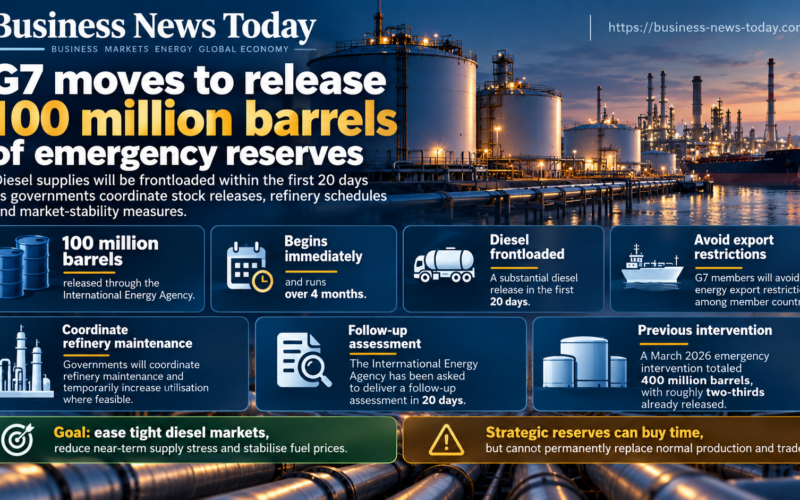
The Group of Seven has agreed to coordinate the release of 100 million barrels of emergency energy reserves through the International Energy Agency, beginning immediately and running over four months. The official G7 statement says a substantial diesel release will be frontloaded within the first 20 days by members and partners, while governments will also coordinate refinery maintenance and temporarily increase utilisation rates where feasible.
The agreement does not specify how the 100 million barrels will be divided among diesel, crude oil and other petroleum products, nor does it identify each participating country’s volume. The G7 also committed to avoiding energy export restrictions among member countries and asked the IEA to deliver a follow-up assessment within 20 days, including recommendations on market stability and eventual stock replenishment.
Why has diesel become the immediate priority in the latest G7 emergency release?
Global diesel markets have become unusually tight because disruption to Middle Eastern supply has reduced normal refined-product flows at the same time as shipping and refinery constraints have increased replacement costs. Europe has become more dependent on US diesel cargoes, while inventories and wholesale prices have moved sharply enough to create wider inflation concerns.
Diesel matters far beyond passenger vehicles. Freight trucks, construction equipment, agriculture, shipping and industrial machinery all consume middle distillates, meaning shortages can move rapidly through supply chains and eventually affect food and manufactured-goods prices.
That explains the decision to frontload diesel rather than spread the entire release evenly over four months. The G7 is attempting to increase immediately available product supply while the larger crude and refining system adjusts.
How does the new 100-million-barrel release relate to the record March 2026 intervention?
The IEA coordinated a much larger 400-million-barrel emergency commitment in March after the Iran war produced one of the most severe energy-market disruptions in decades. IEA Executive Director Fatih Birol said recently that members had released roughly two-thirds of that earlier commitment.
The October agreement explicitly says it takes account of commitments already fulfilled, making the new 100-million-barrel figure part of a continuing international response rather than an entirely separate energy policy. The exact overlap between previously pledged barrels and the new release has not been broken out publicly.
That distinction prevents a misleading calculation in which every headline commitment is simply added together as though all volumes were completely new and immediately available. What matters operationally is how many additional barrels reach markets, which products they contain and how quickly inventories can later be replenished.
Why is the G7 coordinating refinery maintenance as well as releasing stockpiles?
Emergency crude reserves alone cannot solve a diesel shortage if refineries lack capacity to turn crude into finished fuel. Scheduled maintenance can temporarily remove significant refining capacity, so simultaneous shutdowns across several countries would make the current product shortage worse.
The G7 has therefore agreed to coordinate maintenance schedules and temporarily increase refinery utilisation where technically feasible. That approach recognises that today’s stress is partly a refining and logistics problem rather than simply a shortage of crude oil underground.
Increasing utilisation has practical limits. Refineries require maintenance for safety and reliability, and pushing units harder for too long can increase outage risk, so governments cannot treat maximum throughput as a permanent solution.
Could the emergency release materially lower diesel and oil prices?
Initial market reaction suggests additional supply can relieve some pressure. Reuters reported that US diesel futures and benchmark European diesel prices fell after details of the coordinated plan emerged, although market prices remain highly sensitive to further conflict and shipping disruptions.
A strategic-stock release changes near-term physical availability but does not create new production capacity. If geopolitical disruption persists for months, inventories can be depleted faster than producers and refiners replace them.
That is why the G7 statement specifically asks the IEA to examine replenishment. Governments face a balancing problem: emergency stocks are valuable precisely because they can be released during crises, but drawing them down repeatedly reduces protection against the next supply disruption.
Why did the G7 rule out export restrictions among members?
Export bans can appear attractive domestically because they keep locally produced fuel inside one country. The problem is that international fuel markets depend on cross-border trade, and restricting one supplier can create shortages elsewhere that ultimately feed back into global prices.
The G7 commitment to refrain from energy export restrictions is therefore designed to preserve product flows between members. It also reduces the risk that countries respond individually to high prices in ways that fragment the broader market.
This matters especially for Europe, which has become heavily reliant on imported diesel after Middle Eastern supply disruptions. A coordinated reserve release is intended to add supply without creating another shock through protectionist restrictions.
What are the key takeaways from the G7’s latest emergency energy intervention?
The confirmed commitment is 100 million barrels released through the IEA over four months, with a substantial share of diesel arriving within the first 20 days. The G7 has not disclosed the exact product split or country-by-country contributions, so those figures should not be inferred from proposals discussed before the final statement.
Governments are also addressing refinery utilisation and export restrictions, showing that the current crisis involves product availability and logistics as much as crude supply. The intervention follows the record 400-million-barrel IEA commitment made in March, of which only part had been drawn by early October.
The policy can buy time and reduce near-term market stress, but it cannot substitute indefinitely for restored Middle Eastern flows or additional refining capacity.
What will show whether the 100-million-barrel release is actually working?
The first indicators will be diesel inventories, wholesale crack spreads, tanker flows and the IEA’s required follow-up report within 20 days. If prices ease while stocks stabilise, the coordinated release will have achieved its immediate objective.
If fuel markets remain extremely tight despite the release, governments may have to consider additional stock drawdowns or demand-management measures. The core constraint is straightforward: strategic reserves can bridge a disruption, but they cannot permanently replace normal production and trade.
Discover more from Business-News-Today.com
Subscribe to get the latest posts sent to your email.