


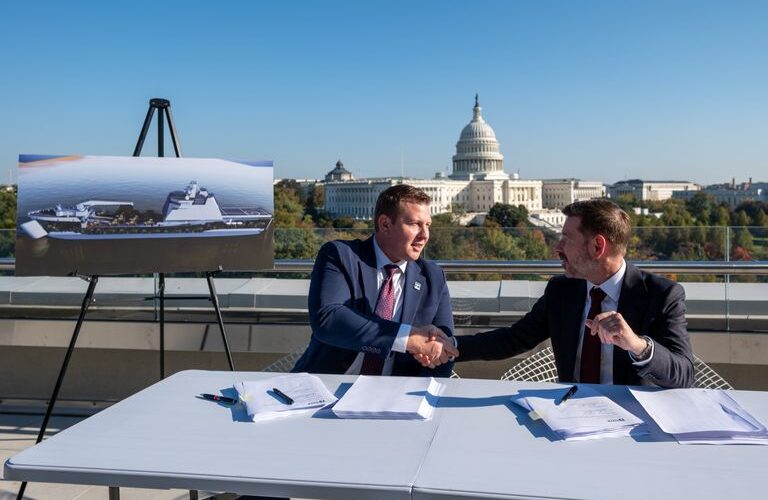
Hanwha Defense USA, Inc., a subsidiary of South Korea’s Hanwha Aerospace Co., Ltd. (KRX: 012450), has secured a $269 million contract to construct a Medium Landing Ship for the United States Navy and Marine Corps at Hanwha Philly Shipyard in Pennsylvania. Announced on October 30, 2026, the selection by TOTE Services represents Hanwha Defense USA’s first US Navy shipbuilding award and includes options for three additional vessels, positioning the Philadelphia facility for a larger role in American naval construction. The contract forms part of a $2.2 billion Navy vessel construction management programme supporting an initial group of up to eight ships within a planned 35-vessel fleet. The award follows Hanwha Group’s proposed $5 billion shipyard investment programme and a separate October 29 announcement that Hanwha Defense USA is moving to acquire control of the Philadelphia facility. Its strategic significance lies in creating an initial contracted route into US Navy shipbuilding, although the financial returns will depend on production execution, future orders and successful expansion of the yard’s capabilities.
The contract will be managed through TOTE Services, which holds the principal vessel construction management agreement with the Navy. Hanwha Defense USA will undertake construction at the Philadelphia shipyard, while TOTE Services coordinates shipbuilder performance, programme requirements and related contractual responsibilities. The first construction activities are expected to begin in the fourth quarter of 2027, with the programme’s initial vessel delivery now expected in 2030.
The arrangement gives Hanwha a concrete defence manufacturing opportunity at a facility historically concentrated on commercial shipbuilding and government non-combatant vessels. It also provides an early test of whether the company’s investments in workforce development, industrial infrastructure and production technology can support the transition towards military ship construction.
What does Hanwha Defense USA’s $269 million Medium Landing Ship contract actually cover?
The newly awarded contract covers construction of one Medium Landing Ship, commonly designated LSM, valued at $269 million. Hanwha Defense USA has also secured contractual options covering three additional vessels, although the financial value and exercise conditions of those options have not been disclosed.
The initial $269 million award should therefore be distinguished from the potential value of future ships. The options create an opportunity for additional work but do not establish that three further orders have been funded, exercised or recognised as revenue.
The contract was awarded through a competitive process managed by TOTE Services. The company issued requests for proposals to qualified US shipyards in July 2026 and selected Hanwha Defense USA based on its competitive pricing and acceptance of the subcontract’s commercial terms.
Jeff Dixon, president of TOTE Services, indicated that the award demonstrates how the vessel construction management model can shorten the interval between competitive procurement and construction planning. He said the agreement secures construction positions that would allow work to begin during the final quarter of 2027.
The contract establishes a defined entry point into naval construction, but it does not provide information about expected operating margins, payment milestones or the final cost structure. Those factors will determine how much financial value Hanwha captures from the work.
The shipyard must also demonstrate that its commercial vessel experience can be translated into the quality assurance, production control and programme management requirements associated with US Navy construction.

Why is the $2.2 billion Navy programme different from Hanwha’s shipbuilding order?
The $269 million Hanwha award sits within a broader procurement arrangement established by the US Navy in July 2026.
Under that agreement, TOTE Services received a $2.2 billion contract to serve as Vessel Construction Manager for the Medium Landing Ship programme. Its responsibilities include managing shipbuilder subcontracts, coordinating construction requirements and overseeing the delivery process across participating shipyards.
The programme is initially structured around up to eight vessels, while the Navy and Marine Corps have identified a longer-term requirement for a fleet of 35 Medium Landing Ships.
These figures represent different levels of contractual and programme scope. The $2.2 billion amount relates to TOTE Services’ programme contract, while the 35-vessel figure describes the broader planned fleet rather than ships already ordered from Hanwha.
In July, the Navy identified Bollinger Shipyards for one initial vessel and Fincantieri Marinette Marine for four, while retaining flexibility over the allocation of up to three further ships. TOTE Services confirmed on October 30 that discussions with those two shipbuilders were continuing and that both were expected to contribute to the initial programme.
Hanwha’s selection adds another shipbuilder to the planned production network. The arrangements could create competition and additional manufacturing flexibility, although subsequent vessel allocations will depend on procurement decisions and contractual implementation.
The selection also does not mean that Hanwha has secured the entire $2.2 billion programme. Its presently identified construction award is $269 million, with additional opportunities dependent on the exercise of options or future awards.
For the Philadelphia operation, the contract is commercially meaningful because it establishes a funded vessel construction assignment within a larger Navy acquisition programme. Any substantial expansion beyond the initial ship will require further decisions and sustained competitive performance.
How does the award advance Hanwha’s $5 billion Philadelphia shipyard investment strategy?
Hanwha Group acquired Philly Shipyard from Norway’s Aker ASA in December 2024 through a transaction valued at approximately $100 million. The acquisition provided the South Korean industrial group with an established US commercial shipbuilding facility and a platform for expanding into government and defence-related maritime projects.
In August 2025, Hanwha announced a proposed $5 billion infrastructure investment programme for the Philadelphia facility. The plan includes additional docks, expanded quays and the potential development of a new block assembly facility intended to support higher annual vessel output.
Hanwha has described a long-term ambition to increase annual production at the shipyard from fewer than two vessels to as many as 20. That figure represents a future capacity objective rather than the facility’s current demonstrated production rate.
The proposed investment is substantially larger than the initial Navy contract, making the relationship between infrastructure expenditure and future order intake an important consideration.
The $269 million award represents approximately 5.4% of the announced $5 billion investment plan. This comparison provides perspective on the scale of the first naval construction order, but it is not a measure of investment recovery or profitability.
The company has not publicly provided a complete project-by-project capital expenditure schedule for the full $5 billion programme. It would therefore be premature to treat the entire amount as expenditure already incurred or financing that has been irrevocably committed.
Additional shipbuilding infrastructure could improve the yard’s ability to undertake different types of vessels simultaneously. However, expanding physical capacity does not automatically generate an equivalent increase in commercial output.
Shipbuilding productivity depends on skilled labour availability, equipment utilisation, supply-chain coordination, construction sequencing and a sufficiently predictable orderbook.
Hanwha’s next task is to demonstrate that industrial upgrades and customer commitments can advance together, reducing the risk of expanding capacity faster than the business can use it.
Hanwha Defense USA is also moving to take control of the Philadelphia shipyard
The Navy contract follows a separate corporate development announced on October 29.
Hanwha Defense USA disclosed plans to acquire a controlling interest in Hanwha Philly Shipyard, bringing the facility under its defence-oriented leadership and governance structure.
The transaction follows an internal ownership arrangement established when Hanwha Group acquired the shipyard in 2024. Hanwha Systems held a 60% interest, while Hanwha Ocean held the remaining 40%.
In September 2026, Hanwha Systems announced plans to sell its stake to Hanwha Defense USA Shipbuilding LLC, a joint venture led by Hanwha Defense USA alongside Hanwha FutureProof.
The latest announcement describes the acquisition of control as a transaction in progress rather than a fully completed transfer. The final ownership arrangements and any associated financial consequences should therefore be assessed once completion is confirmed.
The restructuring is intended to align shipyard operations more closely with Hanwha Defense USA’s military contracting activities. Tom Anderson, a retired US Navy rear admiral and president of US shipbuilding at Hanwha Defense USA, is expected to oversee the group’s domestic shipbuilding operations.
Bringing commercial and defence programmes under a more coordinated management structure could improve resource planning, customer engagement and oversight of naval construction.
It may also help the group coordinate investments across its existing commercial shipbuilding business and emerging defence activities.
However, the effectiveness of the arrangement will depend on practical operational changes rather than the ownership transfer alone. The Philadelphia yard will still need to balance naval requirements with its existing commercial orderbook.
Why does the Navy need 35 Medium Landing Ships for future Marine Corps operations?
The Medium Landing Ship programme is intended to address a capability gap between smaller landing craft and large amphibious warfare vessels.
The US Marine Corps is developing more distributed operating concepts that require personnel, vehicles and supplies to move between coastal positions and islands without relying exclusively on large amphibious ships.
Medium landing ships are designed to support those operations by transporting equipment and personnel through coastal environments where conventional deep-water ports may be unavailable.
The programme has particular relevance to maritime operating requirements in the Indo-Pacific, where geography can place substantial demands on transport, resupply and expeditionary logistics.
Unlike major amphibious assault ships, medium landing ships are intended to provide a more distributed form of maritime lift. Their operational usefulness depends on carrying suitable payloads, reaching austere coastal locations and supporting repeated movement between dispersed forces.
The planned 35-vessel fleet reflects the Navy and Marine Corps’ broader requirement, but it is not equivalent to a funded procurement commitment for all 35 ships.
The initial programme will therefore provide an opportunity to establish construction performance, refine procurement arrangements and assess delivery costs before any much larger production commitment.
For Hanwha, participation offers a route into a vessel category that could support repeat construction if the Navy proceeds with further orders. The company will nevertheless compete within a programme involving other established US shipbuilders.
Can the TOTE Services construction management model reduce Navy shipbuilding delays?
The Navy’s decision to place TOTE Services in a vessel construction management role represents an effort to use commercial contracting practices in military ship procurement.
Under the arrangement, TOTE Services holds the principal contract with the Navy and manages the shipbuilding subcontracts directly. The model is designed to provide a single organisation responsible for coordinating construction requirements, shipyard performance and delivery arrangements.
The Navy has identified configuration standardisation, coordinated purchasing and more direct commercial oversight as potential advantages. These measures could reduce duplication between shipyards and support procurement of common components across multiple vessels.
The programme also draws on experience from the National Security Multi-Mission Vessel project for the US Maritime Administration.
TOTE Services has overseen the five-vessel programme at Hanwha Philly Shipyard, with four ships delivered by October 2026 and the fifth expected in 2027.
That record provides relevant evidence of the relationship between TOTE Services and the Philadelphia facility. However, the National Security Multi-Mission Vessels serve training and humanitarian purposes, and their construction experience does not eliminate the additional requirements associated with Navy landing ships.
The latest contracting approach may improve coordination, but successful implementation will still depend on engineering readiness, material availability, qualified labour and disciplined construction management.
The programme’s delivery expectations also require attention. When the Navy announced the vessel construction management award in July, it anticipated the first Medium Landing Ship in autumn 2029. The October announcements now identify 2030 as the expected first delivery period.
The updated timetable provides the more recent programme reference, but the available information does not establish how much of the change reflects revised construction sequencing, design decisions or other scheduling considerations.
The first useful execution milestones will involve detailed construction preparations, procurement progress and the planned commencement of work in late 2027.
What does Hanwha Philly Shipyard’s existing commercial orderbook contribute to its defence expansion?
Hanwha Philly Shipyard has an established history of constructing commercial vessels used in domestic American maritime trade.
The facility has produced a substantial portion of the large ocean-going commercial ships built for the US Jones Act market since 2000, including container ships and product tankers.
Its infrastructure includes a large graving dock, heavy-lift equipment and facilities used for assembling and launching commercial vessels.
This existing capability provides an industrial foundation for naval construction, particularly in areas involving hull fabrication, large block assembly, marine systems and project management.
The shipyard is also expanding into liquefied natural gas carrier construction. Hanwha Shipping placed an order in 2025 for an LNG carrier, with an option for a second vessel subsequently exercised.
The facility’s orderbook also includes a four-vessel programme involving medium-range oil and chemical tankers, with options for additional vessels and deliveries beginning in 2029.
These commercial commitments create opportunities for workforce continuity and equipment utilisation, but they also require careful coordination as Navy work enters the production schedule.
Naval and commercial projects can compete for skilled employees, dock availability, engineering capacity and specialised suppliers.
A dual-use shipyard could benefit from a more diversified customer mix, provided management can organise construction schedules without creating bottlenecks.
Hanwha’s broader industrial capabilities may provide additional engineering and manufacturing resources, but the October contract does not establish which equipment or services will be sourced from other Hanwha affiliates.
The most important operating advantage would come from delivering different vessel classes efficiently while maintaining consistent quality and cost control.
What do Hanwha Aerospace’s latest earnings and 8.4% share-price decline mean for the shipbuilding investment case?
The award comes immediately after a weak quarterly earnings announcement from listed parent Hanwha Aerospace.
On October 29, the company reported third-quarter 2026 consolidated revenue of approximately KRW 6.09 trillion, down 6% from the same period a year earlier.
Operating profit declined 46.2% to KRW 452 billion, while the group recorded a net loss of approximately KRW 36.7 billion.
The earnings decline reflected changes in defence equipment delivery schedules and other operating factors. Deliveries of certain K9 self-propelled howitzers to Poland were shifted towards the fourth quarter, while some equipment had been delivered earlier than originally scheduled during the preceding quarter.
These timing effects contributed to weaker reported performance but should not be automatically interpreted as lost contract demand.
The company’s South Korean shares closed at KRW 696,000 on October 30, down 8.42% from the previous close of KRW 760,000.
The stock also stood approximately 12.1% below its October 23 closing price of KRW 792,000. Its October 30 trading range was KRW 662,000 to KRW 729,000, with the lower level also matching its reported 52-week low.
The share-price decline occurred during the Korean trading session before the US announcement of the Navy subcontract. It therefore cannot be described as a negative market reaction to the $269 million shipbuilding award.
Contemporary Korean financial reporting associated the weakness primarily with the third-quarter earnings shortfall and weaker-than-expected defence profitability.
The distinction is relevant because Hanwha Aerospace’s near-term financial results are driven by a broader portfolio of defence, aerospace and industrial operations. The new US shipbuilding award is strategically meaningful, but the disclosed amount is modest compared with the group’s quarterly revenue.
The contract also does not establish when revenue will be recognised or what operating margin the work will generate. Those details will depend on construction progress and applicable accounting treatment.
For shareholders, the Philadelphia expansion represents a longer-term diversification and market-access opportunity rather than an immediate solution to the earnings pressures reported in South Korea.
What would turn Hanwha’s first US Navy landing ship order into a larger defence manufacturing business?
The initial contract provides Hanwha Defense USA with a defined construction assignment and a potential route to additional Navy orders.
The strongest near-term evidence will come from construction readiness at Hanwha Philly Shipyard, including detailed engineering, equipment availability and workforce preparation before work begins in the fourth quarter of 2027.
A successful construction programme would need to demonstrate compliance with contractual requirements while maintaining cost and schedule discipline.
The options for three additional vessels provide a potential source of follow-on work, but their exercise remains outside the confirmed value of the initial award.
Any expansion of Hanwha’s share of the wider Navy programme would depend on procurement decisions and demonstrated shipyard performance rather than the strategic ambition associated with the $5 billion infrastructure plan.
The group’s proposed governance restructuring provides another measurable milestone. Completion of the controlling-stake acquisition would clarify how the US shipyard will be managed within Hanwha’s defence organisation.
Longer term, the business case depends on whether the Philadelphia facility can support repeat production across commercial ships, government vessels and naval programmes without persistent underutilisation or costly scheduling conflicts.
Hanwha has established an initial position in US Navy shipbuilding through a contract that combines near-term commercial relevance with broader strategic opportunities. The $269 million award does not validate the economics of the entire proposed shipyard expansion, but it gives the company a concrete programme through which to demonstrate its capabilities.
The next decisive test will be whether Hanwha Philly Shipyard reaches construction readiness for the planned late-2027 start and delivers the first contracted landing ship within the programme’s updated schedule. Successful execution, followed by additional vessel orders, would provide stronger evidence that the company’s investment in American naval manufacturing can support a sustainable business.
Key takeaways from Hanwha Defense USA’s $269 million Navy landing ship award
- Hanwha Defense USA secured a $269 million contract on October 30, 2026, to construct one Medium Landing Ship at Hanwha Philly Shipyard in Pennsylvania.
- The agreement includes options for three additional vessels, but their exercise and potential contract value remain unconfirmed.
- The award sits within TOTE Services’ $2.2 billion Navy vessel construction management programme supporting an initial group of up to eight landing ships.
- The Navy and Marine Corps envision a broader 35-vessel fleet, although this does not represent 35 confirmed orders for Hanwha.
- Construction positions are planned for the fourth quarter of 2027, with the first programme delivery currently expected in 2030.
- Hanwha previously announced a $5 billion Philadelphia infrastructure investment plan intended to expand manufacturing capacity, but the entire investment has not been established as completed expenditure.
- Hanwha Defense USA is separately moving to acquire a controlling stake in the Philadelphia shipyard as part of its transition towards military and commercial vessel construction.
- Existing National Security Multi-Mission Vessel experience provides an operational foundation, while naval construction will introduce additional programme requirements.
- Hanwha Aerospace reported a 46.2% decline in third-quarter operating profit, and its shares fell 8.42% on October 30 before the US shipbuilding announcement.
- Future financial value will depend on construction execution, additional vessel orders, capital discipline and successful utilisation of expanded shipyard capacity.
Discover more from Business-News-Today.com
Subscribe to get the latest posts sent to your email.