
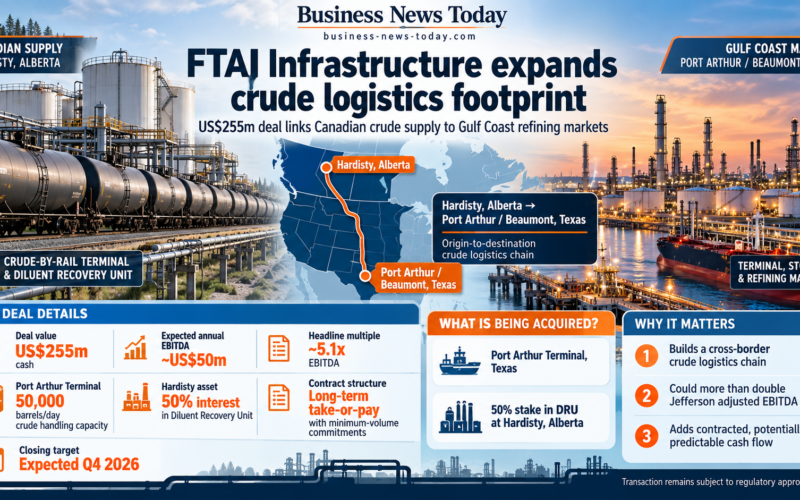
FTAI Infrastructure Inc. (NASDAQ: FIP), through subsidiary FTAI Energy Partners LLC (Jefferson), has agreed to acquire the Port Arthur Terminal in Texas and a 50% interest in a Diluent Recovery Unit at Hardisty, Alberta, from USD Group LLC for approximately US$255 million in cash. Management expects the acquired assets to generate about US$50 million of annual EBITDA over the next 12 months, implying a headline purchase-price-to-forward-EBITDA ratio of roughly 5.1 times before financing costs, transaction expenses, maintenance capital and any future growth investment are considered.
The transaction is more strategically significant than a simple terminal purchase because the two assets form an origin-to-destination logistics chain linking western Canadian crude with the Beaumont and Port Arthur refining complex on the US Gulf Coast. Jefferson said the assets operate under a long-term take-or-pay arrangement with minimum-volume commitments from an investment-grade exploration and production counterparty, potentially adding a comparatively predictable cash-flow stream to a business already focused on storage, transloading and energy logistics.
Why does a $255m acquisition look inexpensive against $50m of expected annual EBITDA?
A simple division of US$255 million by US$50 million produces a headline multiple of approximately 5.1 times expected next-12-month EBITDA, a level that appears relatively modest for contracted midstream infrastructure. That figure should not be confused with an equity return because FTAI Infrastructure will assume existing indebtedness associated with the acquired business and plans to use an acquisition debt facility secured by Jefferson and its subsidiaries, while interest expense and capital requirements sit below EBITDA.
Even with those qualifications, the ratio explains why management describes the transaction as highly accretive. The acquired assets are expected to more than double Jefferson’s existing adjusted EBITDA, meaning the transaction could materially change the earnings mix of the segment without requiring FTAI Infrastructure to build an equivalent logistics system from the ground up. The value is also supported by contracted minimum volumes, which can reduce exposure to short-term commodity-price volatility compared with businesses dependent on merchant throughput.
The comparison becomes more interesting when placed against Jefferson’s historical earnings base. FTAI Infrastructure reported US$43.6 million of adjusted EBITDA from Jefferson Terminal in 2025, while the new assets alone are forecast to generate about US$50 million over the coming 12 months. Although segment definitions and ownership structures mean those figures are not perfectly comparable, the acquisition is clearly large enough to reshape Jefferson rather than merely add an incremental terminal.
How does the Port Arthur Terminal connect Canadian crude with Gulf Coast refineries?
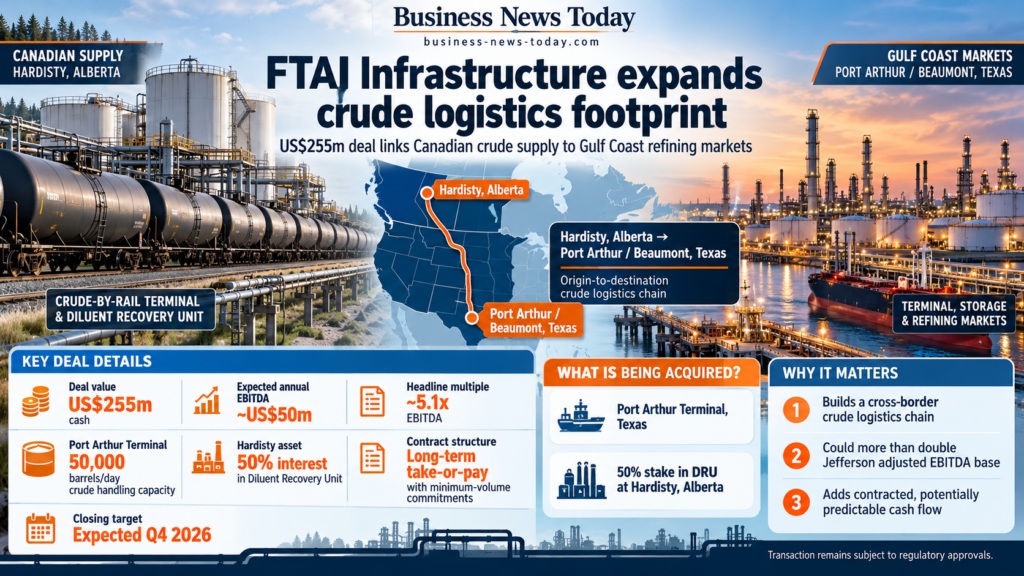
The Port Arthur Terminal is designed to handle approximately 50,000 barrels per day of crude oil arriving by rail. From the terminal, crude moves through an owned 12-mile, 24-inch pipeline connected with Phillips 66’s Beaumont terminal, providing onward access to refineries in Beaumont, Lake Charles and other Gulf Coast markets.
That positioning matters because the Beaumont-Port Arthur corridor contains one of the world’s densest concentrations of refining and petrochemical capacity. A logistics asset positioned inside that network does not need to speculate on the direction of crude prices to create value; its economics depend more heavily on contracted throughput, terminal utilisation and the durability of customer demand.
The Canadian end of the system adds another layer. The acquired 50% interest in the Hardisty Diluent Recovery Unit connects the transaction with Alberta’s heavy-oil supply chain. Heavy crude such as bitumen is often blended with lighter hydrocarbons so it can move through pipelines, and recovery infrastructure can improve transportation economics by separating part of that diluent before onward movement through alternative logistics chains.
Jefferson therefore gains exposure at both ends of a cross-border crude route. Instead of owning only a destination terminal, it participates in infrastructure that begins near one of Canada’s most important crude hubs and ends inside a major US refining market.
Why are long-term take-or-pay contracts so important to the acquisition economics?
A terminal with 50,000 barrels per day of physical capacity is valuable only if customers use it or pay for that capacity under contractual commitments. Jefferson said the acquired platform is supported by a long-term take-or-pay contract containing minimum-volume commitments from an investment-grade exploration and production company.
Take-or-pay structures can improve bankability because the infrastructure owner receives contracted payments even if actual customer volumes fall below specified thresholds, subject to the precise commercial terms. That makes cash flow more predictable than a purely merchant terminal whose earnings rise and fall directly with spot throughput.
This stability becomes especially important because FTAI Infrastructure plans to finance the transaction with debt. Predictable contracted EBITDA can support acquisition leverage more effectively than volatile cash flows, provided the customer remains financially strong and contract terms remain enforceable.
There is still concentration risk. The company has not named the major exploration and production counterparty in the announcement, leaving investors unable to assess precisely how much of the expected US$50 million EBITDA depends on one customer or one production basin.
Can the deal actually deleverage Jefferson if it is being financed with acquisition debt?
Management says the acquisition is expected to significantly deleverage Jefferson’s balance sheet even though debt will be used to fund it. That sounds contradictory until earnings are considered alongside borrowing.
Leverage ratios compare debt with EBITDA rather than measuring debt alone. If the acquired business adds enough contracted EBITDA relative to the debt assumed or raised, total borrowings can increase while debt-to-EBITDA declines. Jefferson’s expectation that the assets will more than double existing adjusted EBITDA is therefore central to the deleveraging argument.
Jefferson has already obtained a commitment for acquisition financing and is evaluating whether the assets should ultimately be combined with Jefferson Bond Borrower LLC, the entity that owns its main terminal business and part of Jefferson South. FTAI Infrastructure also indicated that additional parity bonds could be used under the existing bond indenture.
The financing structure deserves close attention after closing. The attractive headline acquisition multiple can create shareholder value only if interest expense does not consume too much of the incremental EBITDA and if the acquired assets do not require unexpectedly heavy maintenance or expansion capital.
What growth options could emerge after Jefferson combines the assets?
The transaction gives Jefferson another large customer relationship and another path into cross-border crude logistics. Management has already highlighted potential growth opportunities around both the acquired assets and the company’s existing Beaumont-area terminal system, suggesting the transaction is being viewed as a platform rather than a static cash-flow acquisition.
One logical opportunity is higher utilisation. A 50,000-barrel-per-day rail terminal carries significant fixed infrastructure, meaning incremental throughput can improve asset economics if capacity remains available. Integration with Jefferson’s existing storage, blending, marine, rail and pipeline capabilities could also create opportunities to offer customers a broader logistics package.
Another potential benefit is commercial diversification. Jefferson already handles crude oil, refined products and ammonia, while the acquired system adds another contracted crude chain. A broader customer and asset mix can reduce dependence on any single commodity or terminal configuration.
The risks remain execution-oriented rather than exploratory. Regulatory approvals are still required, closing is expected in the fourth quarter of 2026, and the expected US$50 million EBITDA remains a management forecast rather than realised earnings.
What does FTAI Infrastructure’s stock performance say about investor reaction?
FTAI Infrastructure shares traded as low as US$2.94 during September 28, down roughly 6% from the previous close in an intraday market snapshot, despite the company announcing an acquisition it describes as accretive. The stock had closed at US$3.13 on September 25 and was already down materially over the preceding months, indicating that broader company-level concerns and market conditions continued to influence valuation.
It would be too strong to attribute the entire decline to the transaction because US markets were also under pressure amid rising bond yields and renewed energy-market volatility. The acquisition announcement itself does not provide enough information on acquisition debt, interest cost or post-close free cash flow to allow investors to calculate the precise equity accretion.
The next useful disclosure will therefore be financing detail rather than another strategic description. If Jefferson closes the assets at roughly 5.1 times expected EBITDA, preserves the take-or-pay cash flows and achieves the promised deleveraging, the transaction could materially improve the segment’s earnings base. If financing costs rise or the US$50 million forecast proves optimistic, the apparently inexpensive acquisition multiple will look less compelling.
Discover more from Business-News-Today.com
Subscribe to get the latest posts sent to your email.