Form Energy, Inc. has secured $750 million in Series G financing as the United States energy storage company moves from proving its 100-hour iron-air battery technology toward manufacturing tens of gigawatt-hours for utilities and artificial intelligence infrastructure. T. Rowe Price led the financing, with new investors including Sequoia Capital, Janus Henderson, Franklin Templeton and PEAK6 Investments, while existing backers including TPG Rise Climate, Breakthrough Energy Ventures, GE Vernova, Coatue and Energy Impact Partners also participated. The latest transaction takes cumulative equity funding above $2 billion and will support further expansion of Form Factory 1 in Weirton, West Virginia, alongside commercial deployments whose backlog has increased from approximately 20 GWh to 80 GWh during 2026. The scale of those orders changes the nature of the investment case because Form is no longer principally financing battery development. It must now prove that a new battery chemistry built around reversible rusting can be manufactured cheaply and reliably enough to support some of the largest energy storage installations ever proposed.
Why does Form Energy’s jump from roughly 20 GWh to 80 GWh of backlog matter more than the funding headline?
The strongest commercial signal behind the $750 million Series G is the increase in contracted projects. Form Energy disclosed that its backlog expanded from approximately 20 GWh earlier this year to around 80 GWh following a series of major agreements. The expansion means the company has roughly quadrupled its commercial pipeline in a relatively short period while moving beyond demonstration-scale utility projects into contracts measured in tens of gigawatt-hours.
Three publicly disclosed agreements already explain more than half of that backlog. Xcel Energy’s programme associated with Google’s planned Pine Island, Minnesota, data center includes a 300 MW, 30 GWh Form Energy system. Crusoe has reserved 12 GWh of iron-air storage capacity for artificial intelligence data centers, while FuturEnergy Ireland is planning a 10 MW, 1,000 MWh project expected to enter service in 2029. Together, those projects represent 43 GWh, or approximately 53.8% of Form Energy’s stated 80 GWh backlog. This Business News Today calculation indicates that the commercial expansion is not simply the accumulation of dozens of small pilot orders. A significant portion comes from a small number of very large infrastructure commitments.
The Google and Xcel Energy project is particularly important because it links long-duration storage directly to the electricity requirements of artificial intelligence infrastructure. Xcel Energy said the wider agreement with Google will support 1,900 MW of additional clean energy, including 1,400 MW of wind generation, 200 MW of solar and the 300 MW Form Energy battery installation. The battery’s 100-hour configuration produces the unusually large 30 GWh energy figure from only 300 MW of power capacity. Xcel Energy described the project as the largest battery installation announced to date globally when measured by gigawatt-hour energy capacity.
That distinction between megawatts and gigawatt-hours is central to understanding Form Energy. Lithium-ion systems dominate short-duration storage and can deliver large quantities of power quickly, but conventional grid installations are commonly designed around a few hours of energy. Form’s product is optimised for a different problem: carrying electricity systems through prolonged periods of low renewable generation, extreme weather or grid stress.
This gives Form Energy a potentially complementary rather than purely substitutional role alongside lithium-ion batteries. Utilities can use shorter-duration batteries for daily balancing and fast-response services, while multi-day storage can address longer periods when generation shortages persist beyond a normal charge-discharge cycle.
The backlog growth suggests customers are beginning to recognise that distinction commercially. The remaining question is whether Form Energy can manufacture fast enough to convert those contracted gigawatt-hours into installed and revenue-producing systems.

Can Form Factory 1 manufacture quickly enough to support an 80 GWh commercial pipeline?
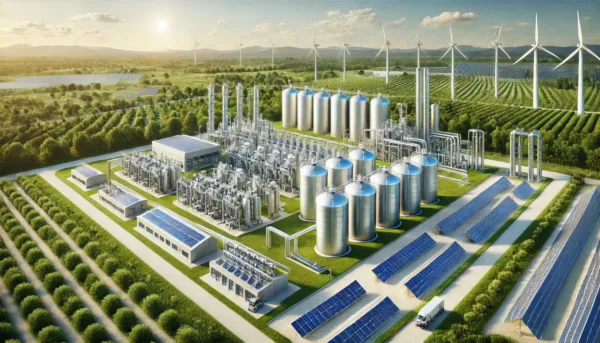
Manufacturing is now the primary execution constraint. Form Factory 1 occupies approximately 550,000 square feet on the former Weirton Steel site in West Virginia and currently employs nearly 400 people. Form Energy plans to expand the facility to roughly 850,000 square feet, employ more than 750 workers and establish annual production capacity of at least 500 MW by 2028.
The relationship between that factory target and the commercial backlog is revealing. A 500 MW annual production rate, if applied entirely to Form Energy’s 100-hour product configuration, corresponds theoretically to around 50 GWh of energy storage capacity per year. An 80 GWh backlog would therefore equal approximately 1.6 years of output at the factory’s planned minimum 500 MW annual rate. This is a Business News Today capacity comparison rather than company guidance because individual projects may use different configurations, delivery schedules can overlap several years and Form Energy may expand production beyond the stated minimum capacity.
Even with those qualifications, the calculation highlights why another $750 million of equity is commercially necessary. The demand pipeline has moved ahead of the manufacturing base. Form Energy must purchase equipment, qualify additional production lines, build inventory, recruit workers and finance customer projects before full cash proceeds from those systems are realised.
The company has already demonstrated that it can build manufacturing infrastructure quickly. Construction of the original Weirton facility began in 2023, with the 550,000-square-foot plant completed roughly a year later. Form Energy subsequently launched commercial production and delivered its first commercial pilot system to Great River Energy in Minnesota. The expansion programme was initiated in October 2024 as the company prepared for higher-volume orders.
Moving from pilot manufacturing to repeat industrial production is nevertheless a substantially harder problem. Battery cells must perform consistently across thousands of modules, manufacturing yields must remain high, suppliers must deliver material at scale and field systems must continue operating through repeated charge and discharge cycles.
The capital intensity also creates a different financial profile from software startups receiving similarly large venture rounds. Form Energy needs physical factories before it can deliver product. Revenue recognition follows manufacturing, installation and customer acceptance, meaning growth requires substantial working capital before the economics of each project are fully visible.
The Series G should therefore be judged by how much production capacity it creates and how quickly Form converts the backlog into deployed assets, rather than by the private valuation attached to the financing. Form Energy did not disclose a valuation for the latest round.
Why is a 100-hour iron-air battery commercially different from conventional lithium-ion storage?
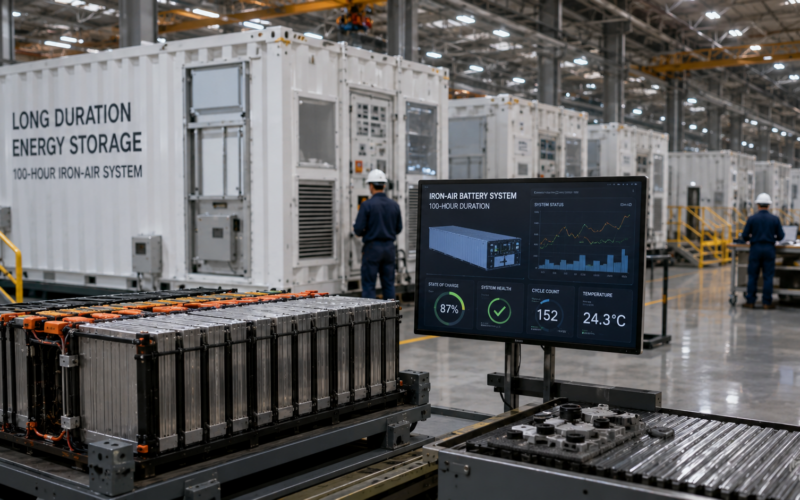
Form Energy’s battery operates through reversible rusting. During discharge, oxygen from the air reacts with iron inside the battery and converts the iron to rust. Charging reverses that reaction, converting the rust back into iron and releasing oxygen. Individual cells use iron and air electrodes with a water-based, non-flammable electrolyte, and the cells are assembled into larger modular systems.
The chemistry creates several potential advantages for stationary energy storage. Iron is inexpensive, widely available and already supported by enormous global supply chains. Form Energy says approximately 80% of its battery components are currently sourced within the United States, while its system avoids the heavy and rare-earth metals associated with some other battery chemistries.
Safety is another consideration. The water-based electrolyte does not have the same thermal-runaway profile associated with lithium-ion cells, which can affect site design, permitting and fire-protection costs. Form Energy reported successful UL9540A testing of its system in 2024, an important milestone as utilities consider deploying extremely large storage installations.
The trade-off is that Form Energy is not trying to maximise energy density. Iron-air systems require more physical space than lithium-ion batteries for a comparable amount of power, making them better suited to utility-scale locations where land is available than to electric vehicles, smartphones or other applications where weight and volume matter.
Their value instead lies in duration. A 100-hour battery can theoretically discharge continuously for more than four days at its rated power. That allows utilities to store large amounts of excess electricity when generation is abundant and use it through prolonged shortages.
This creates a different revenue proposition. A four-hour lithium-ion installation may cycle frequently and earn revenue from daily price spreads, frequency services and peak periods. A 100-hour system may operate less frequently but provide insurance against much longer supply shortages and reduce the need for generation capacity that exists principally to serve rare periods of system stress.
The economics consequently depend on how electricity markets value reliability across multiple days. Storage technologies cannot become commercially dominant merely because they can hold electricity longer. Utilities need regulatory structures, capacity mechanisms and system-planning models that recognise the value of avoiding outages, renewable curtailment and expensive backup generation.
Form Energy’s growing backlog indicates that at least some utilities and data center customers now see sufficient value to procure the technology before the category has reached broad commercial maturity.
Why could AI data center demand become a bigger catalyst for Form Energy than renewable energy alone?
Form Energy was originally positioned primarily around the challenge created by wind and solar variability. Artificial intelligence has added a second demand driver by creating unusually large electricity loads that utilities must connect quickly without compromising grid reliability.
The 12 GWh agreement with Crusoe demonstrates that change particularly clearly. Crusoe reserved volume, pricing and delivery terms for Form Energy systems beginning in 2027 as part of its strategy to secure electricity infrastructure alongside artificial intelligence computing capacity. Form Energy said the agreement contributes to a commercial portfolio that had already exceeded 75 GWh by March.
The Google and Xcel Energy arrangement is much larger. Google will fund costs associated with the Pine Island data center’s new service and associated grid infrastructure, while the broader programme will introduce new wind, solar and long-duration storage. The Form Energy component alone is designed to store 30 GWh.
For data center developers, long-duration batteries could solve a problem different from conventional backup generation. Artificial intelligence campuses need huge quantities of reliable electricity, but utilities increasingly face transmission queues, generation constraints and public concern that data centers could increase electricity costs for existing consumers.
Pairing new electricity demand with new generation and storage could make large-load projects easier for utilities and regulators to approve. Long-duration batteries cannot create electricity, but they can make variable generation more dependable by shifting energy across periods far longer than conventional short-duration storage.
This also increases the potential addressable market for Form Energy beyond grids with very high renewable penetration. A utility facing rapidly growing load from data centers may value a 100-hour storage resource even if its immediate objective is reliability and capacity rather than decarbonisation.
AI infrastructure therefore changes Form Energy’s commercial narrative. The company is no longer dependent solely on the pace of renewable-policy adoption. It can potentially sell storage as an enabling technology for industrial and digital load growth.
That does not eliminate competition. Data centers are also driving investment in natural gas generation, nuclear power, geothermal energy, fuel cells and other storage technologies. Form Energy’s systems must compete against those options on total system cost, deployment speed, land requirements, reliability and financing.
The strongest commercial outcome would be for iron-air batteries to become one component in a diversified power architecture rather than requiring customers to choose between multi-day storage and every other technology.
How much execution risk remains despite more than $2 billion of equity financing?
Form Energy now has more than $2 billion of cumulative equity funding, institutional investors across technology, energy and public-market asset management, a functioning United States manufacturing facility and an 80 GWh backlog. Those advantages materially reduce the financing and market-validation risks that confront earlier-stage battery startups.
They do not remove technology or manufacturing risk. The company is only beginning the transition from initial commercial deployments into large projects whose energy capacities are hundreds of times greater than its earliest installations.
The scale difference is especially visible in Minnesota. The Google and Xcel programme contains 30 GWh of Form Energy storage, while the initial Great River Energy commercial project was designed around 1.5 MW and 150 MWh. The Google-linked project is therefore 200 times larger by energy capacity. That expansion cannot be achieved simply by producing more of the same hardware. Supply-chain controls, installation logistics, system integration and long-term field servicing must all mature at the same time.
Customer concentration also deserves attention. The disclosed 30 GWh Xcel Energy and Google project alone accounts for 37.5% of the 80 GWh backlog, while the three major disclosed Xcel Energy, Crusoe and FuturEnergy Ireland agreements collectively represent about 53.8%. Large projects create manufacturing visibility, but delays or scope changes in one major programme could materially affect delivery schedules.
Regulatory status matters as well. Xcel Energy stated in February that its Electric Service Agreement with Google would require formal review by the Minnesota Public Utilities Commission. Announced project capacity should therefore not automatically be treated as completed revenue.
The funding also raises the future capital-efficiency test. More than $2 billion of equity gives Form Energy significant resources, but shareholders eventually need the installed fleet and manufacturing system to produce economic returns exceeding the cost of repeated capital injections.
A future IPO could potentially provide another source of capital, and management has previously discussed an eventual public listing as a long-term possibility. The more immediate milestone is not public-market readiness. It is demonstrating that commercial orders can be manufactured and commissioned predictably enough that future growth becomes less dependent on ever-larger equity rounds.
What are the key takeaways from Form Energy’s $750 million Series G and 80 GWh backlog?
- Form Energy secured $750 million in Series G financing led by T. Rowe Price.
- New investors include Sequoia Capital, Janus Henderson, Franklin Templeton and PEAK6 Investments.
- Total equity financing now exceeds $2 billion.
- Form Energy says its commercial backlog expanded from approximately 20 GWh to 80 GWh during 2026.
- The Xcel Energy and Google programme includes a 300 MW, 30 GWh Form Energy battery system in Minnesota.
- Crusoe has reserved 12 GWh of iron-air battery systems for artificial intelligence data center infrastructure.
- FuturEnergy Ireland plans a 10 MW, 1 GWh project for deployment in 2029.
- Those three projects represent 43 GWh, or approximately 53.8% of Form Energy’s disclosed 80 GWh backlog.
- Form Factory 1 is expected to reach at least 500 MW of annual battery manufacturing capacity by 2028.
- At a theoretical 100-hour configuration, 500 MW of annual output would correspond to approximately 50 GWh of energy capacity, making manufacturing scale the critical next test.
Can Form Energy turn a huge order book into a commercially durable long-duration storage business?
Form Energy has moved past one of the hardest hurdles facing new battery technologies: convincing major customers that the chemistry deserves a place in real electricity systems. An 80 GWh backlog, a 30 GWh programme associated with Google and Xcel Energy, a 12 GWh commitment from Crusoe and a first international deployment provide stronger commercial validation than another venture financing announcement alone.
What has improved most is demand visibility. Form Energy can now make manufacturing decisions against a substantial project pipeline rather than relying primarily on forecasts of how rapidly long-duration storage might develop.
What remains unresolved is production economics. The company has not publicly disclosed the revenue value of its 80 GWh backlog, gross margins on commercial systems, manufacturing cost per kilowatt-hour or the level of additional capital required to complete its current commitments. Those figures will eventually determine whether an enormous energy backlog also becomes an attractive financial backlog.
The next measurable proof points are therefore physical. Form Factory 1 needs to progress toward its planned 500 MW annual production capability, the Great River Energy system needs to establish operating experience, and larger projects must advance from agreements into construction and commissioning.
The thesis would strengthen materially if the company can expand production while retaining strong field reliability and without requiring equity funding to grow at the same rate as backlog. It would weaken if manufacturing delays widen the gap between contracted demand and deliveries or if customers discover that competing generation and storage combinations provide similar reliability at lower system cost.
The $750 million Series G buys Form Energy the capacity to address that challenge. It does not settle it. The company has already shown that utilities and AI infrastructure developers are willing to order 100-hour batteries at extraordinary scale. The defining test is now whether Weirton can manufacture enough reversible rust to turn 80 GWh of promised storage into operating grid infrastructure.
Discover more from Business-News-Today.com
Subscribe to get the latest posts sent to your email.