



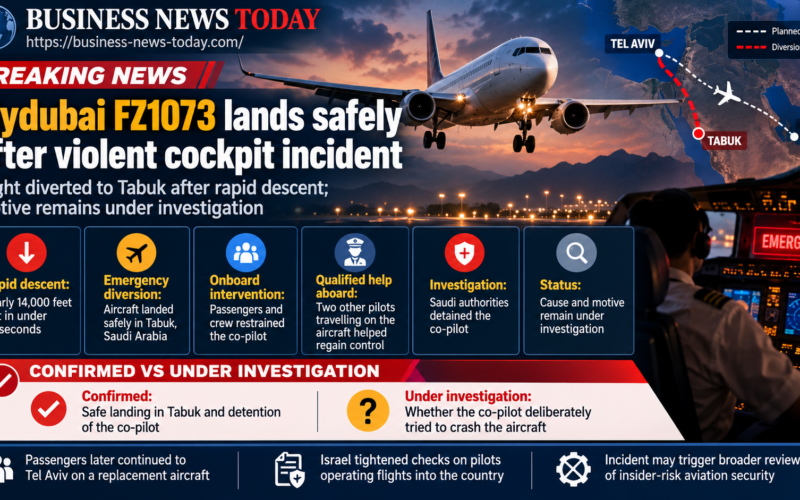
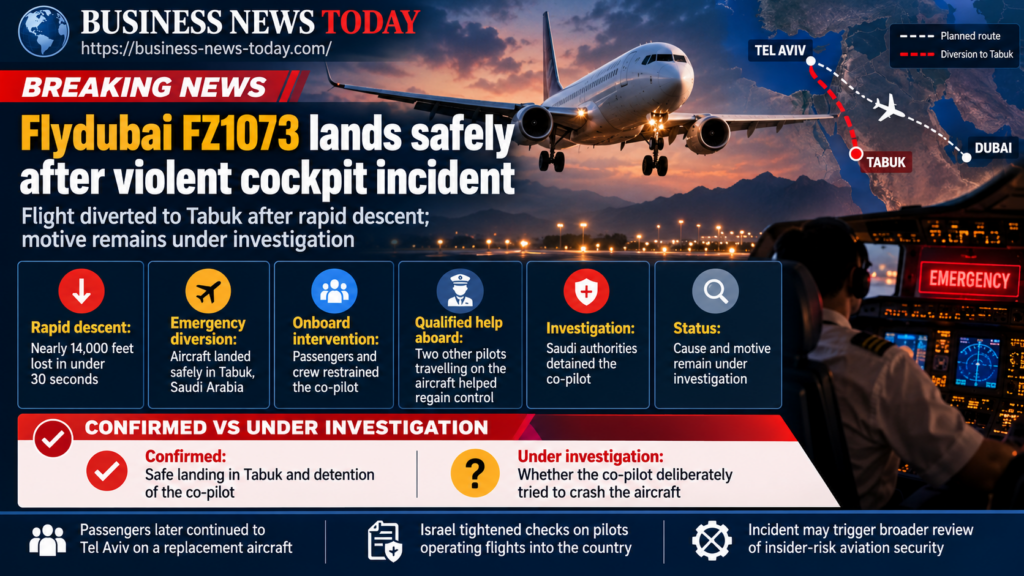
Flydubai flight FZ1073 from Dubai to Tel Aviv landed safely in Tabuk, Saudi Arabia, after a violent cockpit incident in which the captain was stabbed and the aircraft plunged nearly 14,000 feet in less than 30 seconds, according to Israeli officials. Passengers and crew entered the cockpit and overpowered the co-pilot, allowing another pair of flydubai pilots travelling aboard the aircraft to regain control and make the emergency landing. The co-pilot was detained by Saudi authorities, while flydubai cautioned that the reason for the incident remained unknown and warned against premature speculation about motive.
The distinction between what is confirmed and what remains alleged is important. Israeli Prime Minister Benjamin Netanyahu said the co-pilot apparently tried to crash the aircraft after stabbing the other pilot, but flydubai has not independently confirmed that intent and Saudi investigators are examining what happened. The passengers later reached Ben Gurion Airport aboard a replacement flydubai aircraft, more than 10 hours after the original emergency.
What happened aboard flydubai flight FZ1073 between Dubai and Tel Aviv?
FZ1073 was travelling from Dubai toward Israel when a violent confrontation developed in the cockpit. Israeli officials said one pilot stabbed the other and the aircraft entered a rapid descent, losing close to 14,000 feet of altitude in under half a minute. Passengers and crew then gained access to the cockpit, restrained the alleged attacker and enabled off-duty or positioning flydubai pilots on board to stabilise the aircraft.
The aircraft diverted to Tabuk in northwestern Saudi Arabia rather than continuing directly to Tel Aviv. Saudi authorities detained the co-pilot, while the injured captain and alleged attacker required medical attention. Israel’s ambulance service later said a 51-year-old passenger was treated in Israel for upper-body injuries and was in mild condition.
The fact that qualified pilots happened to be travelling aboard the flight appears to have been particularly important. Modern airliners require specialised type training, and even a passenger with general aviation experience would not normally be expected to assume control during such an emergency.
Did the flydubai co-pilot deliberately try to crash the aircraft?
Israeli officials say yes, but investigators have not yet publicly established motive or intent. Netanyahu said the co-pilot stabbed the captain and apparently attempted to crash the aircraft, while US President Donald Trump later stressed that the detailed account he repeated publicly was information he had received from Netanyahu and that he could not independently verify it.
Flydubai took a more cautious position. The airline confirmed a serious cockpit incident but said the underlying reasons remained unknown and urged against speculation before the investigation is completed. An Israeli official identified the co-pilot as an Omani national, but Oman had not publicly commented when the latest reporting was published.
That makes the safest current description a violent cockpit incident involving a stabbing and loss of aircraft control, with Israeli authorities alleging an intentional attempt to crash the plane. Whether prosecutors ultimately treat the episode as terrorism, attempted murder, sabotage or another offence will depend on evidence collected by Saudi and other authorities.
Why did passengers enter the cockpit despite modern aviation security rules?
Cockpit doors are deliberately reinforced and access is tightly controlled precisely because post-September 11 aviation security aims to prevent passengers or attackers from reaching pilots. An emergency in which one pilot is alleged to have become the threat creates an unusual reversal of that security model.
Netanyahu said a passenger and a crew member managed to get inside and restrain the pilot while he was interfering with the aircraft. Reuters separately reported that passengers and crew helped overpower the co-pilot before other flydubai pilots aboard assumed control.
The event is therefore likely to prompt scrutiny not only of cockpit access but of procedures for dealing with a threat originating from a flight crew member. Airlines already subject pilots to medical, licensing and security checks, but insider-risk events are particularly difficult because pilots necessarily possess privileged access to aircraft controls.
Why did Israel immediately tighten checks on pilots operating flights into the country?
Israel treats civil aviation as a major national-security concern, and officials said additional pilot screening would follow the FZ1073 incident. The route itself is politically significant because direct UAE-Israel flights expanded after the two countries normalised relations through the Abraham Accords in 2020.
The new measures could include closer examination of crew histories, credentials or security information, although Israel had not publicly detailed every procedural change. Aviation-security decisions may also involve cooperation with airlines and foreign governments because flight crews operating international services are licensed and employed outside Israel.
The wider question is whether other countries or airlines introduce similar reviews. A confirmed case of deliberate cockpit sabotage by a serving pilot would be treated very differently from an ordinary disruptive-passenger incident because it involves direct control over the aircraft itself.
What does the Tabuk diversion show about Saudi-Israeli emergency aviation cooperation?
Saudi Arabia and Israel do not have the same normalised diplomatic relationship that Israel has with the United Arab Emirates, yet aviation emergencies require practical cooperation regardless of politics. Tabuk offered a nearby safe diversion point, and Saudi authorities accepted the aircraft, detained the alleged attacker and dealt with the injured crew.
The event therefore demonstrates the importance of regional emergency protocols during a period of intense Middle Eastern conflict. Commercial aircraft regularly cross or approach airspace belonging to governments with complicated diplomatic relationships, making aviation safety dependent on rapid technical coordination.
For flydubai, the priority was getting the aircraft and passengers onto the ground rather than the political symbolism of the diversion. That principle is fundamental to international civil aviation, where airports may accept emergency aircraft even when normal route networks are politically constrained.
What are the key takeaways from the flydubai FZ1073 cockpit incident?
The aircraft landed safely and the passengers ultimately reached Israel, preventing what could have become a mass-casualty aviation disaster. Israeli officials say the co-pilot deliberately tried to bring the plane down after stabbing the captain, but the airline says the cause and motive remain under investigation.
Passenger and crew intervention appears to have been crucial, while the presence of additional flydubai pilots aboard provided qualified personnel capable of taking control. Saudi authorities now hold the alleged attacker, making their investigation central to determining intent and potential criminal charges.
The lasting impact may extend into airline security policy. If investigators establish deliberate sabotage by a flight crew member, regulators will have to examine whether existing insider-risk screening and cockpit-control procedures are sufficient for an era in which aviation security has concentrated overwhelmingly on threats originating outside the flight deck.
Discover more from Business-News-Today.com
Subscribe to get the latest posts sent to your email.