



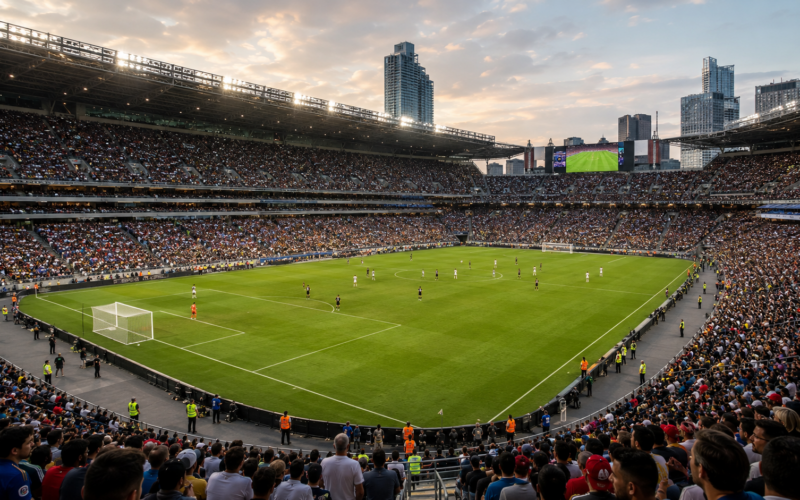
Brazil defeated Scotland 3-0 in their final FIFA World Cup 2026 Group C match at Miami Stadium in Miami Gardens, Florida, on Wednesday, June 24, 2026. The match began at 6pm local time and concluded during the early hours of June 25 in India, with 64,478 spectators watching Brazil secure first place in the group.
Vinícius Júnior scored twice before half-time, opening the scoring in the seventh minute after Rayan punished a defensive error and supplied the final pass. The Real Madrid forward headed in his second during first-half stoppage time from Bruno Guimarães’ cross, before Matheus Cunha completed the scoring in the 60th minute.
Brazil also had a Vinícius Júnior goal disallowed following a VAR review in the 22nd minute. The officials ruled that the forward had fouled Jack Hendry while winning possession before finishing past Angus Gunn.
The victory lifted Carlo Ancelotti’s Brazil to seven points and confirmed them as Group C winners ahead of Morocco on goal difference. Morocco advanced in second place after beating Haiti 4-2, while Scotland finished third with three points and entered an anxious wait to discover whether their record would be sufficient to qualify as one of the eight best third-placed teams.
FIFA World Cup 2026 Scotland 0-3 Brazil full match scorecard and key incidents
How did Brazil’s pressing structure force Scotland into the errors that decided the match?
Scotland attempted to begin the match with greater ambition than the scoreline eventually suggested. Steve Clarke’s team used a 4-2-3-1, with Scott McTominay and Kenny McLean operating behind an attacking line that tried to support Lawrence Shankland and challenge Brazil for possession rather than immediately retreating into a deep defensive block.
That approach gave Scotland a brief period of controlled possession, but it also required their defenders and midfielders to receive the ball under pressure in their own half. Brazil recognised the opportunity and positioned Vinícius Júnior, Matheus Cunha and Rayan to close passing lanes while Casemiro, Bruno Guimarães and Lucas Paquetá moved aggressively towards Scotland’s next receiver.
The first goal demonstrated the risk. Scott McKenna was unable to complete a clearance under pressure, Rayan reacted first and supplied Vinícius Júnior, who moved around Gunn and finished into the unguarded goal.
Brazil’s pressing was not constant in a reckless sense. Ancelotti’s players often allowed Scotland to begin a passing sequence before accelerating towards the ball when the receiving player’s body position restricted his options. That made several Scotland turnovers more damaging because their full-backs and midfielders had already moved forward.
Why was Vinícius Júnior able to become the decisive player before half-time?
Vinícius Júnior did not remain fixed on the left touchline. He moved inside when Cunha dropped away from the centre-backs, attacked the space between Scotland’s right-back and central defender, and positioned himself close enough to exploit any mistake during Brazil’s press.
His first goal was created by anticipation as much as pace. Rayan won the decisive ball, but Vinícius Júnior’s position meant he could immediately attack Gunn rather than waiting for teammates to join the move.
Brazil believed they had scored again in the 22nd minute when Vinícius Júnior dispossessed Hendry and finished. VAR intervened, however, and the goal was correctly cancelled after the review identified a foul during the turnover.
The disallowed goal briefly gave Scotland relief, but it did not alter the central tactical problem. Brazil continued to regain possession in areas from which Guimarães and Paquetá could deliver quickly towards the front three.
Vinícius Júnior’s second goal arrived at the most damaging possible moment for Scotland. Guimarães crossed towards the far post in the second minute of first-half stoppage time, and the forward escaped his marker before directing a header past Gunn.
The brace increased Vinícius Júnior’s FIFA World Cup 2026 total to four goals. He scored in each of Brazil’s three Group C matches, giving Ancelotti a consistently productive attacker at a stage when several tournament favourites were still searching for attacking rhythm.
How did Bruno Guimarães control the match without dominating possession statistics?
Brazil finished with 54% possession, a figure that reflected control without suggesting an entirely one-sided territorial contest. The more revealing difference was how effectively Brazil used possession after winning it.
Guimarães was central to that advantage. He assisted the second goal with an accurate cross and created the third by winning a physical duel against McLean, carrying the ball into the penalty area and drawing Gunn before passing to Cunha.
The midfielder’s two assists represented only part of his contribution. He repeatedly positioned himself behind Scotland’s first pressing line, provided Brazil with a secure passing option and accelerated attacks when the defensive structure became unsettled.
Casemiro supplied positional discipline behind him, while Paquetá connected the midfield with the forward line. This balance allowed Brazil to attack with numbers while retaining enough protection against Scotland’s direct passes and set-piece threat.
Guimarães’ performance also showed why Brazil did not require overwhelming possession to dominate the important phases. Their passes were faster, their movements around the penalty area were better coordinated and their recoveries were converted into attacks before Scotland could reorganise.
Why did Matheus Cunha’s third goal remove Scotland’s remaining qualification margin?
Scotland entered the second half needing not only an unlikely comeback but also protection of their goal difference. In the expanded FIFA World Cup 2026 format, a third-placed team’s points, goal difference and goals scored can determine whether it reaches the Round of 32.
Clarke introduced Kieran Tierney for Andrew Robertson at half-time, and Scotland produced their strongest attacking period shortly afterwards. Tierney provided more penetration from the left, McTominay registered efforts on target and Ferguson forced Alisson into a difficult save.
The improvement did not produce a goal. Brazil then punished Scotland’s willingness to commit players forward when Guimarães overpowered McLean and moved directly into the penalty area.
Cunha stayed to the midfielder’s right, received the pass and placed his finish into the bottom corner. The goal was Cunha’s third of the tournament and gave Brazil a margin that left Scotland with a goal difference of minus three.
That third goal therefore carried consequences beyond the match result. A 2-0 defeat would have left Scotland in a stronger comparative position among the third-placed teams, while a consolation goal could also have materially improved their chances.
What did Scotland’s second-half chances reveal about Brazil’s remaining defensive risks?
The final score accurately reflected Brazil’s superior attacking quality, but Scotland did create enough opportunities to prevent the performance from being described as completely risk-free. Their 14 attempts and five shots on target showed that Brazil’s defence could be tested when Scotland moved the ball into wide areas and attacked crosses.
Tierney’s half-time introduction was particularly important. His forward movement created crossing opportunities and allowed McTominay to make delayed runs into the penalty area rather than receiving possession with his back to goal.
Ferguson forced Alisson to tip a curling attempt away, while McTominay tested the goalkeeper with headers and a late effort following a cutback. Shankland also headed over after another delivery from Scotland’s left side.
Brazil’s central defenders generally controlled direct play, but the space outside their midfield block occasionally allowed Tierney and Nathan Patterson to advance. A more clinical opponent could convert those territorial moments into greater pressure.
Ancelotti will nevertheless be encouraged by Alisson’s concentration. The goalkeeper responded when required and protected Brazil’s second consecutive clean sheet after the 3-0 victory over Haiti.
How did Neymar’s return change Brazil’s attacking options for the knockout rounds?
Neymar entered for Cunha in the 76th minute, making his first appearance for Brazil since October 2023. His return followed a prolonged absence and added another creative option ahead of the knockout stage.
The 34-year-old immediately looked for combinations with Vinícius Júnior and operated between Scotland’s midfield and defence. He created opportunities, took responsibility for corners and tested Gunn during the closing stages.
Ancelotti did not need Neymar to decide this match because Brazil were already three goals ahead. The value of the appearance instead came from restoring his competitive rhythm without requiring him to carry the attack for an extended period.
Brazil’s challenge will be integrating Neymar without reducing the freedom currently enjoyed by Vinícius Júnior, Cunha and Guimarães. The Scotland match suggested he can initially serve as a high-impact substitute who enters when opponents are tiring and spaces are beginning to open.
That role could become especially useful against Japan, whose organised structure and quick transitions will require Brazil to combine patience with creativity. Neymar’s availability also gives Ancelotti more flexibility if Raphinha is not ready to return immediately.
Why did Brazil finish above Morocco despite both teams collecting seven points?
Brazil and Morocco both completed Group C unbeaten with seven points. Their opening meeting finished 1-1, meaning the final position was decided by the broader group-stage tiebreakers rather than the result between them.
Brazil scored seven goals and conceded one, producing a goal difference of plus six. Morocco scored six and conceded three, leaving Walid Regragui’s team with a goal difference of plus three.
The difference was created primarily by Brazil’s consecutive 3-0 victories over Haiti and Scotland. Morocco defeated Scotland 1-0 and Haiti 4-2, but conceding twice against Haiti prevented them from matching Brazil’s defensive and goal-difference record.
Brazil therefore secured the Group C route into the Round of 32, where they will face Japan. Morocco finished second and will meet the Netherlands, the Group F winners.
Scotland’s three points placed them third, while Haiti finished fourth without a point. Haiti were formally eliminated, but Scotland’s status could not be finalised until the remaining groups completed their matches.
FIFA World Cup 2026 Group C final points table
What must happen for Scotland to qualify as one of the best third-placed teams?
Scotland completed the group stage with three points, a goal difference of minus three and only one goal scored. That record left them vulnerable because teams finishing third with four points automatically ranked above them.
Bosnia and Herzegovina, Ecuador and Sweden had already secured four-point third-place records by the time the latest completed groups were assessed. Korea Republic also finished with three points but held a superior goal difference of minus one.
Scotland therefore needed enough third-placed teams from the remaining groups to finish with fewer than three points or with an inferior tiebreaker record. Any team reaching four points would move above Scotland, while teams finishing on three points could also overtake them through goal difference and goals scored.
The ranking is especially unforgiving because Scotland scored only once, against Haiti. Even a single goal against Brazil would have improved both their goal difference and goals-scored tiebreaker, which explains the significance of Alisson’s late saves.
Scotland had not been officially eliminated when this report was prepared. However, they had no control over the remaining qualification process and required favourable results across several outstanding groups.
What does the confirmed Brazil vs Japan Round of 32 fixture mean tactically?
Brazil will face Japan at Houston Stadium on Monday, June 29, 2026. Japan finished second in Group F after drawing with the Netherlands and Sweden and defeating Tunisia.
The fixture presents a different tactical challenge from Scotland. Japan are generally more comfortable playing through pressure, moving quickly between midfield lines and attacking space after recovering possession.
Brazil’s pressing can still be decisive, but Ancelotti must ensure that the full-backs and midfielders are protected when the first pressure is bypassed. Japan’s technical midfielders and coordinated wide movements could punish an overly aggressive structure.
Brazil will enter the contest with significant attacking momentum. Vinícius Júnior has four goals, Cunha has three and Neymar has returned, while Guimarães has become increasingly influential as the link between midfield recoveries and final-third creation.
The concern is whether the attacking unit can remain efficient against a team likely to concede fewer uncontrolled turnovers than Scotland. Brazil’s improvement through the group stage has been clear, but the Japan match will provide a more demanding test of their patience and defensive transition management.
Key takeaways from Scotland vs Brazil at FIFA World Cup 2026
- Brazil defeated Scotland 3-0 in Miami and finished first in FIFA World Cup 2026 Group C.
- Vinícius Júnior scored in the seventh and 45+2nd minutes to complete a first-half brace.
- Rayan assisted the opening goal after Brazil’s press forced a defensive error from Scotland.
- Bruno Guimarães supplied two assists and created Brazil’s third goal through a powerful midfield recovery.
- Matheus Cunha scored in the 60th minute and increased his tournament total to three goals.
- A 22nd-minute Vinícius Júnior goal was disallowed after VAR identified a foul on Jack Hendry.
- Scotland improved after Kieran Tierney’s half-time introduction but could not beat Alisson.
- Neymar made his first Brazil appearance since October 2023 when he entered in the 76th minute.
- Brazil qualified as Group C winners and will face Japan in the Round of 32 in Houston.
- Scotland finished third with three points and remained dependent on results from the remaining groups.
Discover more from Business-News-Today.com
Subscribe to get the latest posts sent to your email.