


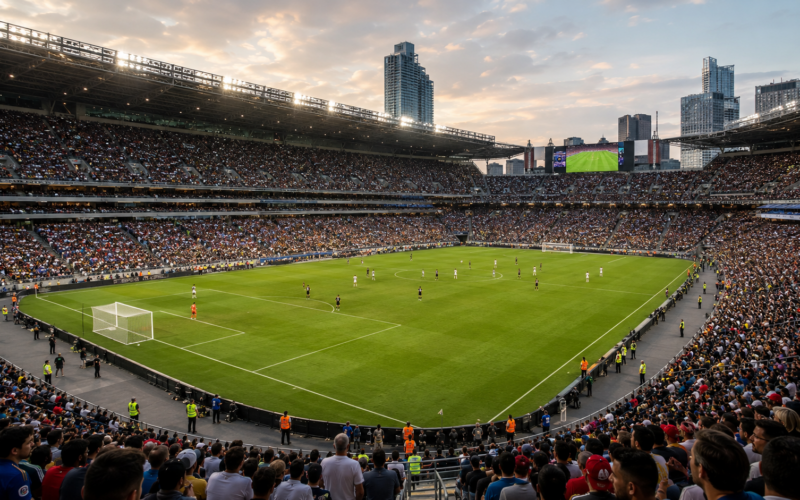
Mikel Oyarzabal scored twice as Spain defeated Austria 3-0 in their FIFA World Cup 2026 Round of 32 match at Los Angeles Stadium in Inglewood, California, on Thursday, July 2, 2026. Oyarzabal opened the scoring in the 36th minute before Pedro Porro headed in Spain’s second in the 66th and the centre-forward completed his brace one minute before full-time.
Spain had earlier seen Marc Cucurella’s close-range finish disallowed for a foul on Austria goalkeeper Alexander Schlager. The decision briefly preserved Austria’s resistance, but Cucurella responded by supplying the cross from which Oyarzabal eventually broke the deadlock.
Austria’s clearest opportunity arrived shortly after Saša Kalajdžić entered during the second half, but the striker headed Marcel Sabitzer’s delivery over the crossbar. Spain allowed no shot on target, controlled 64.4% of possession and finished with 23 attempts compared with Austria’s five.
The result sent Spain into the Round of 16 and eliminated Austria from FIFA World Cup 2026. Luis de la Fuente’s team will face the winner of Portugal vs Croatia at Dallas Stadium on Monday, July 6, at 2pm local time, with the identity of that opponent pending official full-time confirmation.
FIFA World Cup 2026 Spain 3-0 Austria full match scorecard and key incidents
How did Spain turn Austria’s aggressive pressing plan into territorial control?
Austria entered the match with a reputation for pressing high and attempting to force opponents into rushed passes. Spain neutralised that strategy by keeping Rodri close to the centre-backs and allowing Pedri to move into different receiving positions around Austria’s first pressure line.
Pau Cubarsí and Aymeric Laporte remained calm when Austria pushed Michael Gregoritsch, Paul Wanner and Marcel Sabitzer towards the ball. Spain repeatedly used Unai Simón as an additional passer before switching possession towards Pedro Porro or Marc Cucurella.
Once the first Austrian line was bypassed, Spain often had a numerical advantage in midfield. Dani Olmo moved away from the centre-backs, Álex Baena drifted inside from the left and Lamine Yamal remained wide enough to stretch David Alaba’s defensive unit.
Austria therefore spent much of the first half retreating rather than pressing. The visitors could still compete physically, but their midfield distances increased as Spain moved possession from one side of the pitch to the other.
Why did Marc Cucurella’s disallowed goal reveal the problem Austria could not solve?
Spain believed they had taken the lead when Cucurella finished from close range after another sustained attack. The goal was ruled out because of a foul on Schlager, giving Austria a temporary reprieve.
The move nevertheless exposed Austria’s difficulty defending Spain’s full-backs when they entered advanced areas. Cucurella was nominally Spain’s left-back, but he repeatedly moved beyond Baena or entered the penalty area after the winger drifted centrally.
Austria’s defenders were occupied by Oyarzabal, Olmo and Yamal, leaving the wing-backs responsible for tracking Spain’s late runners. When those assignments were missed, Cucurella received enough freedom to influence the match near goal.
The disallowed finish did not discourage Spain. Cucurella continued advancing and soon created the legitimate opening goal from almost the same side of the pitch.
Why did Mikel Oyarzabal’s movement create Spain’s decisive opening goal?
Oyarzabal’s value came from his willingness to change position rather than remain between Austria’s central defenders. He frequently dropped towards midfield before accelerating towards the penalty area once Spain moved the ball wide.
Cucurella received on the left and delivered a precise cross towards the space between Schlager and the defensive line. Oyarzabal moved ahead of the nearest defender and redirected the ball into the bottom corner with his left foot.
The goal rewarded Spain’s patience but also demonstrated the importance of timing. Austria had enough defenders around the penalty area, yet none reacted quickly enough to Oyarzabal’s movement across the front of goal.
Oyarzabal had forced Schlager into a save only three minutes earlier. The warning was clear, but Austria could not prevent Spain’s centre-forward from receiving another opportunity in a more dangerous position.
How did Lamine Yamal stretch Austria even without scoring or assisting?
Yamal began the match aggressively and attempted Spain’s first shot inside the opening minute. His willingness to remain wide on the right forced Austria’s left side to defend closer to the touchline than it preferred.
That width created more central space for Olmo and Pedri. Whenever Alaba or Austria’s wing-back moved towards Yamal, Spain could circulate possession inside before returning the ball to the teenager in a one-against-one situation.
Yamal also produced several shots and forced Schlager into an important close-range save during first-half stoppage time. David Alaba later cleared another effort off the line after Yamal found space inside the penalty area.
His finishing was not decisive, but his positioning shaped Austria’s defensive structure. Spain could attack through Cucurella and Baena on the opposite side because Austria were reluctant to leave Yamal isolated against a single defender.
Why was Alexander Schlager essential to keeping Austria competitive before half-time?
Austria reached half-time only one goal behind because Schlager repeatedly intervened during Spain’s strongest attacking period. He denied Oyarzabal shortly before the opening goal and remained alert as Spain produced several efforts around the penalty area.
Baena’s free kick struck the crossbar during stoppage time, and the rebound created another chance for Yamal. Schlager reacted quickly to prevent Spain from establishing a two-goal advantage before the interval.
His six saves reflected the imbalance between the teams. Spain registered ten shots on target, while Austria failed to direct a single attempt at Unai Simón.
Schlager could not prevent the three goals, but the score might have become considerably heavier without his positioning and reactions. The goalkeeper gave Austria an opportunity to change the match after half-time, even though the attacking players could not take it.
Could Saša Kalajdžić’s missed header have changed Austria’s knockout fate?
Ralf Rangnick introduced Kalajdžić and Marko Arnautović in the 60th minute to give Austria greater penalty-area presence. The change immediately produced the visitors’ clearest chance.
Sabitzer delivered from the right and Kalajdžić rose above the defenders near the centre of the penalty area. His header travelled over the crossbar, leaving Unai Simón still without a save to make.
The timing made the miss particularly important. Austria were only one goal behind, and an equaliser would have forced Spain to rebuild the momentum established during the first half.
Spain scored its second goal five minutes later. The sequence showed the difference between the teams, with Austria failing to convert its best opening before Spain punished the next significant defensive weakness.
How did Álex Baena and Pedro Porro combine to eliminate Austria’s comeback hopes?
Spain’s second goal began on the left, where Baena created enough separation to deliver towards the far side of the penalty area. Austria’s defenders moved towards Oyarzabal and the central zone, leaving Porro free beyond them.
Porro attacked the cross like an additional forward and directed his header beyond Schlager. The goal was his first for Spain and demonstrated how De la Fuente’s full-backs repeatedly appeared in unexpected attacking positions.
The movement was possible because Rodri and Pedri protected Spain’s possession behind the attack. Porro could advance without leaving the team completely exposed to a transition.
At 2-0, Austria could no longer remain compact and wait for isolated opportunities. Rangnick’s players had to push higher, creating even more room for Spain’s midfielders and wide attackers.
Why did Austria fail to register a single shot on target despite making attacking changes?
Austria’s problem was not simply a lack of possession. The visitors struggled to progress the ball into areas where their forwards could face Spain’s goal rather than receive with defenders close behind them.
Rodri protected the central corridor, while Cubarsí and Laporte remained disciplined against Gregoritsch, Arnautović and Kalajdžić. Cucurella and Porro also recovered quickly whenever Austria attempted to attack the space behind them.
The visitors completed only four key chances and did not win a corner. Their five attempts consisted largely of headers or shots taken under pressure, with Kalajdžić’s miss representing the only clear opportunity.
Spain’s counter-press was equally important. Austria frequently regained the ball but lost it again before enough players could move forward, preventing Rangnick’s side from building sustained attacking phases.
How did Marc Cucurella become Spain’s most influential supporting attacker?
Cucurella’s two assists came from different situations but reflected the same tactical intelligence. For the opening goal, he delivered accurately after advancing outside Baena, while the third came from recognising Oyarzabal’s run during a late transition.
His defensive work also allowed Spain to maintain pressure. Cucurella recovered loose balls quickly and prevented Austria from using Wanner or Sabitzer to escape down the right side.
The full-back’s influence demonstrated that Spain’s threat extended beyond Yamal, Olmo and Oyarzabal. Austria could not concentrate on one attacking zone because Porro and Cucurella were both capable of arriving around the penalty area.
Oyarzabal’s 89th-minute finish completed the performance. Cucurella released him into space, and the striker calmly placed the ball into the bottom corner for his fourth goal of FIFA World Cup 2026.
Why did Spain’s defensive performance matter as much as the three goals?
Spain’s fourth consecutive clean sheet was built on possession control, immediate pressing and disciplined central defending. Austria were not simply inaccurate because they were rarely permitted to shoot from favourable positions.
Cubarsí and Laporte won their physical duels, while Rodri prevented Austria from collecting second balls around the penalty area. The structure allowed Unai Simón to complete the match without making a save.
Spain became the first team since Germany in the 2014 final to prevent an opponent from recording a shot on target in a FIFA World Cup knockout match. That statistic showed how completely Austria’s attacking options were restricted.
The clean sheet also reduced the pressure on Spain’s forwards. Oyarzabal, Yamal and the supporting attackers could continue taking risks because the defensive structure behind them remained secure.
What must Austria improve after their FIFA World Cup 2026 elimination?
Austria must become more adaptable when the high press fails to disrupt an opponent. Rangnick’s team continued committing players forward during the early stages, but Spain repeatedly bypassed the pressure and attacked the space left behind.
The midfield also struggled to maintain compact distances once Spain switched possession. Seiwald and Xaver Schlager were replaced at half-time, yet Grillitsch and Chukwuemeka could not restore control against Rodri and Pedri.
Austria require more creativity around the penalty area. Sabitzer delivered the cross for Kalajdžić’s chance, but the team otherwise depended on direct passes and physical contests rather than combinations through Spain’s defensive lines.
The campaign still represented progress after Austria reached a FIFA World Cup knockout round for the first time in decades. However, the defeat showed that intensity alone is insufficient against opponents capable of playing through pressure with technical precision.
What must Spain change before facing Portugal or Croatia in the Round of 16?
Spain produced its most complete performance of the tournament, but the next opponent will offer greater individual quality and more experience in managing knockout matches. Portugal or Croatia will also possess players capable of punishing any loss of concentration during Spain’s aggressive attacking phases.
De la Fuente’s team could improve its early finishing. Spain created several openings before Oyarzabal scored, and a stronger opponent may not allow ten shots on target without producing dangerous counterattacks at the opposite end.
The full-backs’ attacking movement remains a major strength but also creates a defensive responsibility. Rodri, Cubarsí and Laporte must continue protecting the spaces behind Cucurella and Porro whenever both advance.
Spain will travel to Dallas with four clean sheets, improved attacking rhythm and a centre-forward who has scored four tournament goals. The Round of 16 will test whether the control displayed against Austria can be maintained against a team carrying a far greater counterattacking and set-piece threat.
How does Spain’s victory reshape the FIFA World Cup 2026 knockout bracket?
Spain advanced to the Round of 16 and will play at Dallas Stadium on Monday, July 6. Their opponent will be the winner of Portugal vs Croatia, with that Round of 32 match still awaiting full-time confirmation during the preparation of this article.
The Dallas winner will progress to the quarter-finals and enter the section of the bracket connected to other Round of 16 fixtures. No quarter-final opponent should be treated as confirmed until the relevant preceding matches are completed.
Austria were eliminated after reaching the knockout stage through a dramatic group-stage draw with Algeria. Their tournament included victory over Jordan, defeat against Argentina and a six-goal draw that secured progression before Spain ended the campaign.
Key takeaways from Spain vs Austria at FIFA World Cup 2026
- Spain defeated Austria 3-0 and advanced to the FIFA World Cup 2026 Round of 16.
- Mikel Oyarzabal scored in the 36th and 89th minutes to reach four goals at the tournament.
- Marc Cucurella had an earlier goal disallowed for a foul on goalkeeper Alexander Schlager.
- Cucurella recovered from that decision by assisting both of Oyarzabal’s goals.
- Álex Baena struck the crossbar during first-half stoppage time and assisted Pedro Porro’s header.
- Porro scored his first international goal to double Spain’s lead in the 66th minute.
- Saša Kalajdžić missed Austria’s clearest opportunity by heading over shortly after entering.
- Spain recorded 23 attempts, 10 shots on target and nine corners while allowing Austria no shot on target.
- Austria were eliminated after failing to convert their pressing intensity into sustained attacking pressure.
- Spain will face the winner of Portugal vs Croatia at Dallas Stadium on July 6.
Discover more from Business-News-Today.com
Subscribe to get the latest posts sent to your email.