




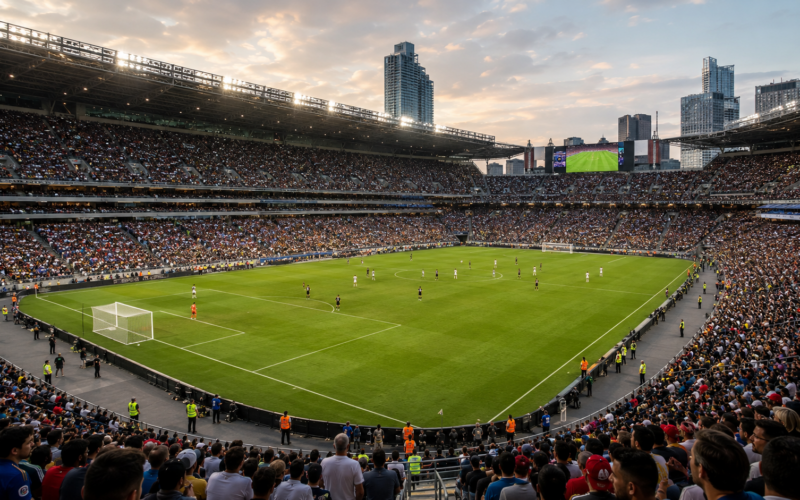
Jude Bellingham scored twice within 98 seconds as ten-man England defeated Mexico 3-2 in a dramatic FIFA World Cup 2026 Round of 16 match at Mexico City Stadium on Sunday, July 5, 2026. Bellingham headed England ahead in the 36th minute and added another goal in the 38th before Julián Quiñones reduced Mexico’s deficit four minutes later.
England’s position became considerably more difficult when Jarell Quansah received a straight red card in the 54th minute following a VAR review of his high sliding challenge on Jesús Gallardo. Harry Kane nevertheless restored the two-goal advantage from the penalty spot after goalkeeper Raúl Rangel brought down Anthony Gordon.
Mexico responded through Raúl Jiménez’s 69th-minute penalty after another VAR review identified Kane’s foul on Brian Gutiérrez. The co-hosts then controlled possession, delivered 52 crosses and won 12 corners, but Jordan Pickford and an England defence reinforced by John Stones, Djed Spence and Dan Burn protected the lead through 13 minutes of stoppage time.
England advanced to face Norway in the FIFA World Cup 2026 quarter-finals at Miami Stadium on Saturday, July 11, at 5pm local time. Mexico were eliminated after suffering their first World Cup defeat at the Azteca, bringing an emotionally charged home campaign to an end.
FIFA World Cup 2026 Mexico 2-3 England full match scorecard and key incidents
How did England manage the altitude and hostile Azteca atmosphere before taking control?
England deliberately avoided pressing Mexico at maximum intensity from the opening whistle. Thomas Tuchel recognised that continuously chasing the ball at Mexico City’s altitude could leave his players exhausted during the final stages.
The visitors instead defended in a compact middle block. Kane and Bellingham screened Mexico’s central midfield, while Saka and Gordon remained positioned to attack the space behind the full-backs whenever England recovered possession.
Mexico controlled the ball and received encouragement from more than 80,000 supporters, but their early possession did not consistently break England’s defensive lines. Pickford’s save from Jiménez’s diving header represented the strongest warning during the opening half-hour.
The strategy allowed England to conserve energy and wait for specific transition opportunities. When those opportunities appeared, the speed of Rice, Saka, Gordon and Bellingham changed the match within less than two minutes.
Why did Jude Bellingham’s two goals completely reverse the emotional momentum?
England’s opening goal began with Rice carrying the ball through midfield after Mexico lost their attacking structure. Saka received on the right and delivered towards the six-yard area, where Bellingham arrived beyond the midfielders.
The timing of the run was decisive. Mexico’s centre-backs remained occupied by Kane, allowing Bellingham to attack the delivery without facing a defender in a stable position.
Bellingham committed fully and directed a diving header beyond Rangel. The finish was England’s first shot on target and immediately silenced a stadium that had been building pressure around every Mexican attack.
Mexico restarted but lost possession almost immediately. Anderson helped recover the ball before Kane moved towards the right and squared across the penalty area.
Bellingham again arrived ahead of the defenders and bundled the ball into the net. Only 98 seconds separated the goals, converting a tense and balanced contest into a two-goal England advantage.
How did Mexico’s defensive structure collapse during England’s rapid counterattacks?
Mexico’s full-backs had advanced during the opening period because England were defending deeper. That positioning supported possession but left large recovery distances whenever the ball was lost.
For the first goal, Rice accelerated through the space behind Mexico’s midfield before the defensive line could retreat. Sánchez was unable to prevent Saka’s cross, while the central defenders became focused on Kane instead of Bellingham.
The second goal began before Mexico had mentally recovered from the first. England pressed the restart, regained possession and attacked a defensive line that had not restored its spacing.
Mexico’s defenders were not defeated by extended passing combinations. They were punished by the speed with which England changed from defence to attack and by Bellingham’s willingness to enter the penalty area from midfield.
The two goals also demonstrated why possession alone did not represent control. Mexico had completed more passes, but England created the more dangerous situations whenever the game became transitional.
Why was Julián Quiñones’ goal before half-time so important for Mexico’s belief?
Mexico required an immediate response because allowing England to reach the interval with a two-goal advantage could have weakened the atmosphere and encouraged Tuchel’s side to defend even more conservatively.
The opportunity came from a free kick delivered by Alvarado. England failed to complete the clearance, allowing the ball to remain inside the penalty area during a crowded second phase.
Quiñones reacted fastest and struck a forceful volley through the players in front of Pickford. The finish gave Mexico a goal from an attack that appeared close to ending without a shot.
The Azteca responded immediately, and Mexico produced another dangerous period before half-time. Pickford was forced into an important intervention from Jiménez as the co-hosts attempted to equalise before the whistle.
Quiñones’ goal restored the pressure England had removed with Bellingham’s double. It also ensured the second half began with Mexico believing one successful attack could restart the entire contest.
Why was Jarell Quansah’s challenge upgraded to a red card after the VAR review?
Quansah attempted to stop Gallardo after Mexico progressed into England’s right defensive channel. The defender slid towards the ball but arrived with his foot raised and made high contact with the Mexico player.
Referee Alireza Faghani initially allowed the incident to continue without producing a red card. The video assistant referee recommended an on-field review because the height and force of the challenge created a potential serious-foul-play offence.
The replay showed Quansah’s studs making contact above Gallardo’s ankle. Although the defender appeared to be attempting to play the ball, intent was not required for the challenge to be classified as endangering an opponent.
Faghani returned from the monitor and dismissed Quansah in the 54th minute. England therefore faced more than half an hour, plus an unusually long period of stoppage time, with ten players.
The red card also created an immediate tactical problem because Quansah had been operating at right-back. Tuchel removed Saka three minutes later and introduced Stones, shifting Konsa towards the right side while protecting the central defence.
How did Anthony Gordon win England’s penalty despite Mexico having the extra player?
England did not retreat completely after the dismissal. Gordon remained high enough on the left to offer a counterattacking outlet whenever Mexico committed players forward.
The winger accelerated onto a forward pass and attacked the space behind Mexico’s defensive line. Rangel left his goal in an attempt to reach the ball before him but arrived late.
Gordon moved the ball around the goalkeeper and was brought down before he could finish. The contact was clear enough for the referee to award the penalty without requiring another prolonged review.
Kane remained composed despite the hostile atmosphere and Mexico’s attempts to delay the kick. He sent Rangel the wrong way and placed the ball accurately into the lower corner.
The goal carried major tactical value. England had just lost a defender and appeared likely to spend the remainder of the match protecting a one-goal advantage, but Gordon’s direct running restored a two-goal cushion.
Was Mexico’s penalty against Harry Kane justified after the second VAR intervention?
Mexico’s penalty developed from another crowded phase inside England’s area. Kane had dropped deep to help defend and attempted to clear the ball as Gutiérrez moved into the same space.
The England captain caught the substitute rather than making clean contact with the ball. The referee initially allowed play to continue, but the video assistant referee identified the contact and recommended a review.
The footage showed Kane’s boot making contact with Gutiérrez’s leg. Faghani determined that the challenge had prevented the Mexico player from continuing and awarded the penalty.
Jiménez waited for Pickford to move and converted into the lower corner. The goal reduced Mexico’s deficit to 3-2 and ensured England would spend the final 20 minutes defending under almost continuous pressure.
Tuchel criticised the VAR intervention after the match, but the decisive issue for England was not the debate surrounding the decision. The players needed to reorganise immediately because the numerical disadvantage and reduced margin had transformed the closing period.
How did Thomas Tuchel’s substitutions create a defensive structure capable of surviving?
Stones initially replaced Saka after the red card, allowing England to form a back four without asking Bellingham, Gordon or Kane to occupy an unfamiliar defensive position.
As Mexico increased the number of attackers, Tuchel introduced Spence and Burn. England moved into a five-player defensive line containing Spence, Konsa, Stones, Guéhi and Burn.
O’Reilly and Anderson were removed, while Rice and Bellingham protected the central spaces in front of the defence. Gordon remained the principal counterattacking outlet until the physical demands forced him to operate deeper.
Burn’s height became particularly valuable against Mexico’s repeated crosses. Stones organised the spacing, Guéhi attacked first contacts and Konsa covered the channel through which Giménez and Jiménez attempted to combine.
The structure did not prevent Mexico from delivering the ball into the penalty area. It ensured those deliveries were usually contested by enough England defenders to stop a clear finish.
Why do England’s 49 clearances explain the final half-hour better than possession?
England finished with only 33.1% possession and attempted 209 fewer accurate passes than Mexico. Those numbers reflected the match after Quansah’s dismissal rather than England being tactically overwhelmed throughout the entire contest.
Mexico attempted 52 crosses, won 12 corners and recorded 37 touches in England’s penalty area. England responded with 49 clearances, including 21 headed clearances.
The defensive statistics show a team that accepted the match had changed. England no longer attempted to maintain an even share of possession and instead prioritised protecting the six-yard box, blocking shots and winning the first contact.
Mexico completed 13 crosses, but many arrived from positions that allowed England’s defenders to prepare. Seven Mexican shots were blocked before reaching Pickford.
The approach carried risk because one loose clearance could have produced the equaliser. However, England maintained enough concentration to survive despite the volume of pressure.
How decisive was Jordan Pickford during Mexico’s strongest attacking periods?
Pickford made his first major contribution when Alvarado crossed accurately towards Jiménez in the 15th minute. The striker’s diving header appeared capable of giving Mexico the lead, but the goalkeeper reacted quickly and pushed it away.
He made another important intervention shortly before half-time after Quiñones had reduced England’s advantage. Preventing Mexico from equalising during that period allowed Tuchel to reorganise during the interval.
Pickford’s workload became more complicated after the red card because Mexico crowded the area and repeatedly attempted to obstruct his route towards crosses. He punched when necessary and remained prepared for deflections through several bodies.
Giménez and Fidalgo later forced saves as Mexico searched for the equaliser. Pickford also gathered a looping deflection during stoppage time after another crowded corner.
His three recorded saves do not fully describe the performance. His decisions under crosses, communication with the back five and control of loose balls reduced the number of second chances available to Mexico.
Why was England’s finishing efficiency more important than Mexico’s attacking volume?
England attempted only six shots but placed five on target and scored three times. Mexico attempted 20 shots, also placed five on target and scored twice, including one penalty.
Bellingham converted two chances valued at a combined expected-goals figure below one. Kane then converted England’s penalty, ensuring the visitors gained maximum value from their limited attacking moments.
Mexico generated more volume but frequently shot through or around multiple defenders. Seven attempts were blocked and eight travelled off target.
England’s 1.55 expected goals came from only six attempts, indicating that the visitors reached favourable positions when they did attack. Mexico’s 1.94 figure included Jiménez’s penalty and several lower-probability efforts during the late siege.
The match therefore rewarded precision rather than accumulation. Mexico controlled the final half-hour, but England had already converted the high-value opportunities that established the decisive margin.
What did Bellingham contribute after scoring twice and England went down to ten players?
Bellingham’s performance did not end with the two goals. After Quansah’s dismissal, he dropped deeper beside Rice and accepted greater responsibility for protecting the centre.
Mexico attempted to move Gutiérrez and Fidalgo between England’s midfield and defensive lines. Bellingham repeatedly followed those movements and helped prevent clean passes towards Jiménez and Giménez.
He also provided England with brief periods of relief by carrying the ball away from the penalty area or winning fouls. Each retained possession reduced Mexico’s opportunity to launch another immediate attack.
During one of the final Mexico moves, Bellingham recovered into his own penalty area and made a crucial defensive intervention. The action reflected a performance combining elite attacking quality with the physical commitment required by the red card.
His two-goal display made him the obvious player of the match, but the second-half work may have been equally important to England’s survival.
Why could Mexico not convert 52 crosses and 12 corners into an equaliser?
Mexico’s numerical advantage encouraged them to attack through width. Sánchez, Gallardo, Alvarado and the substitutes repeatedly delivered towards Jiménez, Giménez and Martínez.
The volume became predictable. England could position Burn, Stones, Guéhi and Konsa inside the area and prepare for aerial contests rather than being moved by combinations through the centre.
Only 13 of the 52 attempted crosses reached a teammate. Even when Mexico won the first contact, Rice and Bellingham competed for the second ball around the edge of the penalty area.
Mexico’s strongest late opportunities came when the delivery created confusion rather than when a striker won a clean header. Stones nearly diverted one cross into his own net during the final minute, but the ball travelled narrowly outside the post.
Greater variation could have created a clearer route. Mexico needed more cutbacks, low deliveries and movement behind England’s midfield rather than repeatedly attacking a defensive line selected specifically for its aerial strength.
Why did Mexico’s strongest FIFA World Cup campaign in decades still end in frustration?
Mexico won all three group matches without conceding and then defeated Ecuador 2-0 in the Round of 32. The campaign ended a 40-year wait for a knockout victory and created genuine belief that the co-hosts could reach the quarter-finals.
Their performance against England demonstrated why that belief was reasonable. Mexico dominated possession, recovered from two separate two-goal deficits and continued attacking until the final seconds.
The decisive weakness was the period surrounding Bellingham’s goals. A team that had not conceded during the tournament allowed England to score twice within 98 seconds because the defensive structure failed during consecutive transitions.
Rangel’s foul on Gordon created another damaging moment after Mexico had gained the numerical advantage. Instead of using the red card to equalise, the co-hosts immediately allowed England to restore the two-goal cushion.
Javier Aguirre’s team showed resilience but could not eliminate the mistakes that elite knockout opponents punish. Mexico leave with meaningful progress, although another home World Cup opportunity ended without reaching the last eight.
What must England improve before facing Haaland and Norway in Miami?
England will be without Quansah through suspension, while Henderson’s post-match wrist injury has reportedly ended his tournament. Tuchel must therefore reassess his defensive options before facing one of FIFA World Cup 2026’s strongest attacks.
Norway will test England differently from Mexico. Martin Ødegaard and Sander Berge can control possession, while Andreas Schjelderup and Oscar Bobb provide creativity around Haaland.
England cannot allow Haaland the same volume of penalty-area service Mexico generated. Burn’s height may be useful, but England must also stop crosses and through balls before they reach the striker.
The spaces around the full-backs require particular attention. Mexico repeatedly advanced through England’s wide defensive zones, and Norway’s second-half substitutions against Brazil showed how effectively they can exploit those areas.
England’s attacking strength remains clear. Bellingham, Kane, Saka and Gordon can punish Norway during transitions, while O’Reilly demonstrated an ability to threaten from distance.
The Mexico victory proved England can survive adversity. The quarter-final will test whether they can combine that resilience with greater control against Haaland, Ødegaard and a Norway team entering with historic momentum.
How does England’s victory shape the FIFA World Cup 2026 quarter-final bracket?
England advanced to face Norway at Miami Stadium on Saturday, July 11, at 5pm Eastern Time. Norway reached their first quarter-final by defeating Brazil 2-1 through two late Haaland goals.
The fixture brings together three players level near the top of the tournament scoring race. Haaland and Kylian Mbappé have seven goals, while Kane’s penalty against Mexico moved him to six.
England will attempt to reach a third consecutive World Cup semi-final. Norway are seeking the first semi-final appearance in their history after already eliminating the tournament’s most successful nation.
The winner will advance to the semi-final at Atlanta Stadium on July 15. The opponent will emerge from the section containing Argentina, Egypt, Switzerland and Colombia.
Key takeaways from Mexico vs England at FIFA World Cup 2026
- England defeated Mexico 3-2 and advanced to a FIFA World Cup 2026 quarter-final against Norway.
- Kick-off at the Azteca was delayed by approximately one hour because of thunderstorms and lightning.
- Jude Bellingham scored twice within 98 seconds, with assists from Bukayo Saka and Harry Kane.
- Julián Quiñones reduced Mexico’s deficit in the 42nd minute after England failed to clear a free-kick sequence.
- Nico O’Reilly struck the post early in the second half before England’s position changed dramatically.
- Jarell Quansah received a straight red card in the 54th minute following a VAR review.
- Anthony Gordon won a penalty despite England playing with ten men, and Kane converted in the 60th minute.
- Raúl Jiménez scored Mexico’s penalty after VAR identified Kane’s foul on Brian Gutiérrez.
- Mexico attempted 52 crosses and 20 shots, but England completed 49 clearances and survived 13 minutes of stoppage time.
- England will face Erling Haaland’s Norway at Miami Stadium on July 11 at 5pm local time.
Discover more from Business-News-Today.com
Subscribe to get the latest posts sent to your email.


