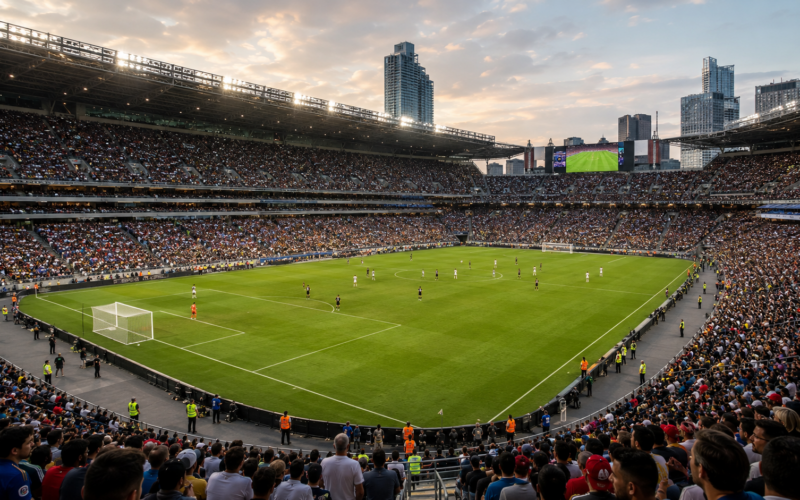
Switzerland defeated Algeria 2-0 in their FIFA World Cup 2026 Round of 32 match at BC Place in Vancouver on Thursday, July 2, 2026, local time. Breel Embolo opened the scoring in the 10th minute before Dan Ndoye doubled the advantage only seconds after the second half began.
Johan Manzambi created the opening goal by carrying the ball through Algeria’s retreating defence and supplying Embolo with a simple close-range finish. Switzerland then protected the lead through a compact midfield structure before Ndoye punished Algeria’s failure to clear the ball in the 46th minute.
Algeria held 55.5% possession but produced only eight attempts and two shots on target. Ibrahim Maza missed the clearest first-half opportunity, Riyad Mahrez had an effort blocked shortly after the second goal and Gregor Kobel completed another controlled clean sheet.
The result delivered Switzerland’s first FIFA World Cup knockout victory since 1938 and eliminated Algeria from the tournament. Murat Yakin’s unbeaten side will remain in Vancouver to face the winner of Colombia vs Ghana in the Round of 16 at BC Place on Tuesday, July 7, at 1pm local time.
FIFA World Cup 2026 Switzerland 2-0 Algeria full match scorecard and key incidents
How did Switzerland turn Algeria’s promising start into an immediate counterattacking goal?
Algeria began with more possession and attempted to position Mahrez, Aouar and Chaïbi between Switzerland’s midfield and defensive lines. The early circulation appeared comfortable, but it also brought Algeria’s full-backs forward and created space behind them whenever possession was lost.
Switzerland did not attempt to press continuously during this phase. Yakin’s players waited for an inaccurate pass or loose touch before accelerating through Manzambi, Vargas and Ndoye.
The opening goal demonstrated the plan perfectly. Switzerland recovered the ball inside their own half and immediately found Manzambi moving into the large space behind Algeria’s right side.
Manzambi drove forward before releasing a low pass across the penalty area. Embolo arrived between the retreating defenders and redirected the ball beyond Zidane from close range.
The goal required only a small number of passes because Switzerland recognised the transition before Algeria could restore its shape. Algeria had controlled the ball, but Switzerland controlled the space in which the decisive attack occurred.
Why was Johan Manzambi the player Algeria could not contain during the first half?
Manzambi’s starting position created uncertainty inside Algeria’s defensive structure. He operated centrally when Switzerland defended but moved towards the left during transitions, forcing Belghali, Mandi and Bentaleb to decide who should engage him.
His acceleration for the opening goal punished that hesitation. Manzambi carried the ball with enough speed to prevent Algeria’s midfield from recovering and enough composure to wait for Embolo’s run before releasing the pass.
The 20-year-old continued attacking the same area after Switzerland took the lead. Chaïbi eventually received a yellow card in the 36th minute after arriving late while attempting to stop another Manzambi advance.
Manzambi’s contribution extended beyond the assist. He dropped into midfield when Algeria held possession, supported Ricardo Rodríguez defensively and helped Switzerland maintain compact distances between its lines.
That combination of creativity and tactical discipline explains why Switzerland could grant Algeria possession without losing control. Manzambi supplied the transition threat that discouraged the visitors from committing every available player forward.
How did Murat Yakin’s compact midfield structure remove Algeria’s central passing routes?
After Embolo scored, Switzerland became more conservative without retreating completely into the penalty area. Ndoye and Vargas dropped alongside Xhaka, Freuler and Manzambi, creating a five-player midfield barrier whenever Algeria attempted to build centrally.
The structure protected Elvedi and Akanji from being pulled towards Maza between the lines. It also allowed Zakaria and Rodríguez to remain closer to the central defenders rather than chasing Algeria’s wide players into advanced positions.
Algeria could circulate across the back and through Bentaleb, but the next forward pass was usually unavailable. Mahrez received frequently near the right touchline, where Switzerland could direct him away from the penalty area.
The possession figure therefore created a misleading impression of Algeria’s control. Petković’s team completed more passes and recorded greater passing accuracy, but much of that activity occurred outside Switzerland’s defensive block.
Switzerland were comfortable allowing passes that did not move the ball closer to Kobel. Yakin’s side protected the central spaces, challenged for second balls and remained ready to counter whenever Algeria attempted a riskier forward delivery.
Why could Riyad Mahrez and Ibrahim Maza not convert possession into meaningful pressure?
Mahrez remained Algeria’s most recognisable creative threat, but Switzerland rarely allowed him to receive with his body facing goal. Rodríguez, Xhaka and Vargas formed layers around the right-sided attacker and encouraged him to move the ball backwards.
When Mahrez attempted to cross, Switzerland’s centre-backs had enough time to organise around Maza. Algeria’s use of the young attacker as a mobile central forward did not produce the physical presence required to unsettle Akanji and Elvedi.
Maza came closest to equalising during first-half stoppage time. Mahrez delivered accurately from the right, Aouar controlled inside the area and Maza attempted an instinctive finish that travelled narrowly wide.
The opportunity showed what Algeria had been missing. Mahrez finally received enough time to deliver, and additional players entered the penalty area rather than waiting outside Switzerland’s block.
Algeria could not repeat the pattern consistently. Their eight attempts produced only two shots on target and an expected-goals total of 0.74, despite holding the ball for longer periods.
Why did Dan Ndoye’s goal seconds after half-time effectively end Algeria’s challenge?
Algeria entered the second half needing greater attacking urgency but immediately made the defensive mistake Switzerland had been waiting to punish. Belghali and the nearby defenders had multiple opportunities to clear a developing attack but failed to remove the ball from the penalty area.
The incomplete clearance travelled towards Ndoye outside the central congestion. He controlled the situation calmly, selected the far corner and drove his finish through the defenders and beyond Zidane.
The timing was devastating for Algeria. Petković had used the interval to reorganise his side, but the two-goal deficit appeared before the new approach could produce a single sustained attack.
Ndoye’s finish also strengthened Switzerland’s tactical position. They no longer needed to balance the pursuit of a second goal against the risk of allowing Algeria a transition.
The Swiss could protect the central zones, reduce the tempo and wait for Algeria to expose additional space. Algeria, meanwhile, had to attack more aggressively without possessing the speed of circulation required to move Switzerland’s block.
How important was Denis Zakaria’s block when Riyad Mahrez threatened an immediate response?
Algeria produced its most important second-half opportunity almost immediately after Ndoye scored. Belghali advanced down the right and delivered into the path of Mahrez, who arrived centrally with enough space to attempt a first-time finish.
Zakaria recognised the danger and moved inside from his right-back position. He remained balanced, blocked the shot and prevented Kobel from being tested at a moment when an Algeria goal could have changed the emotional direction of the match.
The intervention carried greater significance because Switzerland had briefly lost its compact shape. Several players were still reorganising after the transition that produced Ndoye’s goal, leaving Mahrez with the type of central opening he had rarely received.
A 2-1 scoreline at that stage would have restored Algeria’s belief and forced Switzerland to reconsider its defensive approach. Zakaria’s block instead preserved the two-goal margin and allowed Yakin’s team to return immediately to its preferred structure.
The moment also illustrated Switzerland’s collective discipline. When one area of the shape failed, another defender recognised the danger and protected the goal.
Why were Granit Xhaka and Remo Freuler more influential than Algeria’s possession numbers suggest?
Xhaka and Freuler did not dominate through spectacular attacking actions. Their influence came from deciding where Algeria could pass, when Switzerland should increase pressure and how quickly the team should reorganise after losing the ball.
Xhaka remained the reference point in front of the defence. He directed Ndoye and Vargas into narrower positions, closed the route towards Maza and ensured that Mahrez could not move inside without meeting another defender.
Freuler operated with greater mobility. He pressed Algeria’s midfield receivers, collected loose balls and supported the counter-press whenever Switzerland’s forwards lost possession.
Together, they allowed Manzambi to carry greater creative responsibility. The younger player could move forward during transitions because Xhaka and Freuler continued protecting the spaces behind him.
Algeria completed 478 passes compared with Switzerland’s 355, but those figures did not translate into territorial danger. Switzerland won more duels, completed more successful tackles and recorded 17 interceptions, reflecting the control exercised without the ball.
Did Vladimir Petković’s substitutions give Algeria a realistic route back into the match?
Petković introduced Gouiri and Hadjam in the 58th minute, removing Zerrouki and Aouar. The changes increased the number of players prepared to run beyond Switzerland’s midfield, but they did not produce a reliable connection between Algeria’s possession and its forwards.
Mahrez and Bentaleb were then replaced by Hadj Moussa and Boudaoui in the 71st minute. Boudaoui was booked almost immediately, while Hadj Moussa provided greater direct running without consistently reaching the penalty area.
Removing Mahrez reflected Algeria’s need for fresh energy, but it also removed the player most capable of delivering an unexpected final pass. The attack became quicker but less controlled during the final 20 minutes.
Boulbina replaced Belghali late as Algeria accepted greater defensive risk. Switzerland responded by adding Aebischer and Widmer, reinforcing the midfield and right side without abandoning the possibility of another counterattack.
The substitutes altered personnel but not the outcome. Algeria still found two narrow defensive lines protecting the edge of Switzerland’s penalty area and lacked the combinations required to move through them.
How did Gregor Kobel and Switzerland’s defence protect another knockout clean sheet?
Kobel faced only two shots on target, but the limited workload reflected the organisation in front of him rather than Algeria’s unwillingness to attack. Akanji and Elvedi controlled the central area, while Rodríguez and Zakaria prevented Algeria from creating repeated crossing opportunities.
Chaïbi tested Kobel late in the first half, but his effort travelled directly towards the goalkeeper. Hadj Moussa forced a diving intervention near the end, although the attempt appeared closer to a cross than a controlled shot.
Kobel remained important through his positioning and communication. He claimed deliveries cleanly, allowed the defenders to hold their line and avoided producing rebounds that Algeria could attack.
Switzerland completed 23 clearances and blocked three shots. The defensive numbers showed a team prepared to protect the penalty area without becoming chaotic.
The clean sheet was Switzerland’s first of FIFA World Cup 2026 after conceding once in each group match. Producing it during the first knockout fixture indicated that Yakin’s side could increase its defensive control when the tournament demanded greater caution.
Why did Fabian Rieder’s extraordinary late miss not undermine Switzerland’s performance?
Rieder received the clearest opportunity to score a third goal after entering for Vargas. A cross reached him only a short distance from goal with Zidane already low and the Algeria defence unable to recover.
The substitute failed to make clean contact and sent the ball back towards the goalkeeper. The miss accounted for Switzerland’s only recorded big chance not converted and contributed heavily to the expected-goals total.
In a closer match, the moment could have become costly. Algeria, however, had produced little evidence that it could score twice during the remaining minutes.
The chance instead highlighted how vulnerable Algeria had become. Even while protecting a two-goal lead, Switzerland continued reaching the penalty area through direct movement and quick switches.
Yakin may still view the miss as a warning before the Round of 16. Switzerland were clinical with the first two opportunities but could require greater efficiency against an opponent capable of creating more sustained pressure.
Why did Switzerland deserve to win despite holding less possession than Algeria?
Switzerland created the clearer chances, attacked the most valuable spaces and defended the central areas more effectively. Their 11 attempts included five shots on target, while Algeria’s greater possession produced only two efforts that required saves.
The expected-goals margin of 2.45 to 0.74 reflected that difference. Embolo scored from close range, Ndoye finished from a favourable central position and Rieder missed with the goal exposed.
Algeria’s possession frequently remained outside Switzerland’s structure. Passing accuracy and total passes increased, but the ball did not reach Maza, Mahrez or Gouiri in sufficiently dangerous positions.
Switzerland also responded better to mistakes. Manzambi turned an Algeria turnover into the opening goal, while Ndoye punished the failed clearance at the beginning of the second half.
Knockout football often rewards the team that controls decisive moments rather than the team that controls the ball. Switzerland’s defensive maturity and attacking efficiency made the result logical rather than fortunate.
What must Algeria improve after another World Cup knockout elimination?
Algeria must develop greater variety when opponents defend compactly. Petković’s team relied heavily on Mahrez creating from the right, which allowed Switzerland to concentrate defenders around a predictable attacking route.
The midfield completed passes but rarely broke Switzerland’s lines. Bentaleb, Zerrouki and Chaïbi needed more movement ahead of them, while Maza required closer support when receiving centrally.
Algeria must also become more secure immediately after losing possession. Both Switzerland goals followed moments in which the defensive structure failed to respond quickly enough to a turnover or incomplete clearance.
The campaign still represented progress after Algeria returned to the FIFA World Cup following a 12-year absence and advanced beyond the group stage. They recovered from a 3-0 opening defeat against Argentina, beat Jordan and survived a dramatic draw with Austria.
The Round of 32 defeat showed the next requirement. Algeria can compete physically and technically, but deeper tournament progress will require greater penalty-area presence, faster attacking combinations and fewer mistakes during defensive transitions.
What does Riyad Mahrez’s international retirement mean for Algeria’s next cycle?
Mahrez confirmed after the match that the defeat represented his final appearance for Algeria. The announcement ended an international career in which he became captain, a continental champion and the team’s most influential attacking figure across several tournament cycles.
His final match demonstrated both his value and Algeria’s dependence on him. Mahrez supplied the delivery for Maza’s best chance and moved into a promising position after the second goal, but Switzerland’s defensive plan was designed largely around restricting his influence.
Algeria must now distribute creative responsibility among a younger group. Maza, Hadj Moussa, Gouiri and Chaïbi possess technical quality, although none has yet replaced Mahrez’s combination of decision-making, set-piece delivery and authority.
The transition may initially reduce Algeria’s attacking certainty. It also creates an opportunity to build a less predictable structure in which chances emerge from both sides and through several midfield combinations.
Mahrez leaves after helping Algeria return to the World Cup knockout stage. The challenge for the next generation is turning that achievement into a sustainable platform rather than treating it as the end of a single era.
What must Switzerland improve before returning to BC Place in the Round of 16?
Switzerland will face the winner of Colombia vs Ghana at the same venue on July 7. Remaining in Vancouver removes the disruption of travel and gives Yakin’s players continuity in their preparation, recovery and familiarity with the playing conditions.
The next opponent is likely to place greater pressure on Switzerland’s defensive transitions. Yakin’s team cannot assume that every early turnover will produce the same space Manzambi exploited against Algeria.
Switzerland must also become more secure when protecting the ball after winning possession. Algeria recovered several loose passes, and a more clinical opponent could punish those moments before the defensive block reforms.
Finishing remains another area for improvement. Embolo and Ndoye converted the decisive opportunities, but the Rieder miss prevented Switzerland from completing a heavier and more accurate reflection of its expected-goals advantage.
The positive signs are substantial. Manzambi provides youthful creativity, Embolo offers a physical reference point, Ndoye carries direct attacking speed and Xhaka continues to control the team’s tactical positioning.
Switzerland enter the Round of 16 unbeaten and with three consecutive victories. The next test is whether the disciplined approach that ended an 88-year knockout wait can also carry the team beyond the last 16.
How does Switzerland’s victory shape the FIFA World Cup 2026 knockout bracket?
Switzerland advanced from Match 85 and will meet the winner of Colombia vs Ghana in Match 96. The Round of 16 fixture will take place at BC Place on Tuesday, July 7, at 1pm local time.
The winner will progress to the FIFA World Cup 2026 quarter-finals. The later bracket path remains dependent on the results of the connected Round of 16 fixtures and should not be treated as confirmed.
Algeria were eliminated after reaching the knockout stage for only the second time. Switzerland, meanwhile, ended a sequence of World Cup knockout disappointments that had included Round of 16 exits in 2006, 2014, 2018 and 2022.
The historical significance does not alter the immediate task. Switzerland have finally crossed the first knockout barrier, but their tournament will now be judged by whether they can turn that breakthrough into a deeper run.
Key takeaways from Switzerland vs Algeria at FIFA World Cup 2026
- Switzerland defeated Algeria 2-0 and recorded their first FIFA World Cup knockout victory since 1938.
- Breel Embolo opened the scoring in the 10th minute after Johan Manzambi’s direct counterattacking run and low cross.
- Manzambi combined attacking creativity with disciplined defensive positioning during another influential tournament performance.
- Dan Ndoye punished an incomplete Algeria clearance only seconds after the second half began.
- Denis Zakaria blocked Riyad Mahrez’s immediate response and protected Switzerland’s two-goal advantage.
- Algeria held 55.5% possession but produced only eight attempts, two shots on target and 0.74 expected goals.
- Granit Xhaka and Remo Freuler controlled the central spaces despite Switzerland spending less time in possession.
- Fabian Rieder missed an opportunity from close range that could have given Switzerland a third goal.
- Algeria were eliminated, while Riyad Mahrez confirmed the match was his final international appearance.
- Switzerland will face the winner of Colombia vs Ghana at BC Place on July 7 at 1pm local time.
Discover more from Business-News-Today.com
Subscribe to get the latest posts sent to your email.