


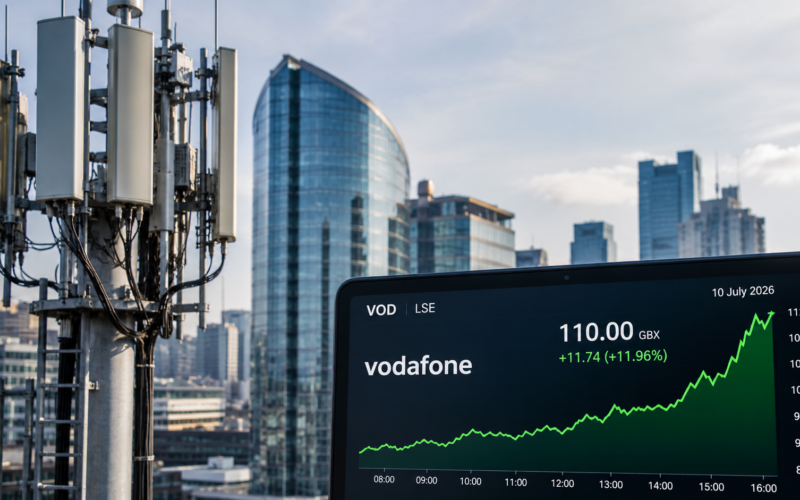
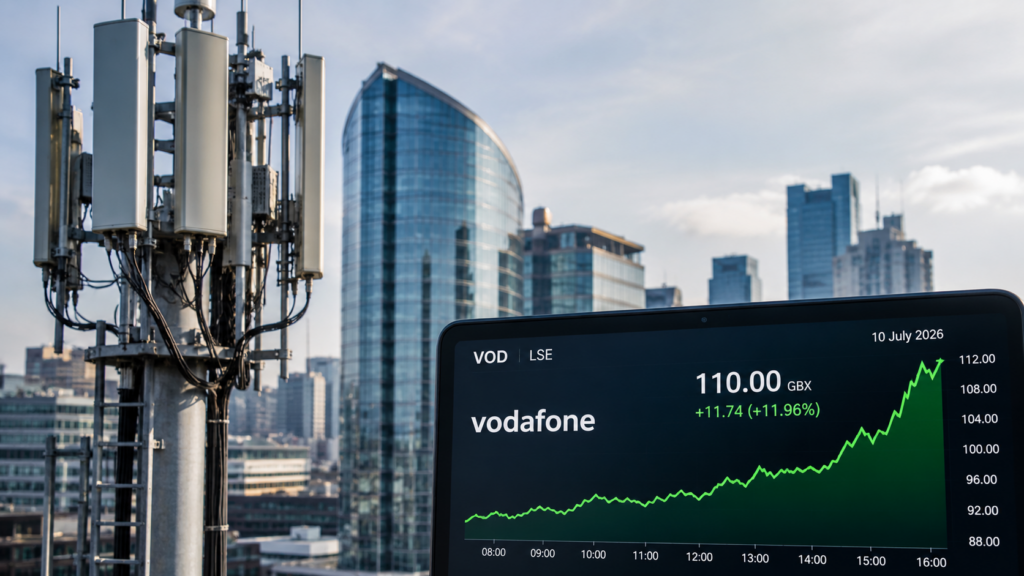
Vodafone Group Plc (LSE: VOD, NASDAQ: VOD) shares rose approximately 12 percent to a session high of 110 pence in London trading on July 10, 2026 after Vega, an acquisition vehicle wholly owned by the family group of French billionaire Xavier Niel, agreed to buy Emirates Telecommunications Group Company PJSC’s entire 16.21 percent stake in the British telecommunications operator for approximately £4.4 billion, or roughly 5.91 billion United States dollars. The purchase price of 112.5 pence per share, comprising a cash element and a future 2.02 eurocent per share dividend entitlement, represents approximately a 13 percent premium to Vodafone Group Plc’s Thursday closing price of 97.76 pence and establishes Vega as the largest shareholder in Vodafone Group Plc with 3,944,743,685 ordinary shares representing 16.21 percent of share capital and 17.13 percent of voting rights upon closing. Emirates Telecommunications Group Company PJSC, which trades on the Abu Dhabi Securities Exchange under the ticker EAND and operates commercially as e& following its 2022 rebrand from Etisalat, is walking away with approximately 1.3 billion United States dollars in net cash from the sale relative to its original 4.4 billion United States dollar investment made in stages beginning in 2022.
The Relationship Agreement that had been in place between Vodafone Group Plc and Emirates Telecommunications Group Company PJSC has been terminated, and e& board nominee Hatem Dowidar has resigned as a non-executive director with immediate effect. The deal marks the second time in as many years that a major French tycoon has taken a decisive stake in a British telecommunications company, following Patrick Drahi’s Altice acquisition of nearly 25 percent of BT before selling to Bharti Global two years ago, and it arrives at a specific inflection point for Vodafone Group Plc under Chief Executive Margherita Della Valle, whose three-year portfolio reshaping programme has completed the sales of the Italian, Spanish, Ghanaian, and Hungarian operations, merged the United Kingdom operations with Three UK to form VodafoneThree, and initiated the process of buying back CK Hutchison Holdings Limited’s 49 percent stake in VodafoneThree to gain full United Kingdom ownership.
What does Xavier Niel’s £4.4 billion Vodafone stake purchase actually change for the group’s shareholder base
The immediate change is that Vega replaces Emirates Telecommunications Group Company PJSC as the anchor institutional voice in the Vodafone Group Plc shareholder register, and it does so at a moment when the group is transitioning from an active portfolio restructuring phase into an execution and value-realisation phase. Emirates Telecommunications Group Company PJSC had held its 16.21 percent stake for approximately four years, had accepted a board representation arrangement in 2023 that included procurement collaboration and the joint pursuit of enterprise customer opportunities, and had increasingly been characterised by markets as a strategic partner rather than a purely financial investor. Vega’s arrival replaces that strategic anchor with an investor whose telecommunications operating credentials are materially stronger and whose historical playbook favours active engagement with portfolio companies.
The structural implications of the shift extend beyond individual shareholder identity. Vega has explicitly stated that the transaction does not include any governance arrangements, which formally distinguishes it from the e& Relationship Agreement that was terminated as part of the sale. That formal distinction is important for regulatory clearance timelines and for the operating relationship between Vega and the Vodafone Group Plc board through the near term. However, the practical dynamic that follows a scale telecommunications operator becoming the largest shareholder of a peer operator is that the influence architecture is shaped as much by informal engagement as by contractual governance rights, and Xavier Niel’s track record across Iliad Group, Monaco Telecom, Eir, Tele2 AB, and the pending Telefónica Chile transaction with Millicom International Cellular S.A. establishes that pattern clearly.
The commercial significance of the shareholder rotation is that Vodafone Group Plc now has a strategic anchor investor with deep operational expertise in the European telecommunications sector at a moment when consolidation opportunities are broadening. Xavier Niel has been publicly positioned as one of the most active dealmakers in European telecommunications for more than a decade, and his stated view that European telecommunications consolidation is necessary for the sector to compete effectively with United States and Asian scale operators has informed his investment activity across France, Italy, Poland, Sweden, Ireland, and now the United Kingdom. Whether Vega uses the new stake to advocate specific consolidation opportunities within the Vodafone Group Plc footprint will define the medium-term direction of the shareholder relationship.
Why is e& walking away from Vodafone after four years of stake building, and what does the pivot signal
Emirates Telecommunications Group Company PJSC accumulated its Vodafone Group Plc stake in stages beginning with an initial 9.8 percent purchase in May 2022 for approximately 4.4 billion United States dollars, followed by successive increases that took the position to 16.21 percent alongside the 2023 Relationship Agreement, board representation, and joint commercial engagement architecture. The strategic framing at that time was that Emirates Telecommunications Group Company PJSC was building a global telecommunications and technology platform that would use the Vodafone Group Plc relationship to accelerate international expansion and to develop joint enterprise and consumer service offerings. That strategic framing has now been formally reversed. The company’s July 10, 2026 statement described the sale as reflecting the natural evolution of its strategic priorities to sharpen its focus on core businesses and to unlock cash from the sale for redeployment.
The specific commercial calculus that drove the exit is analytically important. Emirates Telecommunications Group Company PJSC’s Vodafone Group Plc position had weighed on earnings growth over the four-year holding period as the investment tied up capital that could have been deployed into higher-return core operations. The reported approximately 1.3 billion United States dollar net cash return from the sale, after adjusting for currency and dividends received during the holding period, represents a substantially lower return than Emirates Telecommunications Group Company PJSC’s core operating businesses have generated over the same period. That underperformance combined with the strategic pivot away from international expansion beyond core telecommunications operations delivers a straightforward rationale for the exit.
The read-through to the broader Middle East sovereign and quasi-sovereign investment posture is worth noting. Emirates Telecommunications Group Company PJSC is majority owned by the Government of the United Arab Emirates through the Emirates Investment Authority, and the sovereign investment posture across the Middle East has been shifting toward focused industrial anchor investments rather than diversified portfolio exposures. That structural shift is visible across other United Arab Emirates state-linked investment vehicles, and the Vodafone Group Plc exit is one specific manifestation of the broader capital reallocation. Whether other United Arab Emirates state-linked telecommunications and technology investments in Europe face similar review remains to be seen, but the precedent has now been established.
How does the 13 percent premium versus 112.5 pence acquisition price recalibrate Vodafone’s valuation floor
The 112.5 pence per share acquisition price is analytically significant beyond the specific transaction economics because it establishes a public reference point for Vodafone Group Plc’s equity value that has been endorsed by a sophisticated telecommunications operator with deep sector expertise. The 13 percent premium to the pre-announcement 97.76 pence closing price reflects the specific combination of the block trade discount that would otherwise apply to a 16.21 percent block, the strategic value of gaining control-adjacent influence in Britain’s largest mobile operator, and Vega’s own assessment of the intrinsic value of Vodafone Group Plc’s operating portfolio.
The mechanical anchoring effect on the equity price is likely to persist through the coming months. Vodafone Group Plc shares had been trading at levels reflecting substantial investor caution about the pace at which the completed portfolio simplification, the VodafoneThree merger integration, and the ongoing capital return programme could translate into visible earnings growth. Vega’s willingness to pay 112.5 pence for a 16.21 percent block establishes a valuation floor that other institutional investors will consider when calibrating their own positioning, and the acquisition price is likely to function as a technical support level in the equity through the transaction closing period.
The read-across to the broader European telecommunications equity universe is meaningful. If Vega’s implicit valuation framework applies more broadly, other European telecommunications equities including BT Group Plc, Deutsche Telekom AG, Orange SA, Telefónica SA, and Telenor ASA may face similar re-rating pressure as the market recognises that a sophisticated telecommunications operator is prepared to pay premium prices for scale European telecommunications equity exposure. That secondary read-through is one of the specific reasons the deal has attracted attention beyond the immediate Vodafone Group Plc and Emirates Telecommunications Group Company PJSC counterparty view.
What role does the Tele2 playbook play in analyst expectations for Niel’s engagement with Vodafone
Berenberg analysts have specifically cited Xavier Niel’s Tele2 AB investment as the analytical template for how the Vodafone Group Plc engagement is likely to develop. Iliad Group acquired an initial 20 percent stake in Tele2 AB in 2024 through progressive open market purchases, and subsequent operational and strategic engagement with the Tele2 AB board and management has accelerated cost reduction, free cash flow growth, and strategic focus at the Swedish operator. Analysts expect a similar pattern to develop at Vodafone Group Plc, with Xavier Niel’s operational expertise and strategic clarity accelerating the value realisation that Chief Executive Margherita Della Valle’s restructuring has established.
NewStreet Research has separately characterised Xavier Niel’s general playbook as buy and hold with progressive engagement and potentially eventual movement to full control over time. That analytical framing captures the broader pattern across the Niel family group’s telecommunications portfolio, which spans full ownership at Monaco Telecom, 70 percent ownership at Eir through NJJ, controlling positions at Iliad Group, and progressive stake building at Tele2 AB. Whether the Vodafone Group Plc engagement follows this pattern depends on both Vega’s specific commercial priorities and the responsiveness of the Vodafone Group Plc board and management to shareholder input.
The specific operational levers that a Tele2-style engagement might target at Vodafone Group Plc include acceleration of the cost reduction programme, particularly around the German operations that represent 35 to 40 percent of group earnings before interest, taxes, depreciation, and amortisation after leases, more aggressive capital allocation discipline including higher share buybacks and lower dividends, and strategic acceleration of the value realisation opportunities in the African operations through Vodacom Group Limited and Safaricom PLC. Each of these levers has been discussed in Vodafone Group Plc investor communications over the past two years, and Vega’s arrival introduces the possibility that execution pace on these agenda items increases materially.
Why is the Vodafone Italy history relevant to how Niel positions his stake in the coming months
Xavier Niel attempted to acquire Vodafone Italy on two separate occasions over the past several years and was rebuffed by the Vodafone Group Plc board on both occasions before Vodafone Group Plc ultimately agreed to sell the Italian operations to Swisscom AG in a transaction that completed as part of Chief Executive Margherita Della Valle’s portfolio reshaping programme. The specific history matters because it establishes both Xavier Niel’s demonstrated interest in Vodafone Group Plc assets and the Vodafone Group Plc board’s willingness to sell operations for the right price to the right counterparty. Whether the Italian precedent creates unresolved strategic tension that shapes Vega’s approach to the current shareholder relationship is a live analytical question.
The commercial implication of the historical context is that Vega’s stake building may function as a mechanism for Xavier Niel to gain a more direct role in future Vodafone Group Plc strategic decisions, including any potential divestiture or strategic partnership opportunities across the remaining European and African portfolio. Vega’s spokesperson has explicitly indicated that the transaction was a straightforward stake purchase without governance arrangements, but the practical reality of a 16.21 percent shareholder with deep telecommunications operating credentials is that strategic decisions are increasingly likely to reflect that shareholder’s input regardless of formal governance mechanisms.
The related analytical question is whether Vega’s Vodafone Group Plc position creates specific competitive dynamics with Iliad Group’s existing European operations. Iliad Group operates as a competitor to Vodafone Group Plc in the French, Italian, and Polish markets, and any material change in Vodafone Group Plc’s competitive strategy in these markets would need to be evaluated against the potential for shareholder conflict of interest. The Iliad Group operations are held through a separate corporate structure from Vega, but the ultimate beneficial ownership rests with the Niel family group in both cases, and regulatory authorities including the European Commission and national competition authorities are likely to scrutinise any strategic decisions that could benefit both operators simultaneously.
How does the CK Hutchison VodafoneThree buyback interact with Niel’s arrival as the top shareholder
Vodafone Group Plc announced in June 2026 that it would buy back CK Hutchison Holdings Limited’s 49 percent stake in VodafoneThree, the United Kingdom mobile operator formed through the completed merger of Vodafone UK and Three UK, to gain full United Kingdom ownership after less than one year of joint operation. The specific rationale communicated by Chief Executive Margherita Della Valle at the May 2026 investor presentation was that full ownership provides simplified governance, clearer strategic direction, and improved capital allocation flexibility across the United Kingdom operations. The transaction economics and financing structure were not fully disclosed at the initial announcement, and the specific completion timeline is subject to regulatory approvals and financing arrangements.
The interaction between the VodafoneThree buyback and Vega’s stake purchase creates specific analytical dynamics for the Vodafone Group Plc capital structure. Vega’s £4.4 billion stake purchase is being funded independently of Vodafone Group Plc’s balance sheet through Vega’s own resources, but the VodafoneThree buyback will require significant Vodafone Group Plc capital deployment through some combination of cash on hand, new debt issuance, or equity dilution. Whether Vega’s arrival influences the specific financing structure of the VodafoneThree buyback depends on Vega’s early engagement with the Vodafone Group Plc board and the timing alignment between the two transactions.
The strategic implication for the United Kingdom operations is that VodafoneThree emerges as a wholly owned Vodafone Group Plc asset just as the largest external shareholder is a French telecommunications operator with material United Kingdom market interest through Iliad Group’s own potential future strategic expansion. That configuration creates specific optionality across the United Kingdom telecommunications competitive landscape that neither Vodafone Group Plc nor the current United Kingdom regulatory framework has previously encountered. The Communications Act 2003 and the current competition framework administered by the Office of Communications provide the regulatory architecture within which these dynamics will develop, and any material change in United Kingdom telecommunications competitive structure would require both Ofcom and Competition and Markets Authority engagement.
What are the execution, regulatory, and shareholder governance risks that could complicate the transaction
The primary execution risk is regulatory approval timing. Vega has indicated that the immediate focus is securing the necessary regulatory approvals, including foreign investment clearances, and until closing the shares will be held by three financial institutions on Vega’s behalf under off-market block trade arrangements. The specific regulatory reviews likely include foreign direct investment screening under the National Security and Investment Act 2021 in the United Kingdom, competition assessment where applicable across European jurisdictions where Vodafone Group Plc operates, and specific reviews under the sector-specific regulatory framework administered by Ofcom. Any of these reviews could extend the closing timeline beyond the initial expectations and could impose specific conditions or undertakings that reshape the transaction economics.
The shareholder governance risk framework is more nuanced. Vega has explicitly indicated that the transaction does not include governance arrangements, but a 16.21 percent shareholding at the Vodafone Group Plc scale typically carries substantial informal influence on board composition, executive remuneration, and strategic direction through the annual general meeting voting process. Vodafone Group Plc’s response to any Vega board nomination proposals, changes to the executive remuneration framework, or specific strategic direction proposals will shape the operational dynamic between the largest shareholder and the executive team through the coming years.
The competitive and market risk architecture around European telecommunications remains complex. The sector faces continued regulatory pressure on wholesale pricing, spectrum allocation costs, and consumer service quality standards, and the transition to fifth-generation mobile network infrastructure requires substantial capital expenditure that competes with shareholder capital return commitments. The Xavier Niel investment thesis rests on the view that European telecommunications consolidation and operational improvement can offset these headwinds and deliver material shareholder value, but the specific timing and pace at which that thesis translates into visible earnings and cash flow improvement depends on execution across multiple operating markets simultaneously. Any single market disappointing on execution could compress the value realisation trajectory for the entire investment thesis.
Key takeaways on what the Niel Vodafone deal signals for European telecom consolidation and equity investors
- Xavier Niel’s Vega vehicle has agreed to acquire Emirates Telecommunications Group Company PJSC’s entire 16.21 percent stake in Vodafone Group Plc for approximately £4.4 billion, or roughly 5.91 billion United States dollars, at 112.5 pence per share, representing a 13 percent premium to the pre-announcement closing price of 97.76 pence.
- Vodafone Group Plc shares rose approximately 12 percent to a session high of 110 pence on July 10, 2026, and the acquisition price establishes a valuation floor that other institutional investors are likely to reference when calibrating positioning through the coming months.
- The Relationship Agreement between Vodafone Group Plc and Emirates Telecommunications Group Company PJSC has been terminated, and e& board nominee Hatem Dowidar has resigned as a non-executive director with immediate effect, formally ending the four-year strategic partnership.
- Emirates Telecommunications Group Company PJSC realises approximately 1.3 billion United States dollars in net cash from the sale after adjusting for the initial 4.4 billion United States dollar investment made in stages beginning in 2022, and the exit reflects the natural evolution of its strategic priorities to focus on core telecommunications operations.
- Vega has explicitly indicated the transaction does not include governance arrangements, but Berenberg and NewStreet Research analysts expect Xavier Niel to follow the buy-and-influence playbook that Iliad Group established at Tele2 AB following its 2024 stake building, with progressive engagement on cost reduction, capital allocation, and strategic focus.
- Xavier Niel attempted to acquire Vodafone Italy on two occasions and was rebuffed before Vodafone Group Plc ultimately sold the Italian operations to Swisscom AG as part of Chief Executive Margherita Della Valle’s portfolio reshaping programme, establishing a specific historical context for the current stake purchase.
- Chief Executive Margherita Della Valle’s three-year restructuring has completed the sales of the Italian, Spanish, Ghanaian, and Hungarian operations, merged the United Kingdom operations with Three UK to form VodafoneThree, and initiated the buyback of CK Hutchison Holdings Limited’s 49 percent stake in VodafoneThree to gain full United Kingdom ownership.
- The Vega arrival introduces the possibility that execution pace on Vodafone Group Plc’s cost reduction, capital return, and strategic focus programme accelerates materially, with specific operational levers likely to target the German operations that represent 35 to 40 percent of group EBITDA after leases and the African operations through Vodacom Group Limited and Safaricom PLC.
- The transaction is the second time in as many years that a major French tycoon has taken a decisive stake in a British telecommunications company, following Patrick Drahi’s Altice acquisition of nearly 25 percent of BT Group Plc before its sale to Bharti Global two years ago.
- The primary execution risks include regulatory approval timing under the National Security and Investment Act 2021 in the United Kingdom and equivalent foreign direct investment reviews in relevant jurisdictions, informal shareholder governance dynamics as Vega engages with the Vodafone Group Plc board and management, and potential conflict of interest scrutiny given Xavier Niel’s ownership of Iliad Group operations that compete with Vodafone Group Plc in several European markets.
Discover more from Business-News-Today.com
Subscribe to get the latest posts sent to your email.