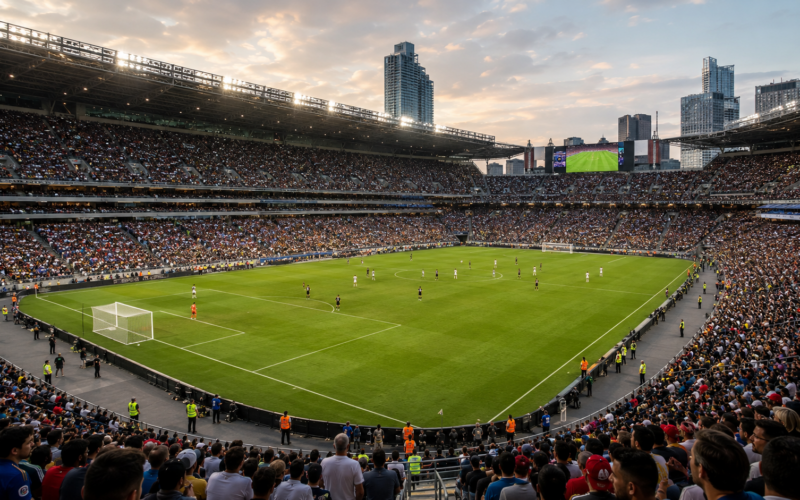
England defeated Panama 2-0 in their final FIFA World Cup 2026 Group L match at New York New Jersey Stadium in East Rutherford on Saturday, June 27, 2026. Jude Bellingham and Harry Kane scored during a five-minute second-half spell as England secured first place in front of 80,663 spectators.
Bellingham broke Panama’s resistance in the 62nd minute after Bukayo Saka delivered a corner from the left. The midfielder fought through close marking inside the crowded penalty area and directed a left-footed finish beyond Orlando Mosquera.
England doubled their advantage in the 67th minute when Bellingham crossed from the left and Kane rose above his marker to head into the net. The goal was Kane’s 11th at a FIFA World Cup, moving him beyond Gary Lineker’s previous England record of 10.
Thomas Tuchel’s side completed Group L unbeaten with seven points, finishing one point ahead of Croatia. England will face one of the qualifying third-placed teams from Groups E, H, I, J or K in Atlanta on July 1, while Panama ended their campaign without a point or a goal.
FIFA World Cup 2026 Panama 0-2 England full match scorecard and key incidents
Why did England struggle to break down Panama during a flat first half?
Tuchel made five changes from the team that drew 0-0 with Ghana, bringing Quansah, Nico O’Reilly, Morgan Rogers, Saka and Rashford into the starting lineup. Declan Rice was rested, while Reece James missed the match because of a hamstring injury.
England controlled possession from the opening phase but found limited space through the centre. Panama maintained narrow distances between midfield and defence, leaving Kane surrounded whenever he moved towards the penalty area.
Rashford created England’s first clear chance in the seventh minute. He moved onto his right foot and drove towards the near corner, forcing Mosquera to make a strong save.
England’s attacks increasingly became concentrated on the left, where Rashford and Bellingham frequently received the ball. The repeated pattern allowed Panama to move defenders across early, while Saka became isolated against two players on the right.
Rashford later headed wide from close range and sent a free kick narrowly beyond the post. Anderson also tested Mosquera, but England reached half-time without converting 65% possession into a decisive opening.
How did Panama’s counterattacking threat prevent England from committing more players forward?
Panama had already been eliminated, but Thomas Christiansen’s team did not defend passively. José Luis Rodríguez and Édgar Bárcenas attempted to move quickly into the spaces left behind England’s advancing full-backs.
The clearest warning arrived in the 26th minute. Rodríguez escaped into a shooting position and forced Pickford to make an important save, preventing Panama from taking a lead that would have increased the pressure on England.
Panama’s 12 attempts demonstrated that England did not control every phase. Most of those efforts were taken from low-value positions, but the willingness to counter prevented O’Reilly and Quansah from advancing without protection.
Elliot Anderson and Rogers therefore remained responsible for controlling the areas behind Bellingham. England’s midfield retained the ball effectively but did not initially move it quickly enough to disrupt Panama’s compact defensive structure.
The balance improved after half-time as England recovered possession earlier and kept Panama further from Pickford’s goal. That territorial pressure eventually produced the corner from which Bellingham scored.
Why did Jude Bellingham become the player who finally changed the match?
Bellingham began in an advanced midfield role but frequently moved towards the left to combine with Rashford and O’Reilly. His freedom allowed him to influence both England’s build-up and the decisive actions inside the penalty area.
The breakthrough came from Saka’s corner in the 62nd minute. Panama attempted to crowd the six-yard area, but Bellingham resisted the defender holding him and created enough room to reach the dropping ball.
His left-footed finish was not a clean, uncontested strike. It instead reflected the physical persistence England had required against opponents defending with several players close to goal.
Bellingham then created the second goal five minutes later. He received possession on the left and delivered a measured cross towards Kane, who attacked the space between Panama’s central defenders.
The midfielder completed the match with one goal and one assist from England’s two decisive chances. Tuchel withdrew him in the 71st minute after first place had moved firmly under England’s control.
How did Harry Kane set a new England FIFA World Cup scoring record?
Kane endured a difficult opening hour. Panama’s defenders prevented him from receiving cleanly with his back to goal, while England’s slower passing allowed the defensive line to prepare for crosses.
He failed to control one close-range opportunity early in the second half and then saw Mosquera save another attempt in the 57th minute. The striker nevertheless remained positioned between the centre-backs rather than dropping excessively deep in search of possession.
That discipline was rewarded when Bellingham crossed in the 67th minute. Kane rose above his marker and directed a powerful header beyond Mosquera.
The goal was Kane’s 11th across his FIFA World Cup career. He moved beyond Lineker’s total of 10 to become England’s leading scorer in the men’s competition.
Kane had also scored a hat-trick against Panama during England’s 6-1 victory in 2018. His latest goal carried less influence on the scoreline, but considerably greater historical importance.
What did Thomas Tuchel learn from England’s five starting changes?
The rotation gave Tuchel an opportunity to assess players competing for knockout-stage roles. O’Reilly provided composure at left-back, Rogers offered another attacking midfielder and Rashford produced several first-half shooting opportunities.
Quansah’s selection at right-back became necessary after James’ injury. The defender handled Panama’s wide attacks reasonably well but received a yellow card in the 60th minute and left three minutes later after twisting an ankle.
Spence replaced him and gave England a more natural overlapping outlet. However, the injuries to James and Quansah created uncertainty around a position Tuchel had expected to rotate throughout the tournament.
Madueke replaced Saka during the same substitution window, while Eze later entered for Bellingham. Watkins and Henderson were introduced after the second goal as England managed the closing stages.
Henderson’s appearance carried historical significance. He became the first England player to take part in four editions of the men’s FIFA World Cup.
Why did Panama complete their FIFA World Cup 2026 campaign without scoring?
Panama lost 1-0 to Ghana, 1-0 to Croatia and 2-0 to England. Their defensive structure kept all three matches competitive for extended periods, but the attack failed to convert possession and transitions into goals.
Christiansen’s side attempted 12 shots against England and tested Pickford twice. However, the absence of Adalberto Carrasquilla limited their ability to progress through midfield and create higher-quality opportunities.
Tomás Rodríguez started as the central forward but was replaced by Fajardo at half-time. Fajardo supplied greater physical pressure but received a yellow card and struggled to find space between Marc Guéhi and Ezri Konsa.
Panama’s wider tournament problem was not a complete absence of attacking moments. It was the failure to produce enough actions inside the penalty area before opposing defences could reorganise.
The team finished with no points, no goals scored and four conceded. Christiansen subsequently indicated that he would take time before deciding whether to continue as head coach.
How did Croatia’s victory over Ghana determine the final Group L standings?
England entered the final match level with Ghana on four points, while Croatia remained one point behind. A victory guaranteed England first place regardless of the simultaneous result.
Croatia defeated Ghana 2-1 to finish with six points. England’s two second-half goals therefore proved necessary to retain first place rather than dropping behind the 2018 finalists.
Ghana finished third with four points and entered the ranking of best third-placed teams. Their neutral goal difference left them in a strong position, although the final allocation depended on Groups J and K.
Panama completed the group in fourth place. They were the only Group L team that did not collect a point or score a goal.
FIFA World Cup 2026 Group L final points table
Who can England face in the FIFA World Cup 2026 Round of 32 in Atlanta?
England will play at Atlanta Stadium on Wednesday, July 1, against a qualifying third-placed team from Group E, H, I, J or K.
Ecuador and Senegal were among the third-placed teams already involved in the allocation. The final identity of England’s opponent depended on the completion of Groups J and K and the combination of the eight third-placed teams advancing.
Winning Group L placed England on a route that could lead to a Round of 16 meeting with the winner of Mexico’s knockout match. Tuchel’s immediate focus, however, will be resolving the right-back situation and improving the speed of England’s attacking play.
England completed the group stage unbeaten, but the goalless draw with Ghana and the difficult first hour against Panama showed that compact opponents can slow their progression. The contribution of Bellingham and Kane again demonstrated that individual quality can decide matches even when the wider performance lacks fluency.
Key takeaways from Panama vs England at FIFA World Cup 2026
- England defeated Panama 2-0 and won Group L with seven points.
- Jude Bellingham opened the scoring in the 62nd minute from Bukayo Saka’s corner.
- Bellingham assisted Harry Kane’s header five minutes later.
- Kane scored his 11th FIFA World Cup goal and moved beyond Gary Lineker’s England record.
- England controlled 65% possession and registered 17 attempts, including six on target.
- Orlando Mosquera kept Panama level during the first half with saves from Marcus Rashford and Elliot Anderson.
- Jordan Pickford denied José Luis Rodríguez during Panama’s strongest counterattack.
- Jarell Quansah left with a twisted ankle, increasing England’s right-back injury concerns.
- Jordan Henderson became the first England player to appear at four FIFA World Cups.
- England will face a qualifying third-placed team in Atlanta, while Panama exited without scoring a goal.
Share this:
Discover more from Business-News-Today.com
Subscribe to get the latest posts sent to your email.