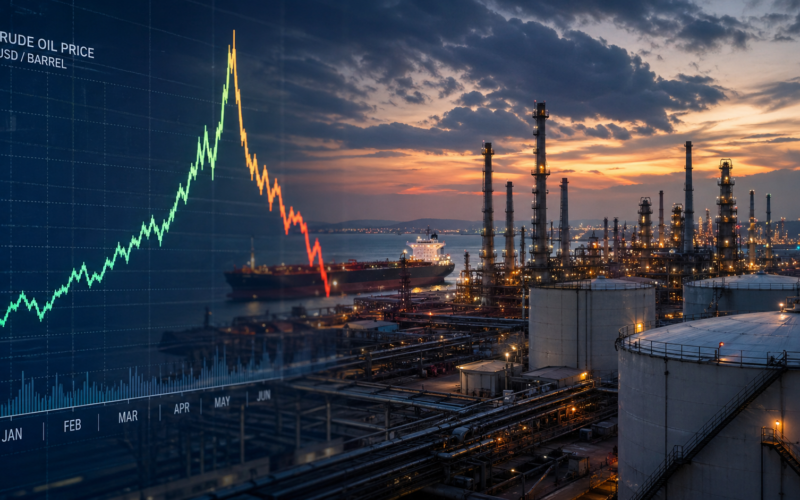
Global oil prices retreated on Thursday after briefly hitting their highest level in four years, as traders struggled to price the risk of a widening U.S.-Iran war against a sudden reversal in crude futures that arrived without a clear market catalyst.
Brent crude futures rose as high as $126.41 a barrel, the strongest level since March 2022, before falling sharply during the session. West Texas Intermediate crude also climbed to an intraday peak above $110 a barrel before giving back gains. The move underscored how volatile the global oil market has become as investors assess the risk of prolonged disruption in Middle East energy supplies, the possible impact on the Strait of Hormuz, and the wider threat to global growth.
The pullback did not remove the core pressure behind the rally. Oil prices remain elevated because the U.S.-Iran war has raised concern that energy flows from the Middle East could remain constrained for longer than governments, shipping companies, refiners, and central banks had expected. The retreat instead showed how unstable wartime commodity pricing can become when geopolitical headlines, large trades, currency moves, and supply fears collide in a market already under stress.
Why did global oil prices hit a four-year high before retreating sharply?
The immediate trigger behind the oil price surge was renewed concern that the U.S.-Iran war could escalate further and deepen the disruption to Middle East oil supply. Brent crude’s move above $126 a barrel placed the benchmark near levels last seen after Russia’s invasion of Ukraine, when global energy markets were also shaken by sanctions, supply uncertainty, and inflation fears.
The subsequent decline was just as revealing as the rally. Prices fell back even though there was no obvious diplomatic breakthrough, military de-escalation, or supply restoration to explain the reversal. Traders pointed to sharp market swings, possible profit-taking, and large sell orders as signs that the price action was not being driven only by fresh fundamentals.
That matters because the global oil price retreat does not necessarily signal confidence that the U.S.-Iran crisis is easing. It may instead show that the crude market is now operating inside a wide risk band, where prices can jump on escalation fears and fall quickly when traders lock in gains or reduce exposure.
For import-dependent economies, the key issue is not whether Brent crude settles at $114, $120, or $126 on a single day. The bigger concern is whether oil prices remain structurally higher for weeks or months. Sustained high crude prices can feed inflation, widen trade deficits, pressure currencies, and force central banks to delay interest-rate relief.

How is the U.S.-Iran war reshaping market expectations for Middle East oil supply?
The U.S.-Iran war has shifted the oil market from a demand-and-inventory story into a geopolitical supply-risk story. Before the latest escalation, traders were already watching global demand, Organization of the Petroleum Exporting Countries Plus policy, refinery margins, and Chinese consumption signals. The conflict has now pushed supply security back to the centre of the market.
The central fear is that a prolonged confrontation could keep major export routes under threat and reduce the reliability of Middle East supply flows. The Strait of Hormuz remains the most sensitive point in that calculation because it is one of the world’s most important energy transit corridors. Any sustained restriction, military risk, or insurance disruption around the Strait of Hormuz can affect crude oil, liquefied natural gas, shipping costs, refinery planning, and strategic reserves.
The market is also being forced to price political uncertainty in Washington and Tehran. Reports that United States President Donald Trump was to be briefed on possible military options against Iran added to fears that the conflict could become more difficult to contain. Iran’s warnings of a painful response if attacks resumed added another layer of risk for traders already facing volatile pricing.
The institutional consequence is that energy markets are no longer reacting only to supply that has physically disappeared. They are also pricing the risk that more supply could become unavailable, delayed, rerouted, or costlier to move. That distinction explains why prices can move violently even before confirmed supply numbers change.
Why does the Strait of Hormuz remain central to crude oil and liquefied natural gas risk?
The Strait of Hormuz matters because it links the Persian Gulf to global markets and carries a significant share of the world’s seaborne oil and liquefied natural gas trade. When the Strait of Hormuz becomes a security concern, the price impact is not limited to crude oil contracts. It spreads through shipping insurance, tanker availability, refinery procurement, gas markets, inflation expectations, and sovereign energy-security planning.
For Asian importers, the risk is especially direct. Countries such as India, Japan, South Korea, and China depend heavily on imported energy, and any disruption in Middle East flows can raise procurement costs or force buyers to seek alternative grades. For Europe, the risk comes through inflation and gas-market sensitivity. For the United States, the risk is less about direct import dependence and more about global benchmark pricing, consumer fuel costs, and political pressure.
The latest crude price retreat therefore does not remove the Strait of Hormuz premium from the market. It only shows that traders are still debating how much of that premium should be embedded in current prices. If the Strait of Hormuz remains constrained or if military risks around shipping rise again, oil prices could remain vulnerable to another rapid spike.
The broader strategic issue is that energy markets are exposing the limits of spare capacity, shipping flexibility, and diplomatic reassurance during wartime. Once traders begin to question whether a critical route can operate normally, even partial disruption can behave like a full-scale pricing shock.
Why did oil prices retreat without an obvious catalyst after such a sharp rally?
The retreat in oil prices appears to reflect market mechanics as much as changing geopolitical judgment. After Brent crude surged above $126 a barrel, some traders likely moved to take profits, reduce risk, or respond to large sell orders. In highly volatile markets, a few heavy trades can accelerate a reversal, especially when liquidity is uneven and futures contracts are close to expiry.
The June Brent contract was also approaching expiry, which can make price action more erratic. The more actively traded July Brent contract showed a smaller move, suggesting that part of the extreme swing may have been linked to positioning in the prompt contract rather than a full reassessment of the supply outlook.
Currency movements may also have played a role. Crude oil is priced in U.S. dollars, so shifts in the dollar can influence the cost of oil for non-U.S. buyers and affect short-term futures demand. However, the scale of the price reversal suggests that positioning and risk management were at least as important as currency effects.
This is why the phrase “without an obvious catalyst” matters. It does not mean the market was irrational. It means the reversal was not tied to one visible diplomatic or supply event. In wartime commodity markets, volatility itself can become a catalyst, as traders react to price levels, margin calls, contract expiry, liquidity gaps, and headline risk.
How could elevated oil prices affect inflation, central banks, and global growth?
Elevated oil prices create a direct risk to global inflation because crude oil influences transport, aviation, petrochemicals, diesel, shipping, power generation in some markets, and consumer fuel prices. If high crude prices persist, the inflation effect can move beyond petrol pumps and diesel costs into food distribution, manufacturing inputs, and business margins.
Central banks face a difficult policy problem when oil prices rise because energy-driven inflation can weaken household purchasing power while also slowing growth. Raising interest rates into an oil shock risks hurting demand further, while cutting rates too early risks allowing inflation expectations to drift higher. That tension is why oil spikes linked to war can become macroeconomic problems rather than only energy-market events.
For emerging markets, the pressure can be more severe. Oil import bills rise, local currencies can weaken, and governments may face pressure to absorb part of the increase through subsidies or tax reductions. That can strain public finances. For advanced economies, the damage may show up through slower consumer spending, higher logistics costs, and renewed inflation anxiety.
The current retreat in crude prices offers some short-term relief, but it does not settle the macroeconomic question. The decisive issue is the duration of the disruption. A one-day spike is disruptive for traders. A multi-month oil shock can change inflation forecasts, fiscal planning, corporate earnings, and political sentiment.
What does the oil price retreat signal for energy investors and policymakers?
For energy investors, the latest move signals that crude oil is now trading as a geopolitical risk asset as much as a commodity. Supply fundamentals still matter, but the marginal price driver is the perceived path of the U.S.-Iran war, the status of the Strait of Hormuz, and the probability of wider military action.
That creates both opportunity and danger. Oil producers and energy-linked equities may benefit from higher prices, but extreme volatility can also damage demand, raise recession fears, and increase political pressure on governments to intervene. Refiners may face margin pressure if crude costs rise faster than product prices. Airlines, chemicals companies, shipping firms, and consumer-facing businesses may face renewed cost pressure.
For policymakers, the message is more uncomfortable. Energy security is once again a hard constraint on economic stability. Strategic petroleum reserves, alternative supply routes, diplomatic crisis management, refinery flexibility, and import diversification are not background issues when a major transit corridor is under pressure.
The expert read is that the oil price retreat should not be mistaken for market calm. It is better understood as a volatility reset after a panic-driven surge. Unless there is a durable reduction in U.S.-Iran war risk or a clearer restoration of confidence around Middle East flows, oil markets are likely to remain sensitive to every military, diplomatic, and shipping signal.
What are the key takeaways from the global oil price retreat after the four-year high?
- Global oil prices briefly rose above $126 a barrel before retreating sharply during Thursday’s session.
- Brent crude touched $126.41 a barrel, its highest level since March 2022, before falling back toward the mid-$110 range.
- West Texas Intermediate crude also climbed above $110 a barrel before giving back gains.
- The rally was driven by concern that the U.S.-Iran war could deepen Middle East oil supply disruption.
- The price retreat occurred without a clear diplomatic breakthrough or obvious supply-side catalyst.
Discover more from Business-News-Today.com
Subscribe to get the latest posts sent to your email.