



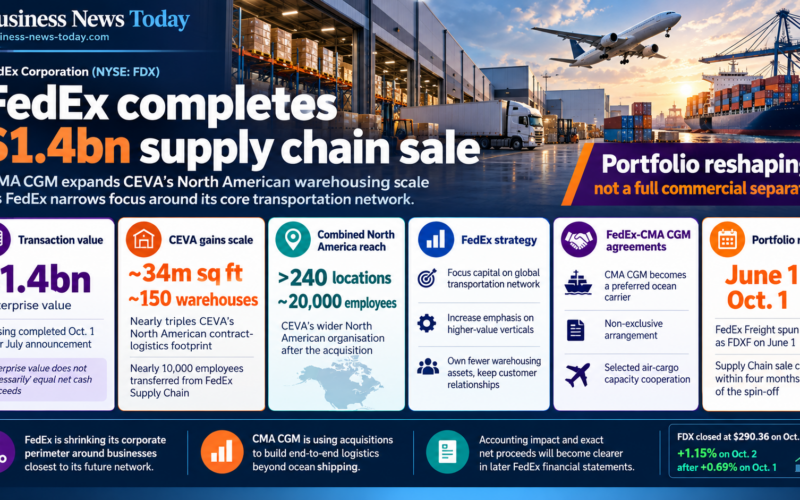
FedEx Corporation (NYSE: FDX) has completed the sale of FedEx Supply Chain to France’s CMA CGM Group at an enterprise value of $1.4bn, transferring a major contract-logistics operation to CMA CGM subsidiary CEVA Logistics while FedEx focuses its capital more heavily on its global transportation network.
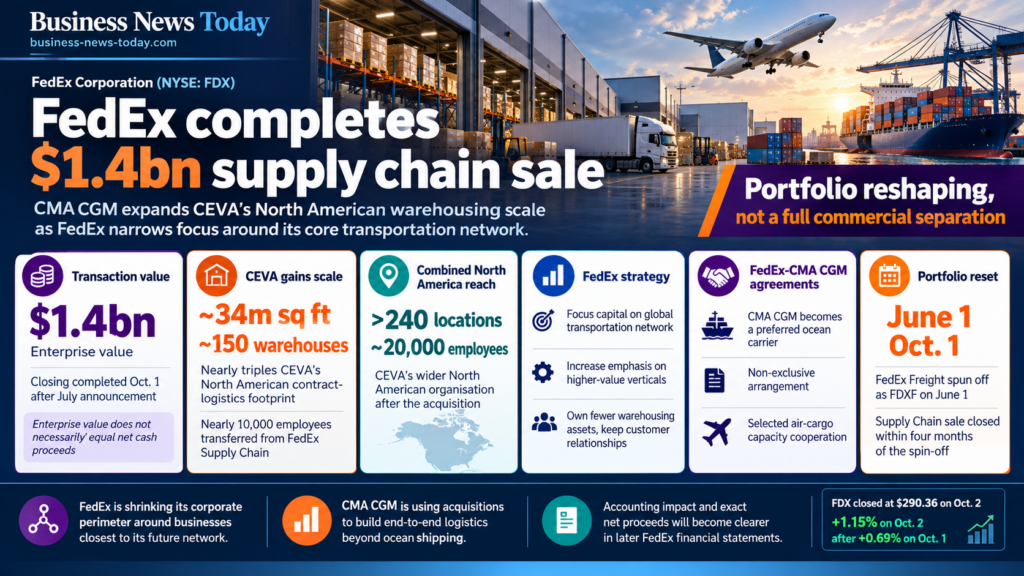
The October 1 closing follows the transaction announced in July and transfers nearly 10,000 FedEx Supply Chain employees into CEVA’s North American organisation. CMA CGM says the acquisition adds approximately 34 million square feet of warehouse space, nearly triples CEVA’s North American contract-logistics footprint and leaves the combined business operating around 150 warehouses.
CEVA’s wider North American presence now extends to more than 240 locations with approximately 20,000 employees. The scale makes the transaction strategically significant for CMA CGM, which has been using acquisitions to move beyond ocean container shipping into end-to-end logistics.
For FedEx, the sale continues a much broader portfolio reshaping. The company completed the spin-off of FedEx Freight as a separately traded company on June 1 under the NYSE ticker FDXF, meaning two substantial organisational changes have now been completed within four months.
Why did FedEx sell Supply Chain while keeping a global logistics network?
FedEx’s core strategic argument is that it can create greater value by concentrating resources where its integrated parcel, air and ground transportation networks provide the strongest differentiation.
Contract logistics is a different business model. Warehousing operations require property, labour, automation, inventory-management systems and customised customer processes. Returns depend heavily on facility utilisation and long-term contracts.
FedEx said when announcing the transaction that it wanted to increase focus on higher-value verticals including healthcare, automotive, aerospace and data centres. Selling FedEx Supply Chain does not mean the company is withdrawing from logistics customers in those industries; it changes which parts of the physical logistics chain FedEx owns directly.
That distinction becomes clearer through the commercial agreements accompanying the sale. FedEx and CMA CGM remain partners even after FedEx no longer owns the warehousing business.
The model can therefore be understood as asset and portfolio separation rather than a complete commercial separation.
What does CMA CGM gain from the $1.4bn acquisition?
CMA CGM gains immediate scale in North American contract logistics through CEVA, its global logistics subsidiary.
The addition of roughly 34 million square feet of warehouse capacity is particularly significant. Warehouse scale gives CEVA more locations from which it can handle e-commerce fulfilment, automotive parts, healthcare products, retail goods and other customised supply-chain programmes.
The combined organisation operates around 150 warehouses and more than 240 North American locations when other CEVA operations are included. Those two figures refer to different measures and should not be confused: not every CEVA location is necessarily a warehouse.
The nearly 10,000 employees joining from FedEx Supply Chain also increase CEVA’s operational capability immediately rather than requiring years of organic hiring and facility construction.
CMA CGM intends to use the enlarged network to provide more integrated transport from factories and ports through warehousing and final distribution. That strategy can make customer relationships more valuable because several supply-chain functions sit within one provider.
The execution challenge will be integration. Warehouse-management systems, customer contracts, labour practices and automation platforms need to be combined without disrupting service.
Why are FedEx and CMA CGM still signing commercial agreements after the sale?
The two companies have entered multi-year arrangements covering ocean and air freight, illustrating that ownership and commercial cooperation can move in opposite directions.
CMA CGM is becoming a preferred ocean carrier for FedEx under a non-exclusive arrangement. That wording matters because preferred does not mean exclusive; FedEx can continue using other ocean carriers when appropriate.
The companies are also cooperating on selected air-cargo capacity solutions intended to improve aircraft utilisation and provide flexible long-haul capacity.
That can benefit both sides. FedEx has an enormous global air network, while CMA CGM operates one of the world’s largest container-shipping businesses and has been expanding air cargo through CMA CGM Air Cargo.
Commercial cooperation allows each side to access capabilities without owning every underlying operation.
The arrangement therefore fits a broader logistics-industry trend toward networks assembled through both owned assets and strategic partnerships. Capital-intensive businesses can preserve customer breadth without placing every warehouse, aircraft or vessel on the same balance sheet.
How does the Supply Chain sale fit with the FedEx Freight spin-off?
FedEx completed the separation of FedEx Freight on June 1, creating an independent listed North American less-than-truckload company trading as FDXF.
FedEx distributed 80.1% of FedEx Freight shares to its shareholders and initially retained 19.9%, with the retained interest intended to be disposed of within the specified post-separation period under the transaction arrangements.
The Supply Chain transaction is structurally different. FedEx sold the subsidiary to an external buyer for a stated enterprise value rather than distributing ownership to FedEx investors.
Both transactions nevertheless support the same strategic theme: narrowing the corporate perimeter around businesses management believes fit most closely with the future FedEx network.
Portfolio simplification can improve managerial focus, but it is not automatically value creative. FedEx gives up future earnings from the businesses it separates, so the proceeds, capital savings and strategic benefits need eventually to exceed the profits that would have remained inside the group.
That test can take several years rather than one earnings quarter.
Does the $1.4bn enterprise value mean FedEx received $1.4bn in cash?
Not necessarily, and this distinction is important when assessing the financial impact.
Enterprise value is a transaction valuation concept that can incorporate equity value, debt, cash and other adjustments. The completion announcement states an enterprise value of $1.4bn but does not provide enough information to conclude that FedEx received exactly $1.4bn of net cash proceeds after every adjustment, tax and transaction cost.
The completion release also does not establish the accounting gain or loss that FedEx will record on disposal. That figure depends on the carrying value of the business, transaction adjustments, costs and applicable accounting treatment.
Investors should therefore wait for subsequent FedEx financial statements rather than converting the headline enterprise value directly into profit or free cash flow.
FedEx shares closed October 2 at $290.36, up 1.15% after advancing 0.69% on October 1. Those gains occurred alongside broader market movements and should not be attributed entirely to the Supply Chain closing.
The strategic consequence is clearer than the immediate accounting consequence. FedEx owns one fewer major logistics operation, while CMA CGM owns a much larger North American warehousing network and remains commercially connected to FedEx.
Discover more from Business-News-Today.com
Subscribe to get the latest posts sent to your email.