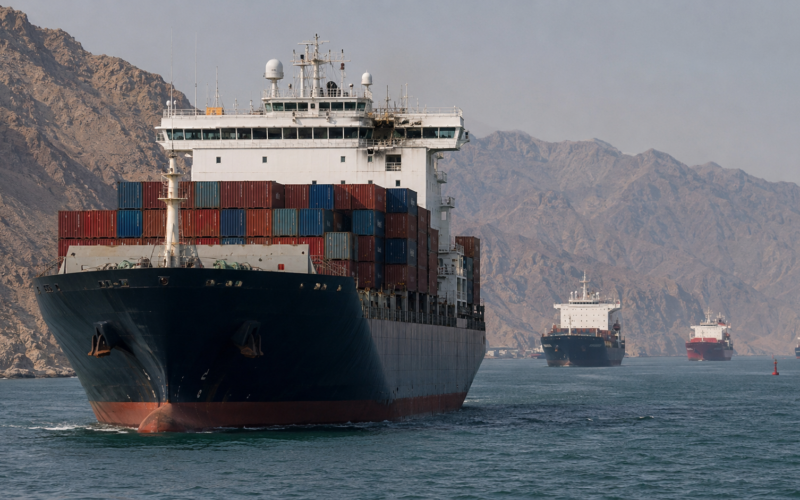
The United Nations International Maritime Organization has suspended an emergency operation designed to move hundreds of stranded vessels and thousands of seafarers out of the Persian Gulf after the container ship Ever Lovely was struck near Oman. Taiwan’s Evergreen Marine Corporation said the Singapore-flagged vessel was hit on its starboard side by an unknown object after passing through the Strait of Hormuz on June 25, 2026. Initial inspections found damaged bridge windows, but the crew, cargo and vessel remained safe, and the ship subsequently left the strait.
Two United States officials attributed the attack to Iran, while a separate United States official said the projectile was a drone operated by Iran’s Islamic Revolutionary Guard Corps. Iran had not publicly acknowledged carrying out the attack when the incident was reported. The United Kingdom Maritime Trade Operations centre confirmed that a commercial vessel had been struck by a projectile off Oman, with no injuries or environmental damage reported.
The Ever Lovely was not participating in the United Nations evacuation framework. International Maritime Organization Secretary-General Arsenio Dominguez nevertheless paused the wider operation to determine whether the security assurances supporting the temporary shipping routes remained reliable. The suspension threatens efforts to free between 500 and 600 vessels trapped inside the Gulf after months of conflict and disruption around the Strait of Hormuz.
The attack also exposes unresolved divisions inside the preliminary United States-Iran ceasefire framework. Iran insists that vessels must use routes authorised by Tehran, while the United Nations, Oman and the United States have been coordinating alternative passages intended to restore navigation and reduce pressure on global energy supplies.
What happened to the Ever Lovely after it travelled through the Strait of Hormuz?
The Ever Lovely, operated by Evergreen Marine Corporation, was travelling close to the coast of Oman after passing through the Strait of Hormuz when it reported being struck. Evergreen Marine Corporation said the vessel had followed a route recommended by the United Kingdom Maritime Trade Operations centre, a British maritime security body that receives incident reports and distributes navigational warnings.
The company described the object that hit the ship as unknown. Damage was concentrated around windows on the vessel’s bridge, the command area from which navigation and ship operations are managed. No crew member was injured, the cargo was not reported damaged, and the vessel remained sufficiently operational to leave the strait safely.
A maritime security source said the ship was probably targeted by a drone. Two United States officials blamed Iran, while an official briefing the Associated Press attributed the incident to a drone operated by the Islamic Revolutionary Guard Corps. Those assessments remained claims by United States officials rather than an admission by Iranian authorities.
The attack occurred hours after Iran warned commercial ships against travelling through routes that it had not approved. Iran’s Persian Gulf Strait Authority said safe passage would not be guaranteed for vessels using unauthorised routes and that shipowners, operators and captains would bear responsibility for the consequences.

Iran’s Islamic Revolutionary Guard Corps Navy separately described the new Oman-side route as unacceptable and dangerous because it had been established without coordination with Tehran. Iranian forces had also ordered two Panama-flagged ships to alter course on June 25, demonstrating that Iran intended to continue asserting operational control over commercial navigation.
Why did the International Maritime Organization suspend its ship evacuation operation?
The International Maritime Organization launched its voluntary evacuation initiative on June 23 after months of negotiation involving Iran, Oman, the United States, coastal governments and the shipping industry. The operation was intended to help commercial vessels and crews leave the Gulf after becoming trapped by military activity, navigational restrictions and the threat of mines.
The framework created two temporary outbound tracks. One passed through Iranian waters, while the second crossed waters coordinated by the Sultanate of Oman and the United States. Vessels were instructed to wait for individual transit directions so that ships would not crowd narrow waiting areas or enter the routes simultaneously.
Approximately 57 ships carrying an estimated 1,100 seafarers had used the framework between June 23 and the morning of June 25. The wider plan could eventually have assisted hundreds of ships carrying around 11,000 seafarers who had been unable to leave the Gulf safely.
Arsenio Dominguez said the initiative would remain paused while the International Maritime Organization reconfirmed the safety guarantees covering vessels on its evacuation list and ships throughout the region. Although the Ever Lovely was outside the formal programme, an attack near one of the developing transit corridors raised doubts about whether commercial operators could rely on existing assurances.
The suspension does not necessarily terminate the evacuation programme permanently. The International Maritime Organization could resume the routes after consultations with Iran, Oman, the United States and maritime companies. However, shipowners are unlikely to participate in large numbers unless they believe naval and political guarantees can protect vessels against drones, missiles, mines and forced course changes.
Why are normal shipping lanes through the Strait of Hormuz still considered unsafe?
The Strait of Hormuz normally uses a Traffic Separation Scheme adopted through the International Maritime Organization to organise inbound and outbound traffic. The system functions like divided road lanes at sea, reducing collision risks in a narrow waterway used by tankers, container ships, bulk carriers and military vessels.
The central routing system has become difficult to use because of the threat of floating mines and military action. Iran said it mined the principal passage after United States and Israeli attacks began on February 28, and at least one mine had reportedly been sighted in the waterway.
Disruption to Automatic Identification System signals has created an additional danger. Commercial ships ordinarily transmit their locations, headings and identities electronically so that other vessels and shore authorities can follow their movements. Signal interference, deliberate shutdowns and fears of being targeted have made it harder to establish an accurate picture of traffic.
Before the conflict, approximately 125 ships crossed the strait each day. Recent movements had recovered to more than 25 vessels daily after falling to around 10 or 11, but traffic remained far below normal levels. The temporary improvement indicated that some shipowners were willing to accept the risk, not that maritime security had been restored.
The Ever Lovely attack could reverse that limited recovery. Even when a strike causes no deaths or major structural damage, it can raise insurance premiums, discourage crews, increase freight rates and persuade operators to delay departures until governments provide clearer security guarantees.
How does Iran’s demand for authorised routes challenge United Nations and Omani navigation plans?
Iran controls the northern shoreline of the Strait of Hormuz and maintains significant military capabilities around the waterway. Tehran therefore argues that international organisations and foreign governments cannot establish safe shipping corridors without Iranian consent and coordination.
The United Nations-backed alternative route was intended to reduce dependence on Iran’s preferred channels by allowing vessels to travel closer to Oman under coordination involving Muscat and Washington. The arrangement offered stranded shipowners another path at a time when the central traffic lanes remained exposed to mines and military enforcement.
Iran’s Persian Gulf Strait Authority has responded by insisting that only Iranian-designated passages carry a guarantee of safety. The authority’s warning suggests that Tehran views control of shipping routes as part of its strategic leverage in negotiations with the United States rather than as a purely technical question of maritime safety.
The legal and operational positions do not align neatly. The Strait of Hormuz contains territorial waters belonging to Iran and Oman, but it is also an international strait used for passage between the Persian Gulf and the open sea. Iran can exert substantial physical control through coastal forces, mines, drones and inspections even when foreign governments dispute the extent of its authority.
The attack has therefore created a test that extends beyond one vessel. If Iran can determine which international routes are safe through threats or attacks, the ceasefire framework may leave Tehran with continuing control over the timing and terms of commercial passage. If the United States and Oman guarantee alternative access, they must demonstrate that the guarantee is operational rather than rhetorical.
Why does the suspension threaten the preliminary United States-Iran peace framework?
The United States and Iran recently signed a memorandum establishing an initial cessation of military operations and a 60-day period for negotiating a broader settlement. Reopening the Strait of Hormuz was one of the most economically important parts of that process because the waterway had become the central pressure point of the conflict.
The preliminary framework has not resolved major disputes involving Iran’s nuclear programme, financial incentives, maritime control and Israel’s military operations in Lebanon. Public statements by Washington and Tehran have also produced conflicting descriptions of what each side accepted.
United States Secretary of State Marco Rubio had warned before the vessel attack that Washington would regard threats to shipping or renewed restrictions in the strait as a serious problem. The United States has presented open passage without Iranian fees or coercive controls as essential to restoring regional and global economic stability.
Iran has taken a narrower position. Tehran appears prepared to permit navigation, but only through channels that preserve an Iranian role in approving and supervising maritime movements. That difference could become a decisive obstacle because reopening the strait means little commercially when vessels remain vulnerable outside routes selected by Iran.
The Ever Lovely incident does not by itself prove that the wider ceasefire has collapsed. No deaths were reported, the ship continued its voyage and the United States had not announced immediate military retaliation. However, the attack shows how a single maritime incident can interrupt humanitarian operations and revive the military tensions that the agreement was intended to reduce.
Why does the Strait of Hormuz remain critical to global oil, gas and commercial shipping?
Before the conflict, the Strait of Hormuz handled around one fifth of global daily oil and liquefied natural gas shipments. Producers including Saudi Arabia, the United Arab Emirates, Kuwait, Iraq and Qatar depend heavily on the waterway to reach customers in Asia, Europe and other markets.
Alternative pipelines can move part of the region’s oil without using the strait, but they cannot replace its full capacity. Liquefied natural gas exports from Qatar are particularly dependent on maritime access through the narrow passage.
Disruption therefore affects much more than companies directly operating in the Gulf. Reduced exports can increase fuel and electricity costs, raise shipping and insurance charges, alter inflation expectations and place pressure on governments that subsidise energy or import large quantities of oil and gas.
There were signs of recovery before the Ever Lovely incident. Saudi Arabian Oil Company resumed loading at the Ras Tanura terminal after a near four-month suspension, while tankers began moving millions of barrels through the strait. South Korea also reported that several of its vessels had successfully exited the area.
Those developments showed that exporters and shipping companies were preparing for a wider reopening. The International Maritime Organization’s suspension now creates uncertainty over whether the improvement can continue safely or whether traffic will again depend on individually negotiated passages and military protection.
What happens next for stranded ships, seafarers and the fragile Hormuz reopening?
The International Maritime Organization must first establish whether Iran, Oman and the United States continue to support the safety commitments underlying the evacuation initiative. The organisation will also need to examine whether the Oman-side route can remain operational after Iran’s warning and the attack on a ship using a British-recommended path.
Stranded vessels may continue travelling independently, but each owner and captain must conduct a separate risk assessment. Commercial operators will consider the presence of mines, the likelihood of drone attacks, insurance coverage, naval support and the ability to communicate with Iranian and Omani authorities.
The hundreds of ships remaining inside the Gulf face growing operational pressures. Seafarers have already spent months aboard vessels unable to follow normal schedules, while operators must manage food, fuel, maintenance, crew changes and medical needs.
Diplomatic attention will focus on whether Iran publicly accepts responsibility, denies involvement or provides new navigational instructions. A denial could leave the attack formally unresolved, while an acknowledgement would place greater pressure on the United States to respond and could undermine the ceasefire negotiations.
The most important short-term indicator will be whether the International Maritime Organization resumes its operation. A rapid restart would suggest that governments have restored minimum security guarantees. A prolonged suspension would indicate that the Ever Lovely attack has exposed a deeper conflict over who controls the world’s most important energy chokepoint.
What are the key takeaways from the Ever Lovely attack and the Hormuz evacuation suspension?
- The Singapore-flagged Ever Lovely, operated by Evergreen Marine Corporation, was struck near Oman on June 25, 2026, after travelling through the Strait of Hormuz on a route recommended by British maritime authorities.
- Evergreen Marine Corporation reported damage to bridge windows on the vessel’s starboard side, but said the crew, cargo and ship remained safe and that the vessel subsequently departed the Strait of Hormuz.
- Two United States officials blamed Iran for the attack, while another United States official attributed the strike to an Islamic Revolutionary Guard Corps drone, but Iran had not publicly accepted responsibility.
- International Maritime Organization Secretary-General Arsenio Dominguez suspended the United Nations evacuation initiative while officials reassessed security assurances for ships participating in the programme and other vessels operating in the region.
- Approximately 57 ships carrying an estimated 1,100 seafarers had used the evacuation framework between June 23 and June 25 before the International Maritime Organization paused further implementation.
- The wider evacuation plan was intended to assist hundreds of vessels and approximately 11,000 seafarers stranded inside the Gulf after military conflict, mines and navigational restrictions disrupted commercial passage.
- Iran has warned that it will not guarantee safe passage outside routes approved by Tehran, directly challenging the alternative corridor coordinated by Oman, the United States and the International Maritime Organization.
- The incident threatens the preliminary United States-Iran peace process because control of the Strait of Hormuz remains unresolved despite commitments to reduce hostilities and restore global energy shipments.
Discover more from Business-News-Today.com
Subscribe to get the latest posts sent to your email.