


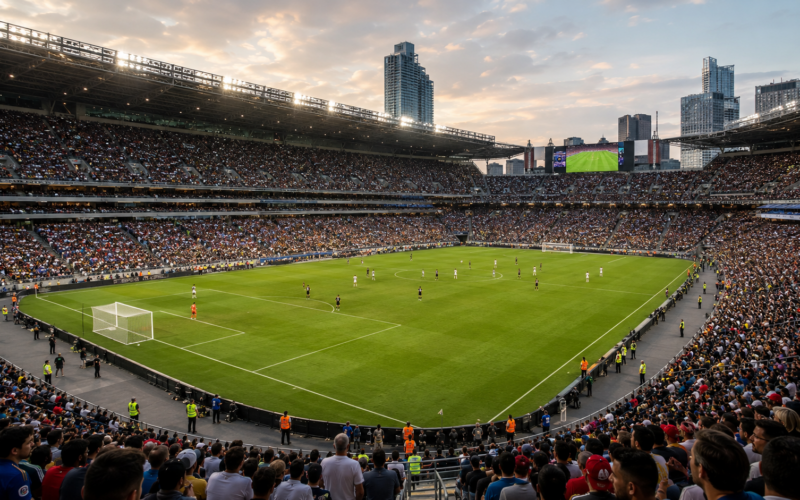
Australia qualified for the FIFA World Cup 2026 Round of 32 after drawing 0-0 with Paraguay in their final Group D match at San Francisco Bay Area Stadium in Santa Clara, California, on Thursday, June 25, 2026. The match finished during the morning of June 26 in India and was watched by an official attendance of 68,827.
The Socceroos controlled 56% of possession, attempted 12 shots and tested Paraguay goalkeeper Orlando Gill five times, but could not convert their territorial advantage. Jackson Irvine, Cristian Volpato and Jordan Bos created Australia’s clearest openings.
Paraguay improved after introducing Mauricio at half-time and threatened through Julio Enciso during the closing stages. Patrick Beach preserved Australia’s clean sheet by saving Mauricio’s stoppage-time effort, while Bos narrowly missed a possible late winner at the opposite end.
The point secured second place for Australia with four points, ahead of Paraguay on goal difference. The United States won Group D with six points, Paraguay finished third with four and Türkiye were eliminated despite defeating the United States in the simultaneous match.
FIFA World Cup 2026 Paraguay 0-0 Australia full match scorecard and key incidents
Why did Australia’s six starting changes improve their control after the United States defeat?
Tony Popovic made six changes after Australia’s 2-0 defeat to the United States. Nestory Irankunda and Connor Metcalfe returned to the starting side, Cristian Volpato entered the attack and Lucas Herrington was selected in the defensive line.
The changes produced greater technical control, particularly on Australia’s right. Bos switched from his normal left-sided role to cover for the injured Jacob Italiano and repeatedly combined with Volpato beyond Paraguay’s midfield.
Australia gained a numerical advantage in central areas because Paraguay defended with five players across the back. Aiden O’Neill, Irvine and Metcalfe could circulate the ball without being placed under constant pressure by Paraguay’s two forwards.
The Socceroos consequently controlled possession and territory during the first half. Their problem was not reaching advanced positions, but converting those positions into clear chances.
Australia’s 12 attempts generated an expected-goals total of only 0.58. The figures showed that Popovic’s changes improved progression and defensive security without completely solving the team’s final-third limitations.
How did Jordan Bos become Australia’s most dangerous player from an unfamiliar position?
Bos normally performs on the left, where he can advance on his stronger foot and deliver from the outside. Against Paraguay, he moved to the right because Italiano was unavailable through injury.
The positional change did not reduce his influence. Bos used his speed to attack the space outside Omar Alderete and forced Paraguay’s midfielders to retreat whenever Australia moved possession towards Volpato.
Gill saved one Bos attempt during the first half, while the wing-back also carried the ball beyond several challenges and created crossing opportunities. Paraguay struggled to decide whether Alderete should leave the defensive line or allow a midfielder to track him.
Bos produced Australia’s best late opportunity in the 89th minute. He collected possession on the right, moved between two defenders and curled a left-footed shot narrowly beyond the far post.
The effort did not produce the winning goal, but his performance underlined Australia’s developing athletic profile. At 23, Bos became the clearest example of the younger group Popovic has trusted during the tournament.
Why did Paraguay’s five-player defence produce a low-risk first half?
Paraguay began in a 5-3-2 without the suspended Miguel Almirón. Gustavo Alfaro prioritised defensive width and protection of the penalty area, knowing a draw would leave his team with four points.
Gustavo Gómez, Juan José Cáceres and Alderete protected the centre, while Gustavo Velázquez and Maidana dropped into the wing-back positions. The structure allowed Australia to possess the ball but limited direct passes into the penalty area.
Gill dealt comfortably with Irvine’s early effort and later stopped shots from Bos and Volpato. None required the type of emergency intervention that would suggest Paraguay’s shape had been completely opened.
The cost was a lack of attacking threat. Paraguay produced only one attempt during the opening half and struggled to move the ball towards Enciso or Ávalos with enough supporting runners.
Australia therefore controlled the first 45 minutes without scoring, while Paraguay maintained the result most likely to preserve their qualification hopes.
How did Mauricio’s half-time introduction give Paraguay a stronger attacking route?
Alfaro replaced Maidana with Mauricio at half-time and reorganised his team into a less conservative structure. The substitution introduced another player capable of carrying possession and shooting from distance.
Mauricio attempted two shots, both on target, after entering. His willingness to move into the spaces around Australia’s midfield also reduced the burden placed on Enciso.
Paraguay’s increased attacking ambition became visible during the opening phase of the second half. Enciso began receiving the ball higher, while Australia were forced to defend more often instead of circulating possession without pressure.
Mauricio’s best opportunity came during stoppage time when the ball fell to him near the edge of the penalty area. His low shot lacked enough power to beat Beach, who collected it securely.
The substitution improved Paraguay’s threat but did not transform the quality of their chances. Their seven attempts produced only 0.25 expected goals, illustrating the continued absence of a clear opening inside Australia’s penalty area.
Why could Julio Enciso not convert his influence into a decisive goal?
Enciso was Paraguay’s principal creative player and attempted to carry the ball through Australia’s defensive block whenever he received possession. His dribbling briefly changed the tempo during a match dominated by cautious passing.
Australia responded by surrounding him with multiple defenders. Circati stepped forward from the back three, while O’Neill and Irvine recovered towards the same central zone.
Enciso still created moments of concern. He moved beyond the first pressure on several occasions and dragged a low shot wide during Paraguay’s strongest second-half spell.
The problem was the lack of supporting movement. With Ávalos isolated and Paraguay’s wide defenders starting from deep positions, Enciso frequently reached the final third without a clear passing option.
His individual quality was visible, but Australia’s numerical concentration ensured he could not convert those carries into a shot from a central, high-value position.
How did Australia’s young defensive unit protect the result under late pressure?
Herrington became Australia’s youngest player to start a FIFA World Cup match. He joined Circati and Harry Souttar in a back three that combined youth with Souttar’s aerial experience.
The structure remained compact throughout the match. Circati followed Enciso when the attacker moved between the lines, Herrington protected the left channel and Souttar controlled direct deliveries towards Paraguay’s forwards.
Beach faced only two shots on target. His late save from Mauricio was important, but Australia’s defenders prevented Paraguay from creating a one-on-one opportunity or a clear header inside the six-yard area.
Popovic shifted towards a deeper 5-4-1 during the closing stages. Yengi replaced Irankunda and Okon-Engstler entered for Irvine as Australia attempted to protect central spaces and retain enough energy to counterattack.
The defensive performance completed Australia’s second clean sheet of the tournament. It also secured consecutive knockout-stage appearances for the first time in the country’s FIFA World Cup history.
Why did both teams become increasingly cautious during the final 20 minutes?
Australia knew a draw guaranteed second place. Paraguay also understood that four points would leave them strongly positioned in the third-place ranking, even though qualification was not immediately certain.
Those incentives reduced the willingness to commit large numbers forward. Australia frequently retained possession across the defensive line, while Paraguay declined to press aggressively unless the ball entered midfield.
The match still produced late openings because fatigue increased the distance between the lines. Enciso and Mauricio threatened for Paraguay, while Bos and Yengi found space during Australian counterattacks.
Neither team accepted the level of risk required to create a sustained late siege. Defenders remained behind the ball, midfielders committed tactical fouls and both coaches used substitutions partly to manage the result.
The final expected-goals total of 0.83 was the lowest recorded in any match during the tournament up to that point. It reflected two teams prioritising qualification security over attacking volume.
How did Türkiye’s victory over the United States affect the final Group D table?
The United States had already secured first place before facing Türkiye and remained top despite losing 3-2. Their two earlier victories gave them six points and a goal difference of plus four.
Australia and Paraguay both completed the group with four points. Their direct meeting ended level, so Australia’s superior overall goal difference placed the Socceroos second.
Türkiye’s late victory lifted Vincenzo Montella’s team to three points. However, earlier defeats against Australia and Paraguay ensured they remained fourth and were eliminated.
Paraguay entered the third-place ranking with four points and a minus-two goal difference. The South American side needed the remaining groups to be completed before learning whether that record was sufficient.
FIFA World Cup 2026 Group D final points table
What does Australia’s Group G matchup mean for the Round of 32?
Australia will face the team finishing second in Group G at Dallas Stadium on Friday, July 3. Egypt, Iran, Belgium and New Zealand remained involved in the group’s qualification race before its final matches.
The eight-day gap gives Popovic time to recover injured players and decide whether the experimental selection used against Paraguay should be retained. Bos’ performance on the right and Herrington’s composure have created genuine competition for places.
Australia’s attacking output remains the principal concern. The Socceroos scored only two goals in Group D, both during their opening victory against Türkiye, and failed to score against the United States or Paraguay.
The defensive structure provides a stronger foundation. Australia conceded twice across three games and recorded two clean sheets, showing they can remain competitive even when the attack lacks efficiency.
Their Round of 32 opponent is likely to offer greater individual quality than Paraguay. Australia will need to preserve their compactness while producing more decisive actions from Irankunda, Metcalfe, Hrustić and Bos.
What must happen for Paraguay to qualify through the third-place ranking?
Paraguay completed Group D with four points, two goals scored, four conceded and a goal difference of minus two. That total placed them provisionally among the leading third-placed teams.
Four points often provides a strong route into a format where eight of the 12 third-placed teams advance. Paraguay nevertheless could not receive immediate confirmation because several groups still had final fixtures remaining.
Teams finishing third with five or six points would move above Paraguay automatically. Other four-point teams could also rank higher through goal difference, goals scored and the remaining FIFA tiebreakers.
Alfaro’s team therefore left Santa Clara without knowing whether their tournament would continue. Their defensive recovery after conceding four times to the United States gave them a realistic chance, but their negative goal difference left some vulnerability.
Key takeaways from Paraguay vs Australia at FIFA World Cup 2026
- Australia drew 0-0 with Paraguay and qualified automatically for the FIFA World Cup 2026 Round of 32.
- The Socceroos finished second in Group D with four points and a neutral goal difference.
- Paraguay also finished with four points but placed third because of an inferior goal difference.
- Australia controlled 56% possession and attempted 12 shots compared with Paraguay’s seven.
- Orlando Gill made five saves to preserve Paraguay’s clean sheet.
- Patrick Beach denied Mauricio during stoppage time to protect Australia’s qualification result.
- Jordan Bos was Australia’s most dangerous player despite operating from an unfamiliar right-sided position.
- Lucas Herrington became Australia’s youngest player to start a FIFA World Cup match.
- Australia recorded their second clean sheet of the group stage and reached consecutive knockout stages for the first time.
- Paraguay entered the best-third-place ranking but had to await the remaining group results.
Discover more from Business-News-Today.com
Subscribe to get the latest posts sent to your email.