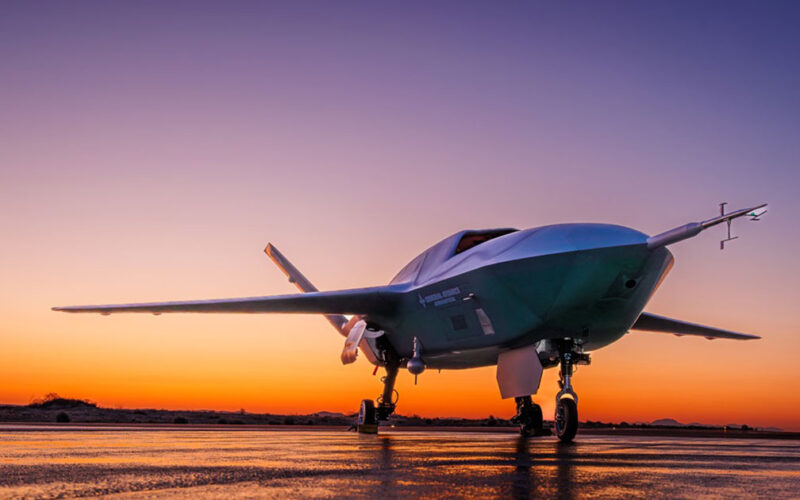
General Atomics Aeronautical Systems and Anduril Industries have secured engineering, manufacturing development and production contracts from the U.S. Air Force for the first increment of its Collaborative Combat Aircraft programme. General Atomics Aeronautical Systems will produce the FQ-42, while Anduril Industries will manufacture the FQ-44, moving both semi-autonomous fighter aircraft from competitive prototypes into full-scale production. The contract values and initial aircraft quantities were not disclosed, limiting immediate financial visibility for the two privately held companies. However, the U.S. Air Force intends to acquire more than 150 combat-capable Collaborative Combat Aircraft by the end of 2030 and approximately 1,000 aircraft over the longer term. The awards therefore represent a potentially defining shift in military aerospace procurement, defence manufacturing and the balance between traditional prime contractors and software-led challengers.
The June 17, 2026 awards were made four months ahead of the U.S. Air Force’s original schedule, indicating that the service considers both aircraft sufficiently mature to enter manufacturing. General Atomics Aeronautical Systems said production of the FQ-42 was already underway, while Anduril Industries had begun building the FQ-44 at its Arsenal-1 manufacturing complex in Ohio before the formal production decision.
Speed is central to the programme’s strategic significance. The U.S. Air Force selected General Atomics Aeronautical Systems and Anduril Industries to build production-representative aircraft in 2024, with the General Atomics YFQ-42A reaching its first flight in August 2025 and the Anduril YFQ-44A following in October 2025. Moving from prototype selection to production in slightly more than two years is unusually fast for a combat aviation programme, particularly one involving autonomous flight, weapons integration and human-machine teaming.
Why are the U.S. Air Force CCA production contracts strategically important despite their undisclosed value?
The absence of a disclosed contract value means the awards cannot yet be evaluated like a conventional aerospace order. Investors, suppliers and competitors do not know how many aircraft are included in the initial production lot, how payments are structured or how revenue is divided between engineering work and aircraft deliveries.
That uncertainty should not obscure the industrial significance. The contracts establish General Atomics Aeronautical Systems and Anduril Industries as the first production airframe suppliers for a programme that could eventually involve approximately 1,000 autonomous combat aircraft. Even a limited initial order can create an advantage because early manufacturers shape production standards, maintenance concepts, software interfaces and operational doctrine.
The awards also validate a new competitive structure inside the U.S. defence market. General Atomics Aeronautical Systems brings decades of unmanned aircraft experience through platforms such as the Predator, Reaper and Gray Eagle. Anduril Industries represents a newer defence technology model built around privately financed development, software-defined systems and manufacturing designed for rapid scaling.
Selecting both companies reduces dependence on a single airframe and allows the U.S. Air Force to compare production costs, reliability and operational performance. It also preserves competitive pressure after the prototype stage, rather than allowing an early winner to become the uncontested supplier for the programme’s entire life.
The dual award could create a continuing series of production competitions. The U.S. Air Force has described Collaborative Combat Aircraft as an incremental programme, meaning later batches may introduce new designs, payloads, engines or autonomy systems. General Atomics Aeronautical Systems and Anduril Industries have won the first industrial round, but neither has secured a permanent monopoly.
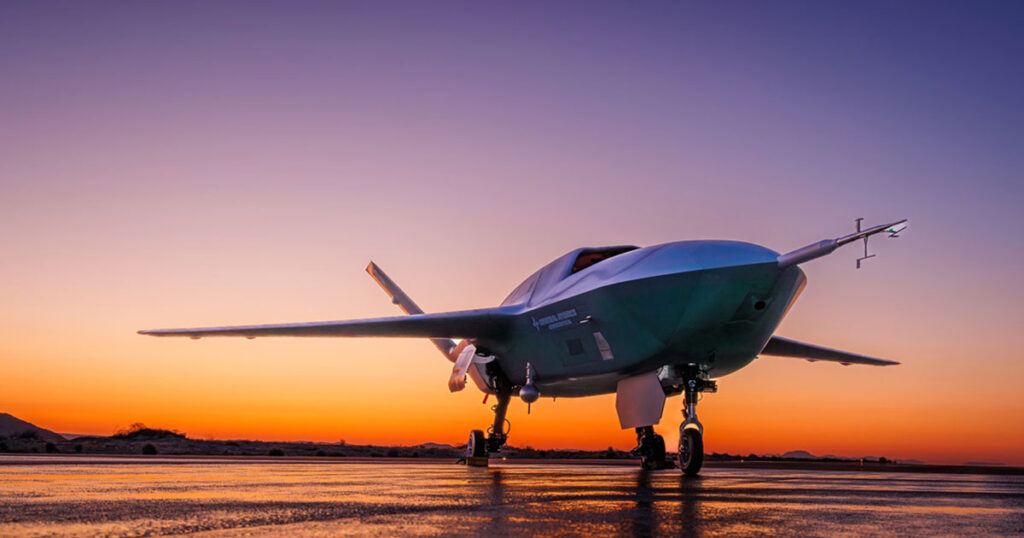
How will the FQ-42 and FQ-44 change the economics of U.S. combat aviation?
Collaborative Combat Aircraft are intended to operate alongside crewed fighters, extending sensor coverage, carrying weapons, conducting electronic warfare and increasing the number of aircraft available for high-risk missions. The concept is not to replace every piloted fighter with a drone, but to create mixed formations in which a smaller number of crewed aircraft direct a larger autonomous force.
This model addresses a persistent problem in military aviation. Advanced fighters have become increasingly capable, but they have also become expensive to develop, purchase, maintain and replace. A force composed only of premium crewed aircraft can struggle to generate enough mass for a prolonged conflict, particularly across the enormous distances of the Indo-Pacific.
Autonomous fighters offer a possible middle ground between costly crewed aircraft and cheap one-way attack drones. The FQ-42 and FQ-44 are expected to be reusable, fast and capable of carrying sophisticated sensors or weapons, but affordable enough to be deployed in greater numbers and exposed to risks that commanders would hesitate to accept with piloted aircraft.
Affordability remains an objective rather than a proven outcome. Uncrewed aircraft do not require cockpits, ejection seats or onboard life-support systems, but they still need engines, secure communications, advanced sensors, weapons integration and resilient autonomy. Those components can push costs higher, particularly when the programme moves from controlled testing into combat-ready production.
The strongest economic case may emerge from mission specialisation. A Collaborative Combat Aircraft configured for sensing does not necessarily require the same equipment as one designed for air-to-air combat or electronic attack. Modular aircraft could therefore be produced in different variants without forcing every unit to carry the most expensive possible configuration.
General Atomics Aeronautical Systems has positioned the FQ-42 within a broader family of aircraft that could support surveillance, air superiority and strike missions. Its modular design and common core could reduce development costs if different mission variants reuse engines, structures, manufacturing tooling and software interfaces.
Why is the U.S. Air Force buying autonomy software separately from the aircraft hardware?
The most disruptive part of the Collaborative Combat Aircraft programme may not be the aircraft. It may be the decision to procure mission autonomy separately from the airframes.
Traditional military aircraft programmes frequently bind hardware and software to a single prime contractor. That structure can simplify accountability, but it may also create vendor dependence, slow upgrades and make it expensive to introduce technology from competing suppliers.
The U.S. Air Force has instead created a six-year mission autonomy contract pool involving Anduril Industries, General Atomics Aeronautical Systems, Lockheed Martin Corporation, Northrop Grumman Corporation, RTX Corporation’s Collins Aerospace business and Shield AI. Anduril Industries, Collins Aerospace and Shield AI received initial production options for the first six-month competition phase.
A second competitive phase will follow, with the U.S. Air Force planning to select the primary autonomy provider for the first Collaborative Combat Aircraft increment by the summer of 2027. The service can also acquire software licences from other approved vendors during the six-year contract period if alternative systems offer better performance or affordability.
This arrangement turns autonomy into a competitive product rather than a permanently embedded feature of one aircraft. Software developed by one supplier could potentially operate on an airframe manufactured by another, provided both comply with the government-owned Autonomy Government Reference Architecture.
The strategy could shorten upgrade cycles because the U.S. Air Force would not need to redesign the entire aircraft each time mission software improves. It could also prevent a hardware supplier from using proprietary interfaces to block competitors.
Integration risk is the obvious counterweight. Software portability is easier to promise than to achieve across aircraft with different flight characteristics, sensors, weapons and processing systems. Government ownership of the architecture may reduce vendor lock-in, but the U.S. Air Force will still need rigorous certification, cybersecurity testing and configuration control.
What do the awards mean for Anduril Industries and its $61 billion private valuation?
The FQ-44 contract provides industrial validation for Anduril Industries at a sensitive point in the company’s growth. The defence technology company raised $5 billion in May 2026 at a valuation of approximately $61 billion, doubling its valuation as private investors increased exposure to autonomous weapons, defence software and military manufacturing.
That valuation creates substantial expectations. Anduril Industries must show that it can convert venture capital, technology demonstrations and prototype awards into repeatable production revenue. Winning a production contract for a combat aircraft moves the company closer to that objective, but delivery performance will matter more than the announcement.
The FQ-44 will be produced at Arsenal-1 near Columbus, Ohio. Anduril Industries has described the campus as a hyperscale facility capable of manufacturing tens of thousands of autonomous defence systems annually across multiple product categories. The broader site is expected to involve approximately $1 billion of investment and support as many as 4,000 jobs over the next decade.
Arsenal-1 is central to Anduril Industries’ argument that defence products can be manufactured more like commercial technology. The company is attempting to design systems and production lines together, use common components across product families and invest in capacity before receiving every associated government order.
That model can accelerate delivery, but it transfers more financial risk to the contractor. Traditional defence companies often expand manufacturing only after receiving long-term procurement commitments. Anduril Industries is spending in anticipation of future volume, meaning underutilised capacity could become expensive if programmes are reduced, delayed or redirected.
The production award reduces that risk but does not eliminate it. The initial quantity remains undisclosed, and the U.S. Air Force’s long-term goal of 1,000 aircraft is not the same as a funded order for 1,000 units. Annual appropriations, testing results and future strategic priorities will determine how much of the ambition becomes contracted revenue.
How does General Atomics benefit from moving the FQ-42 into full-scale production?
General Atomics Aeronautical Systems enters the programme with a different commercial position. It is not trying to prove that it can become a defence manufacturer. It is trying to extend its unmanned aircraft franchise into a faster and more demanding category of combat aviation.
The company has accumulated more than nine million flight hours across its unmanned aircraft portfolio. That operational experience gives General Atomics Aeronautical Systems an advantage in flight controls, ground systems, maintenance, customer training and the regulatory complexities surrounding unmanned operations.
The FQ-42 nevertheless represents a significant technical transition. Aircraft such as the MQ-9 Reaper are designed primarily for endurance, surveillance and strike missions in relatively permissive airspace. Collaborative Combat Aircraft must operate at higher speed, coordinate with crewed fighters and survive in environments containing advanced aircraft, surface-to-air missiles and electronic warfare.
General Atomics Aeronautical Systems developed and flew the FQ-42 within 15 months of the initial contract award. The company has said manufacturing was already underway when the production award was announced, suggesting it invested early in tooling, suppliers and production planning.
Its San Diego manufacturing base could benefit from a multi-year production ramp, while the FQ-42 may also create opportunities for engine suppliers, composite manufacturers, electronics providers and weapons-integration specialists. Suppliers that prove capable of supporting affordable, high-rate aircraft production could gain positions on later Collaborative Combat Aircraft increments or related U.S. Navy and Marine Corps programmes.
General Atomics Aeronautical Systems has already been selected to support U.S. Navy and U.S. Marine Corps collaborative aircraft design efforts. Success with the Air Force could therefore create a family of opportunities across multiple services, although each service will impose different requirements for carrier operations, expeditionary deployment and communications.
Could Anduril and General Atomics weaken the dominance of traditional aerospace primes?
The airframe awards are a notable competitive setback for established fighter manufacturers, but they do not remove traditional primes from the market. Lockheed Martin Corporation, Northrop Grumman Corporation and RTX Corporation remain involved through the autonomy software competition, while their sensors, engines, weapons and mission systems may appear across the aircraft supply chain.
The programme nevertheless demonstrates that future combat aircraft competitions may no longer be limited to companies with existing crewed fighter production lines. General Atomics Aeronautical Systems and Anduril Industries approached the requirement from unmanned aviation and defence software rather than adapting a traditional fighter business.
This creates pressure on incumbent primes to shorten development cycles and reduce dependence on proprietary systems. If the FQ-42 and FQ-44 reach production faster and at lower cost than conventional programmes, customers may question why every new military aircraft requires a decade-long development pathway.
The distinction should not be exaggerated. Collaborative Combat Aircraft are smaller and less complex than crewed fighters. They do not carry pilots, and their mission requirements are deliberately narrower. Comparing their development speed directly with a new piloted fighter programme would overlook major differences in safety, survivability and certification.
However, the procurement philosophy is transferable. Continuous competition, open architectures and separate software contracting could spread into missiles, electronic warfare, naval systems and ground vehicles. The real threat to incumbents is not that Anduril Industries or General Atomics Aeronautical Systems will replace every traditional prime, but that government customers will demand similar speed and modularity across more programmes.
What manufacturing and supply-chain risks could slow the U.S. autonomous fighter programme?
The transition from prototypes to production will expose risks that flight demonstrations cannot fully reveal. Building a small number of test aircraft relies on specialist teams and carefully managed components. Producing dozens or hundreds requires repeatable processes, stable suppliers, workforce depth and predictable quality.
Engine availability may become one constraint. The Collaborative Combat Aircraft programme requires propulsion systems that balance speed, range, cost and production capacity. Any dependence on a small number of engine suppliers could create bottlenecks as aircraft output increases.
Electronics and secure communications present another risk. Collaborative Combat Aircraft must exchange information with crewed fighters and other platforms while operating under electronic attack. Communications systems must be capable enough to support coordination but resilient enough to continue operating when links are degraded or denied.
Weapons integration will add cost and complexity. The aircraft must safely carry, release and potentially employ weapons while autonomous software interprets mission objectives and changing battlefield conditions. Technical success will not depend only on whether an aircraft can fly without a pilot. It will depend on whether the whole system can function reliably within command rules.
Cybersecurity will be inseparable from airworthiness. An autonomous combat aircraft could become ineffective if adversaries disrupt its software, data links or navigation. Frequent software updates may improve capability, but they also require continuous testing to ensure that one upgrade does not create unexpected behaviour elsewhere in the system.
The U.S. Air Force’s decision to link software fees partly to operator feedback and combat performance could strengthen accountability. It could also create contractual disputes over how performance is measured, particularly when results depend on the interaction between airframe, software, sensors and external networks.
How could Collaborative Combat Aircraft reshape Indo-Pacific and allied procurement?
The programme is designed for contested environments where crewed aircraft face dense air defences and long operating distances. Those conditions closely match U.S. planning for the Indo-Pacific, where aircraft may need to operate across dispersed bases and wide maritime areas.
Collaborative Combat Aircraft could increase the number of sensors and weapons available to commanders without requiring a proportional increase in pilots. They may also allow crewed aircraft to remain farther from the most heavily defended areas while autonomous platforms move closer to threats.
Allied interest is likely if the first aircraft demonstrate credible performance and manageable costs. Countries operating the Lockheed Martin F-35 or developing next-generation combat aircraft will face similar questions about force size, pilot shortages and survivability.
Export potential should not be assumed, however. Autonomous combat aircraft involve sensitive technologies, including artificial intelligence, electronic warfare, secure networking and weapons employment. U.S. export controls and operational-security concerns may limit which capabilities are released and to which partners.
Different allies may also prefer domestically developed systems. Australia has invested in Boeing’s MQ-28 Ghost Bat, while European and Asian manufacturers are developing their own collaborative aircraft. The U.S. programme may therefore shape international standards even where the FQ-42 or FQ-44 is not directly exported.
For General Atomics Aeronautical Systems and Anduril Industries, international demand could eventually expand production volumes and reduce unit costs. The more immediate commercial opportunity remains the U.S. Air Force, followed by potential requirements from the U.S. Navy and Marine Corps.
What must happen next before FQ-42 and FQ-44 become operational combat assets?
The first priority is converting early manufacturing into accepted production aircraft. Both companies must demonstrate repeatable quality, maintain affordability and deliver aircraft that match the configurations tested during development.
Weapons integration, mission-system testing and autonomous teaming will continue alongside manufacturing. The U.S. Air Force must verify not only individual aircraft performance but also the behaviour of formations involving multiple autonomous aircraft and crewed fighters.
The software competition will be another decisive milestone. Anduril Industries, Collins Aerospace and Shield AI will participate in the initial six-month production phase, after which the U.S. Air Force will evaluate progress and begin a second competition. Selection of the primary Increment 1 autonomy provider is planned for the summer of 2027.
Budget support will determine production scale. The objective of more than 150 combat-capable aircraft by the end of the decade implies a rapid manufacturing ramp, but annual procurement quantities will depend on congressional appropriations and programme performance.
Operational doctrine must also catch up with engineering. Pilots and commanders will need clear procedures for assigning missions, controlling formations and responding when autonomous systems behave unexpectedly or lose communications.
The awards prove that the U.S. Air Force is prepared to buy the first generation of autonomous fighters. They do not yet prove that the aircraft can deliver affordable mass, survive a contested environment or operate safely at scale. General Atomics Aeronautical Systems and Anduril Industries have won the opportunity to answer those questions in production, which is where aerospace ambition usually meets the less glamorous discipline of factory output.
Key takeaways on the U.S. Air Force CCA awards and the future autonomous fighter market
- General Atomics Aeronautical Systems and Anduril Industries have moved the FQ-42 and FQ-44 from prototype development into full-scale production.
- The contract values and initial quantities remain undisclosed, limiting immediate revenue visibility for both privately held companies.
- The U.S. Air Force plans to field more than 150 combat-capable Collaborative Combat Aircraft by 2030 and approximately 1,000 over the longer term.
- Awarding production contracts four months early signals confidence in aircraft maturity, but manufacturing scale and operational reliability remain unproven.
- Procuring autonomy software separately from aircraft hardware could reduce vendor lock-in and create recurring competition throughout the programme.
- Anduril Industries must use the contract to justify its $61 billion valuation and substantial investment in the Arsenal-1 manufacturing campus.
- General Atomics Aeronautical Systems can use its unmanned aviation experience to expand from surveillance aircraft into high-speed autonomous combat systems.
- Traditional aerospace primes remain involved through autonomy software and the wider supply chain, but the airframe awards increase competitive pressure.
- Export potential exists, although artificial intelligence, electronic warfare and weapons technologies will face stringent approval and security controls.
- The programme’s success will depend on production cost, software integration, cybersecurity, weapons testing and sustained congressional funding.
Discover more from Business-News-Today.com
Subscribe to get the latest posts sent to your email.