
Building a uranium mine creates an unusual financing problem. Developers can spend years proving resources, obtaining permits and completing engineering work before receiving production revenue, while lenders and equity investors remain exposed to commodity prices, construction risk and the timing of long-term utility demand.
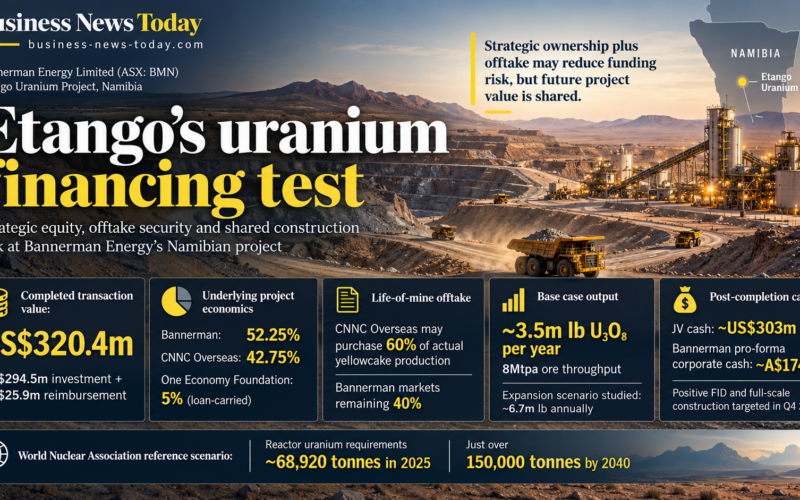
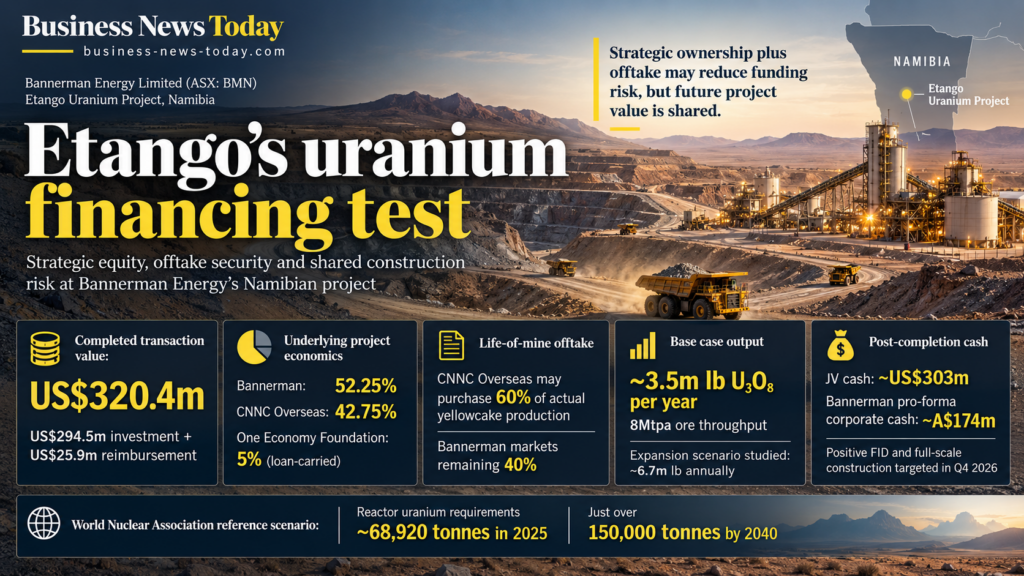
Bannerman Energy Limited (ASX: BMN) has chosen a different route for its Etango Uranium Project in Namibia. On September 24, the company completed a strategic transaction with CNNC Overseas Limited under which the Chinese nuclear group invested US$294.5 million into Bannerman Energy (UK) Limited and paid Bannerman Energy Limited a further US$25.9 million as reimbursement for eligible project expenditure, taking the completed transaction value to US$320.4 million.
The structure does not mean CNNC Overseas Limited owns 45% of Etango directly. It owns 45% of the joint-venture company that in turn owns 95% of Etango, resulting in underlying project economic interests of 52.25% for Bannerman Energy Limited, 42.75% for CNNC Overseas Limited and 5% for Namibia’s One Economy Foundation on a loan-carried basis.
That distinction is central to the financing economics. Bannerman Energy Limited has surrendered a substantial share of future project value, but it has also converted a strategic customer into a major project owner and funding partner before the mine reaches full-scale construction.
Why can strategic equity be more valuable than conventional debt for a uranium developer?
Traditional project debt allows an existing shareholder to retain more ownership if the mine performs well, but debt introduces interest expense, repayment obligations, covenants and refinancing risk before a project has established an operating history.
Bannerman Energy Limited describes the CNNC Overseas Limited structure as enabling debt-free construction of Etango. That is the company’s characterisation of the current financing pathway rather than a guarantee that no debt could ever be used elsewhere in the corporate structure, but the joint venture itself begins with substantial cash and a strategic partner committed to funding future requirements in proportion to ownership.
Following completion, Bannerman Energy Limited and CNNC Overseas Limited are expected to contribute future joint-venture capital expenditure and operating costs in their respective 55% and 45% proportions at the joint-venture level. Bannerman Energy Limited said joint-venture cash was approximately US$303 million after completion, while its own estimated pro-forma corporate cash was approximately A$174 million excluding liquid investments and joint-venture cash.
The advantage is therefore not that Etango suddenly requires no additional money. It is that the construction burden is shared with a partner whose economic interests are directly aligned with bringing the mine into production.
Why does CNNC Overseas Limited receive 60% of Etango’s future uranium output?
The financing arrangement also includes an offtake component. CNNC Overseas Limited has a life-of-mine entitlement to purchase 60% of Etango’s actual yellowcake production, while Bannerman Energy Limited controls marketing of the remaining 40%.
That 60% figure should not be confused with ownership. CNNC Overseas Limited’s underlying economic interest in Etango is 42.75%, yet it can purchase a larger proportion of physical production under the offtake arrangement.
Pricing is intended to be arm’s-length and market based, using uranium-market benchmarks without contractual floors or ceilings, according to Bannerman Energy Limited. The structure therefore provides CNNC Overseas Limited with long-term access to physical uranium rather than automatically transferring 60% of Etango’s revenue or profit to the strategic partner.
For Bannerman Energy Limited, having a cornerstone buyer already associated with most planned production can reduce the volume that must be placed through additional contracts during the early construction period. The economic value will ultimately depend on final offtake documentation, uranium prices and how the market-based pricing mechanism operates in practice.
Why are nuclear-fuel buyers becoming more willing to support new uranium mines?
The uranium supply chain is increasingly being shaped by the expected expansion of nuclear generation and concern over future mine availability. The World Nuclear Association estimates global reactor uranium requirements at approximately 68,920 tonnes of uranium in 2025 and projects requirements of just over 150,000 tonnes by 2040 in its reference scenario.
The association also estimates that mined uranium supplied about 90% of reactor requirements in 2024, up from approximately 78% in 2022, while warning that depletion at existing mines in the middle of the next decade increases the need for new primary supply. Those figures are industry projections rather than guaranteed future demand, but they help explain why nuclear companies are seeking greater visibility over future uranium sources.
For a strategic buyer, taking project equity can therefore serve two purposes. It provides exposure to project economics while simultaneously helping secure physical material that may become more strategically important if nuclear capacity expands as currently planned.
For the mine developer, the same transaction can solve part of the financing challenge. The tension is that greater funding certainty is obtained by sharing both ownership and future production access.
How large could Etango become if the project reaches production?
Etango’s definitive feasibility configuration is based on approximately 8 million tonnes per annum of ore throughput and average annual uranium output of about 3.5 million pounds of U3O8. Bannerman Energy Limited has also completed a 2024 scoping study examining potential expansion to approximately 6.7 million pounds annually, but that higher figure remains an expansion scenario rather than the current base-case production capacity.
The project already has its mining licence, awarded in December 2023, and Bannerman Energy Limited says all environmental approvals required for the proposed mine and external infrastructure have been received. Early works were progressing when the financing transaction completed.
A full final investment decision had not yet been announced in the completion disclosure. Bannerman Energy Limited and its partner were targeting a positive final investment decision and commencement of full-scale construction during the fourth quarter of 2026, meaning the project should not yet be described as having entered full construction merely because the financing has closed.
That chronology matters because financing completion removes one major uncertainty but does not eliminate execution risk. Construction, ramp-up, uranium recovery performance, cost control and eventual commercial production remain future milestones.
Does the Etango structure reduce risk or simply transfer value to the strategic partner?
It does both, which is why the transaction is more interesting than a conventional capital raise. Bannerman Energy Limited has materially reduced the amount of project funding it must provide alone, but shareholders now have exposure to 52.25% of Etango’s project economics rather than the much larger interest held before the joint venture.
The relevant comparison is therefore not between keeping 100% and keeping 52.25% in isolation. It is between owning a larger share of a project that still requires substantial capital and owning a smaller share of a project supported by a well-funded strategic partner, significant joint-venture cash and a cornerstone offtake arrangement.
The quality of the trade-off will become clearer only after final investment approval, construction and production. If Etango enters operation close to planned cost and schedule, the financing structure could demonstrate the value of sacrificing ownership to reduce funding risk; if construction economics deteriorate, both partners may still face additional capital requirements.
This is why project-level dilution should not automatically be analysed like ordinary corporate dilution. The strategic investor is bringing capital, offtake demand and operating alignment directly into the asset that requires financing.
What does Bannerman Energy Limited’s share price say after transaction completion?
Bannerman Energy Limited closed at A$3.34 on October 2 compared with A$3.84 on September 24, a decline of approximately 13% across the period immediately surrounding completion. The shares had traded at A$4.03 on September 23, showing that transaction completion did not produce a straightforward upward rerating in the equity market.
That movement should not automatically be interpreted as a negative verdict on the CNNC Overseas Limited deal because uranium prices, broader mining sentiment and company-specific expectations can all influence the stock. It does demonstrate that investors are still pricing risks beyond financing completion.
The milestones now become more concrete: a final investment decision, commencement of full-scale construction, capital-cost performance, uranium-market conditions and eventual ramp-up toward the base-case 3.5 million-pound annual production profile.
Etango may therefore become an important test of a uranium-financing model that links the buyer, financier and project owner together. In a market where future reactors need secure fuel and mines need large amounts of capital before producing it, strategic ownership and offtake could increasingly become two sides of the same transaction.
Discover more from Business-News-Today.com
Subscribe to get the latest posts sent to your email.