

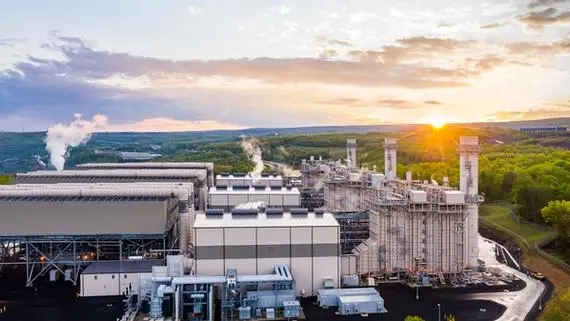
Equinor ASA (OSE/NYSE: EQNR) has agreed to pay $940 million for 87.71% of the Class A shares in Pennsylvania’s 1,483MW Lackawanna Energy Center, extending the Norwegian energy group from large-scale Appalachian natural gas production into one of the most important electricity markets in the United States. The combined-cycle gas plant generates close to 9TWh of electricity annually and operates at an average heat rate of 6,375 Btu/kWh, while its location places it close to an Equinor Appalachian gas position producing more than 1.7 Bcf/d. The transaction does not give Equinor a straightforward 87.71% ownership interest in the entire plant, because Invenergy retains the remaining Class A shares and all Class B shares and will continue operating the facility, while the Class A securities acquired by Equinor carry preferential dividend rights. That distinction makes the transaction less about conventional plant ownership and more about acquiring an early cash-flow position in dispatchable generation at a time when PJM expects electricity demand to accelerate materially. The strategic question is whether Equinor can combine gas production, trading and power-generation exposure into a more valuable integrated US business as data centers and industrial development increase competition for electricity.
What exactly is Equinor buying for $940 million at the Lackawanna Energy Center?
Equinor will acquire 87.71% of Lackawanna’s Class A shares from funds managed by Global Infrastructure Partners, part of BlackRock. The announced $940 million consideration remains subject to a potential reduction at closing, and completion requires customary regulatory approvals. Invenergy AMPCI Thermal Power LLC will retain the remaining Class A shares and 100% of the Class B shares, while Invenergy Services continues managing and operating the plant.
That ownership structure requires precision when discussing valuation. Dividing $940 million by 87.71% to produce an implied value for 100% of Lackawanna’s equity would assume that the Class A and Class B securities have identical economics, which Equinor’s disclosure does not support. The Class A shares have preferential dividend rights, and Equinor specifically describes the investment as providing upfront preferred cash flow, long-term cash-generation visibility and investor protection mechanisms.
A safer scale comparison is that the $940 million purchase price equals about $634,000 for every megawatt of gross plant capacity. Even that figure is not an enterprise-value-per-megawatt multiple because Equinor is acquiring a particular class of equity rather than buying the facility outright. What it does show is that Equinor is gaining material economic exposure to nearly 1.5GW of existing generation for less than $1 billion while avoiding the development and construction period associated with building a comparable greenfield plant.
The transaction also provides immediate operating exposure. Lackawanna began commercial operations in January 2019, so Equinor is buying into an established facility rather than accepting several years of permitting, procurement and construction risk before cash generation begins.
Why does Lackawanna fit unusually well beside Equinor’s 1.7 Bcf/d Appalachian gas position?
Equinor’s Appalachian Basin interests produce more than 1.7 billion cubic feet of natural gas per day into the northeastern United States. The company describes the non-operated position as one of its largest gas assets globally, making the region strategically important even before Lackawanna is added to the portfolio.
Buying exposure to a nearby gas-fired generator does not mean Equinor will simply pipe its own molecules directly into Lackawanna. Gas sourcing, pipeline capacity, trading arrangements and power-market dispatch determine physical flows, and the acquisition announcement does not disclose a dedicated Equinor gas-supply agreement with the plant. The strategic connection is nevertheless important because Equinor now has meaningful economic exposure on both sides of the gas-to-power value chain in the same regional market.
The upstream business benefits when northeast gas demand strengthens, while a gas-fired generating asset can benefit when power prices and capacity values compensate adequately for fuel costs. Equinor’s trading operation can potentially sit between those markets, managing gas and power exposure rather than treating production and electricity generation as completely separate businesses.
This is particularly relevant in Appalachia because abundant Marcellus and Utica production has historically faced pipeline constraints and regional gas-price pressure. Adding exposure to local gas consumption through power generation creates another way to participate in the region’s energy economics without depending exclusively on expanding gas exports from the basin.
How much natural gas could a plant generating nearly 9TWh of electricity actually consume?
Lackawanna’s published operating statistics provide a useful indication of the scale of its fuel requirement. Equinor says the plant produces close to 9TWh of net electricity annually with an average heat rate of 6,375 Btu/kWh. Multiplying those two figures implies roughly 57.4 trillion Btu of annual thermal energy input at that generation level, based on Business News Today calculations.
The same generation figure also implies an approximate capacity factor of 69%. A 1,483MW facility running at maximum output throughout all 8,760 hours of a year could theoretically produce almost 13TWh. Actual annual generation near 9TWh therefore suggests Lackawanna is already being utilised heavily enough to be economically meaningful while retaining some exposure to dispatch conditions, maintenance and market demand.
The 6,375 Btu/kWh heat rate is particularly important. Lower heat rates generally indicate less fuel is required for each unit of electricity produced, which gives efficient combined-cycle plants an advantage over older gas and coal units when generators compete in wholesale markets.
That efficiency should become increasingly valuable if gas prices rise alongside power demand. A highly efficient plant can remain competitive further up the fuel-price curve than a less efficient generator, although actual dispatch also depends on transmission conditions, outages, capacity obligations and competing generation.
Why is Equinor buying an operating gas plant instead of building new generation from scratch?
The timing advantage is substantial. Lackawanna has been operating since 2019 and already consists of three combined-cycle units, each incorporating a gas turbine, steam turbine, generator and heat-recovery system. Equinor can therefore enter PJM generation without waiting for a new project to clear the increasingly difficult sequence of interconnection, permitting, turbine procurement and construction.
That distinction has become more important as electricity demand forecasts rise faster than the pace at which new dependable generating capacity can be developed. PJM’s 2026 long-term forecast expects summer peak demand to increase at an average 3.6% annually over the next decade, compared with only 0.3% annual growth anticipated in its 2021 forecast. PJM now expects summer peak demand to exceed 241GW over the next 15 years.
The demand profile has also shifted dramatically toward large loads. PJM said its analysis during 2025 indicated data-center growth alone could add roughly 30GW of electricity demand between 2025 and 2030. The latest forecast subsequently applied more scrutiny to proposed large-load additions, but it still projects significant long-term growth.
An operating 1,483MW power station therefore offers something a development-stage project cannot: capacity that exists today. Equinor is effectively paying to enter the market after most construction risk has been removed but before the full scale of forecast PJM load growth has necessarily materialised.
Could AI data centers make existing PJM gas plants more valuable than new-build projects?
Data centers are one of several sources of expected demand growth alongside electrification and industrial activity, and Equinor explicitly cited all three when explaining the transaction. The significance for Lackawanna is not that the facility has been contracted directly to one hyperscaler, because no such agreement was announced, but that a rapidly tightening regional supply-demand balance can increase the strategic value of reliable existing generation.
PJM’s forecast illustrates the scale of the change. Summer peak demand is expected to reach about 183GW in 2030, up from roughly 160GW in 2027, while winter demand is projected to rise strongly as well. The system operator expects average winter peak growth of around 4% annually over the next decade.
Existing efficient plants can benefit in several ways if generation becomes scarcer relative to load. Energy prices may become more attractive during periods of tight supply, capacity-market revenues can increase the value of dependable availability, and large customers may seek bilateral arrangements or other structures that place additional value on firm generation.
Those outcomes are not guaranteed. Faster renewable additions, transmission upgrades, new gas projects, nuclear uprates, demand-response resources and storage could all influence future electricity economics. Data-center projects can also be delayed or cancelled, which is one reason PJM has tightened its treatment of proposed large-load additions in forecasting.
Equinor is therefore not simply betting that AI demand rises forever. It is buying exposure to an already operating, relatively efficient plant in a market where the direction of electricity demand has changed markedly from the low-growth assumptions that dominated power planning several years ago.
Why do preferential dividend rights make the transaction different from a conventional utility acquisition?
Equinor specifically says the investment structure offers upfront preferred cash flow and visibility over longer-term cash generation. That language indicates the economics of the Class A securities matter as much as the percentage being purchased.
Preferred economic rights can reduce some of the uncertainty associated with simply holding a proportional common-equity interest, depending on the exact distribution waterfall, protections and contractual arrangements. Equinor has not publicly disclosed enough detail to calculate a dividend yield, internal rate of return or payback period from the $940 million consideration.
This means the market should resist valuing the transaction solely by comparing the purchase price with gross megawatts. Two investors in the same plant can have materially different returns if one owns securities with priority distributions or additional protections.
Invenergy’s continuing role is also important. Equinor gains economic exposure without having to become plant operator, while Invenergy retains operational responsibility and ownership alongside it. The partners also said they intend to explore further opportunities together in PJM, indicating Lackawanna could become the starting point for a broader relationship rather than a standalone financial investment.
How does Lackawanna fit Equinor’s broader shift toward an integrated power business?
Equinor has been reshaping its power strategy around selected markets where it believes generation, trading, storage and existing energy positions can reinforce one another. The company described Lackawanna as a step toward building an integrated power business rather than simply adding another generating asset.
The United States offers a particularly logical market for that approach. It is Equinor’s largest energy-production region outside Norway, and the company already has substantial upstream gas exposure. Equinor also trades electricity through Danske Commodities and has been developing battery-storage positions, giving it capabilities beyond commodity production alone.
Gas generation adds another earnings profile. Upstream gas revenues respond primarily to production volumes and commodity prices, trading can capture geographic and temporal price differences, while power generation converts gas into electricity and can earn revenue from energy, capacity and other market mechanisms.
The strategic objective is therefore portfolio interaction. Equinor does not need every segment to perform best under identical conditions if the combined portfolio offers multiple routes to create value from the same regional energy system.
Lackawanna is a relatively small acquisition compared with Equinor’s global oil and gas operations, but it could have greater strategic relevance if it becomes the foundation for additional PJM generation or commercial partnerships with Invenergy.
Can Equinor comfortably fund the $940 million acquisition while maintaining shareholder distributions?
The transaction is financially manageable relative to Equinor’s current cash generation. The company produced $7.68 billion of cash flow from operations after taxes in the second quarter of 2026 and spent $3.57 billion on total capital expenditure. The $940 million Lackawanna consideration therefore equals roughly 12% of one quarter’s after-tax operating cash flow and about 26% of Q2 capital expenditure, based on Business News Today calculations.
Equinor also ended the second quarter with an adjusted net-debt-to-capital-employed ratio of 10.4%, down from 15.3% at the end of the previous quarter. That balance-sheet position provides considerably more flexibility for a sub-$1 billion acquisition than would be available to a highly leveraged independent generator.
Second-quarter adjusted operating income was $11.48 billion, adjusted net income was $3.22 billion and reported net income reached $4.84 billion. Higher liquids and European gas prices supported the quarter, partially offset by lower US gas prices.
Equinor is simultaneously maintaining distributions to shareholders. Its first-quarter 2026 cash dividend was $0.39 per share, with the NYSE shares trading ex-dividend on August 14, while the company continues executing its 2026 share-repurchase programme.
The key capital-allocation question is therefore not whether Equinor can afford Lackawanna. It is whether buying mature power assets at this stage of the PJM cycle can produce returns competitive with upstream projects, share buybacks, renewable investments and other uses of capital.
What does Equinor’s latest share price indicate about investor expectations after the deal?
Equinor’s New York-listed shares closed the August 17 session at $41.82, up approximately 2.6%, after trading as high as $41.95. The company’s market capitalisation was about $122 billion on the finance feed used for the latest completed US session.
The shares were also trading close to their 52-week peak. Market data place the recent 52-week range at approximately $22.26 to $43.46, which means the August 17 close was only around 3.8% below the high and almost 88% above the low. One-month performance was approximately 9% positive.
The stock-price increase coincided with the Lackawanna announcement but should not be attributed solely to the transaction. Equinor remains primarily exposed to global oil and gas prices, and daily trading also reflects movements in commodities, currencies and the broader energy sector.
The valuation context is nonetheless relevant. Equinor is making the acquisition while its own equity is trading close to a 52-week high rather than during a period of severe market distress, increasing the importance of demonstrating that the $940 million deployment adds incremental returns rather than simply adding diversification.
What risks could prevent the Lackawanna acquisition from delivering the returns Equinor expects?
The first uncertainty is the exact economic structure. Equinor has disclosed preferential dividend rights and investor protections but has not published the distribution waterfall, historical plant EBITDA, expected annual cash distribution, contracted capacity revenues or acquisition multiple. Investors therefore cannot independently calculate the expected return from currently available information.
Power-market exposure creates another layer of risk. A combined-cycle gas plant benefits when electricity prices adequately compensate for fuel, emissions, maintenance and fixed operating costs. If power-market supply grows faster than demand, or gas prices rise without corresponding electricity-price increases, plant margins can compress.
The regulatory environment matters as well. Gas-fired generation faces increasingly complex environmental and permitting requirements, while future state and federal policy can affect emissions compliance costs and operating economics. Lackawanna is relatively young and efficient, which may improve its competitive position against older thermal capacity, but it does not eliminate long-term policy exposure.
Finally, the transaction itself has not closed. Regulatory approvals remain outstanding, and the final purchase price could be reduced under conditions identified in the agreement.
The strongest evidence for Equinor’s thesis will therefore come after closing, when the company begins disclosing how Lackawanna contributes to power-segment cash flow and whether further collaboration with Invenergy converts into additional projects or acquisitions.
What are the key takeaways from Equinor’s $940 million Lackawanna transaction?
- Equinor has agreed to pay $940 million for 87.71% of the Class A shares in the 1,483MW Lackawanna Energy Center in Pennsylvania.
- The transaction is subject to regulatory approvals and a potential purchase-price reduction at closing.
- Invenergy will retain the remaining Class A shares, all Class B shares and responsibility for operating the plant.
- The Class A shares carry preferential dividend rights, so Equinor is not simply acquiring an 87.71% proportional ownership interest in the entire plant.
- Lackawanna has 1,483MW of combined-cycle capacity and generates close to 9TWh of electricity annually with an average heat rate of 6,375 Btu/kWh.
- The annual generation figure implies an approximate 69% capacity factor based on BNT calculations.
- Equinor’s nearby non-operated Appalachian gas position produces more than 1.7 Bcf/d, creating a logical regional connection between gas production and power generation.
- PJM expects summer peak electricity demand to grow about 3.6% annually over the next decade, substantially faster than forecasts made earlier in the decade.
- The $940 million purchase price equals roughly 12% of Equinor’s $7.68 billion of Q2 after-tax operating cash flow, making the transaction financially manageable relative to group cash generation.
- Equinor shares closed August 17 at $41.82, around 3.8% below their 52-week high, although the daily gain cannot be attributed solely to the Lackawanna deal.
Is Equinor building an Appalachian gas-to-power platform rather than simply buying one US power plant?
Lackawanna changes the strategic interpretation of Equinor’s Appalachian gas position more than it changes the immediate financial scale of the company. Equinor already produces more than 1.7 Bcf/d from the region, has power-trading capabilities and operates within a US energy system where electricity-demand expectations have shifted sharply upward. The acquisition adds an efficient 1,483MW generator capable of turning gas-market exposure into power-market exposure without requiring Equinor to wait years for a new plant to be constructed.
The economics are also structured differently from a simple asset purchase. Equinor is acquiring preferred Class A cash-flow rights while Invenergy continues operating the facility and retains a separate ownership class. That allows Equinor to gain immediate economic exposure while relying on an established US power operator, potentially reducing some operational complexity as it builds experience in PJM.
What remains unproven is how far the integration strategy will go. Equinor has not announced that Lackawanna will take dedicated gas from its Appalachian production, nor has it disclosed the plant’s expected annual contribution to EBITDA or cash distributions. Investors also do not yet know whether the proposed collaboration with Invenergy will lead to additional generating assets.
The next proof points are therefore closing, cash-flow disclosure and replication. If Lackawanna begins producing attractive preferred distributions and Equinor follows it with additional PJM generation, storage or commercial arrangements linked to its gas portfolio, the $940 million deal could mark the beginning of a genuine Appalachian gas-to-power platform. If it remains an isolated financial stake, the transaction will still provide cash-flow exposure to a tightening electricity market, but its strategic significance will be considerably narrower.
Discover more from Business-News-Today.com
Subscribe to get the latest posts sent to your email.