


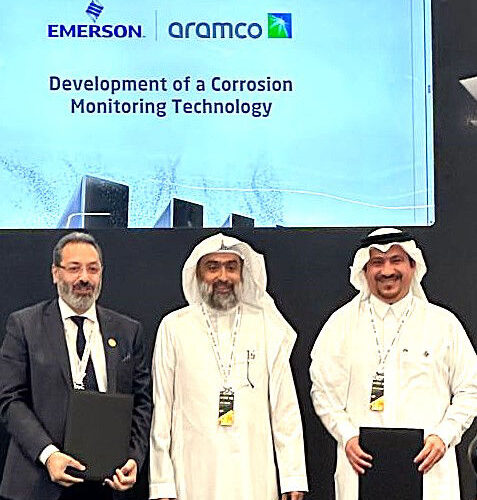
Aramco (Tadawul: 2222) and Emerson Electric Co. (NYSE: EMR) have entered into a strategic research and development collaboration to co-develop corrosion management solutions for Aramco operations. The collaboration brings together Aramco’s operating expertise and intellectual property with Emerson Electric Co.’s ultrasonic online corrosion monitoring, wireless wall-thickness monitoring, and real-time data collection capabilities. The immediate relevance is not merely technical, because corrosion directly affects asset integrity, uptime, safety, environmental performance, maintenance cost and production reliability across oil and gas infrastructure. For Emerson Electric Co., the agreement strengthens its positioning in high-value industrial automation at a time when customers are moving from periodic field inspection to continuous asset intelligence.
The deal sits in that less glamorous corner of the energy industry where real money often leaks quietly before anyone writes a dramatic headline. Corrosion is not a boardroom buzzword like artificial intelligence, energy transition or digital twin, but it is one of the persistent operational risks that can determine whether complex hydrocarbon systems run safely, efficiently and predictably. Aramco’s decision to work with Emerson Electric Co. points to a broader industry shift: asset integrity is moving from scheduled inspection culture toward sensor-led, data-driven decision-making. That matters because the economic value of corrosion monitoring is not only in detecting metal loss, but in preventing downtime, reducing hazardous manual intervention and giving operators earlier warning before maintenance becomes emergency repair.
Why does the Aramco and Emerson Electric corrosion partnership matter for oil and gas asset integrity?
The first strategic signal is that Aramco is treating corrosion management as an operational performance lever rather than a narrow maintenance function. In large integrated energy systems, corrosion risk touches upstream production facilities, pipelines, processing plants, refineries and petrochemical infrastructure. A better corrosion management system can influence asset life, inspection intervals, maintenance planning, shutdown frequency and capital allocation decisions. That makes the collaboration relevant to both reliability engineers and finance teams, because unplanned outages rarely stay inside the maintenance budget once production losses, safety exposure and repair logistics are included.
The second signal is that continuous monitoring is becoming more attractive as oil and gas infrastructure becomes older, more complex and more digitally connected. Manual corrosion measurements can be difficult, intermittent and exposed to field conditions that are not always friendly to people or equipment. Moving more of that monitoring burden to installed sensors and wireless systems allows operators to collect more consistent data and reduce reliance on inspection snapshots. The value is not that the machine magically knows everything, because machines have an impressive talent for humbling everyone eventually, but that the operator gets a stronger data stream before the risk turns into a production event.
The third implication is that corrosion management is becoming part of the same digital operations stack that already includes process control, predictive maintenance, reliability software, plant optimisation and enterprise asset management. Emerson Electric Co. has spent years repositioning itself around automation, software and higher-value industrial technology. A corrosion collaboration with Aramco gives Emerson Electric Co. another proof point in mission-critical industrial environments where automation vendors are judged by resilience, integration and lifecycle value rather than product brochures.

How could Emerson Electric use the Aramco collaboration to strengthen its automation software strategy?
For Emerson Electric Co., the partnership fits neatly into a larger portfolio transformation toward industrial automation, sensing, software and lifecycle services. Corrosion monitoring is a useful gateway because it connects field instrumentation to analytics and decision workflows. A sensor that measures wall thickness is valuable, but the bigger commercial prize is the ability to turn that measurement into a reliable operational signal that maintenance teams, plant managers and asset integrity leaders can trust. That is where Emerson Electric Co. can convert hardware capability into a deeper automation relationship.
The collaboration also gives Emerson Electric Co. an opportunity to show that its automation stack can solve highly specific, high-cost industrial problems rather than simply selling generalised digitalisation. Industrial customers have grown more sceptical of vague transformation promises, especially after years of software platforms that looked elegant in presentations and less elegant during field deployment. Corrosion management has a clearer operational use case. If a system can reduce unnecessary manual inspection, identify risk earlier, improve maintenance timing and support safer operations, the return on investment is easier to defend.
There is also a competitive angle. Emerson Electric Co. competes in a crowded automation and industrial technology market against companies such as Honeywell International Inc., Siemens AG, ABB Ltd., Schneider Electric SE, Rockwell Automation Inc. and Yokogawa Electric Corporation. Large oil and gas customers are not simply buying sensors; they are increasingly comparing ecosystems. The vendor that can combine measurement hardware, wireless connectivity, analytics, process knowledge and software integration has a better chance of becoming embedded in long-term asset management workflows. The Aramco collaboration may therefore matter less as a one-off agreement and more as a reference point for Emerson Electric Co.’s credibility in high-consequence industrial environments.
What does this corrosion monitoring push reveal about Aramco’s operating priorities in 2026?
Aramco remains one of the most strategically important energy producers in the world, but its operating priorities are not limited to production scale. The company’s recent financial profile shows why reliability matters. Aramco reported strong first-quarter 2026 adjusted net income, continued major dividend distributions and substantial capital expenditure to support growth objectives. That combination creates a familiar pressure point for a national oil company with global market influence: sustain cash generation, fund long-term investment, support shareholder returns and keep operations resilient through volatile commodity and geopolitical cycles.
Corrosion management fits into that balancing act because operational reliability protects both production continuity and capital efficiency. A large oil company can spend heavily on expansion, but asset degradation can quietly erode returns if maintenance becomes reactive or failure risk rises. By digitalising corrosion management, Aramco is effectively trying to improve the quality of operational visibility across complex infrastructure. That could support better maintenance prioritisation, fewer unnecessary interventions and stronger confidence in asset condition.
The timing also matters because oil and gas operators are facing a more demanding external environment. Infrastructure must perform through volatile demand cycles, supply chain disruptions, stricter safety expectations and rising scrutiny of environmental risk. A corrosion failure is not merely an engineering problem. It can become a reputational issue, a regulatory concern and a financial event. Aramco’s collaboration with Emerson Electric Co. therefore reflects the larger energy industry reality that operational excellence is becoming a defensive strategy as much as a productivity strategy.
How could real-time corrosion monitoring change maintenance economics for energy infrastructure?
The economic case for real-time corrosion monitoring begins with the difference between knowing and guessing. Periodic inspection can identify problems, but it may miss the pace and pattern of degradation between inspection cycles. Continuous or more frequent data collection gives operators a better basis for condition-based maintenance. That can reduce unnecessary shutdowns when assets remain healthy and accelerate intervention when deterioration is moving faster than expected. In industries where downtime can be expensive, even small improvements in reliability can carry meaningful economic value.
The second economic benefit is labour and safety efficiency. Manual inspection in industrial environments often requires access planning, field work, safety procedures and sometimes shutdown coordination. A digital monitoring system does not eliminate human expertise, but it can change where that expertise is applied. Engineers can spend more time interpreting patterns and planning interventions, and less time depending on scattered field measurements that arrive late or lack context. That is a better use of scarce technical talent, especially when experienced asset integrity professionals are not exactly falling from the sky.
The third benefit is data compounding. Once corrosion information becomes a reliable digital stream, it can be combined with process conditions, fluid composition, operating temperatures, maintenance history and equipment performance. Over time, that opens the door to more predictive models and more precise risk ranking. For Aramco, this could help standardise corrosion decision-making across assets. For Emerson Electric Co., it creates a potential pathway to repeatable solutions that can be adapted across refineries, petrochemical plants, pipelines, LNG facilities, power plants and other process-heavy industries.
What risks could limit the impact of the Aramco and Emerson Electric corrosion collaboration?
The first risk is integration complexity. Industrial systems do not become smarter simply because new sensors are installed. Data quality, wireless reliability, cybersecurity, field calibration, maintenance workflows and operator adoption all determine whether a corrosion monitoring platform becomes useful or just another digital dashboard competing for attention. In large operations, the hardest part is often not measurement, but translating measurement into trusted action.
The second risk is scalability. A solution that performs well in a controlled deployment may face tougher conditions when applied across varied assets, operating environments and corrosion mechanisms. Aramco’s operations are vast and technically diverse. A fit-for-purpose solution will need to handle different materials, process fluids, temperatures, wall-thickness profiles, maintenance practices and operational constraints. The collaboration will be more strategically valuable if it produces a repeatable architecture rather than a bespoke system that works beautifully in one environment and becomes expensive everywhere else.
The third risk is commercial proof. The announcement did not disclose financial terms, deployment scale, implementation timeline or expected savings. That means investors should avoid treating the collaboration as a material near-term revenue event for Emerson Electric Co. or a measurable immediate cost reduction event for Aramco. The strategic significance is clear, but the financial significance will depend on whether the companies move from co-development to broader deployment and whether the solution proves durable enough to become part of long-cycle asset integrity spending.
How are Aramco and Emerson Electric shares positioned after the corrosion R&D announcement?
Aramco’s Tadawul-listed shares were recently around SAR 27.16, with market data showing the stock close to the upper portion of its 52-week range of SAR 23.04 to SAR 27.96. The shares have remained relatively stable in short-term trading, with five-day and one-month performance showing only modest movement compared with the strategic scale of the business. That is not surprising. A corrosion R&D partnership, while operationally meaningful, is unlikely to move Aramco’s valuation on its own when the stock is driven more heavily by oil prices, dividends, production expectations, geopolitical risk and government ownership dynamics.
Emerson Electric Co. shares were recently around the $140 level, below the 52-week high of $165.15 and above the 52-week low of $122.64. Market data showed mixed short-term performance, with modest weakness over five days but a more constructive one-month picture in some data feeds. The stock context suggests investors are still weighing Emerson Electric Co.’s broader automation demand, software integration strategy, earnings trajectory and valuation rather than assigning major standalone value to a single Aramco collaboration.
The sentiment read is therefore balanced. For Aramco, the partnership supports operational resilience but does not change the immediate investment debate around dividends, free cash flow, capital spending and crude market exposure. For Emerson Electric Co., the agreement reinforces a credible industrial automation narrative, especially in energy and process industries. It is helpful for strategic positioning, but investors will likely need evidence of commercial scaling, margin contribution or broader adoption before treating it as a financial catalyst.
What could happen next if the Aramco and Emerson Electric corrosion system succeeds?
If the collaboration succeeds, the first likely outcome is deeper deployment within Aramco’s own operations. A validated corrosion management solution could be expanded across more assets where continuous monitoring improves reliability and reduces inspection burden. That would make the collaboration more than a technology test. It could become part of Aramco’s long-term operating model for asset integrity and maintenance planning.
The second outcome could be broader commercialisation. Emerson Electric Co. has an incentive to develop solutions that can travel beyond one customer, especially into industries where corrosion and erosion are persistent risks. Refineries, petrochemical plants, pipelines, offshore facilities, power stations, water infrastructure and mining operations all face asset degradation challenges. A solution proven inside Aramco’s demanding operating environment would carry stronger credibility with other industrial customers.
The third outcome could be competitive pressure across the automation sector. If corrosion monitoring becomes a more visible digital operations category, rivals will have to strengthen their own offerings in sensing, wireless networks, asset performance management and predictive analytics. That could accelerate partnerships between energy producers and automation vendors, especially as operators look for practical digital projects with measurable operational value. The big lesson is simple: in industrial automation, the unglamorous problem often becomes the profitable one.
Key takeaways on what the Aramco and Emerson Electric corrosion partnership means for oil and gas automation
- Aramco and Emerson Electric Co. are turning corrosion management into a digital asset intelligence challenge, not just a maintenance function, which could reshape how large energy operators monitor reliability risk.
- The agreement matters because corrosion affects uptime, safety, environmental exposure and capital efficiency across oil and gas infrastructure, making it a strategic operating issue rather than a narrow engineering concern.
- Emerson Electric Co. gains a high-credibility industrial reference point for its automation, sensing and software strategy, especially in mission-critical process industries where reliability has direct financial consequences.
- Aramco can use the collaboration to strengthen condition-based maintenance and reduce reliance on difficult manual inspection routines across complex assets, provided the technology scales beyond pilot settings.
- The partnership reinforces a broader industry shift from periodic inspection toward continuous monitoring, where asset integrity decisions increasingly depend on live data, wireless connectivity and predictive analytics.
- The financial impact is not yet clear because the companies have not disclosed contract value, deployment scale, implementation timeline or expected savings from the corrosion management collaboration.
- Aramco’s share price is unlikely to move meaningfully on this announcement alone, as investors remain more focused on oil prices, dividends, free cash flow and geopolitical supply risk.
- Emerson Electric Co.’s stock story may benefit more from the strategic signal than from near-term revenue, because the agreement supports the company’s long-running shift toward higher-value automation and software-led industrial systems.
- The main execution risks are integration complexity, data reliability, cybersecurity, field adoption and the challenge of adapting corrosion monitoring across different operating environments and asset classes.
- If the collaboration succeeds, Emerson Electric Co. could use Aramco as a powerful proof point for corrosion monitoring solutions across refineries, pipelines, petrochemicals, power and other process-heavy sectors.
Discover more from Business-News-Today.com
Subscribe to get the latest posts sent to your email.