





Elroy Air, Inc., which has agreed to go public through a business combination involving Columbus Circle Capital Corp II (NASDAQ: CMII), has secured a firm-fixed-price U.S. Army contract with a potential value of US$46.06 million to develop an autonomous hybrid-electric vertical-takeoff-and-landing cargo aircraft for modular military payload delivery. The programme is expected to run through 2029 and adds a government-funded development pathway for the Chaparral aircraft as Elroy Air simultaneously prepares for commercial-scale production and a proposed Nasdaq listing under the ticker ELRY.
The most important qualification is that the entire US$46.06 million has not been funded at award. Approximately US$5.14 million of fiscal 2026 research, development, test and evaluation funding was obligated when the contract was awarded, equivalent to about 11% of the maximum contract value. Future funding therefore depends on contract execution, option exercise and available government appropriations rather than representing US$46 million of immediately secured revenue.
Army Contracting Command at Aberdeen Proving Ground is the contracting activity, with work expected to be performed in California. The contract builds on U.S. Army work awarded to Elroy Air during the previous two years and is intended to advance Chaparral’s operation in contested and austere environments, including modular payload delivery, protected communications, GPS-denied navigation, mobile mission planning and higher levels of autonomous operation.
What does the $46m Army programme require Elroy Air’s Chaparral to do?
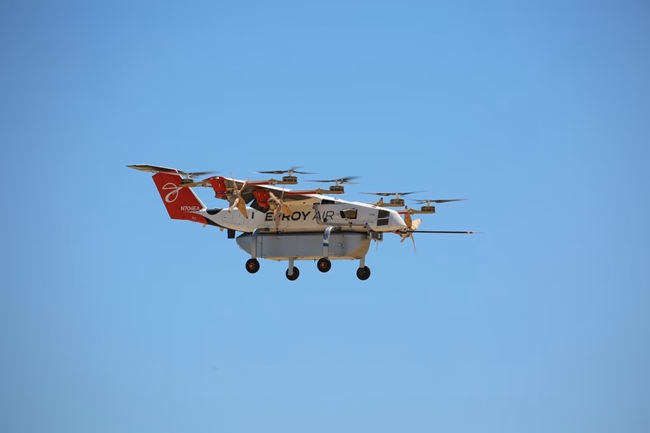
Chaparral is being developed as an autonomous heavy-cargo aircraft capable of vertical takeoff and landing without conventional runway infrastructure. Elroy Air says the platform is designed to carry more than 500 pounds of payload over ranges of up to 450 miles using a hybrid-electric propulsion architecture. Those performance specifications remain company-stated capabilities subject to continued development, testing and mission requirements.
The Army programme focuses less on basic demonstration of vertical flight and more on making the aircraft useful within an operational military logistics system. Development work includes modular payload mechanisms, cyber-protected communications, navigation where GPS signals may be jammed or unavailable and autonomous capabilities intended to reduce dependence on aircrew and personnel at delivery locations.
That use case fits the U.S. military’s increasing focus on contested logistics. Traditional supply routes, large airfields and crewed transport aircraft can become vulnerable in high-threat environments, creating demand for distributed systems capable of moving ammunition, medical supplies, equipment and other cargo without exposing pilots or requiring prepared runways.
Chaparral is not yet established as a mass-produced Army fleet aircraft. The current award is a multi-year development contract, and broader procurement would depend on programme performance, military requirements, appropriations and subsequent contracting decisions.
How significant is the Army award relative to Elroy Air’s planned $1bn public-market deal?
Elroy Air has agreed to combine with the SPAC currently known as Columbus Circle Capital Corp II, which is itself expected to be renamed Inflection Point Acquisition Corp VII before completion of the transaction. The proposed combination values Elroy Air at approximately US$800 million on a pre-money basis and is expected to result in an enterprise value of about US$1 billion.
The US$46.06 million maximum Army award equals roughly 5.8% of that US$800 million pre-money valuation. That comparison does not establish an earnings multiple because the contract is spread across several years, only part is currently obligated and development contracts can have very different margin profiles from future aircraft production.
Its strategic value may nevertheless exceed the immediate revenue contribution. Military-funded development can provide technical validation, improve product maturity and generate operational experience that supports subsequent procurement or sales to allied customers.
The public-market transaction also includes more than US$165 million of committed private investment in public equity financing. Approximately US$65 million was funded when the business combination agreement was executed, while the parties expect the overall PIPE proceeds to support commercial-scale Chaparral manufacturing with Kratos Defense & Security Solutions, Inc.
That creates two parallel funding streams: government contract money aimed at developing military capability and transaction capital intended to help scale manufacturing. Neither guarantees future fleet orders, but together they reduce the extent to which Elroy Air must fund both development and production infrastructure entirely from its existing private balance sheet.
What still has to happen before Elroy Air becomes a Nasdaq-listed manufacturer?
The SPAC transaction has not closed. The parties are targeting the fourth quarter of 2026, subject to shareholder approval, regulatory requirements and effectiveness of the registration statement. Columbus Circle Capital Corp II has confidentially submitted a draft Form S-4 to the U.S. Securities and Exchange Commission, but the review and shareholder-vote process still stand between the company and a completed listing.
Commercial-scale production is also still ahead. Elroy Air has identified Kratos as its U.S. manufacturing partner and has presented a commercial pipeline involving potential customers and memoranda of understanding, but several of those expressions of interest are non-binding and should not be treated as firm aircraft orders. SEC-filed transaction materials specifically caution that pipeline agreements may not convert into future revenue.
The Army contract gives the company something more concrete than those non-binding commercial discussions. It is a formal government development award with more than US$5 million obligated at inception and a potential programme value exceeding US$46 million through 2029.
For Elroy Air, the next two years are consequently about converting validation into scale. The company must execute the Army development programme, complete its public-market transaction, finance manufacturing and demonstrate that Chaparral’s stated payload and range can translate into reliable field operations. If those pieces come together, the US$46 million award could become less important for its standalone revenue than for establishing the military reference customer needed to support a much larger autonomous cargo-aircraft business.
Discover more from Business-News-Today.com
Subscribe to get the latest posts sent to your email.

