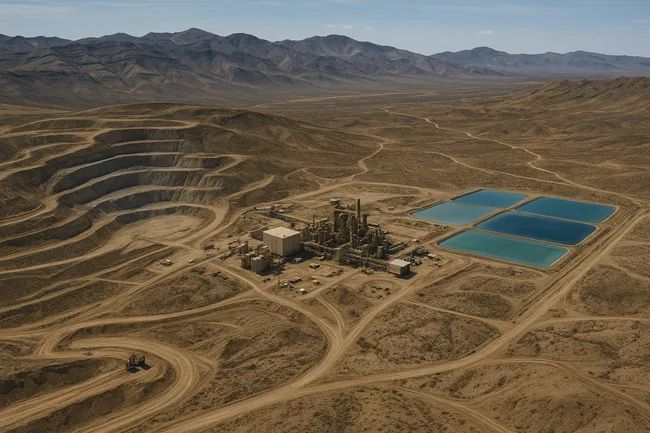
Elevra Lithium Limited (ASX: ELV; Nasdaq: ELVR), the Brisbane-headquartered lithium producer operating the North American Lithium mine in Québec, Canada, has signed a binding agreement to supply LG Energy Solution with 240,000 dry metric tonnes of spodumene concentrate through scheduled deliveries extending from 2026 to 2029. The October 8, 2026 announcement establishes a significant customer relationship with one of the world’s major battery manufacturers, but the contract uses market-linked pricing rather than a publicly disclosed fixed selling price. Consequently, the agreement improves visibility over future sales volumes without establishing a guaranteed revenue amount or protecting Elevra from every potential decline in lithium prices.
The agreement comes at an important stage in Elevra’s operating recovery. Its North American Lithium operation produced 197,967 tonnes of spodumene concentrate during FY2026, while the company’s latest expansion plan targets approximately 373,000 tonnes of average annual post-expansion production capacity. The new LG Energy Solution relationship could provide a substantial outlet for that growing production, although the eventual financial benefit will depend on the prices realised, mining and processing costs, shipment timing and the successful completion of expansion works.
The profitability question is particularly important because Elevra’s June 2026 quarter demonstrated how quickly commodity-price movements can affect operating economics. Its average realised selling price fell to US$921 per tonne from US$1,453 in the preceding quarter, while its reported free-on-board unit operating cost increased to US$907 per tonne sold. The difference between those measures narrowed sharply, although it does not represent a complete accounting profit margin or include every expense associated with the business.
Elevra closed FY2026 with US$255 million in cash and reported a US$44 million statutory profit, but consolidated operating cash flow was negative US$44 million. Its strategic financing arrangements provide resources for the planned expansion, yet a stronger customer portfolio must ultimately translate into sustainable cash generation. The central question is whether market-linked contracts and increasing production scale can improve margins sufficiently to withstand another downturn in lithium prices.
What has LG Energy Solution actually committed to purchase from Elevra?
The binding supply agreement covers 240,000 dry metric tonnes of spodumene concentrate produced at North American Lithium. The scheduled base deliveries comprise 30,000 tonnes in calendar 2026, followed by 60,000 tonnes in each of 2027 and 2028, and 90,000 tonnes in 2029. These quantities represent contractual sales volumes distributed across several years, not an additional annual production target or an immediate shipment of the full amount.
The agreement also provides for up to 90,000 tonnes of optional additional supply, subject to agreement between both parties. This potential increase should not be included in the committed base quantity because its delivery is not automatic. If the option were agreed in full, the total could reach 330,000 tonnes, but only 240,000 tonnes currently forms the disclosed base commitment.
The scale is meaningful relative to Elevra’s existing production. Its FY2026 output was approximately 198,000 tonnes, making the contract’s 240,000-tonne aggregate base volume equivalent to roughly 1.2 years of historical annual production. However, the deliveries will be spread over several calendar years, and a single year’s production is not the appropriate basis for estimating guaranteed annual revenue.
The 60,000-tonne deliveries scheduled for 2027 and 2028 would each equal approximately 30% of FY2026 production, illustrating the customer relationship’s potential importance. That is a historical scale comparison, not a forecast of LG Energy Solution’s future share of total sales. Elevra expects to expand production and continue supplying other customers, meaning the eventual sales mix may differ substantially from the existing operation.
Why do Elevra and LG Energy Solution describe different contract durations?
One important detail requires careful treatment because the two companies describe the agreement’s duration differently. Elevra’s October 8 regulatory filing describes a three-year term commencing with the first shipment, expected during calendar 2026. However, the same filing specifies deliveries across four calendar years, ending in 2029, while LG Energy Solution explicitly describes the arrangement as covering a four-year period.
The available public disclosures do not fully explain how the stated three-year contractual term aligns with the four-calendar-year delivery schedule. A three-year interval can span portions of four calendar years, but the precise starting date and contractual scheduling provisions have not been disclosed sufficiently to reconcile the descriptions definitively. It would therefore be premature to treat either company’s wording as evidence of a different contracted quantity.
Both announcements agree on the essential commercial commitment of 240,000 tonnes, and Elevra provides the specific annual delivery allocations. Those allocations are the most reliable basis for examining the future supply profile until additional contractual clarification becomes available. The difference in terminology does not establish that an extra year of deliveries has been added or that the contractual obligations have changed.
Does market-linked lithium pricing protect Elevra from falling spodumene prices?
The agreement establishes pricing linked to the spodumene concentrate market, with adjustments for lithium content. This structure allows selling prices to respond to market conditions rather than relying on a publicly announced fixed price for the entire contracted volume. Elevra has not disclosed the pricing index, adjustment formula, settlement periods or any applicable minimum-price provisions.
That distinction is important because an undisclosed price floor cannot be assumed to exist, but its absence also cannot be established merely because the public announcement does not mention one. The appropriate conclusion is that no publicly verifiable minimum selling price has been provided. Consequently, the agreement cannot be characterised as guaranteeing a particular operating margin or total contract value.
Market-linked pricing offers commercial advantages when lithium prices rise because realised revenue can potentially move with the market, subject to contractual adjustments and timing. The opposite exposure also remains relevant when prices weaken. A committed customer may reduce uncertainty about where production can be sold without removing uncertainty about the amount received per tonne.
Elevra’s recent commercial history makes this distinction especially significant. The company previously had a pricing ceiling associated with spodumene volumes supplied under a legacy arrangement involving Piedmont Lithium. Following the merger of Sayona Mining and Piedmont, that internal arrangement was eliminated, allowing Elevra to participate more directly in favourable lithium market conditions.
The company has also completed obligations under certain older contracts containing lagged pricing mechanisms, which had prevented some shipments from immediately reflecting stronger market prices. Management has identified more diversified, market-aligned sales arrangements as a strategic priority. The LG agreement advances that objective, but the company has not disclosed enough information to demonstrate how its terms compare financially with each existing or alternative sales channel.
What does North American Lithium’s US$14-per-tonne price-cost difference reveal?
The June 2026 quarter illustrates why contract volumes alone cannot establish profitability. Elevra reported an average realised FOB selling price of US$921 per dry metric tonne, compared with US$1,453 in the March quarter. Its unit operating cost per tonne sold increased to US$907 from US$884 over the same period, leaving an arithmetic difference of just US$14 per tonne between the two reported measures.
That difference compares two company-defined operating indicators and is not equivalent to statutory gross profit, EBITDA or free cash flow. Elevra’s unit operating cost includes mining, processing, transport, port charges, site-level administration and specified inventory movements, while excluding depreciation, amortisation, freight and royalties. Other corporate, financing and accounting expenses are also relevant when assessing the overall financial result.
The pricing pressure occurred despite improving operational performance. North American Lithium produced 54,479 tonnes during the June quarter, an increase of approximately 15% from the preceding quarter, while lithium recovery improved to 71% from 66%. Those figures demonstrate that stronger processing performance does not necessarily translate immediately into stronger financial results when realised commodity prices decline.
Sales volumes also fell substantially, reaching 33,977 tonnes compared with 55,526 tonnes in the March quarter. Elevra attributed the wider annual reduction in sales volumes partly to shipment scheduling and customer requirements. The difference between production and sales contributed to inventory accumulation, which can defer cash receipts even when mining and processing operations are performing well.
The quarterly figures consequently highlight two independent operating priorities. Elevra must improve processing efficiency and lower costs while maintaining commercially effective sales and shipment arrangements. The LG contract addresses part of the customer-demand question, but cost competitiveness and commodity prices will still determine the economics of the tonnes delivered.
Why did Elevra report a US$44 million profit but negative operating cash flow?
Elevra’s FY2026 results showed meaningful improvement in revenue and underlying profitability. Group revenue increased 39% to US$202 million, supported by a 57% rise in average realised selling prices to US$1,092 per tonne. Underlying EBITDA improved from a US$43 million loss in FY2025 to a US$14 million profit, while the statutory result moved from a US$247 million loss to a US$44 million profit.
However, the statutory profit included substantial non-cash accounting effects associated with the merger and the valuation of mining assets. These included a US$156 million reversal of an earlier impairment at North American Lithium, partially offset by significant merger-related accounting adjustments. The reported statutory earnings therefore cannot be interpreted as representing US$44 million of cash generated by mining operations.
The consolidated cash-flow statement provides a different perspective. Elevra used US$43.6 million in operating cash during FY2026, compared with US$9.6 million in the preceding year. The company identified US$25.2 million of non-recurring merger-related cash expenditure within operating cash flows, while changes in receivables, inventory and other working-capital balances also affected cash conversion.
North American Lithium itself generated approximately US$3 million in operating cash inflow during the year, according to management. Nevertheless, the company’s consolidated cash generation remained negative, highlighting the importance of separating the mine’s operating performance from corporate expenditure and working-capital requirements. Future customer agreements will strengthen the financial recovery only if shipments translate into collected cash at commercially attractive margins.
Can Elevra’s planned 373,000-tonne expansion reduce its exposure to weak lithium prices?
Elevra’s September pre-feasibility study outlines a three-stage expansion intended to increase North American Lithium’s average annual post-expansion production to approximately 373,000 tonnes, compared with a base-case capacity of around 199,000 tonnes. The first stage involves optimisation of the existing mill, targeted for mid-2027, followed by expanded milling capacity around mid-2028 and additional crushing and ore-sorting infrastructure around mid-2029. These remain development targets rather than production capacity already commissioned.
The estimated initial capital expenditure is C$366 million, approximately US$271 million, including contingency. The estimate carries a stated accuracy range of approximately plus or minus 40%, demonstrating that the ultimate investment requirement remains subject to engineering, procurement and execution risks. The company considers the expansion funded under its strategic financing arrangements, although successful delivery still depends on maintaining capital discipline and satisfying relevant approvals.
The study estimates post-expansion life-of-mine C1 operating costs of approximately US$630 per tonne, with all-in sustaining costs of approximately US$680 per tonne. These are prospective study measures, not achieved operating costs, and are not directly interchangeable with the historical FOB cost per tonne sold reported in quarterly results. The projected reduction depends on higher throughput, improved ore sorting, mining assumptions and continued operational efficiency.
Elevra also expects FY2027 production of 198,000 to 210,000 tonnes, sales of 200,000 to 230,000 tonnes and FOB unit operating costs of US$880 to US$950 per tonne sold. That guidance is more relevant to near-term margin expectations than the fully expanded project’s long-term cost estimates. A higher-cost transition year could create pressure if realised lithium prices weaken before the expansion’s intended efficiency improvements are delivered.
The LG agreement helps provide a customer relationship for part of future production, while additional volume flexibility may become useful as capacity increases. However, the investment case ultimately depends on producing more tonnes at lower costs rather than merely increasing contracted deliveries.
Is Elevra’s financing sufficient to support growth without further capital pressure?
Elevra ended June 2026 with US$255 million in cash, substantially above the preceding year’s balance after completing major equity financing. The company raised approximately US$196 million through an institutional placement and a further US$11 million through a share purchase plan. These financing proceeds strengthened its balance sheet, but should not be mistaken for cash generated through the underlying lithium operation.
After the reporting date, Elevra issued C$65 million in convertible notes to a subsidiary of Canada Growth Fund, receiving the proceeds on July 31. A further C$80 million convertible tranche remains conditional on additional requirements and the company’s decision to proceed. Consequently, the entire proposed convertible financing cannot be treated as though every tranche had already been drawn.
The company has identified US$120 million to US$140 million in planned FY2027 capital expenditure, including sustaining investment, North American Lithium expansion work and Moblan development studies. Those commitments demonstrate why operating cash conversion remains important despite the strengthened liquidity position. Additional spending, construction overruns or prolonged commodity-price weakness could reduce financial flexibility.
The LG agreement provides sales visibility but does not replace the need for disciplined funding and project execution. Its commercial contribution will depend on future realised prices, shipment performance and cash receipts, while the expansion’s capital requirements will arise according to the construction programme rather than necessarily matching customer-payment timing.
What would demonstrate that the LG supply agreement is improving Elevra’s financial position?
The first test will be delivery of the initial 30,000 tonnes scheduled for 2026 and the subsequent volumes under the agreement. Confirmation of shipments will establish that the customer relationship is progressing into commercial activity, but reported pricing and cash collection will be needed to assess its financial contribution. Without disclosed pricing formulas, the contract’s economic value cannot be reliably calculated from committed tonnage alone.
A second test will involve production costs and cash conversion. Lower FOB unit costs, stronger lithium recoveries, improved shipment timing and positive consolidated operating cash flow would demonstrate that higher sales volumes are supporting a more sustainable business. Progress against the staged expansion timetable would provide additional evidence that Elevra can achieve the scale required by its long-term operating plans.
The broader strategic rationale is clear. LG Energy Solution has identified North American battery supply chains and growing energy storage requirements as reasons for securing Canadian spodumene concentrate. For Elevra, supplying an established battery manufacturer supports its goal of diversifying customers while moving towards a more market-aligned commercial portfolio.
The October agreement strengthens Elevra’s sales outlook, but it does not guarantee profitable lithium prices. Its significance will ultimately depend on whether the company can deliver committed volumes, manage commodity-price volatility and convert its expansion investment into lower operating costs and stronger cash generation. The distinction between securing demand and securing margins remains the central question for shareholders.
Discover more from Business-News-Today.com
Subscribe to get the latest posts sent to your email.