





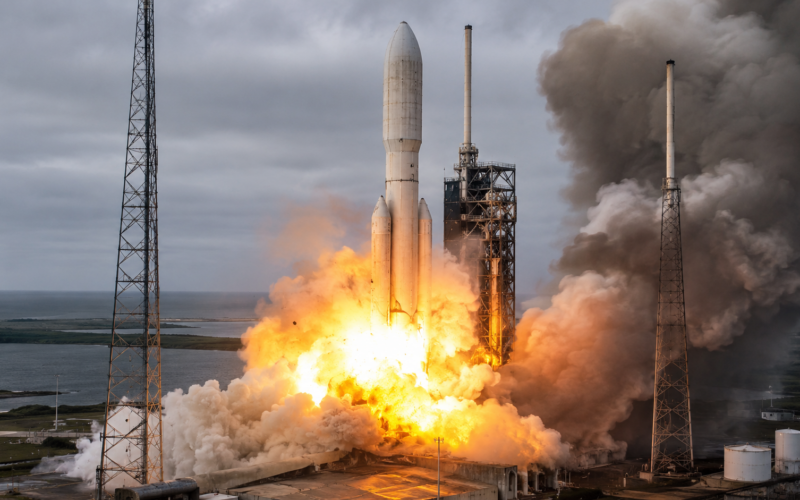
Blue Origin’s New Glenn rocket exploded during a launchpad test at Cape Canaveral Space Force Station in Florida, creating a major setback for Jeff Bezos’ space company as it tries to build credibility in the heavy-lift launch market. The rocket was uncrewed, no injuries were reported, and Blue Origin has begun an investigation into what it described as an anomaly. The failure matters because New Glenn is central to Blue Origin’s attempt to compete more directly with SpaceX, support commercial satellite deployment demand and serve customers such as Amazon.com, Inc. (NASDAQ: AMZN), whose Project Kuiper broadband constellation requires large-scale launch capacity. The incident does not end Blue Origin’s ambitions, but it sharply raises the cost of proving that New Glenn can move from engineering promise to repeatable launch operations.
Why does the Blue Origin New Glenn rocket explosion matter for the commercial space launch market?
The New Glenn explosion matters because the commercial space launch market is no longer a niche contest over rocket science bragging rights. It is becoming a logistics backbone for satellite broadband, national security payloads, lunar infrastructure, Earth observation networks and cloud-connected communications systems. Launch reliability is now a strategic economic asset, not just a technical milestone.
Blue Origin has spent years building New Glenn as a reusable heavy-lift rocket designed to compete in a market dominated by SpaceX. The company needs New Glenn to prove that it can offer customers scale, cadence and reliability. A launchpad explosion during testing does not automatically mean the system is fundamentally flawed, but it does slow the credibility-building process. In space infrastructure, momentum is fragile because customers do not merely buy a launch slot. They buy confidence that the slot will exist, the rocket will be ready and the payload will reach its intended orbit.
The timing is especially important because launch capacity is becoming more valuable as satellite operators race to deploy constellations. Amazon.com, Inc.’s Project Kuiper is one of the most closely watched examples. Amazon.com, Inc. needs to place thousands of satellites into orbit to compete with SpaceX’s Starlink and other connectivity platforms. New Glenn’s reliability therefore has consequences beyond Blue Origin’s own internal roadmap. Any delay in proving the rocket’s operational readiness can ripple into satellite deployment planning, customer contracts and competitive positioning.
The explosion also reinforces a hard truth for investors and policymakers: reusable launch vehicles are difficult to scale, even for companies backed by enormous private capital. SpaceX’s lead was not created only by vision or funding. It was built through years of launch repetition, failure analysis, rapid iteration and operational learning. Blue Origin is now facing the uncomfortable part of that same curve, but under far greater market scrutiny.
How could the launchpad failure affect Blue Origin’s effort to narrow the gap with SpaceX?
Blue Origin’s challenge is not simply to build a powerful rocket. The challenge is to build a launch system that can fly often enough to become commercially trusted. SpaceX has created a high bar by demonstrating frequent launches, booster reuse and deep customer confidence across commercial, government and civil space missions. Blue Origin needs New Glenn to become more than a technically impressive vehicle. It needs New Glenn to become a dependable service.
The launchpad explosion could slow that progression in several ways. First, Blue Origin must identify the root cause and determine whether the failure was isolated to ground test conditions, specific hardware, fueling systems, engine behaviour, integration procedures or broader design assumptions. Second, the company must assess whether launch infrastructure suffered damage that could delay future tests or missions. Third, it must reassure customers that corrective action can be completed without creating an open-ended schedule risk.

For SpaceX, the incident does not eliminate competition, but it does protect the incumbent advantage. Every month Blue Origin spends investigating, repairing or redesigning is another month in which SpaceX can keep flying, learning and deepening customer dependence. That cadence advantage compounds. In launch markets, reliability is partly technical and partly reputational. The provider that flies more often generally collects more data, builds more operational confidence and becomes harder to displace.
Blue Origin still has important advantages. It has deep funding, engineering talent, government relevance and strategic alignment with Amazon.com, Inc.’s satellite ambitions. However, the company now faces a sharper burden of proof. The question for customers is not whether Blue Origin can eventually recover. It is whether Blue Origin can recover fast enough to support commercial schedules in a market where delays can shift competitive outcomes.
Why does New Glenn reliability matter for Amazon’s Project Kuiper and satellite broadband competition?
New Glenn reliability matters for Amazon.com, Inc. because Project Kuiper is a deployment race as much as a technology project. Satellite broadband constellations depend on manufacturing throughput, launch availability, orbital deployment, ground infrastructure and regulatory milestones. A weakness in any one of those links can slow the entire network rollout.
Amazon.com, Inc. is trying to challenge SpaceX’s Starlink, which already has a massive operational lead in low Earth orbit broadband. That means Project Kuiper cannot afford indefinite launch uncertainty. Amazon.com, Inc. has diversified launch arrangements, but Blue Origin is strategically important because of its close connection to Jeff Bezos’ broader space ecosystem and because New Glenn’s heavy-lift profile could support large satellite batches. If New Glenn timelines stretch, Project Kuiper may need to lean more heavily on other launch providers, adjust deployment sequencing or accept slower constellation scaling.
The stock market may not price this as a major Amazon.com, Inc. event in isolation because Amazon.com, Inc. is a vast business driven primarily by cloud computing, retail, advertising and artificial intelligence infrastructure. Amazon.com, Inc. shares recently traded around $270.64, with the latest available session showing a modest decline. That suggests investors are not treating the Blue Origin incident as a core valuation threat to Amazon.com, Inc. at this stage.
However, the strategic connection still matters. Project Kuiper is one of Amazon.com, Inc.’s biggest long-duration bets outside its core commerce and cloud platforms. Satellite broadband could eventually support rural connectivity, enterprise communications, defense applications and integrated cloud services. If launch bottlenecks delay network scale, Amazon.com, Inc.’s ability to compete against Starlink becomes more difficult. The market may not punish Amazon.com, Inc. immediately, but execution risk around Project Kuiper has not disappeared simply because the explosion happened at a privately held space company.
What does the Blue Origin accident reveal about execution risk in reusable heavy-lift rockets?
The accident reveals that heavy-lift reusable rocket development remains an execution-heavy, failure-prone business even when backed by patient billionaire capital. A static fire or ground test is designed to expose problems before flight, which means a failure during testing is not automatically abnormal in rocket development. The issue is the severity of the failure and its effect on the launch system timeline.
Reusable heavy-lift rockets combine propulsion complexity, structural loads, cryogenic fuel management, avionics, ground systems, launchpad operations and safety protocols. A weakness in any one element can produce cascading consequences. That is why launch companies often describe testing failures as learning events. They are, but some learning events are very expensive tutors.
For Blue Origin, the key question is whether the explosion points to a contained problem or a broader reliability issue. If it was caused by a specific component, procedure or ground system fault, the recovery path may be relatively direct. If the failure exposes deeper integration problems, the timeline could stretch further. Customers and regulators will want evidence, not optimism.
The incident also highlights the importance of launchpad redundancy. If a launch provider depends heavily on a limited number of ground facilities, damage to a pad can become as important as damage to the rocket. Rockets are not standalone products. They are part of a launch ecosystem that includes pads, fueling equipment, transport systems, range coordination, safety zones and personnel procedures. Blue Origin must therefore prove not only that New Glenn can be fixed, but that the entire launch operation can return safely and predictably.
How could regulators, customers and government agencies respond to the New Glenn explosion?
Regulatory and customer responses will likely focus on investigation quality, safety procedures and schedule realism. The Federal Aviation Administration and range safety authorities typically examine major launch and test incidents to ensure that future operations do not create unacceptable risk. Even when no one is injured, a large launchpad explosion can lead to debris concerns, environmental checks and operational restrictions until the cause is understood.
Government agencies will also watch closely because heavy-lift launch capacity has national security and civil space implications. The United States benefits from having multiple credible launch providers. A stronger Blue Origin would reduce dependence on SpaceX and support resilience across military, NASA and commercial missions. That policy logic remains intact, but the New Glenn explosion complicates the near-term path.
Customers may respond differently depending on their urgency. Some will accept delays if Blue Origin offers transparency and a credible recovery timeline. Others may seek backup options, especially if payload schedules are linked to regulatory deadlines, competitive launches or revenue commitments. In satellite broadband, timing is not just operational. It is competitive territory. The first network to reach scale can secure customers, spectrum confidence, distribution partnerships and enterprise trust.
Blue Origin’s communication strategy will therefore matter. The company must avoid underplaying the failure while also making clear that testing setbacks are part of aerospace development. The balance is delicate. Too much reassurance can sound dismissive. Too much caution can trigger customer anxiety. The company needs to turn a visible failure into a disciplined recovery narrative, backed by engineering evidence and updated timelines.
Can Blue Origin turn this setback into a stronger launch reliability story?
Blue Origin can recover from the New Glenn explosion, but the quality of the recovery will matter more than the public statement issued immediately after the fireball. Space companies are judged by how quickly they identify causes, correct systems and return to safe operations. SpaceX built part of its reputation by treating failures as data and converting them into faster iteration. Blue Origin must now show that it can do the same while operating in a more mature and commercially demanding market.
The opportunity for Blue Origin is to demonstrate that New Glenn’s test programme is rigorous enough to catch severe issues before customer payloads are at risk. That argument can work if the investigation is transparent, corrective measures are credible and subsequent tests show measurable progress. A failure in testing is far less damaging than a failure with a valuable satellite payload onboard.
The risk is that Blue Origin becomes associated with schedule slippage just as customers need launch certainty. The company has long faced criticism for moving more slowly than SpaceX. Another delay reinforces that narrative unless Blue Origin quickly shows technical control. Reputation in launch markets is cumulative. Each test, success, delay and failure becomes part of the underwriting process customers use when choosing providers.
For the broader space sector, the incident is a reminder that launch competition will not be decided only by funding announcements, factory expansions or executive ambition. It will be decided on pads, in test stands, through flight cadence and in the unglamorous discipline of turning engineering systems into repeatable operations. In other words, the future of space infrastructure may be thrilling, but it still has to pass the plumbing test.
Key takeaways on what the Blue Origin New Glenn explosion means for space infrastructure and satellite competition
- Blue Origin’s New Glenn launchpad explosion is a major operational setback because the rocket is central to Jeff Bezos’ effort to compete with SpaceX in heavy-lift commercial launch services.
- The incident does not end Blue Origin’s programme, but it raises fresh questions about reliability, launch cadence and the timeline for converting New Glenn into a trusted customer service.
- Amazon.com, Inc.’s Project Kuiper is indirectly exposed because satellite broadband constellations depend on reliable launch capacity to achieve scale and compete against SpaceX’s Starlink.
- No injuries were reported, which limits the immediate human impact, but safety investigations, debris management and launchpad damage assessment could still affect future testing schedules.
- The failure may strengthen SpaceX’s incumbent advantage because launch cadence, operational data and customer confidence compound over time in the commercial space market.
- Blue Origin must now demonstrate that the failure was understood, contained and corrected, rather than allowing customers to infer broader integration or infrastructure weaknesses.
- The incident reinforces that reusable heavy-lift rockets remain technically difficult even for companies with deep capital, experienced engineers and strong strategic backers.
- Government agencies have an interest in Blue Origin’s recovery because the United States benefits from multiple credible launch providers for commercial, civil and national security missions.
- The recovery path will depend on root-cause transparency, launchpad readiness, customer reassurance and Blue Origin’s ability to return to testing without open-ended schedule slippage.
- For the space industry, the lesson is clear: the next phase of competition will be won not by ambition alone, but by repeatable launch reliability at commercial scale.
Discover more from Business-News-Today.com
Subscribe to get the latest posts sent to your email.

