





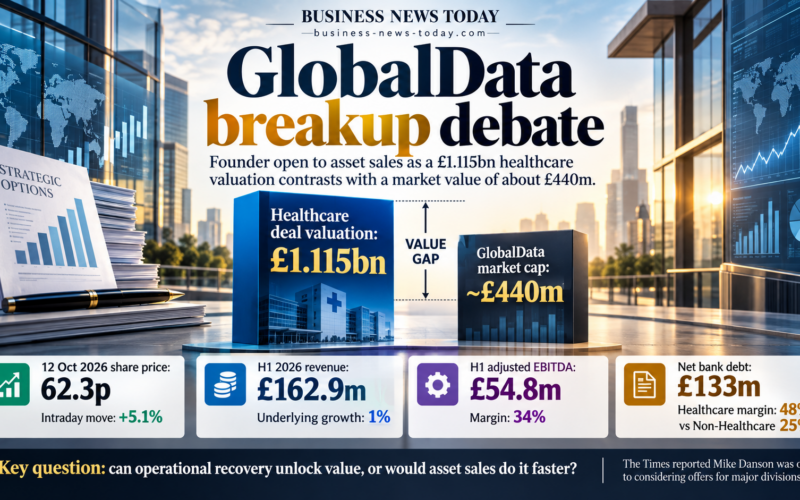
GlobalData Plc (LSE: DATA), the London-listed data analytics and business intelligence company, faces a potentially defining strategic decision after founder and chief executive Mike Danson indicated that he would consider selling major divisions if the terms delivered sufficient value for shareholders. The comments, disclosed in an interview with The Times, introduce the possibility of a partial breakup following a sharp decline in GlobalData’s share price and repeated disappointments over its growth trajectory. The valuation contrast is striking: a previous private equity transaction valued GlobalData’s Healthcare business at £1.115 billion, while the entire listed company’s ordinary equity was worth approximately £440 million during trading on 12 October 2026. However, slower organic growth, increased borrowing and the existing minority ownership of Healthcare complicate any straightforward assumption that selling assets would deliver an immediate valuation uplift. The central question is whether GlobalData can recover its historical growth premium through operational improvements or generate greater shareholder value by separating businesses that may command stronger valuations under different ownership structures.
The Times reported that Danson was prepared to consider offers involving any of GlobalData’s three principal divisions, Healthcare, Consumer and Technology, while emphasising the importance of restoring operational performance before pursuing major strategic changes. According to the publication, he was more inclined to consider transactions towards the end of 2027, when he hoped the business would have returned towards its historical annual sales growth rate of approximately 10%. His comments represent strategic openness rather than an announced disposal process, a binding acquisition proposal or a board-approved breakup.
The distinction is important because GlobalData has already demonstrated the ability to attract substantial private equity investment while retaining control of an operating division. Whether another buyer would now pay an attractive multiple depends on the quality of the underlying businesses, their ability to generate recurring cash flow and the financial implications of separating them. The company’s September earnings warning makes that question particularly relevant, as investors reassess the returns available from its acquisition-led expansion and continuing investment in artificial intelligence.
Why is Mike Danson considering a GlobalData breakup after years of acquisitions and expansion?
GlobalData has developed a portfolio of specialist intelligence businesses serving pharmaceutical companies, consumer product manufacturers, financial institutions, technology providers and industrial customers. Its operating model combines proprietary datasets, research expertise, analytics and subscription services, with acquisitions used to expand industry coverage and strengthen the information available through its common technology platform. The commercial attraction lies in recurring customer relationships and specialist intelligence that supports business decisions involving investment, competition, product development and market entry.
That strategy has produced a sizeable international business, but the expected acceleration in organic growth has proved difficult to achieve. Since launching its Growth Transformation Plan in January 2024, GlobalData has completed seven acquisitions and invested more than £132 million in strengthening its portfolio. The company has simultaneously reorganised its sales operations, expanded technology capabilities and introduced a divisional management structure intended to bring commercial decision-making closer to customers.
According to The Times, Danson acknowledged that implementing several changes simultaneously had disrupted sales activity, including the company’s ability to secure additional subscription spending from existing customers. The publication reported that changes to sales teams, licensing systems and artificial intelligence integration had created operational difficulties, although Danson expected those issues to be resolved as the transformation progressed. This explanation is consistent with GlobalData’s September financial disclosure, which acknowledged that organisational progress had not yet produced the intended improvement in revenue growth.
The possibility of asset sales therefore arises from a combination of operational pressure and strategic flexibility. Selling a division could establish its value through an independently negotiated transaction, potentially offering shareholders an alternative to waiting for the integrated business to achieve its growth targets. Yet management’s apparent preference for improving operations first suggests that a disposal would be more attractive if prospective purchasers could see a sustained recovery in underlying performance.

Does GlobalData’s £1.115 billion healthcare valuation reveal hidden shareholder value?
The strongest evidence supporting the breakup argument comes from GlobalData’s transaction with Inflexion Private Equity Partners LLP, announced on 21 December 2023 and completed on 28 June 2024. Inflexion acquired a 40% interest in the Healthcare division through an agreement that valued the entire business at approximately £1.115 billion, equivalent to roughly 22 times its standalone EBITDA for the 12 months ended June 2023. GlobalData retained 60% ownership and majority control, while the transaction generated gross cash proceeds of £451.4 million and approximately £434 million in expected net proceeds.
The valuation remains remarkable when compared with GlobalData’s present stock market position. At approximately 62.3 pence per share at 11:49 a.m. British Summer Time on 12 October, the company had an indicative equity market capitalisation of £439.5 million, calculated using the 705,528,818 ordinary shares outstanding following its completed buyback programme on 2 October. The historical Healthcare transaction valuation was therefore about 2.5 times the current market value of the entire listed company’s ordinary equity.
However, the comparison requires important financial qualifications. The £1.115 billion figure was an enterprise valuation established through an agreement reached in 2023, whereas the £439.5 million figure represents the market value of GlobalData’s equity in October 2026. Enterprise value and equity value measure different things, particularly when borrowings, cash balances, minority ownership and other financial obligations must be considered.
GlobalData also no longer owns the whole of Healthcare. Applying the historical transaction valuation proportionately to its retained 60% economic interest produces an indicative enterprise-value reference of approximately £669 million, but that figure does not represent the proceeds shareholders would receive from a sale. Any actual transaction would require consideration of the division’s current financial position, contractual arrangements, taxes, transaction expenses and potentially different valuation multiples.
The historical benchmark has become less straightforward as operating conditions have changed. GlobalData recognised a £228.4 million impairment against its Healthcare investment in its 2025 parent-company accounts, reflecting a challenging business environment, although the adjustment did not affect consolidated group results. The impairment is not a current market valuation of Healthcare, but it reinforces the need to distinguish an earlier transaction price from the amount another purchaser might offer.
A credible valuation assessment must therefore ask two separate questions. First, could Healthcare or another GlobalData division still attract a premium enterprise-value multiple because of its recurring subscription revenue, proprietary data and profitability? Second, how much of that valuation would ultimately translate into proceeds attributable to GlobalData’s ordinary shareholders after existing ownership interests and financial obligations were addressed?
What do GlobalData’s September 2026 results reveal about its weakening earnings outlook?
GlobalData’s financial results for the six months ended 30 June 2026 illustrate why operational performance has become central to the restructuring debate. Revenue increased 4% to £162.9 million from £156.5 million a year earlier, while adjusted EBITDA rose 5% to £54.8 million from £52.1 million. The adjusted EBITDA margin improved to approximately 34%, but statutory profit before tax declined 6% to £23.2 million as higher financing costs offset improvements elsewhere.
The more revealing figure was underlying revenue growth of just 1%. Reported revenue benefited from approximately £7.9 million of acquisition-related year-on-year contributions and a £3.3 million revenue adjustment relating to earlier periods, while adverse currency movements reduced the result by approximately £3.4 million. Underlying adjusted EBITDA remained broadly unchanged, indicating that the core business had yet to deliver the operating acceleration expected from its investments.
Subscription revenue accounted for 76% of first-half sales, up from 74% in the comparable period, and increased 6% year on year. For customers spending more than £20,000 annually, the value renewal rate improved to 91% from 89% at December 2025, while the volume renewal rate remained at 83%. Those figures indicate resilience in spending among retained customers, but also show that the company has substantial room to improve customer retention and generate more revenue from existing relationships.
The September results also forced a reduction in profitability expectations. GlobalData indicated that full-year 2026 revenue would be towards the lower end of the then-prevailing analyst expectation range of £325.3 million to £335.7 million, while adjusted EBITDA would fall below the earlier consensus range of £121 million to £126.7 million. Management expected adjusted EBITDA margins to remain broadly consistent with the first-half level of 34%, reflecting slower revenue growth and continued investment in technology, data and specialist expertise.
Subsequent analyst revisions demonstrate the scale of that adjustment. GlobalData’s company-compiled September consensus, incorporating estimates from seven analysts, indicated mean 2026 revenue of £327.9 million and adjusted EBITDA of £111.5 million, equivalent to an estimated margin of approximately 34%. The same consensus projected adjusted EBITDA of £116.8 million for 2027, suggesting that analysts expected improvement but had not yet incorporated a rapid return to the profitability levels previously anticipated.
These forecasts are not company guidance or guaranteed outcomes. They nevertheless provide an important measure of market expectations against which Danson’s ambition to restore stronger sales growth can be assessed. If GlobalData delivers sustained underlying growth materially above current forecasts, its shares could attract a different valuation without any sale of assets; continued disappointment would strengthen the commercial argument for reviewing alternative ownership structures.
How do GlobalData’s healthcare earnings compare with the profitability of its other divisions?
GlobalData’s first-half segmental results reveal a substantial difference in profitability between Healthcare and the remainder of the group. Healthcare generated £65.2 million in revenue and £31.6 million in adjusted EBITDA during the first six months of 2026, equivalent to a margin of approximately 48%. Non-Healthcare produced higher revenue of £97.7 million but only £24.1 million in adjusted EBITDA, representing a margin of approximately 25%.
Healthcare consequently contributed approximately 40% of consolidated revenue but nearly 58% of group adjusted EBITDA before accounting for the economic interests of minority shareholders. That concentration helps explain why a purchaser might value Healthcare differently from the wider business, particularly given its exposure to pharmaceutical intelligence, healthcare market data and commercial research. However, adjusted EBITDA is not equivalent to distributable profit or cash attributable exclusively to GlobalData’s ordinary shareholders.
The accounting structure is especially important. GlobalData consolidates 100% of Healthcare’s revenue and operating earnings because it retains control, even though Inflexion owns 40% of the business. In the first half of 2026, consolidated profit after tax was £14.1 million, of which £8.3 million was attributable to shareholders of GlobalData’s parent company and £5.8 million to non-controlling interests.
Healthcare’s own statutory profit after tax also declined to £14.6 million from £19.6 million a year earlier, despite an increase in adjusted EBITDA. This difference reinforces the importance of assessing statutory earnings, financing costs and cash generation alongside adjusted profitability when considering transaction multiples. A purchaser would examine the business’s entire financial structure rather than applying a headline multiple to a single earnings measure.
Performance across the wider portfolio is not uniformly weak. GlobalData reported underlying revenue growth of 7% in Consumer during the first half, substantially above the group average, suggesting that some of its commercial initiatives are delivering results. Its financial statements, however, continue to present Healthcare and Non-Healthcare as the main reportable segments, rather than publishing fully separated financial accounts for Healthcare, Consumer and Technology.
That reporting structure limits the precision with which investors can independently value the three principal divisions. Greater disclosure of divisional margins, standalone cash flows, shared operating costs and customer economics would make a potential breakup easier to assess. Without those details, a sum-of-the-parts valuation risks overstating the economic benefit of separating businesses that currently share technology, data infrastructure and commercial resources.
Could GlobalData’s higher borrowings and lower free cash flow complicate a potential asset sale?
GlobalData’s balance sheet has become another important element of the investment debate. At 30 June 2026, net bank debt stood at £133 million, compared with £16.8 million a year earlier, with gross borrowings of £181 million and cash of £48 million. Net bank debt represented approximately 1.2 times trailing adjusted EBITDA, a level that does not independently indicate financial distress but leaves less capacity to absorb prolonged earnings disappointment.
Cash generation weakened during the first half. Operating cash flow declined 23% to £50.8 million, while free cash flow fell 27% to £31.3 million from £42.6 million. GlobalData attributed part of the movement to customer collection timing, foreign exchange and a one-off share-based payment, indicating that reported cash-flow trends were affected by factors beyond underlying trading performance.
The company has also taken steps to increase financing flexibility. In July 2026, it expanded its Non-Healthcare financing facility by £60 million to £245 million and extended the maturity of its £200 million Healthcare facility to December 2028. GlobalData also disclosed a further £30 million drawdown from the Non-Healthcare facility during July, meaning the June balance-sheet snapshot should not be mistaken for a complete statement of its subsequent borrowing position.
Meanwhile, capital has continued to flow towards acquisitions and shareholders. Since 2024, GlobalData has invested more than £132 million in acquisitions and returned more than £189 million through tender offers and share repurchases. These decisions demonstrate an active capital-allocation strategy, but the returns on that investment must now be assessed against slower organic growth and increased financing costs.
A disposal could potentially reduce leverage, fund further development or release capital to shareholders. Its economic attractiveness would depend on whether the consideration received exceeded the value of earnings and cash flow surrendered, after accounting for transaction costs and any liabilities remaining with the group. Selling Healthcare solely because its historical enterprise valuation exceeds the listed company’s current equity value would not, by itself, establish that shareholders would be better off.
Why did previous private equity takeover approaches fail, and could buyers return for GlobalData assets?
GlobalData has already attracted interest from financial investors seeking exposure to its proprietary information assets and subscription business model. In April 2025, the company confirmed preliminary, conditional approaches involving investment vehicles associated with Kohlberg Kravis Roberts & Co. and Intermediate Capital Group plc regarding possible offers for the whole company. The proposals included potential cash consideration and an option for shareholders to elect an unlisted equity alternative, but neither process produced an agreed takeover.
GlobalData announced in May 2025 that discussions with Kohlberg Kravis Roberts & Co. had ended because agreement on terms could not be reached. Discussions with Intermediate Capital Group plc were subsequently terminated in June 2025. The formal company announcements established that neither proposal proceeded to a completed transaction, without validating any particular acquisition price.
Danson provided additional context in his interview with The Times, explaining that concerns about the additional debt associated with the proposed transactions and his intention to maintain his controlling interest influenced the decision not to proceed. These comments represent his reported explanation of the negotiations rather than evidence that a new transaction is currently under consideration. Nevertheless, they suggest that the structure and financing of any future proposal could be as important as its headline valuation.
A divisional acquisition could offer a different route for private equity investors. Rather than financing an acquisition of the entire listed group, a purchaser might seek ownership of a focused business with identifiable customers, recurring subscription revenue and independent management. Such a transaction could also allow GlobalData to retain other operations while preserving flexibility over how the proceeds are deployed.
Founder control remains particularly relevant. GlobalData’s shareholder disclosures showed Danson holding approximately 61.32% of ordinary shares as of 31 August 2026, giving him substantial influence over the direction of the business. While concentrated ownership can support long-term restructuring, any transaction must still produce defensible economics for the company and its wider shareholder base.
Can GlobalData’s artificial intelligence investment restore growth before a breakup becomes necessary?
Artificial intelligence remains central to GlobalData’s longer-term strategy and to the financial pressure affecting its near-term outlook. The company is investing in AI-native research workflows, proprietary datasets, new product capabilities and improved commercial systems intended to strengthen customer engagement and increase operational productivity. During its September results presentation, GlobalData reported that more than 90% of customers had adopted its AI Hub and that active users had increased threefold.
GlobalData has also established a commercial partnership with Microsoft, including integration with Microsoft 365 Copilot through the Model Context Protocol. The arrangement broadens the ways in which customers may interact with GlobalData’s proprietary intelligence, potentially bringing specialist information into software environments already used for everyday business decisions. However, product adoption and technical integration do not automatically establish incremental subscription revenue, improved pricing power or higher operating margins.
The company’s competitive opportunity depends on combining artificial intelligence with differentiated information that customers cannot easily reproduce from publicly available sources. Pharmaceutical intelligence, competitive analysis, proprietary market datasets and specialist research can retain commercial value as generative AI reduces the cost of producing more generic content. GlobalData must nevertheless demonstrate that customers are prepared to pay for these capabilities at levels sufficient to recover the cost of investment.
Management expects some operational efficiencies from its artificial intelligence transformation to begin emerging towards the end of 2026 and continue into 2027. Stronger underlying subscription growth, higher renewal volumes and sustained EBITDA margin improvement would provide measurable evidence that this spending is creating economic value. Without those results, GlobalData could face continued pressure to reconsider the structure and ownership of its portfolio.
Why did GlobalData shares rise on the breakup discussion, and what would support a lasting recovery?
GlobalData shares traded at approximately 62.3 pence during late-morning London trading on 12 October 2026, representing an increase of around 5.1% from the previous session’s closing price of 59.3 pence. The movement coincided with renewed attention to Danson’s comments and the potential for asset disposals, although the share-price reaction cannot establish that a transaction is likely. The stock remained approximately 13% below its 71.6 pence closing level on 11 September, immediately before the company’s latest earnings warning.
The earlier decline was substantial. GlobalData shares closed at 58.2 pence on 14 September, falling approximately 18.7% during the session following the release of its interim results. That reaction reflected the financial significance of the revised profit outlook and the market’s reduced confidence in the speed at which transformation investments would translate into stronger earnings.
The company’s broader market position has changed during 2026. GlobalData transferred from AIM to the Main Market of the London Stock Exchange in March and subsequently joined the FTSE 250 in June, increasing its visibility among institutional investors. However, greater market access has not prevented valuation pressure as expectations for earnings growth and financial performance have deteriorated.
Investor sentiment is therefore divided between the potential value of GlobalData’s assets and the financial evidence from its ongoing operations. A successful disposal could establish a new valuation benchmark, but an operating recovery might also support a higher earnings multiple without reducing the group’s scale. Conversely, further disappointing results could make prospective purchasers more cautious about the prices they are prepared to offer.
What would make a GlobalData breakup more valuable than retaining the integrated business?
GlobalData has demonstrated that its specialist information assets can attract substantial private capital, and Healthcare continues to generate significantly stronger margins than the rest of the group. The Inflexion transaction provides evidence of historical private-market demand, while the 2025 takeover approaches show that prospective buyers have considered the company as a whole. Neither development, however, establishes the valuation or financial outcome of any future transaction.
The strongest case for separation would involve a purchaser offering a price that adequately compensates shareholders for the earnings, cash flow and strategic opportunities transferred. Management would also need to explain how shared operating costs would be absorbed, whether the remaining portfolio could function efficiently and how any proceeds would be allocated between debt reduction, investment and capital returns. Those considerations are especially important if GlobalData were to dispose of Healthcare, its highest-margin major reporting segment.
There is a credible alternative to selling assets. Consumer’s stronger underlying growth, resilient subscription renewals and the potential benefits of artificial intelligence investment suggest that parts of the operational transformation may already be producing results. If these improvements spread across the portfolio and translate into stronger cash generation, the rationale for maintaining an integrated information platform could become more compelling.
The Times’ reporting has consequently introduced an important new strategic option, but not a completed solution to GlobalData’s valuation problem. The next convincing evidence will be either sustained improvement in underlying revenue growth and profitability or a concrete proposal that establishes the current value of an individual business after accounting for ownership, financing and separation costs. Until then, the apparent gap between GlobalData’s historical Healthcare valuation and its present stock market value remains a reason for serious analysis rather than proof of immediately realisable shareholder upside.
What are the key takeaways from the GlobalData breakup discussion for shareholders?
- Potential breakup: Mike Danson is open to considering offers for GlobalData’s principal divisions, according to The Times, but no formal sale has been announced.
- Historical transaction: Inflexion’s 40% investment valued the Healthcare business at approximately £1.115 billion in an agreement reached in December 2023.
- Current equity valuation: GlobalData’s market capitalisation was approximately £440 million at an intraday share price of 62.3 pence on 12 October 2026.
- Ownership complexity: GlobalData retains 60% of Healthcare, meaning the historical enterprise valuation cannot be treated as immediately available shareholder proceeds.
- Underlying growth: First-half reported revenue increased 4%, but underlying revenue grew only 1%, while underlying adjusted EBITDA remained broadly unchanged.
- Healthcare profitability: The Healthcare division generated a 48% adjusted EBITDA margin, substantially above the approximately 25% recorded by Non-Healthcare.
- Balance-sheet pressure: Net bank debt reached £133 million at the end of June 2026, while first-half free cash flow declined to £31.3 million.
- Analyst expectations: September’s company-compiled consensus projected full-year revenue of £327.9 million and adjusted EBITDA of £111.5 million.
- Next decisive evidence: Stronger organic growth, improved cash generation or an independently negotiated asset transaction would provide a more reliable basis for reassessing GlobalData’s valuation.
Discover more from Business-News-Today.com
Subscribe to get the latest posts sent to your email.

