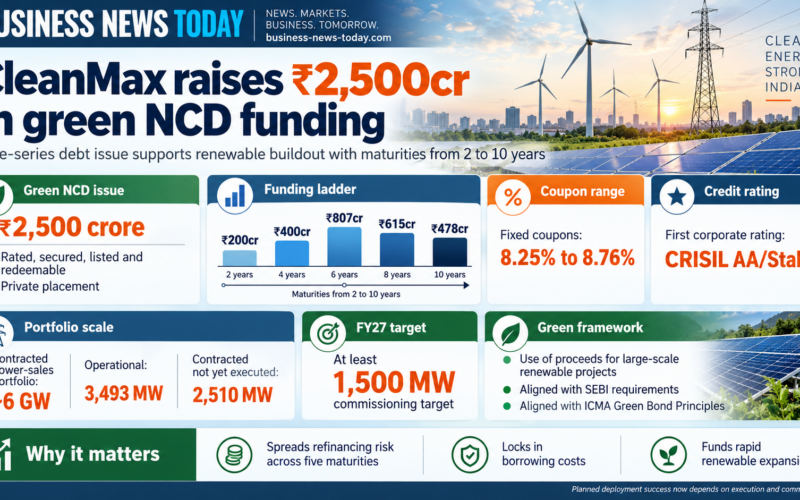
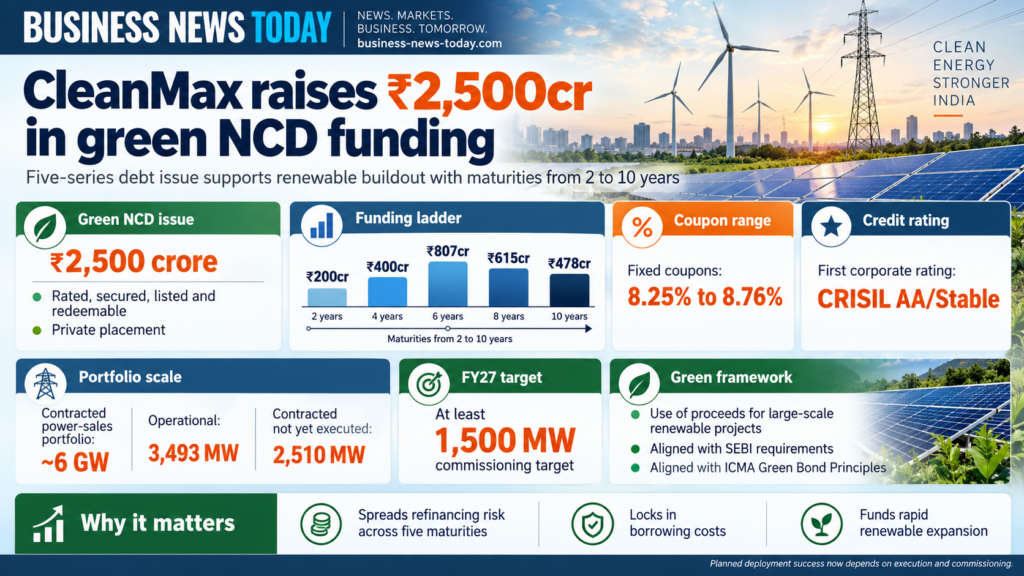
Clean Max Enviro Energy Solutions Limited (NSE: CLEANMAX; BSE: 544717) has secured ₹2,500 crore through rated, secured, listed and redeemable green non-convertible debentures issued on a private-placement basis, creating a funding ladder stretching from two to 10 years at fixed coupon rates ranging from 8.25% to 8.76%. The transaction follows CleanMax’s first CRISIL AA/Stable corporate rating and will direct proceeds toward large-scale renewable-energy projects under a green-use-of-proceeds framework aligned with SEBI requirements and the ICMA Green Bond Principles.
The financing is strategically important because CleanMax is in the middle of a rapid capacity buildout rather than a mature harvesting phase. Its renewable power-sales contracted portfolio reached approximately 6 GW by June 30, 2026, including 3,493 MW already operational and another 2,510 MW contracted but not yet executed, while management has targeted at least 1,500 MW of commissioning during FY27.
Why is CleanMax borrowing ₹2,500cr through five different NCD series?
The five-series structure allows CleanMax to spread refinancing risk instead of concentrating the entire ₹2,500 crore maturity into one future year. Company disclosures show the allotment divided into ₹200 crore, ₹400 crore, ₹807 crore, ₹615 crore and ₹478 crore series, with maturities extending from two years to 10 years.
That maturity ladder can be valuable for a renewable developer whose assets generate cash over long periods. Shorter-dated debt can support projects or corporate requirements that are expected to refinance relatively quickly, while longer-dated securities more closely match the duration of contracted renewable cash flows.
The fixed-rate structure provides another benefit. Coupon rates between 8.25% and 8.76% lock in borrowing costs instead of leaving the company entirely exposed to future interest-rate increases. That matters because Indian companies were accelerating debt issuance in late September amid concern that rising oil prices and inflation could bring forward a Reserve Bank of India rate increase.
CleanMax is therefore doing more than raising capital. It is converting a portion of future funding uncertainty into known debt-service obligations at a point when the domestic rate environment has become less predictable.
What does an AA/Stable rating change for CleanMax’s renewable-growth strategy?
Credit ratings influence which institutions can buy corporate debt and how investors price risk. CRISIL assigned CleanMax an AA/Stable corporate credit rating in September, creating a stronger foundation for the company’s first large green-bond issuance.
An AA rating does not eliminate credit risk, but it places the issuer within a relatively strong domestic credit category and can widen the institutional investor pool. CleanMax’s transaction attracted the International Finance Corporation, National Bank for Financing Infrastructure and Development, India Infrastructure Finance Company Limited, Aditya Birla Capital, IDFC First Bank, Nippon India Mutual Fund and other investors.
That investor mix matters because renewable expansion requires repeat access to capital. A company targeting gigawatts of new capacity cannot rely indefinitely on one bank group or one equity sponsor. Bonds create another funding channel alongside project debt, corporate loans and equity.
The rating also gives lenders a framework for tracking future leverage, liquidity and coverage metrics. If CleanMax expands faster than its operating cash flows and contracted asset base can support, borrowing costs can rise despite the strength of the renewable-growth narrative.
How large is CleanMax now compared with the ₹2,500cr financing?
CleanMax says its broader operating renewable portfolio across Asia has reached approximately 4.2 GW, while the power-sales portfolio specifically stood at 3,493 MW operational and 6,003 MW contracted at June 30. The company works with more than 590 corporate businesses and describes itself as one of Asia’s largest commercial and industrial renewable platforms.
That scale gives the bond issue an operating foundation. CleanMax is not financing a pre-revenue pipeline composed entirely of development-stage projects; several gigawatts are already generating electricity and contracted revenues.
The development pipeline nevertheless remains substantial. Roughly 2.5 GW of contracted power-sales capacity had yet to be executed at the end of June, meaning capital needs remain heavy even after the latest bond issue. Modules, turbines, land, substations, transmission connectivity and construction must all be funded before contracted megawatts become revenue-producing assets.
The ₹2,500 crore therefore acts as growth capital and balance-sheet infrastructure at the same time. Its value will depend on whether CleanMax can convert borrowed funds into operating renewable assets fast enough to earn returns above the fixed coupon and other financing costs.
Why do corporate renewable PPAs make long-dated green bonds easier to sell?
CleanMax’s business model is built around supplying renewable electricity to commercial and industrial customers rather than relying exclusively on merchant power prices. Long-term contracted cash flows can improve debt visibility because lenders and bond investors can model expected electricity sales over multiple years.
The company has also built a customer base containing global corporations and large Indian industrial groups, reducing reliance on a single offtaker. Repeat clients accounted for 79% of customers in fiscal 2026, according to CleanMax, suggesting that a large portion of growth comes from customers expanding renewable procurement after establishing an initial relationship.
That contracted structure does not remove credit or operational risk. Corporate customers can renegotiate, terminate or encounter their own financial stress, while renewable generation can fall below expectations because of weather or equipment performance.
However, predictable PPAs create a more natural match for fixed-income capital than a portfolio heavily exposed to spot electricity prices. This helps explain why infrastructure-focused institutions were willing to participate across maturities extending as long as a decade.
Does an 8.25%–8.76% coupon leave enough room for attractive project returns?
The answer depends on project economics rather than the bond coupon alone. CleanMax must earn project-level returns sufficiently above its blended cost of capital to create shareholder value after debt service, operating expenses, taxes and corporate costs.
Corporate renewable projects can sometimes support attractive economics because customers value electricity savings, decarbonisation and predictable long-term power costs. Hybrid wind-solar portfolios can also deliver electricity across a broader daily profile than standalone solar, potentially improving contract value.
But debt above 8% is not cheap capital in absolute terms. Projects that were economically attractive under lower borrowing assumptions can become less compelling if equipment prices rise, construction is delayed or tariffs become overly competitive.
The fixed coupon protects CleanMax against future rate increases but also means the company will continue paying the contracted rate if broader borrowing costs later fall. The economic value of the transaction therefore depends partly on what happens to Indian interest rates over the next several years.
Why did CleanMax shares fall despite completing a large green financing?
CleanMax shares closed at ₹1,373.10 on September 28, down about 1.5% for the session, even though the company announced the ₹2,500 crore financing. The stock nevertheless remained roughly 7% above its September 18 close and substantially higher than levels seen earlier in the year, meaning one weak session does not imply investors rejected the financing.
The broader Indian equity market fell sharply on September 28 as oil prices climbed and expectations of tighter monetary policy increased. The Nifty 50 declined about 1.6%, creating a difficult backdrop for capital-intensive renewable companies whose valuations are sensitive to borrowing costs.
That context makes CleanMax’s timing more interesting. The company has secured fixed-rate funding just as investors are becoming more concerned about rates, oil and financing costs.
The next test is deployment rather than fundraising. If CleanMax converts the ₹2,500 crore into renewable projects that support its 1,500 MW FY27 commissioning target and expand contracted EBITDA faster than finance costs, the green bond will look like a growth-enabling transaction. If execution slips, a long maturity ladder can become a long debt-service obligation before the corresponding assets generate enough cash.
Discover more from Business-News-Today.com
Subscribe to get the latest posts sent to your email.