
Anglo American plc and Teck Resources Limited are approaching the final regulatory hurdle for their approximately $54 billion merger just as China’s copper-processing industry confronts one of its most serious raw-material constraints in years. Reuters reported, citing people familiar with the matter, that China’s State Administration for Market Regulation is seeking commitments that the future Anglo Teck group continue supplying copper concentrate to Chinese customers as part of the merger review.
Neither China’s regulator nor the companies have publicly confirmed the detailed terms of such a remedy, making it important to distinguish the reported negotiations from an approved regulatory condition. Anglo American has, however, repeatedly identified Chinese antitrust clearance as the final outstanding major regulatory milestone for the transaction and continues to target completion between September 2026 and March 2027.
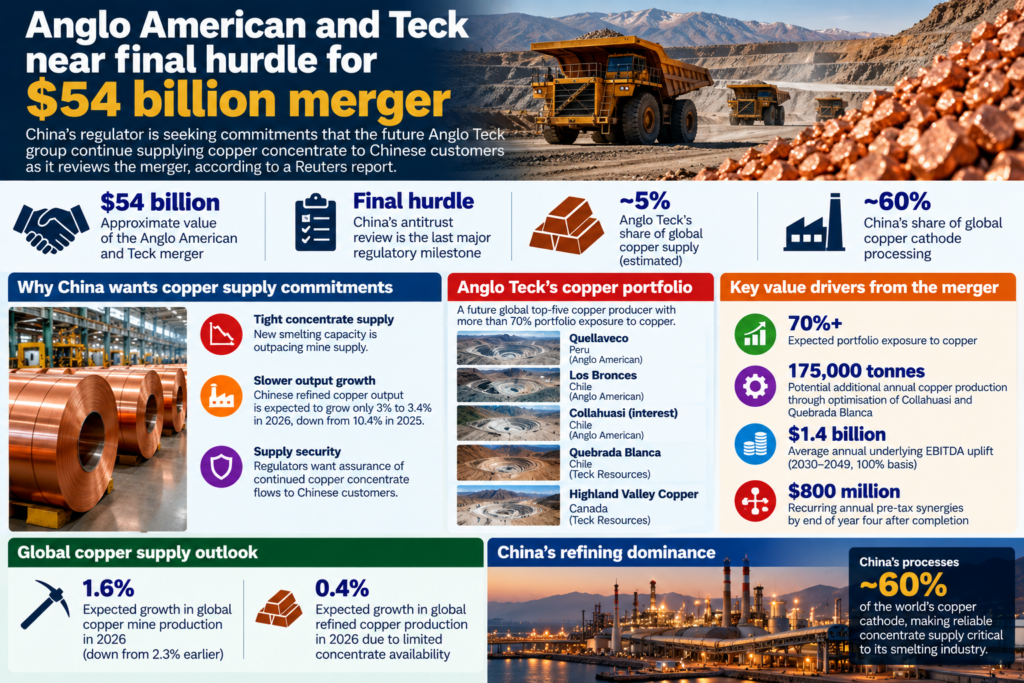
The unusual feature is the apparent mismatch between the combined miner’s global market share and China’s strategic interest in its output. Reuters reported that Anglo Teck would account for only around 5% of global copper supply, yet China processes roughly 60% of the world’s copper cathode and is confronting an increasingly acute shortage of copper concentrate. That imbalance means the most important number in the regulatory debate may not be Anglo Teck’s share of mining supply, but China’s much greater concentration at the smelting stage.
The situation turns what might ordinarily have been a conventional mining-merger review into a broader test of critical-mineral security. If copper supply commitments become part of the approval, the Anglo Teck transaction would illustrate how control over processing capacity can give a consuming country leverage over commodity flows even without ownership of the mines themselves.
Why is China reportedly asking Anglo Teck for copper supply commitments?
China has spent decades building the world’s largest copper smelting industry, creating enormous demand for concentrates produced by mines in Chile, Peru, the Democratic Republic of Congo, Indonesia and other jurisdictions. That processing scale worked particularly well while global mine supply grew quickly enough to provide sufficient feedstock, but the balance has become increasingly uncomfortable as new smelting capacity has expanded faster than concentrate availability.
The International Copper Study Group expects global copper mine production to increase only 1.6% in 2026, down from the 2.3% growth it had previously expected. The organisation specifically cited weaker output expectations in the Democratic Republic of Congo, Chile and Indonesia, alongside continuing constraints at major operations affected by earlier incidents.
The shortage is becoming even more visible further down the chain. International Copper Study Group projections show global refined copper production increasing only about 0.4% in 2026 despite new and ramping smelting capacity. The organisation said primary refined production growth is being constrained by the limited availability of concentrates, with increased production from scrap and solvent extraction-electrowinning operations providing only a partial offset.
China sits at the centre of that mismatch. Reuters reported in late September that analysts expect Chinese refined copper output to grow only around 3% to 3.4% in 2026, compared with 10.4% growth during 2025. If realised, that would represent the slowest expansion in decades even though the country possesses enormous installed smelting capacity.
Against that backdrop, securing predictable supply from a future top-five global copper producer becomes commercially understandable. Anglo Teck may represent only a modest portion of world output, but its portfolio contains several large, long-life mines whose concentrates could remain important to smelters for decades.
How much copper exposure would Anglo Teck actually control?
Anglo American and Teck Resources describe the combined company as a future global top-five copper producer with more than 70% of its portfolio exposure expected to come from copper. The group would combine Anglo American assets including Quellaveco, Los Bronces and its interest in Collahuasi with Teck Resources operations led by Quebrada Blanca and Highland Valley Copper.
The strategic value extends beyond current output. Anglo American and Teck Resources have substantial brownfield and greenfield growth pipelines, while the neighbouring Collahuasi and Quebrada Blanca operations in Chile create an unusual opportunity for operational coordination. The companies estimate that optimisation of those adjacent assets could eventually add approximately 175,000 tonnes of annual copper production.
They expect that opportunity to produce an average annual underlying EBITDA uplift of approximately $1.4 billion between 2030 and 2049 on a 100% basis. Separately, the merger is expected to generate approximately $800 million of recurring annual pre-tax corporate and operating synergies by the end of the fourth year after completion.
Those figures explain why Chinese regulators may be interested in future supply as well as current production. Merger reviews typically examine the market position created at closing, but copper infrastructure has investment cycles measured in decades. A commitment covering future concentrate sales could therefore influence where incremental production from Anglo Teck’s growth pipeline ultimately enters the processing system.
Why does a 5% mining share matter when China controls so much copper refining?
The reported regulatory discussions expose an important distinction between concentration in mining and concentration in processing. A company controlling roughly 5% of global mine supply would ordinarily appear far removed from monopoly territory, particularly in a commodity produced across multiple continents by companies including BHP Group Limited, Freeport-McMoRan Inc., Codelco, Glencore plc, Zijin Mining Group Company Limited and numerous smaller producers.
Processing is distributed very differently. China has built such a large share of global smelting and refining capacity that even a modest disruption in concentrate availability can create considerable pressure on plant utilisation and profitability. Smelters compete with one another for the same tonnes of mine output, strengthening the bargaining position of miners when concentrates become scarce.
Treatment and refining charges provide one of the clearest indicators of that pressure. These are the fees effectively earned by smelters for converting concentrate into refined metal. When concentrate is plentiful, miners compete for smelting capacity and charges tend to strengthen. When concentrate becomes scarce, smelters compete for feedstock and charges can collapse.
The current environment has moved strongly toward the latter condition. The global expansion of smelting capacity has exceeded growth in mine supply, while disruptions at major mines have tightened concentrate availability further. That means Chinese smelters can possess substantial physical processing capacity but still struggle to use it economically if they cannot secure sufficient raw material.
The Anglo Teck review therefore highlights a structural asymmetry. China may have limited direct control over many of the world’s largest copper mines, but its dominant position in downstream processing gives it a powerful commercial interest in ensuring that concentrate continues flowing into its smelting system.
Could merger approval redirect Anglo Teck copper away from other markets?
That is one of the most important unresolved questions because the details of any potential commitment have not been made public. Reuters reported that discussions have included copper sold directly to Chinese customers as well as material reaching China through trading companies, suggesting that regulators may be considering broader supply flows rather than simply requiring a fixed direct-sales contract.
The practical effect would depend heavily on the final wording. A commitment to maintain historical commercial relationships would be very different from an obligation to provide specific minimum volumes, preferential access or long-duration supply guarantees. Until the regulator publishes a decision or the companies disclose binding conditions, it would be premature to assume that China will receive a predetermined share of Anglo Teck’s production.
There is nevertheless a legitimate competitive question for smelters elsewhere. Europe, Japan, South Korea, India and other markets also operate copper-processing capacity and are exposed to the same global concentrate shortage. Any arrangement materially ring-fencing future supply for Chinese customers could reduce the pool of concentrate available to competing processors.
The effect could become more important if mine supply continues expanding more slowly than smelting capacity. Processing plants with weaker purchasing power or less efficient cost structures would then face increasing pressure to reduce production, delay expansions or close altogether. The copper shortage could consequently become not only a mining issue but a catalyst for geographical consolidation of the refining industry.
Why is the global concentrate shortage becoming harder to solve?
Copper mining cannot respond quickly to price signals because discovering, permitting, financing and constructing large mines can require more than a decade. Even brownfield expansions can take years because they require environmental approvals, tailings infrastructure, water supply, processing equipment and substantial capital.
The International Copper Study Group’s latest forecast illustrates that constraint. It expects global mine output to grow only 1.6% in 2026 and 2.3% in 2027 despite high copper prices and powerful long-term demand narratives around electricity grids, electric vehicles, renewable energy and data centres.
Refined copper demand is expected to increase 1.6% during 2026 and 2% in 2027. Those figures do not imply an immediate global shortage of refined copper because the International Copper Study Group currently forecasts a relatively small refined-market surplus of about 96,000 tonnes in 2026 and approximately 377,000 tonnes in 2027.
That apparent contradiction is important. A market can have enough refined copper overall while simultaneously suffering from severe stress in the intermediate concentrate market. Scrap availability, inventories, secondary production and regional trade flows can keep refined metal supplied even when primary smelters struggle to secure mine feed.
This is why the Anglo Teck regulatory story should not be interpreted simply as evidence that the world is running out of copper. The tighter issue is that the geography and growth rates of mines, smelters and end-user demand have become increasingly misaligned.
Could China’s merger review reshape how mining companies market copper?
Large diversified miners traditionally sell concentrates through combinations of long-term contracts, annual negotiations and spot-market transactions. Marketing flexibility allows producers to respond to treatment charges, freight costs, customer creditworthiness and changing regional demand.
A regulatory commitment attached to a major merger could potentially reduce some of that flexibility. If Anglo Teck were required to maintain particular volumes or supply relationships with Chinese smelters, a portion of its future production could effectively become commercially constrained before normal market negotiations take place.
The impact would depend on scale. A relatively small commitment designed simply to preserve existing customer access could have limited economic significance. A larger or longer-lasting obligation could influence marketing strategy, treatment-charge negotiations and the allocation of concentrate across regions.
The possibility is especially relevant because one of the claimed benefits of the merger is greater scale and commercial efficiency. Anglo American and Teck Resources expect approximately $800 million of recurring annual synergies across areas including operational, functional and commercial activities. Any regulatory remedy affecting product marketing would therefore need to be considered against those anticipated benefits.
How different is China’s approach from Canada’s approval of the Anglo Teck merger?
Canada also attached significant commitments to its approval, although they were focused primarily on domestic investment, employment and maintaining the combined company’s Canadian presence. Anglo American and Teck Resources committed to spending at least C$4.5 billion in Canada over five years, including investment associated with Highland Valley Copper, the Trail metallurgical complex and the Galore Creek and Schaft Creek projects.
The future Anglo Teck group is also expected to maintain its global headquarters in Vancouver, where its chief executive, deputy chief executive, chief financial officer and much of the senior management team will be located. These commitments reflected Canada’s interest in preserving economic benefits associated with combining one of its largest miners with Anglo American.
The reported Chinese discussions appear materially different because they focus on commodity flows rather than headquarters, employment or domestic capital expenditure. If confirmed, they would effectively connect merger clearance with continued access to a globally traded raw material.
That distinction demonstrates why the same transaction can generate very different regulatory concerns across jurisdictions. Canada is primarily interested in where corporate control, jobs and investment reside. China’s interest appears to centre increasingly on whether sufficient physical copper concentrate will continue reaching its vast processing industry.
What does the latest Anglo American and Teck share performance suggest?
Investor sentiment toward both companies remained strong on October 2, although it would be inappropriate to attribute the moves entirely to the reported regulatory discussions. Anglo American shares gained approximately 3% in London to close around £40.97, leaving the stock less than 6% below its 52-week high reached in September.
Teck Resources performed even more strongly. Its New York-listed shares climbed about 5.1% to $68.56 on October 2, taking the company’s market capitalisation to approximately $33.6 billion and leaving the stock relatively close to its recent 52-week high.
The performance reflects a wider constructive backdrop for copper producers, including strong copper prices, supply concerns and increasing investor interest in miners positioned to benefit from electrification and infrastructure spending. Progress toward the merger also reduces one source of uncertainty, but China’s approval remains unresolved.
For shareholders, the regulatory timetable is now unusually important because many of the other structural components are already in place. Shareholders have approved the combination, Canada has granted clearance subject to commitments and the future leadership structure has been announced. Chinese antitrust approval remains the largest identifiable regulatory step before Anglo Teck can be created.
Why could the China decision matter beyond Anglo American and Teck Resources?
The significance of the review extends beyond one mining transaction because governments are becoming increasingly sensitive to the security of critical-mineral supply chains. Copper is particularly important because electricity networks, renewable generation, electric vehicles, industrial equipment and data centres all require substantial quantities of the metal.
Countries have spent years discussing where critical minerals are mined and processed. The Anglo Teck review introduces another dimension: whether competition regulators may increasingly consider security of physical supply when reviewing transactions that affect strategically important commodities.
That would complicate future cross-border mining mergers. A transaction could satisfy traditional competition tests based on market share yet still face conditions because a major consuming jurisdiction fears losing access to scarce material. Producers would then have to evaluate regulatory risk not only through conventional antitrust concentration measures but also through national supply-chain priorities.
There are reasons not to generalise too quickly. China has not publicly announced a final Anglo Teck remedy, the negotiations reported by Reuters may still change, and circumstances in copper concentrates are unusually tight. A case involving a different commodity or a better-supplied market might produce a very different regulatory outcome.
The underlying economic pressure is nevertheless real. Global mine production is expanding slowly, refined production growth is constrained by limited concentrate availability, and China possesses far more processing capacity than domestic mine output can feed. That makes access to imported copper concentrate strategically valuable regardless of how the Anglo Teck discussions are ultimately resolved.
For Anglo American and Teck Resources, the immediate issue is whether they can satisfy China without undermining the commercial flexibility and global customer relationships that make their enlarged copper portfolio valuable. For the wider mining industry, the more consequential question is whether the transaction marks the beginning of a world in which regulatory approval increasingly comes with expectations about where critical minerals must flow.
Discover more from Business-News-Today.com
Subscribe to get the latest posts sent to your email.