



Ceigall India Limited (NSE: CEIGALL) has received a formal Letter of Award from Himachal Pradesh State Industrial Development Corporation Limited for a ₹225 crore infrastructure package at the Bulk Drug Park in Una district, advancing a project for which the company had already secured a Letter of Intent in September 2025. The Phase-I package covers formation cutting, internal roads, storm-water drains, a bridge and boundary fencing, with an 18-month execution period. Ceigall disclosed the formal award on August 21, 2026 after receiving the Letter of Award on August 20.
The distinction between the earlier Letter of Intent and the new Letter of Award is important when assessing the financial impact. Ceigall had disclosed the ₹225 crore project in September 2025 and was already showing the Una Bulk Drug Park package in its FY26 project portfolio, meaning the August development should primarily be viewed as a progression in contract status rather than an entirely fresh ₹225 crore addition to backlog. The milestone reduces uncertainty around moving the package toward execution, but simply adding ₹225 crore again to the company’s current order book would risk double counting.
What exactly will Ceigall India build at the Una Bulk Drug Park?
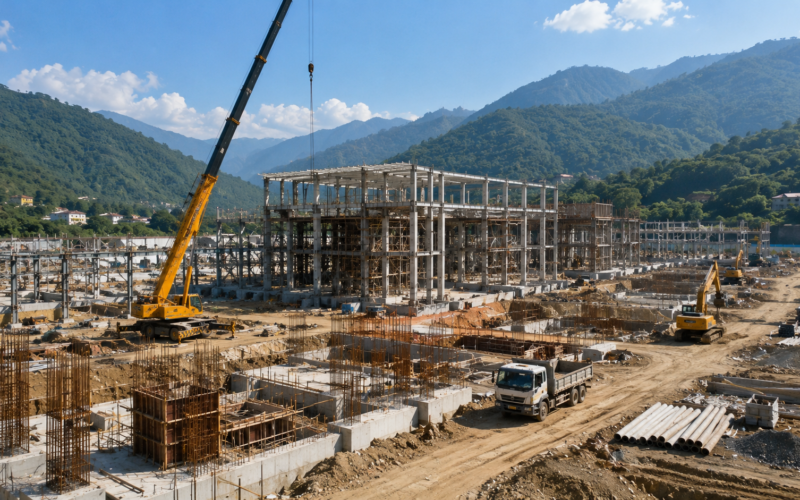
Ceigall’s contract covers enabling infrastructure rather than pharmaceutical production facilities themselves. The work includes site formation and cutting, construction of internal roads, storm-water drainage, a bridge and boundary fencing under the first phase of development. The contract is structured as an item-rate arrangement and the original disclosure specified performance security equivalent to 3% of the contract value.
The 18-month execution schedule places Ceigall inside a much broader multi-package infrastructure programme. Himachal Pradesh’s Bulk Drug Park is being developed at Haroli in Una district across approximately 1,405 acres, with an overall project cost of ₹1,923 crore and common infrastructure facilities estimated at ₹1,118.46 crore. The central government has approved ₹1,000 crore of grant-in-aid for those common facilities.
Ceigall’s ₹225 crore gross contract value is therefore equivalent to roughly 11.7% of the Bulk Drug Park’s stated ₹1,923 crore overall project cost. That does not mean Ceigall controls 11.7% of all project construction because contract values can include taxes and different packages have different accounting treatment, but it shows that the award is meaningful within the physical development programme.
How significant is the ₹225 crore contract for Ceigall India’s current scale?
Ceigall entered FY27 with a substantially larger business than when the Bulk Drug Park project was initially disclosed. Consolidated revenue from operations reached ₹4,022.4 crore in FY26, while the order book stood at ₹18,554.3 crore at March 31. By June 30, 2026, backlog had edged up to ₹18,568.3 crore, with roads still accounting for about 68% and industrial infrastructure representing ₹622 crore.
On a simple scale comparison, ₹225 crore is about 5.6% of Ceigall’s FY26 consolidated revenue and approximately 1.2% of its June-end order book. However, the company’s March investor presentation already listed the Una project with ₹190.7 crore of balance order book, a figure that appears consistent with the ₹225 crore award after allowing for possible tax treatment. That existing inclusion reinforces why the latest Letter of Award should not be interpreted as a brand-new 1.2% increase in backlog.
The more relevant significance is diversification. Ceigall’s historical concentration has been roads and highways, but management has been moving into renewable energy, transmission, metro and industrial infrastructure. At June 30, industrial infrastructure represented only 3.35% of the total order book, so successful delivery of the Bulk Drug Park package can build credentials for future industrial parks, manufacturing zones and specialised infrastructure tenders even though roads remain the dominant business.
Why is the Himachal Pradesh Bulk Drug Park a much larger industrial project?
The Bulk Drug Park is intended to create common infrastructure that can reduce the cost of manufacturing active pharmaceutical ingredients, key starting materials and other bulk drugs. Government plans include a zero-liquid-discharge Common Effluent Treatment Plant, solid and hazardous waste facilities, solvent recovery, steam generation, water systems, internal power distribution and laboratories, allowing manufacturers to share expensive utilities instead of replicating them at each factory.
The project’s economic ambitions are considerably larger than its public infrastructure budget. The approved detailed project report envisages eventual private-sector investment of about ₹8,000 crore to ₹10,000 crore and direct employment for roughly 15,000 to 20,000 people if the pharmaceutical manufacturing ecosystem develops as planned. Those figures remain expectations rather than committed private investment, but they explain why relatively conventional road, drainage and land-development packages have strategic importance for the eventual industrial park.
Execution remains uneven across the various common facilities. As of recent government disclosures, the internal road network and compound-wall package was around 10% complete, the storm-water drainage network around 12% complete and raw, potable and demineralised water infrastructure around 60% complete, while several additional packages remained at tender preparation or tendering stages.

What do Ceigall India’s latest earnings say about execution capacity?
Ceigall reported consolidated Q1 FY27 revenue from operations of ₹969.6 crore, up 15.7% year on year, while EBITDA increased 31.4% to ₹143.4 crore. The EBITDA margin improved to 14.8% from 13% and profit after tax reached ₹63.8 crore, up 24.4%, indicating that the company entered the new financial year with both revenue growth and improved operating profitability.
The company is nevertheless managing a very large execution pipeline. Its ₹18,568.3 crore June-end order book is more than four times FY26 revenue, providing multi-year visibility but also placing considerable importance on working capital, project mobilisation, land availability and timely clearances. Industrial projects such as Una are smaller than Ceigall’s largest highway packages, but they add another operating vertical that management must execute alongside rapid expansion in renewables and transportation infrastructure.
The formal Bulk Drug Park award is therefore best interpreted as an execution milestone within an already recognised project rather than a surprise order-book event. For investors, the next important signals will be mobilisation, revenue recognition and whether the project helps Ceigall convert its small industrial-infrastructure vertical into a repeatable source of contracts.
How did Ceigall India shares react to the formal award?
Ceigall India shares closed at ₹314.35 on the National Stock Exchange on August 21, up 0.5% for the session, after trading between ₹312.25 and ₹321.80. The stock remained well below its 52-week high of ₹405.70 and above its ₹222.61 low, while its market capitalisation was about ₹5,476 crore.
Recent momentum has been subdued despite a heavy flow of contract announcements. The stock had declined about 1.3% over five trading days and roughly 6.8% over 20 trading days by the August 21 close, suggesting investors are looking beyond headline order values toward execution, margins and the capital required to deliver the enlarged backlog.
That reaction is understandable in this instance because the ₹225 crore Una contract was not new information in economic terms. The transition from Letter of Intent to Letter of Award improves contractual certainty, but the larger valuation question remains how effectively Ceigall converts its ₹18,000 crore-plus backlog into revenue, cash flow and sustainable returns.
Discover more from Business-News-Today.com
Subscribe to get the latest posts sent to your email.