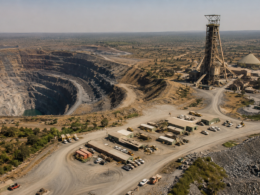


Capricorn Metals Limited (ASX: CMM) surged 14.33% to A$13.61 on July 27, 2026, after releasing an updated pre-feasibility study for the Mount Gibson Gold Project and increasing its total group gold reserves to 5.2 million ounces. The study lifted Mount Gibson reserves by 34% to 3.67 million ounces, including a maiden underground reserve of 365,000 ounces, while outlining steady-state production of approximately 260,000 ounces per year from the third year of operations.
The update also introduced Capricorn Metals’ Range 500 ambition, pointing towards the possibility of building a gold production platform approaching 500,000 ounces annually over time. Range 500 is an aspiration rather than formal production guidance, but it helps explain why CMM shares attracted such a strong market reaction.
At A$13.61, Capricorn Metals carried an implied market capitalisation of approximately A$6.22 billion, based on around 456.79 million shares outstanding. Investors are therefore no longer valuing the company solely as the owner of the producing Karlawinda Gold Project. The market is increasingly pricing Capricorn Metals as a potential multi-mine Australian gold producer, although Mount Gibson must still clear remaining approvals, funding decisions, construction and ramp-up risks.
Why did Capricorn Metals shares jump more than 14% on July 27?
The July 27 rally more than reversed the 6.08% decline recorded by CMM shares in the previous session, when the stock closed at A$11.90. From the July 20 close of A$11.74, the A$13.61 price represented a five-session gain of approximately 15.9%.
Compared with a price of A$12.68 on June 24, Capricorn Metals shares had risen about 7.3% over roughly one month. However, the stock remained approximately 17.4% below its 52-week high of A$16.48 and around 5% below its December 31, 2025 closing price.
The magnitude of the July 27 rally indicates that the reaction was predominantly company-specific rather than simply another move linked to the gold price. Capricorn Metals and several other Australian gold producers had weakened during the previous session as bullion prices declined, but CMM shares rebounded sharply after the Mount Gibson update materially changed expectations around the project’s scale, economics and production potential.
This was not a routine exploration announcement or a modest reserve extension. The updated study increased the expected size of Mount Gibson, extended its operating horizon and introduced an underground component. It also gave investors a clearer view of how Capricorn Metals could evolve from a successful single-mine operator into a significantly larger Australian gold producer.
How has the Mount Gibson study changed the Capricorn Metals investment case?
The reserve increase is one of the clearest indicators of how rapidly the Capricorn Metals portfolio has expanded. In October 2025, the company reported group reserves of approximately 4 million ounces, comprising around 2.74 million ounces at Mount Gibson and 1.30 million ounces at the Karlawinda Gold Project.
The July 2026 update increased total group reserves to 5.2 million ounces. Mount Gibson reserves alone rose by 34% to 3.67 million ounces, including the maiden underground reserve of 365,000 ounces.
The underground component is strategically important because Mount Gibson is no longer exclusively an open-pit development proposition. Underground mining can introduce additional technical complexity and development expenditure, but it can also extend mine life, provide access to higher-grade mineralisation and create opportunities to convert further underground resources into reserves.
The investment case now partly depends on whether Capricorn Metals can integrate open-pit and underground operations while maintaining the operating simplicity and cost control that supported Karlawinda’s performance.
The updated Mount Gibson production profile is also considerably more ambitious than earlier versions of the project. The April 2024 study contemplated average production of approximately 155,000 ounces per year during the first nine years and an initial mine life of around 11.5 years.
The latest study outlines steady-state production of approximately 260,000 ounces annually from the third year of operations across a 19-year mine life. It also estimates life-of-mine all-in sustaining costs of A$1,870 per ounce, a pre-tax net present value of A$6.1 billion and a payback period of approximately 14 months.
Direct comparisons with the earlier study require caution because the mine plan, reserves, gold-price assumptions, project scope and cost estimates have changed. However, the strategic direction is clear. Mount Gibson has evolved from a conventional second-mine development into a potential cornerstone asset capable of reshaping Capricorn Metals’ production profile.
What does the Range 500 ambition mean for Capricorn Metals (ASX: CMM)?
The Range 500 ambition appears to describe Capricorn Metals’ longer-term objective of operating within the vicinity of 500,000 ounces of annual group gold production. It should not be interpreted as formal production guidance or a guaranteed outcome.
Achieving that production range would likely depend on the successful expansion of Karlawinda, construction and ramp-up of Mount Gibson, further reserve conversion and potentially additional contributions from Capricorn Metals’ wider exploration portfolio in Western Australia.
The ambition nevertheless provides useful strategic context. Capricorn Metals is no longer presenting Mount Gibson merely as a replacement project or supplementary source of production. Management is positioning the asset as part of a broader plan to create a larger, longer-life Australian gold business.
For investors assessing CMM shares, the key distinction is between strategic potential and confirmed output. The company has established a sizeable reserve base and published attractive study economics, but Range 500 will require years of permitting, development, construction and operating execution.
Can Karlawinda generate enough cash to support Mount Gibson?
Karlawinda remains the financial and operational foundation of Capricorn Metals. The mine, located southeast of Newman in Western Australia’s Pilbara region, has been operating since June 2021.
Mount Gibson, acquired by Capricorn Metals in July 2021, is located in Western Australia’s Mid West region, approximately 280 kilometres northeast of Perth. The development is expected to become the company’s second operating centre if remaining approvals and investment decisions are completed.
Karlawinda produced 30,437 ounces during the June 2026 quarter, taking full-year production to 123,589 ounces. That result placed annual output towards the upper end of the company’s guidance range of 115,000 to 125,000 ounces.
Full-year all-in sustaining costs were expected to remain within Capricorn Metals’ guided range of A$1,530 to A$1,630 per ounce. The operating mine generated an underlying quarterly cash build of A$68.2 million before development expenditure and the payment of the company’s maiden dividend.
Capricorn Metals ended June with approximately A$507 million in cash and gold after spending A$44.8 million on the Karlawinda Expansion Project, commencing early work at Mount Gibson and paying a maiden dividend of A$22.8 million.
Major construction work associated with the Karlawinda expansion was largely complete, with commissioning activities expected during the September 2026 quarter. A successful ramp-up could raise processing capacity, support higher gold production and strengthen the internally generated funding available for Mount Gibson.
The company’s cash position gives it more development flexibility than a pre-revenue miner attempting to finance its first operation. However, the revised scale of Mount Gibson means investors still need clarity on the final capital requirement and funding structure.
The central financing question is not simply whether Capricorn Metals can access capital. It is whether management can develop Mount Gibson without weakening the balance-sheet characteristics and cost discipline that have supported the company’s market valuation.
Is the CMM share valuation justified after the July 27 surge?
At A$13.61, Capricorn Metals had an implied market capitalisation of approximately A$6.22 billion. The similarity between that valuation and Mount Gibson’s estimated pre-tax net present value of A$6.1 billion is striking, but the figures are not directly comparable.
Market capitalisation represents the equity value assigned to the entire Capricorn Metals business. It includes Karlawinda, Mount Gibson, the company’s cash and gold holdings, exploration assets and future growth expectations.
The Mount Gibson net present value is a project-level estimate based on study assumptions. It does not represent cash currently held by Capricorn Metals and remains dependent on approvals, construction performance, operating costs, taxation, financing decisions and future gold prices.
Capricorn Metals also owns the operating Karlawinda mine, which is already generating production and cash flow. Conversely, Mount Gibson remains a development project and has not yet reached commercial production.
The market is therefore balancing existing value against future execution. The bullish interpretation is that Capricorn Metals has a proven operating mine, a strong cash position, a near-term expansion and a second project capable of materially increasing group production.
The more cautious interpretation is that the valuation of CMM shares already incorporates a meaningful proportion of Mount Gibson’s expected future success. Any increase in capital costs, delay in approvals or weaker operating performance could therefore result in valuation pressure.
Capricorn Metals remained below its 52-week high of A$16.48 despite the July 27 rally. This indicates that the market has not returned the shares to their previous peak, although the strong single-session move demonstrates renewed confidence in the company’s development pipeline.
What are the next measurable catalysts for Capricorn Metals investors?
The first near-term proof point is the detailed June-quarter report, which should provide fuller information on production costs, expansion expenditure and the company’s financial position.
Investors will also be watching for fiscal 2027 production and cost guidance. The strength of Karlawinda’s operating performance will influence how comfortably Capricorn Metals can fund development expenditure while preserving its cash balance.
Commissioning of the Karlawinda Expansion Project during the September 2026 quarter is another important milestone. A successful commissioning and ramp-up would strengthen cash generation and demonstrate that management can execute an operating expansion while preparing for Mount Gibson.
Mount Gibson received federal environmental approval on June 30, 2026, allowing the project to progress through the remaining Western Australian approval processes. Development activities have been targeted for the December 2026 quarter, subject to the completion of those requirements.
The final investment decision, confirmed project capital, funding structure, major contract awards and detailed construction timetable will provide more actionable evidence than the headline net present value alone.
Further drilling and reserve conversion also remain relevant. The maiden underground reserve validates part of Mount Gibson’s underground opportunity, but the longer-term Range 500 ambition will require Capricorn Metals to demonstrate that additional resources can be converted into economically mineable reserves.
What could prevent the Capricorn Metals growth case from developing as planned?
The first material risk is exposure to gold prices. Capricorn Metals benefits directly when gold prices strengthen, but an unhedged position can also expose earnings and project economics to a sustained decline.
Mount Gibson’s proposed 19-year operating life means long-term commodity-price assumptions matter more than the spot gold price prevailing when the study was released. Even a project with attractive current margins can experience a lower valuation if future gold-price assumptions weaken.
The second major risk is development execution. Mount Gibson combines open-pit and underground mining, carries a substantially larger production profile than earlier studies and must still progress through remaining approvals before full construction.
Construction-cost inflation, contractor availability, schedule delays, metallurgical performance and a slower-than-expected ramp-up could reduce project returns even if the reserve estimate remains unchanged.
The third risk is valuation compression. A 14.33% single-session rise reflects meaningful investor optimism, but it also increases the level of future success embedded in the CMM share price.
If the final capital requirement rises, Karlawinda commissioning is delayed or Mount Gibson development takes longer than expected, investors may reduce the premium assigned to Capricorn Metals’ growth pipeline.
The company also remains operationally concentrated. Until Mount Gibson is constructed and producing, Karlawinda remains Capricorn Metals’ principal source of gold production and operating cash flow. Any extended disruption at Karlawinda would have an outsized effect while the company is funding expansion and development activities.
What evidence would strengthen or weaken the Capricorn Metals investment case?
The evidence supporting Capricorn Metals has improved materially. The company delivered production within guidance, accumulated approximately A$507 million in cash and gold, advanced the Karlawinda expansion, obtained federal approval for Mount Gibson and increased group gold reserves to 5.2 million ounces.
The next stage of the investment case is less about proving that Capricorn Metals owns valuable gold assets and more about demonstrating that it can translate those assets into reliable production.
A stronger case would require successful Karlawinda commissioning, stable operating costs, completion of Mount Gibson approvals, a credible funding plan and construction performance consistent with the updated study.
The case would weaken if costs rise materially, approvals are delayed, Karlawinda underperforms or Capricorn Metals requires a funding structure that significantly changes the company’s balance-sheet profile.
A sustained revaluation of CMM shares would likely require measurable operating evidence rather than reserve growth alone. The market will want to see that Capricorn Metals can fund and construct Mount Gibson while preserving the execution standards that made Karlawinda successful.
What are the key takeaways for Capricorn Metals (ASX: CMM) investors?
- Capricorn Metals shares rose 14.33% to A$13.61 after the company released a substantially larger Mount Gibson development study.
- Group gold reserves increased to 5.2 million ounces, including 3.67 million ounces at the Mount Gibson Gold Project.
- Mount Gibson is designed to produce approximately 260,000 ounces annually from its third year across a proposed 19-year mine life.
- The Range 500 ambition signals Capricorn Metals’ intention to develop into a larger multi-mine Australian gold producer, but it is not formal production guidance.
- Karlawinda remains the principal source of production and cash flow supporting the company’s Mount Gibson development strategy.
- The next major milestones include Karlawinda expansion commissioning, remaining Mount Gibson approvals and confirmation of the project’s funding and development plan.
- The principal risks include gold-price exposure, construction-cost inflation, permitting delays, underground execution and the possibility that the current valuation already anticipates substantial future success.
Discover more from Business-News-Today.com
Subscribe to get the latest posts sent to your email.