




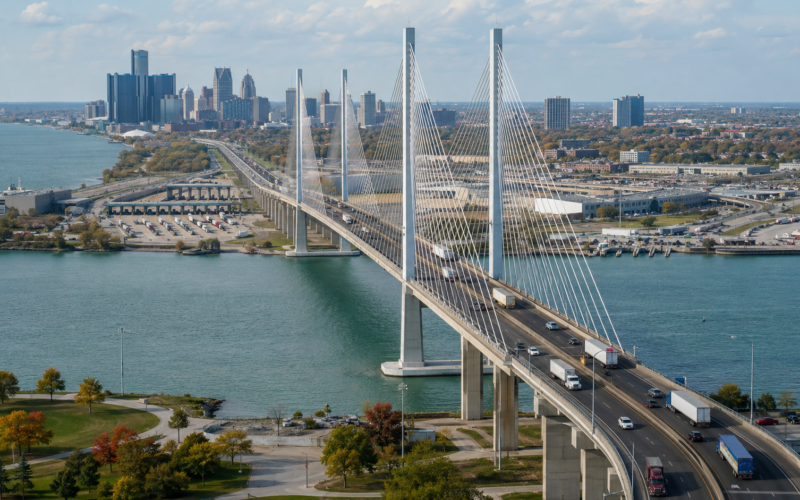
The Gordie Howe International Bridge opened to passenger and commercial traffic on July 27, 2026, creating a new six-lane connection between Detroit, Michigan, and Windsor, Ontario, after weeks of political uncertainty surrounding the completed crossing. The C$6.4 billion public-private partnership project links Interstate 75 directly with Ontario Highway 401, giving freight operators a modern highway-to-highway alternative to the Ambassador Bridge. Its opening strengthens one of North America’s most economically important manufacturing and logistics corridors at a time when tariff tensions are placing unusual pressure on Canada-US trade relations. However, the bridge begins operations with unresolved questions about traffic migration, toll income and the interaction between Canada’s cost-recovery model and a new 15-year revenue arrangement with the United States.
The immediate achievement is operational rather than ceremonial. Vehicles can now use infrastructure that had been effectively complete but unavailable while the two federal governments negotiated outstanding issues involving revenues and toll governance. The agreement removed the immediate obstacle to opening, but it did not eliminate the political and financial tensions surrounding the project. Instead, it transferred those tensions from construction and diplomacy into the bridge’s operating phase, where actual traffic, costs and toll receipts will determine whether the arrangement remains manageable.
Why does the Gordie Howe International Bridge matter so much to North American trade resilience?
The Gordie Howe International Bridge is not simply another urban crossing over the Detroit River. The Windsor-Detroit corridor handles hundreds of millions of dollars in goods each day and has historically accounted for roughly one-quarter of trade between Canada and the United States. It is particularly important to the automotive sector, where engines, components, finished vehicles and intermediate products can cross the border several times before final assembly.
That concentration creates economic efficiency, but it also produces vulnerability. When one crossing carries a large share of time-sensitive freight, congestion, maintenance problems, security incidents, border protests or administrative disruptions can quickly affect production schedules far beyond Detroit and Windsor. Automotive plants operating with tightly managed inventories may have limited capacity to absorb extended delays in component deliveries.
The new crossing introduces redundancy into that system. It allows freight operators to choose between the publicly owned Gordie Howe International Bridge and the privately owned Ambassador Bridge, while also providing a direct connection between two of the continent’s major highway networks. Trucks using the Gordie Howe route can move between Highway 401 and Interstate 75 without relying on the same urban road connections associated with the older crossing.
For manufacturers, the economic benefit will not necessarily appear as a dramatic reduction in the headline cost of transportation. It is more likely to emerge through improved predictability, lower disruption risk and greater flexibility during periods of congestion. The bridge therefore functions partly as an insurance asset for North American supply chains, with much of its value becoming visible when another route is constrained.
How will the new Detroit-Windsor crossing change freight capacity and border processing?
The bridge extends approximately 2.5 kilometres and includes an 853-metre main span, making it the longest cable-stayed main span in North America. The broader project includes Canadian and United States ports of entry, 16 toll lanes, 60 inspection lanes and a major interchange connecting the United States inspection complex with Interstate 75.
These supporting facilities are central to the commercial case. A visually impressive bridge provides limited economic benefit if inspection capacity, toll collection or connecting roads create new bottlenecks. The project was consequently designed as an integrated border system rather than as an isolated river crossing.
The Canadian Port of Entry covers approximately 53 hectares, while the United States facility occupies about 68 hectares. Both incorporate customs, security and traffic-management infrastructure intended to process passenger and commercial vehicles within the same coordinated corridor. Canada Border Services Agency operations at the new crossing also create a third land port of entry in the Windsor area alongside the Ambassador Bridge and the Windsor-Detroit Tunnel.
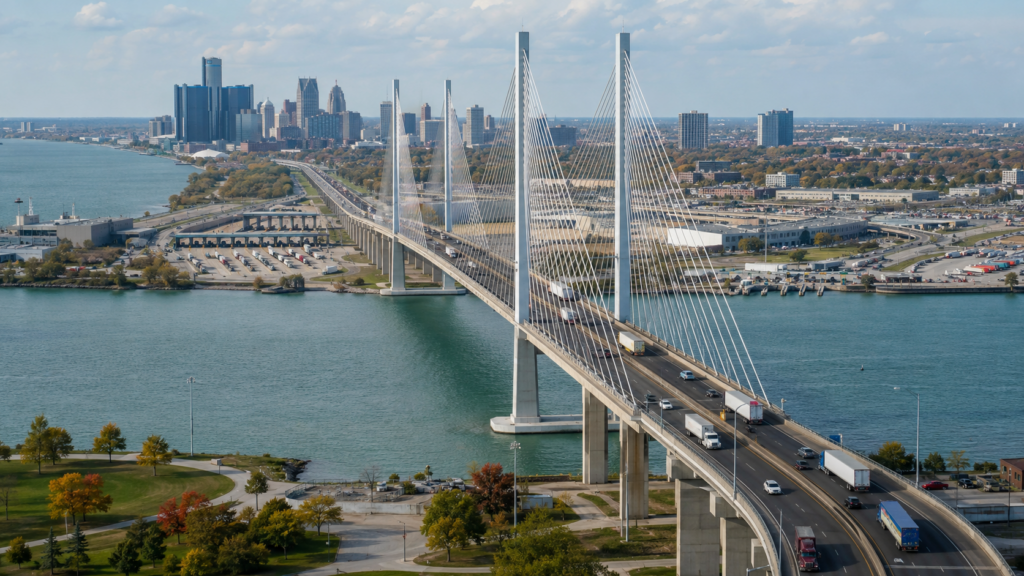
The real performance test will be throughput during peak periods. Carriers will compare total journey times, inspection reliability, tolls, access routes and account-management systems rather than choosing a bridge solely because it is new. Early traffic data will therefore matter more than opening-day symbolism.
A toll-free multi-use path for pedestrians and cyclists is scheduled to open on August 5, adding a public-access element rarely associated with a major international freight crossing. While this feature will not materially affect the project’s revenue economics, it broadens the bridge’s role in connecting the two communities.
What political compromise allowed the completed Gordie Howe bridge to open on July 27?
The bridge had initially been expected to enter service earlier in 2026, but Canada agreed to delay the opening at the request of the United States while outstanding issues were discussed. The resulting proposed agreement in principle provides for Canada to make annual payments equal to 50% of net bridge and crossing-related revenue during the first 15 fiscal years of operation. Those payments are to flow into a United States-Canada Economic Development Fund established and solely controlled by the United States government.
Net revenue is defined as bridge and crossing-related revenue after operating costs. This distinction matters because the agreement does not promise the United States half of gross toll collections. The amount available for the fund will depend on traffic volumes, toll rates and the cost of operating the crossing.
The proposed agreement also gives the United States a defined role in certain toll changes. Windsor-Detroit Bridge Authority must seek US consent when a proposed annual increase exceeds 10% and would move tolls above the average for comparable regional crossings. Consent is also required for reductions that would place tolls below the comparable regional average. If the United States does not respond within 30 days, consent is deemed to have been granted.
At the same time, the agreement states that it does not amend, replace or supersede the 2012 Canada-Michigan Crossing Agreement or the ownership, governance and financial framework created under that deal. Officials are still expected to finalize the legal, financial and administrative arrangements required to implement the new principles.
That wording creates the central financial ambiguity. Canada has consistently presented the bridge as an investment whose costs would be recovered from toll revenue before net proceeds were shared with Michigan under the original framework. The newer proposal introduces payments to a US-controlled fund during the first 15 years without explicitly explaining how those payments interact with Canada’s recovery of its construction investment.
Prime Minister Mark Carney maintained that the original cost-recovery framework remained intact. However, the text of the proposed agreement has allowed differing political interpretations, with the Donald Trump administration presenting it as a renegotiated outcome that gives the United States a more immediate share of bridge economics.
Why did the bridge opening become entangled with wider Canada-US tariff tensions?
A cross-border opening ceremony involving Canadian, United States and Michigan representatives had been expected, reflecting the binational nature of the project. Canadian officials subsequently cancelled the joint celebration after the United States announced new tariff measures affecting Canadian goods. Canada instead held an inauguration event in Windsor on July 24 without the planned US delegation, although the bridge still opened to traffic three days later.
The disagreement illustrated the contrast between the long-term purpose of the bridge and the short-term political environment in which it opened. The infrastructure was built to deepen economic integration, reduce friction and protect supply chains. Its opening occurred while the two countries were arguing over tariffs, market access and the distribution of revenue from the crossing itself.
Ontario Premier Doug Ford said during the Canadian ceremony that cooperation between the countries remained economically preferable despite the difficult political relationship. Michigan Governor Gretchen Whitmer separately marked the opening by driving across the bridge and argued that the crossing would support production, lower transportation costs and strengthen regional trade.
This split-screen opening matters because infrastructure cannot insulate trade from policy decisions. The Gordie Howe bridge can reduce physical bottlenecks, but it cannot remove tariffs, customs disputes or regulatory barriers. In practical terms, the bridge expands the capacity to move goods at the same time that government policy may affect the volume and composition of those goods.
Can toll revenue support Canada’s cost recovery while funding new US economic commitments?
The standard toll for a personal vehicle is C$8, or US$5.75. Drivers enrolled in the Breakaway programme receive a 25% discount, reducing the rate to C$6 or US$4.35. Large commercial and passenger vehicles pay C$12, or US$8.75, per axle at the standard rate, with discounted rates available through the same programme.
These rates are commercially important because the bridge must attract sufficient traffic to produce revenue without pricing itself above practical alternatives. Trucking companies will evaluate tolls against travel time, fuel consumption, driver hours, border-processing reliability and the cost of delays. A higher toll may remain economical if the route consistently saves time, while even a modest toll can look unattractive if processing is unpredictable.
Canada financed the project with the intention of recovering its investment through tolling. The C$6.4 billion contract value includes design, construction, financing and a 30-year operating and maintenance period under the public-private partnership with Bridging North America. The introduction of a separate 15-year US economic participation payment therefore increases the importance of transparent reporting on operating costs and net revenue.
Neither government has publicly established a firm forecast for annual toll revenue. That makes early assumptions about the value of the US fund or Canada’s repayment timeline highly speculative. The economics will depend on the speed at which passenger and commercial traffic migrates from other crossings, changes in trade volumes and the bridge authority’s ability to manage costs.
The first several years may also differ substantially from the bridge’s mature operating profile. Carriers need time to adjust routes, establish toll accounts and compare performance. Revenue during the initial ramp-up should therefore be assessed alongside traffic growth and service reliability rather than treated as a final measure of the bridge’s long-term value.
What does the project’s delayed delivery reveal about North American megaproject execution?
Full construction began in October 2018 under Bridging North America, a consortium involving ACS Infrastructure, Fluor and Aecon. The design-build team included FlatironDragados, Fluor and Aecon, while AECOM served as the bridge design engineer. Following substantial completion, the private partner has moved into a 30-year operations, maintenance and rehabilitation term.
The project was originally valued at C$5.7 billion and targeted for completion in November 2024. Pandemic disruption, emergency restrictions across multiple jurisdictions and additional project conditions led to a revised C$6.4 billion contract value and a September 2025 substantial-completion target. Testing, commissioning and cross-border operational coordination then extended the practical opening into July 2026.
The delay does not erase the engineering accomplishment. More than 15,800 people worked approximately 20.1 million hours on the project, which required the construction of the bridge, two border inspection complexes, approach structures and the Interstate 75 interchange as a coordinated system. Crews installed 216 stay cables before moving into systems testing and operational readiness.
However, the history reinforces a recurring megaproject lesson. Physical construction is only one part of delivery. Regulatory coordination, border-agency readiness, operating systems, political agreement and commercial rules must all be completed before an asset can produce economic value.
The six-week political delay after the infrastructure was ready is especially instructive. It demonstrates that even advanced engineering cannot eliminate sovereign and administrative risk from a binational project. Future cross-border developments may place greater emphasis on resolving operating and revenue frameworks well before final commissioning.
How could the new bridge reshape competition with the Ambassador Bridge?
For decades, the privately owned Ambassador Bridge has been the principal commercial truck crossing between Detroit and Windsor. Its owner opposed the publicly backed Gordie Howe project through legal and political challenges, including support for a Michigan referendum in 2012. Those efforts did not prevent the new crossing from proceeding.
The opening introduces a meaningful competitive alternative rather than immediately replacing the Ambassador Bridge. Freight customers can now compare routes based on tolls, location, processing speed and highway access. Competition may encourage both crossings to improve reliability and customer service, although traffic allocation will depend on the origins and destinations of individual shipments.
The Gordie Howe bridge’s direct Interstate 75 to Highway 401 connection gives it a structural advantage for long-distance freight seeking to avoid local roads. The Ambassador Bridge may retain advantages for customers whose facilities or routes are better aligned with its existing approaches.
Redundancy is more important than market share alone. A two-bridge system provides additional capacity during maintenance, traffic incidents or periods of exceptional demand. From a public-policy perspective, reducing dependence on one privately controlled commercial crossing was a strategic objective of the project from its early planning stages.
What evidence will show whether the Gordie Howe bridge is delivering lasting economic value?
The first proof point will be traffic adoption. Windsor-Detroit Bridge Authority will need to show how passenger vehicles and commercial trucks divide between the new bridge, the Ambassador Bridge and the Windsor-Detroit Tunnel. Commercial traffic will be particularly important because multi-axle vehicles can generate substantially more toll revenue than passenger cars.
The second test will be border-processing reliability. Average crossing times, inspection delays and peak-period performance will determine whether carriers regard the route as a dependable supply-chain asset rather than simply additional theoretical capacity.
The third measure will be financial transparency. Clear disclosure of gross toll receipts, operating costs, net revenue, payments to the US-controlled economic development fund and progress toward Canada’s cost recovery will be necessary to evaluate whether the revised political arrangement is functioning as intended.
The fourth test will involve resilience during disruption. The economic case for a second major bridge becomes strongest when another crossing is congested, restricted or temporarily unavailable. Evidence that freight can be redirected without severe delays would validate one of the project’s most important strategic purposes.
The bridge has already succeeded in one respect: it has transformed a long-planned piece of infrastructure into an operating trade route. What remains unresolved is whether its commercial performance can justify its increased cost while supporting Canadian repayment, US economic participation and competitive tolls.
The decisive evidence will not come from the ribbon-cutting or the first vehicles crossing the river. It will come from sustained freight adoption, predictable border clearance and financial reporting that demonstrates how the new revenue obligations interact with the original cost-recovery model.
What are the key takeaways from the Gordie Howe International Bridge opening?
- The Gordie Howe International Bridge opened to passenger and commercial traffic on July 27, 2026.
- The C$6.4 billion crossing creates a direct connection between Interstate 75 and Ontario Highway 401.
- Its 853-metre main span is the longest cable-stayed main span in North America.
- The bridge adds freight capacity and redundancy to the economically critical Detroit-Windsor corridor.
- Canada financed the project and has planned to recover its investment through toll revenue.
- A proposed agreement requires payments equal to 50% of net crossing revenue for 15 years to a US-controlled economic development fund.
- The proposed agreement preserves the 2012 Canada-Michigan framework but leaves questions about how the two revenue structures interact.
- Traffic migration, border-processing reliability and operating costs will determine the bridge’s financial performance.
- The new crossing introduces competition with the privately owned Ambassador Bridge while reducing dependence on one principal commercial route.
- Transparent reporting on toll revenue, cost recovery and US economic participation will be the next measurable test.
Discover more from Business-News-Today.com
Subscribe to get the latest posts sent to your email.


