




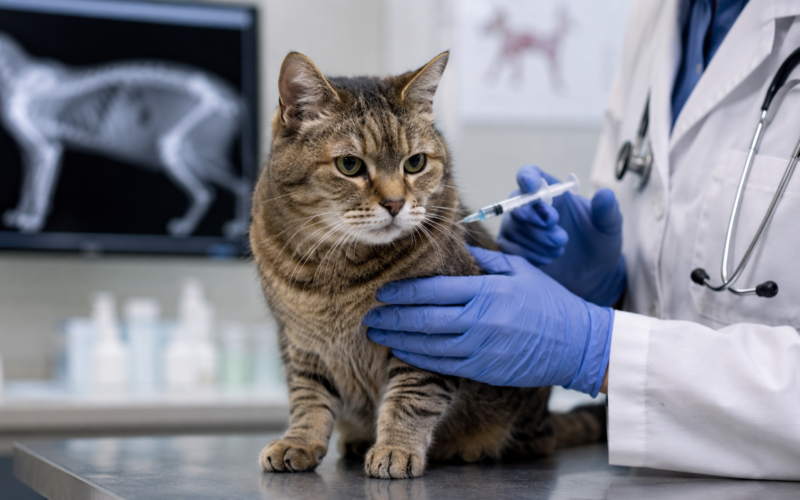
Zoetis Inc. (NYSE: ZTS) has commercially launched Portela, or relfovetmab, in Canada and European Union member states, moving its long-acting feline osteoarthritis therapy from regulatory authorisation into routine veterinary distribution. The prescription monoclonal antibody is indicated for alleviating pain associated with osteoarthritis in cats and is administered by subcutaneous injection once every three months.
The July 22 launch gives Zoetis a new way to address one of the most persistent practical problems in feline medicine: maintaining treatment when cats are difficult to medicate orally or owners struggle with frequent clinic visits. Portela also expands the company’s existing feline osteoarthritis franchise beyond Solensia, its monthly anti-nerve growth factor monoclonal antibody.
This is commercially more important than a routine geographic product rollout. Portela introduces a distinctly longer dosing interval into an already validated therapeutic category, potentially allowing Zoetis to reach untreated cats, retain owners who find monthly administration burdensome and defend its pain portfolio as competition and consumer price sensitivity affect companion-animal spending.
The evidence supporting Portela is substantial enough to secure European Commission marketing authorisation and Health Canada approval, but the regulatory label also establishes clear boundaries. The pivotal trial evaluated treatment for nine months, longer-term effectiveness remains unconfirmed, and the product is approved to alleviate pain rather than slow structural joint deterioration.
Why does Portela’s three-month dosing interval matter in feline osteoarthritis care?
Osteoarthritis pain in cats can be challenging to identify because reduced jumping, changes in grooming, lower activity and altered social behaviour may be interpreted as ordinary ageing. Zoetis cited research suggesting that as many as 40% of cats may show clinical signs of osteoarthritis, while only a minority of affected animals are diagnosed with osteoarthritis pain by veterinary professionals.
Diagnosis is only the first barrier. Cats are notoriously unenthusiastic participants in home medication routines, and daily oral treatment can produce stress for both owners and animals. A long-acting injection administered during a veterinary visit moves adherence away from daily owner behaviour and into a scheduled clinical workflow.
Portela’s three-month interval could therefore reduce the number of treatment visits from approximately 12 annually with a monthly therapy to four, assuming continuous year-round treatment. That reduction does not eliminate the burden of transporting a cat to a clinic, an activity rarely celebrated by the cat, but it could make sustained treatment more realistic for many households.
The clinical value of convenience should not be dismissed as merely commercial. A medicine that produces an effect under controlled conditions may have limited real-world impact when the dosing schedule is difficult to maintain. Portela’s main differentiation is therefore not an entirely new biological pathway, because Solensia already targets nerve growth factor, but a formulation and antibody profile designed to extend the treatment interval.
That creates several possible patient segments. Some cats responding well to monthly Solensia may remain on their existing treatment. Others may move to Portela because of travel difficulties, behavioural stress, owner scheduling or the desire to reduce the frequency of injections. The larger commercial opportunity would come from cats currently receiving inconsistent treatment or no sustained pharmacological pain management.

What do the pivotal Portela trial results reveal about efficacy and evidence maturity?
The European product information describes a randomised, double-masked, multicentre trial involving 307 cats with naturally occurring osteoarthritis. Of these, 153 received relfovetmab and 154 received placebo, with treatment administered at the start of the study and again after three and six months.
Treatment success using client-specific outcome measures was defined as a reduction of at least two points in the total score without deterioration in any individual activity. Three months after the first injection, 72.9% of relfovetmab-treated cats met that threshold, compared with 46.2% of placebo-treated cats. After the second and third treatments, success rates reached 78.9% and 79.3% with relfovetmab, compared with 41.4% and 41.8% for placebo.
Veterinary categorical pain assessments provided a second measure. Success was recorded in 60.6%, 72.2% and 71.4% of treated cats at the three assessment points, compared with 35.5%, 33.1% and 31.9% in the placebo group. The regulatory document states that the differences were statistically significant after all three treatments, while improvement in the owner-assessed score was observed within three days of the first injection.
The repeated separation from placebo across both owner and veterinary assessments strengthens the efficacy case. It suggests that the first three-month response was not an isolated result and that treatment effects were maintained after repeat administration.
The placebo response nevertheless deserves attention. Nearly half of control-group cats met the owner-assessed success definition after the first treatment period, illustrating the challenge of evaluating chronic feline pain through behavioural observations. Previous research involving monthly frunevetmab has similarly highlighted the importance of blinded, placebo-controlled designs because owner-reported improvement can be substantial in feline pain studies.
Portela’s evidence therefore appears strongest when the owner assessment and veterinary evaluation are considered together. The trial supports symptomatic pain relief across a nine-month period, but it does not establish disease modification. Joint radiographs were taken only at screening, meaning the study did not evaluate whether relfovetmab affected osteoarthritis progression or produced adverse structural changes over time.
The launch announcement and European label also do not identify a dedicated peer-reviewed publication containing the complete pivotal relfovetmab dataset. Regulatory review provides a meaningful level of evidence, but publication would allow clinicians and independent researchers to examine trial conduct, missing data, subgroup outcomes and statistical methods in greater depth.
Which Portela safety limitations and label restrictions will veterinarians need to consider?
Portela’s European product information identifies immediate pain upon injection as very common, affecting more than one in ten treated cats. Dermatitis is classified as common, while pruritus, skin scabs, injection-site swelling and injection-site hair loss are listed as uncommon. The Canadian client information cited by Zoetis also includes injection-site pain, skin infection, hair loss, dermatitis and decreased appetite among possible clinical signs.
The product should not be used in cats younger than 12 months, cats intended for breeding, pregnant or lactating animals, or animals with known hypersensitivity to relfovetmab or its excipients. Safety and efficacy have not been investigated in cats with kidney disease above International Renal Interest Society stage 3, requiring an individual veterinary benefit-risk assessment in that population.
The label also discusses possible immunogenicity. Anti-drug antibodies were detected in a small number of animals, but the available numbers were insufficient to determine their effect on safety or efficacy. No information is available for treatment extending beyond nine months, and immunogenicity has not been studied in cats previously treated with another anti-nerve growth factor monoclonal antibody.
This becomes relevant when considering switching from Solensia to Portela. The commercial logic for offering both products is clear, but the label does not yet provide extensive evidence on sequencing between the two antibodies. Veterinarians will therefore need to evaluate response at the individual-animal level rather than assume that success or failure with one therapy predicts the outcome with the other.
There are also no safety data on the concurrent long-term use of non-steroidal anti-inflammatory medicines and relfovetmab in cats. The European label refers to adverse joint outcomes observed in human anti-nerve growth factor programmes, particularly with higher antibody doses and prolonged concomitant non-steroidal anti-inflammatory treatment, although such human findings do not establish that the same outcome will occur with Portela in cats.
These limitations do not overturn the favourable benefit-risk conclusion reached by regulators. They do show why post-market surveillance, treatment selection and continued veterinary assessment will remain important as use expands beyond the registration trial population.
How could Portela reshape Zoetis’ existing feline osteoarthritis pain portfolio?
Portela joins Solensia rather than directly replacing it. Both products are feline-specific monoclonal antibodies targeting nerve growth factor, but Portela binds to a different site and is designed for administration once every three months, while Solensia uses a monthly schedule.
The two-product strategy gives Zoetis flexibility. Solensia has an established market presence and a longer body of veterinary use, while Portela offers a convenience-led alternative. That combination may help Zoetis preserve customers within its franchise even when their preferences, treatment responses or willingness to attend monthly appointments differ.
There is an unavoidable cannibalisation question. Some Portela sales may come from cats that would otherwise have received Solensia, meaning gross Portela revenue will not necessarily represent completely incremental growth. The more important metrics will be whether the combined feline osteoarthritis portfolio treats more cats, produces stronger retention and generates higher total franchise revenue.
The launch may also give veterinary clinics another reason to screen older cats proactively. A clinic able to offer both monthly and quarterly treatment can tailor the conversation around clinical response and owner circumstances rather than presenting a single dosing model. This could expand diagnosis and treatment, although commercial success will still depend on pricing, veterinarian confidence and owner acceptance.
What does the Portela launch mean for Zoetis as companion-animal demand remains pressured?
Portela arrives at a difficult point for Zoetis’ companion-animal business. The company reported first-quarter 2026 revenue of $2.3 billion, up 3% on a reported basis but flat organically. United States companion-animal product sales declined 11%, reflecting softer veterinary demand, price sensitivity, competition and lower sales of several products, including the canine osteoarthritis antibody Librela.
International companion-animal sales performed more strongly, increasing 15% as reported and 7% organically. Because Portela’s initial commercial markets are Canada and the European Union rather than the United States, its near-term contribution is more closely aligned with Zoetis’ comparatively resilient international operation.
Management reduced full-year 2026 revenue guidance to between $9.68 billion and $9.96 billion and projected organic operational revenue growth of 2% to 5%. Within that environment, Portela is unlikely to transform group-level growth immediately, but it can demonstrate whether Zoetis’ research pipeline is capable of creating commercially differentiated products rather than relying primarily on pricing and established brands.
Zoetis shares closed at $74.19 on July 22, down 1.54% for a fourth consecutive declining session and approximately 53.8% below their 52-week high of $160.48. The stock was about 3.5% below its July 16 close and roughly 5.1% below its June 24 close. The weakness coincided with the Portela announcement, but there is no basis for concluding that the product launch caused the decline.
The share-price backdrop suggests investors are focused on broader concerns around companion-animal demand, competition, growth expectations and execution. Portela should therefore be considered a commercial execution test and longer-term portfolio signal, not a stand-alone near-term catalyst capable of reversing sentiment.
Why will pricing, veterinary adoption and post-market evidence decide Portela’s commercial impact?
Zoetis did not disclose Portela’s pricing or expected revenue contribution in the launch announcement. That omission leaves a central adoption variable unresolved because most companion-animal medicines ultimately compete for spending within household and veterinary budgets.
Owners may accept a higher per-injection cost when the therapy replaces three monthly appointments, but the total cost over a treatment cycle will matter more than convenience alone. Clinics must also decide how much inventory to carry, manage refrigerated storage and determine whether demand justifies stocking the available vial strengths. The European label requires storage between 2 and 8 degrees Celsius and immediate use after opening.
Veterinary education will be equally important. Portela is intended to alleviate pain, not regenerate cartilage or halt osteoarthritis. Clear communication will be needed so that improved movement is not interpreted as evidence that underlying joint disease has disappeared.
The European authorisation includes continuing pharmacovigilance requirements, including cumulative analysis of musculoskeletal adverse-event reports and reports of insufficient efficacy. That surveillance could become particularly important as Portela reaches cats with broader ages, comorbidities and treatment histories than those represented in controlled trials.
Zoetis has delivered a meaningful dosing innovation backed by a controlled nine-month efficacy study and regulatory review in two significant animal-health markets. The next evidence will come from ordinary veterinary practice: how many previously untreated cats begin therapy, how many Solensia patients switch, whether benefits remain consistent after extended use and whether the safety profile remains aligned with the approved label.
Portela’s quarterly dosing solves a genuine friction point in feline care. Its commercial success, however, will depend on whether fewer appointments translate into more treated cats rather than merely fewer injections for animals already inside the Zoetis franchise.
Discover more from Business-News-Today.com
Subscribe to get the latest posts sent to your email.