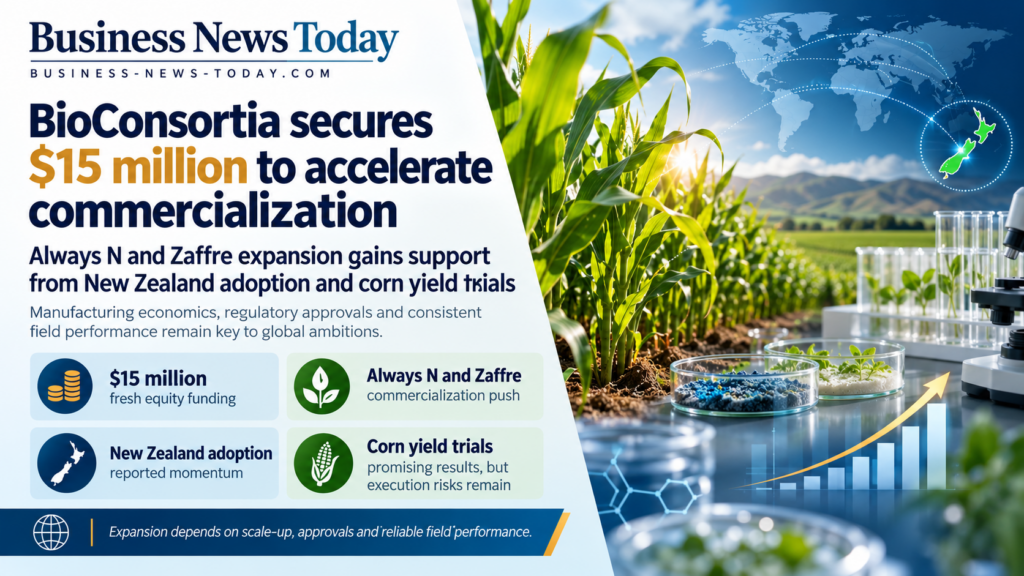
BioConsortia, Inc., a privately held agricultural biotechnology company based in Davis, California, has secured a $15 million equity investment to accelerate commercialization of its Always N nitrogen-fixing microbial seed treatment and Zaffre biostimulant across international agricultural markets. Announced on October 9, 2026, the financing comes from an entity affiliated with John Pasquesi, managing member of existing investor Otter Capital, and will support manufacturing expansion, regulatory activities, commercial infrastructure and further development of the company’s agricultural biological products.
The investment arrives as BioConsortia reports increasing commercial adoption of Always N in New Zealand and prepares broader launches of its microbial crop technologies. The company said adoption of its nitrogen-fixing seed treatment through local partner Hodder and Taylors rose from approximately 5% in 2024 to 50% in 2025, with an estimated 80% adoption level projected for 2026. Separately, Zaffre delivered a company-reported average corn yield improvement of 4.4 bushels per acre across three growing seasons of trials, strengthening the commercial case for another product approaching launch.
The financing represents a further commitment from an established investor rather than a new strategic acquisition or debt financing agreement. BioConsortia did not disclose its valuation, the ownership percentage acquired, the allocation of capital between products or a definitive timetable for individual market launches. Chief Executive Officer Marcus Meadows-Smith indicated that the company’s immediate priority is expanding the manufacturing, regulatory and commercial capabilities required to convert its existing product portfolio into larger-scale agricultural sales.
For the agricultural inputs industry, the development reflects increasing commercial interest in microbial technologies that improve crop performance or nutrient availability without requiring major changes to farming practices. The important distinction is that biological nitrogen fixation and crop biostimulation address different problems, even though both technologies can be delivered through seed treatments. BioConsortia is pursuing these opportunities simultaneously, but success will depend on demonstrating predictable performance, economically attractive returns and compatibility with existing seed distribution systems.
Why is BioConsortia receiving another $15 million as its agricultural products enter commercialization?
The latest financing represents a transition from technology development toward the more capital-intensive activities required to commercialize agricultural biological products. BioConsortia has spent several years developing microbial technologies capable of improving nutrient availability, stimulating crop growth and controlling agricultural pests. As those products move closer to wider market adoption, investment is increasingly needed for production capacity, regulatory registrations, inventory management and international distribution.
The company received a separate $15 million financing in August 2025 from existing investors led by Otter Capital and affiliated funds. At that time, BioConsortia said recurring investments from its established backers totaled approximately $95 million and would help accelerate the launch of its nitrogen-fixing technology. Its current corporate materials indicate that cumulative private funding has exceeded $100 million, placing the October 2026 transaction within a continuing financing programme rather than an isolated capital injection.
The distinction matters because repeated investment from existing shareholders can signal continued financial support without independently establishing commercial profitability or a higher enterprise valuation. BioConsortia has not disclosed its revenue, cash position, operating losses or post-financing valuation. Consequently, the additional $15 million cannot be translated into a verified cash runway or a specific estimate of future profitability.
The financing is also noteworthy because it comes from an entity affiliated with John Pasquesi, who manages existing investor Otter Capital. The company has not identified the investing entity’s ownership percentage or disclosed whether the transaction changes governance arrangements. Pasquesi indicated that the decision reflected confidence in BioConsortia’s progress in translating its microbial research and intellectual property into commercial products.
For BioConsortia, the strategic priority is now to demonstrate that its technologies can generate repeatable commercial demand beyond initial product introductions. Manufacturing investments and regulatory spending can support that process, but they create economic value only if growers and distribution partners purchase products at sufficient volumes and acceptable margins. The new capital provides additional resources to pursue commercialization without confirming that the business has reached financial sustainability.
How significant is Always N adoption growth in New Zealand for BioConsortia’s global expansion?
BioConsortia’s most concrete commercial progress involves Always N, a microbial nitrogen-fixing seed treatment distributed in New Zealand through Hodder and Taylors Limited. The companies established a commercial arrangement for the technology during the 2024/2025 agricultural season, with applications covering crops including maize, cereals, brassicas and pasture species. The product has been marketed locally under the FixiN 33 name, providing an example of how BioConsortia’s technology can be adapted to established seed-treatment distribution channels.
The October announcement reported that Always N adoption increased from approximately 5% in 2024 to 50% in 2025, with the company projecting 80% adoption during 2026. These figures suggest substantially greater uptake within the commercial activity being described, although BioConsortia has not clearly defined the denominator used to calculate the percentages. They should therefore not be interpreted as national market share, the proportion of all New Zealand farms using the product or a verified industry-wide penetration rate.
That limitation does not eliminate the commercial relevance of the reported growth. Agricultural biological products often face a demanding initial adoption process because farmers need confidence that performance will remain consistent under their soil, weather and crop management conditions. Acceptance through an established seed-treatment partner can provide practical evidence of customer interest and compatibility with existing agricultural operations.
The New Zealand experience may also provide useful operational lessons for expansion into other markets. Local results can help BioConsortia and its partners understand storage requirements, application practices, grower purchasing behavior and the commercial performance of different crop segments. However, results achieved in New Zealand cannot automatically predict demand or agronomic performance in Brazil, the United States or European agricultural markets.
The company has not disclosed sales volumes, hectares or acres treated, average selling prices or revenue generated through Hodder and Taylors. Without those figures, the reported adoption percentages cannot establish the financial contribution of the New Zealand business. The next meaningful evidence of commercial maturity would include repeat purchases, larger treated-acreage volumes and sustained distribution growth.
What does Zaffre’s 4.4-bushel corn yield improvement reveal about its potential commercial value?
Zaffre represents a different part of BioConsortia’s microbial portfolio, focusing on crop biostimulation rather than biological nitrogen fixation as its principal commercial proposition. The product is designed to improve crop emergence, establishment, nutrient utilization and tolerance to environmental stresses. BioConsortia reported that corn trials conducted across three growing seasons delivered an average yield increase of 4.4 bushels per acre following Zaffre treatment.
The result is commercially relevant because a relatively modest increase in yield can influence farm profitability when applied across substantial planted acreage. For illustration, an additional 4.4 bushels of corn would generate $17.60 in extra gross revenue per acre at an assumed selling price of $4 per bushel. This is a hypothetical calculation rather than a current crop-price estimate or verified return on investment, and it excludes the cost of treatment, application, operational changes and variation in field results.
The disclosed trial average also requires careful interpretation. BioConsortia has not provided the complete underlying dataset in its October financing announcement, including the number of individual trials, untreated control yields, geographic distribution, variability or statistical significance. An average positive response across three seasons supports further commercial evaluation but does not guarantee that every farm or growing season will produce the same benefit.
Earlier company disclosures identified Zaffre as the North American brand for its BEC69 microbial biostimulant. BioConsortia previously reported positive trial results across several crops, including fruit and vegetable applications, and entered a distribution arrangement involving The Mosaic Company in Asia. The October 2026 update indicates that Zaffre is progressing toward broader launch, rather than establishing that the product has already achieved widespread commercial availability in every intended market.
The potential benefit under cold or heat stress may prove important for commercial differentiation. However, performance under particular environmental conditions must be evaluated against appropriate controls, because microbial activity and plant responses can vary with weather, soil conditions and crop management. The strongest commercial argument for Zaffre would be consistent evidence that its yield benefits justify treatment costs across representative growing environments.
Can Always N microbial seed treatments meaningfully reduce synthetic nitrogen fertilizer dependence?
Always N is based on beneficial nitrogen-fixing microbes designed to establish themselves in the plant root zone and convert atmospheric nitrogen into forms that crops can use. BioConsortia’s approach targets crops such as corn and wheat, which do not naturally obtain substantial quantities of nitrogen through the same root-nodule symbiosis found in many legumes. The technology is intended to supplement plant nitrogen availability and potentially reduce the amount of synthetic fertilizer needed to maintain crop productivity.
The company has focused on strains capable of maintaining nitrogen-fixing activity under agricultural conditions, including situations where conventional nitrogen fertilizer is present. This is relevant because some naturally occurring nitrogen-fixing microorganisms reduce their biological nitrogen-fixation activity when sufficient available nitrogen is present. BioConsortia uses microbial selection and genetic optimization to identify or develop strains with characteristics suitable for commercial crop production.
Its technology platform includes Advanced Microbial Selection, which identifies beneficial organisms through plant-associated microbial interactions, and GenePro, which supports genetic analysis and optimization. The company works with naturally occurring and gene-edited microbial strains, allowing its portfolio to be adapted to different product requirements and regulatory environments. However, the effectiveness and authorization status of an individual formulation must be evaluated separately.
One of Always N’s principal commercial features is its reported product stability. BioConsortia says its microbial formulations can retain a shelf life exceeding two years, with an additional two years of viability after application to treated seed. The company argues that this characteristic enables integration into industrial seed-treatment operations, where seeds may undergo processing, packaging, storage and distribution well before planting.
That characteristic is particularly relevant to large-scale corn seed production. A biological treatment that loses viability during storage could create logistical challenges even if its performance immediately after manufacturing is satisfactory. Longer stability may allow the technology to fit existing seed supply chains without requiring growers to apply a separate biological product immediately before planting.
Nevertheless, the ability to survive storage does not by itself establish how much synthetic nitrogen fertilizer a farmer can safely eliminate. That decision depends on crop nitrogen requirements, soil fertility, fertilizer management and the quantity of nitrogen actually supplied through microbial activity. BioConsortia’s products may provide an opportunity to improve fertilizer efficiency, but the degree of replacement must be supported by crop-specific agronomic evidence rather than inferred from the biological mechanism alone.
How does The Mosaic Company’s partnership strengthen BioConsortia’s position in the Americas?
The Mosaic Company (NYSE: MOS), a major producer of phosphate and potash crop nutrients, established a collaboration with BioConsortia in December 2020 to develop nitrogen-fixing microbial products for major non-legume crops. The arrangement initially covered corn, wheat, cotton and sugarcane, with Mosaic receiving exclusive rights to the relevant technology for core row crops in the Americas. The relationship provides BioConsortia with access to an established agricultural inputs business rather than requiring the company to create an entirely independent commercial network.
The agreement is strategically relevant because biological nitrogen fixation can complement conventional fertilizer products instead of necessarily replacing them entirely. Mosaic has an established position in crop nutrition, and microbial technologies offer a route to expand its portfolio into products associated with nutrient efficiency and soil health. For BioConsortia, the partnership can provide development expertise, commercial access and a potential route to larger agricultural markets.
The original agreement included development activities and contemplated commercial distribution arrangements, with financial terms involving upfront consideration, research funding and royalties. The parties did not disclose the detailed amounts in their public announcement. The latest BioConsortia financing release confirms that the partnership continues to support commercial activity in the Americas, but it does not quantify sales, royalties or new purchase commitments arising from the relationship.
A separate 2022 collaboration expanded the companies’ relationship into microbial biostimulants, including an arrangement involving Zaffre in Asia. This broader history indicates that the relationship has extended beyond a single nitrogen-fixation development programme. However, individual product rights, geographic territories and commercial responsibilities remain agreement-specific and should not be treated as identical across every BioConsortia technology.
For investors following The Mosaic Company, BioConsortia’s progress represents a potential longer-term addition to its crop nutrition and biologicals strategy. The partnership may support portfolio diversification as growers seek to improve input efficiency, but the scale of its economic contribution has not been disclosed. No material earnings impact or share-price response can be attributed to the October financing announcement on the available financial evidence.
Why could gene-edited and naturally occurring microbes influence BioConsortia’s global regulatory strategy?
BioConsortia’s international expansion involves regulatory complexity because countries do not necessarily apply identical requirements to microbial products. Agricultural biologicals can be regulated differently according to their intended use, biological characteristics, formulation and specific claims. Products intended to improve nutrient availability may follow different routes from microbial pesticides designed to control insects, fungi or nematodes.
The company’s portfolio includes both naturally occurring, or wild-type, strains and gene-edited microbial strains. BioConsortia has presented this flexibility as an important feature of its global commercialization strategy because markets may differ in how they regulate genetic modifications. However, availability of a non-gene-edited version does not automatically establish regulatory authorization, and approval of one formulation does not necessarily extend to another.
In the United States, relevant requirements may involve federal and state authorities, depending on the product and its proposed use. BioConsortia’s corporate information indicates that products in its portfolio are approved for distribution and use in 20 states, although that statement does not identify every authorized formulation or establish nationwide registration for Always N and Zaffre. Product-specific state registrations and applicable federal requirements will remain important when evaluating availability.
European market entry introduces additional considerations relating to microbial strain identification, safety, product classification and the substantiation of performance claims. BioConsortia has been conducting field trials and pursuing regulatory activities in European agricultural markets, but the October announcement does not confirm a comprehensive regional authorization covering all intended products and crops. Regulatory progress should therefore be distinguished from completed commercial launch.
The company is also pursuing opportunities in Asia, Australia and Latin America, where crop suitability and market conditions can differ considerably. A nitrogen-fixing formulation suited to corn may require further development or validation before being positioned for rice, vegetables or other crops. BioConsortia’s ability to develop multiple versions of its technology may help it address those differences, but every additional formulation introduces development and commercialization requirements.
What manufacturing challenges could determine whether BioConsortia can scale microbial products?
Manufacturing consistency is a central challenge for agricultural biologicals because products containing living microorganisms must maintain viability and performance through production, storage and application. BioConsortia’s technology focuses heavily on stable, spore-forming microbes, which the company believes can withstand the demanding conditions associated with agricultural supply chains. The claimed advantages include extended shelf life, compatibility with existing crop protection formulations and suitability for industrial seed treatment.
The new capital is intended partly to expand the infrastructure needed to produce and distribute these technologies at greater scale. That process may involve fermentation capacity, formulation operations, quality testing, storage systems and coordination with commercial partners. However, BioConsortia has not disclosed new production capacity figures, manufacturing expenditure allocations or a confirmed timetable for completing additional facilities.
As production volumes increase, the company will need to maintain consistency between commercial batches and the formulations used in field validation. Microbial viability, concentration, formulation stability and compatibility with seed-treatment chemicals can influence the product ultimately delivered to growers. Variability in these characteristics could affect commercial performance even when the underlying microbial strain has demonstrated useful biological activity.
Distribution also becomes more complicated as the company enters multiple agricultural regions. Products may pass through seed processors, chemical treatment facilities, warehouses and local distributors before reaching farms, sometimes over extended periods. Demonstrating that biological activity remains adequate throughout this process is essential to building confidence among commercial customers.
BioConsortia’s partnership-led model may reduce the need to establish its own sales organization in every country. However, coordinating manufacturing, quality assurance, regulatory documentation and inventory across multiple partners still requires substantial operational capability. The latest investment gives the company additional resources for that transition, but scalable manufacturing economics have not yet been publicly established.
Could BioConsortia’s biofungicide and biopesticide pipeline create additional commercial opportunities?
Although Always N and Zaffre are the principal products highlighted in the financing announcement, BioConsortia maintains a broader portfolio of microbial crop technologies. These include biofungicides, bionematicides and bioinsecticides designed to manage agricultural diseases and pests through biological mechanisms. The company is conducting partner trials and development activities across several product categories, creating potential opportunities beyond crop nutrition.
One established relationship involves Nichino America, Inc., which entered a supply agreement with BioConsortia for a microbial biofungicide targeting selected agricultural markets. The product, identified in earlier disclosures as Amara, is based on Bacillus velezensis and was developed for use against fungal diseases in fruit and vegetable crops. BioConsortia’s October update describes continued advancement of its foliar biofungicide through Nichino in selected markets, without providing new revenue figures or confirmation of broader global commercialization.
The company’s bionematicide portfolio addresses another agricultural challenge involving microscopic plant-parasitic worms that can damage roots and reduce crop productivity. BioConsortia has previously disclosed trial work in Brazil and other agricultural regions, supporting development of products intended for seed treatment and soil application. However, successful experimental performance does not establish that these products have completed all applicable regulatory or commercial requirements.
The expanding pipeline could create opportunities for BioConsortia to offer several products through existing agricultural partners. A company already distributing one microbial seed treatment may find it commercially attractive to add complementary technologies if they fit its product portfolio and customers’ agronomic needs. Such expansion could improve the value of distribution relationships, but future revenue will depend on individual product development and market acceptance.
Managing a broader portfolio also requires decisions about capital allocation. BioConsortia must balance spending on products that are already generating commercial activity against investment in technologies that remain under development. The latest financing provides additional capital, but it does not eliminate the need to prioritize programmes with the strongest combination of field performance, regulatory feasibility and commercial demand.
What will determine whether BioConsortia’s $15 million investment produces sustainable growth?
The immediate indicators of BioConsortia’s commercial progress will be the advancement of Zaffre toward launch, continued sales development for Always N and the expansion of manufacturing and regulatory capabilities. More detailed information on product revenue, treated acreage, distribution volumes and customer retention would help establish whether reported commercial momentum is translating into recurring demand. The company’s current disclosures provide encouraging adoption and field-trial indicators but limited financial visibility.
For Always N, the projected 80% adoption level in New Zealand will be worth evaluating against actual results once the relevant 2026 season is complete. The commercial significance of that figure will depend on the customer base represented and the volume of treated seed sold. Further expansion into major agricultural markets would provide additional evidence of whether the technology can achieve similar acceptance outside its initial commercial geography.
For Zaffre, the central question is whether the reported 4.4-bushel-per-acre corn yield advantage can be maintained across representative commercial conditions. The economic benefit for growers will depend on actual crop prices, treatment costs, crop management and the variability of observed results. A positive trial average can support product development, but repeated profitability under ordinary farming conditions is a stronger foundation for sustained adoption.
Regulatory milestones will also influence the pace of growth, particularly in markets where gene-edited microbial technologies face distinct assessment requirements. Product registrations, manufacturing readiness and distribution arrangements may progress at different speeds across regions. The company will need to coordinate these activities without treating anticipated market entry as equivalent to completed authorization or commercial revenue.
BioConsortia’s latest financing indicates that an established investor remains prepared to support its transition toward commercial-scale agricultural biologicals. The company has assembled microbial discovery capabilities, product stability characteristics, strategic partnerships and early commercial experience that collectively support its expansion strategy. The next phase will test whether those assets can consistently deliver value to farmers while supporting a financially sustainable manufacturing and distribution business.
The central opportunity lies in making biological crop technologies practical within conventional agricultural operations rather than positioning them as immediate replacements for all synthetic fertilizers and pesticides. If BioConsortia can demonstrate dependable nutrient-efficiency and yield benefits at commercially acceptable costs, Always N and Zaffre could secure a larger role in agricultural input programmes. Its October 2026 investment provides additional resources to pursue that objective, while actual sales growth, farm-level economics and regulatory progress will determine how much of the potential is ultimately realized.
Discover more from Business-News-Today.com
Subscribe to get the latest posts sent to your email.