



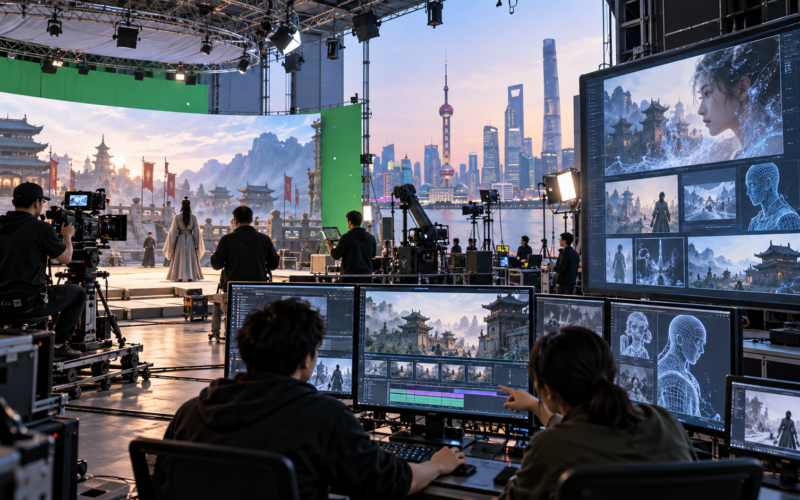
China’s artificial-intelligence boom is moving from software laboratories into movie studios as cities compete to attract AI filmmakers with subsidized rent, computing support, cloud services and production incentives. Reuters reported on September 25 that local governments across China are increasingly treating AI-generated film as an industrial development opportunity similar to electric vehicles, solar equipment and robotics, encouraging studios to build production ecosystems before global rules and business models have fully settled.
The speed of expansion is remarkable. DataEye figures cited by Reuters show 221,900 new AI shows were launched on Douyin, ByteDance’s Chinese short-video platform, during the first half of 2026. Only 1,055 exceeded 100 million views, however, indicating an enormous gap between the volume of content being produced and the proportion achieving significant audience traction. Meanwhile, China Central Television data cited by Reuters indicate production costs for AI short dramas plunged from around 5,000 yuan per minute to only a few hundred yuan during the first half.
Why are Chinese cities competing aggressively to attract AI film studios?
Local governments view AI-generated content as an opportunity to create employment, technology clusters and exportable digital industries without requiring the enormous physical factories associated with traditional industrial policy. A successful AI film ecosystem can draw model developers, visual-effects companies, computing providers, screenwriters and production studios into the same regional economy.
Reuters reported that filmmakers are receiving approaches from cities ranging from major technology centres to smaller localities. Incentives include inexpensive office space, living allowances, computing credits and technical support, dramatically lowering the cost for new studios to experiment with production.
Shanghai introduced measures in May aimed at accelerating AI-powered micro-drama production, including access to computing resources and cloud AI models while supporting international distribution. Beijing maintains a 260 million yuan audiovisual technology fund, while Huairou district provides vouchers intended to reduce computing costs for AI short-drama producers. Shenzhen is offering technical support covering production, visual effects and generative content while also subsidizing property costs.
Those policies resemble China’s established industrial strategy: develop large domestic capacity rapidly, encourage intense competition among producers and allow lower costs and manufacturing scale to create potential export advantages.
How far have artificial intelligence tools reduced film production costs in China?
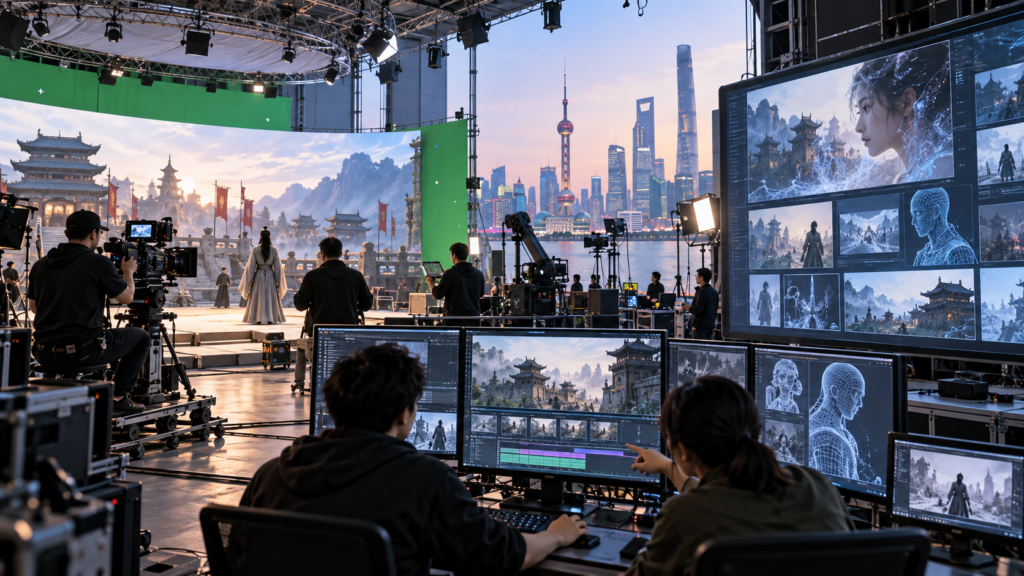
AI changes film economics because tasks traditionally requiring sets, crews, actors, travel, visual-effects teams and lengthy post-production cycles can increasingly be generated or altered through software.
Reuters cited one Chinese filmmaker who estimated a conventional wedding scene could cost approximately 60,000 yuan while a surreal equivalent created with AI cost around 1,400 yuan. Production subsidies can reduce expenses still further by covering part of the computing requirements.
Such cost reductions matter enormously for China’s short-drama industry, where producers need large volumes of relatively inexpensive episodes capable of capturing attention quickly. AI allows studios to test concepts at a fraction of conventional production costs, potentially making previously uneconomic niche audiences commercially viable.
Long-form film economics are more complicated because audiences expect consistent characters, coherent performances and high visual quality across much longer running times. Yet China has already crossed an important milestone: the National Film Administration granted a public-screening licence to “Sanxingdui: Future Memories,” a 90-minute science-fiction production that Reuters described as the first AI film from a major Chinese studio to secure theatrical approval.
Why could China face an AI video overcapacity problem similar to other industries?
Cheap production encourages enormous supply. When the cost of creating content falls from thousands of yuan per minute to hundreds, many more studios and individual creators can enter the market without needing large initial budgets.
The 221,900 Douyin releases during only six months demonstrate the consequence. Fewer than 0.5% reached the 100-million-view benchmark cited by DataEye, meaning most content is competing for audience attention without achieving breakout scale.
That dynamic resembles other industries where subsidies and falling costs encouraged companies to expand faster than demand. Oversupply can push prices lower, increase marketing expenses and make it harder for creators to recover even reduced production budgets.
Streaming platforms may benefit initially because they gain enormous volumes of inexpensive programming. Creators face a harder environment because technology makes production easier while simultaneously increasing the number of competitors fighting for the same viewers.
The result could be a paradox in which AI makes filmmaking cheaper but makes successful filmmaking economically more difficult.
How are iQIYI, Douyin and major studios building AI content businesses?
Large distribution platforms are positioning themselves as both buyers and facilitators of AI content. Reuters reported that iQIYI Chief Executive Gong Yu said the streaming service was “all-in” on artificial intelligence and has offered subsidies to some creators producing AI programming for the platform.
Douyin provides another enormous distribution channel through short-video consumption, while conventional studios such as Bona Film Group are testing longer-form AI filmmaking. The combination means AI content can move across the full spectrum from seconds-long clips and micro-dramas to theatrical movies.
Distribution is strategically important because model technology itself can become commoditized. If several providers produce comparable video-generation tools, platforms controlling audiences may capture a disproportionate share of the economic value by determining which AI content receives attention.
China also has potential advantages in integration. Domestic model developers, cloud companies, social-media platforms and studios can operate within a large single-language market where digital payments and mobile entertainment are deeply established.
Why are actors and creators worried about copyright and AI-generated likenesses?
Rapid commercialization has moved faster than China’s copyright framework. Reuters reported that China requires explicit labelling of AI-generated content but has not yet introduced comprehensive copyright rules covering AI filmmaking.
Actors have raised concerns about unauthorized reproduction of their appearances, while voice performers face the possibility that synthetic voices could replace paid recording work. Consumers have also complained about plagiarism, particularly where familiar characters, dance sequences or creative styles appear to have been incorporated into generated content without clear permission.
Those disputes determine more than compensation. Studios need legal certainty around training datasets and generated output before expensive films can be distributed internationally without fear of infringement lawsuits.
Countries adopting stricter copyright standards could theoretically limit exports of Chinese AI films if creators cannot demonstrate how training materials and digital likenesses were obtained. Clear domestic rules could therefore become commercially important rather than simply restrictive.
Could China become the global centre for artificial-intelligence filmmaking?
China possesses several ingredients required for scale: large domestic audiences, powerful digital platforms, inexpensive computing support, experienced visual-effects and production industries and local governments willing to subsidize experimentation.
The biggest uncertainty concerns quality rather than quantity. Generating hundreds of thousands of productions establishes industrial capacity but does not guarantee global audiences want to watch them. Entertainment remains unusually resistant to pure scale because cultural resonance, storytelling and originality determine value as much as technical production.
China’s AI filmmaking experiment will therefore test whether industrial-policy methods that transformed manufacturing can work in a creative industry. Factories can gain market share by producing a comparable battery or solar panel at lower cost. Movies and dramas must persuade people to care about what happens on the screen.
Discover more from Business-News-Today.com
Subscribe to get the latest posts sent to your email.