



The Boeing Company (NYSE: BA) has secured a $636.1 million modification to its existing US Army Apache sustainment contract, deepening one of the defence segment’s most consistent revenue annuities at a moment when the aerospace giant is still absorbing losses on its fixed-price development programmes. The modification, designated PZ0022 to prime contract W58RGZ-24-C-0028, lifts the cumulative value of the underlying agreement past $1.1 billion and extends depot-level Apache work at Boeing’s Mesa, Arizona facility through April 2029. The Army obligated $506.3 million in fiscal 2026 working capital funds at the time of award, leaving roughly $130 million of the announced value unfunded pending future appropriations. For investors, the central tension sits between a widening, high-visibility Apache aftermarket franchise and a Boeing Defense, Space & Security unit that has continued to post operating losses despite double-digit top-line growth. The question is whether sustainment awards of this scale can meaningfully reset the earnings trajectory of a segment still weighed down by legacy development charges.
What does the $636 million Apache contract modification actually cover and how much cash is committed today?
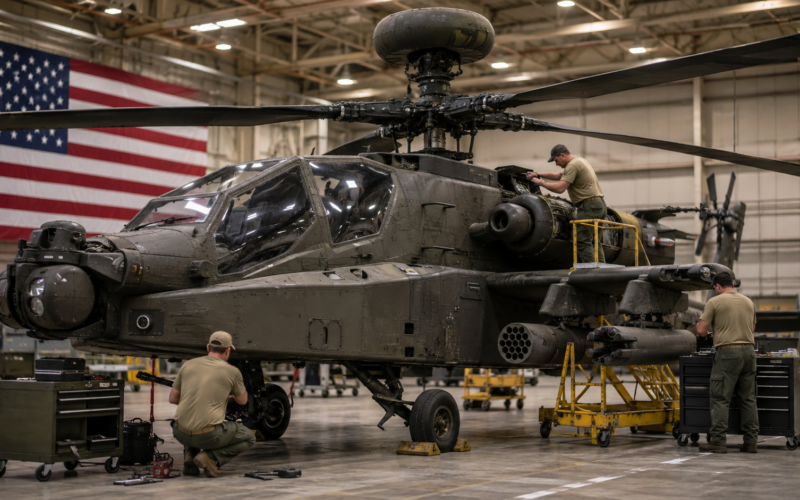
The Department of War announcement discloses that the modification covers depot-level repair of complex Apache airframe components, system component support, supply of unique consumable parts, test equipment support, transmission infrastructure repair and retrograde, an obsolescence management programme and broader supply chain management. Every one of those workstreams sits at the higher-margin end of the aftermarket value chain, well above straightforward spares distribution. Work will be performed at Mesa, Arizona, the traditional home of Apache manufacturing and rotorcraft sustainment for Boeing, with an estimated completion date of 30 April 2029.
The face value of $636.1 million is important to place in context. The Army obligated $506,314,739 in fiscal 2026 Army working capital funds when the modification was signed, meaning only that portion is currently committed cash on the customer side. The residual balance, close to $130 million, will require additional funding actions before it converts into firm Boeing revenue. That funding split is standard practice for multi-year Army sustainment vehicles, but it does mean the headline number should not be read as $636 million of near-term revenue certainty. The disclosure also does not itemise the fleet size, unit repair volumes or specific depot pricing, so the effective margin contribution will depend on Boeing’s execution against internal cost baselines rather than the ceiling number alone.

Why does another Apache sustainment award matter for Boeing Defense at a time when fixed-price development is still bleeding cash?
Boeing’s second-quarter 2026 results underlined how uneven the defence unit’s profitability has become. Defense, Space & Security revenue grew roughly 13 per cent, yet the segment still posted a $15 million operating loss after another charge on the Air Force One programme. That pattern, growing revenue coupled with periodic development charges, has defined the segment for several years, with fixed-price development contracts on Air Force One, KC-46A and T-7A absorbing gains from mature production and support work.
Against that backdrop, the Apache franchise stands out. It sits within Boeing’s rotorcraft portfolio, which combines new-build manufacturing at Mesa with a large installed base of AH-64s in US Army service and across allied fleets. Sustainment revenue is fundamentally different in character from development revenue. It carries lower technical risk, has already amortised most of its engineering base, and generates cash more predictably because the pricing benchmarks are established and the workflows are repeatable. Each incremental modification of the type awarded this week adds to what is effectively a defence-services annuity, one that is largely insulated from the certification-related and design-related charges that have hurt the segment’s headline profitability.
The strategic significance is not that a single $636 million modification will reset Boeing’s defence margins on its own. It is that the pattern of Apache awards, layered across production, remanufacturing, engineering services and now expanded sustainment, is building the ballast the segment needs while management works through the loss-making development portfolio.
How does the growing Apache aftermarket franchise strengthen Boeing’s Mesa production base and long-term services annuity?
The Mesa facility is one of Boeing’s most strategically important defence sites. It is the home of Apache new-build production, remanufacturing and a substantial portion of the depot-level support workload. Concentrating this modification’s scope at Mesa reinforces the industrial base that also delivers on the November 2025 $4.68 billion new-build AH-64E award, itself tied to work running through May 2032, and the December 2025 $2.7 billion post-production support contract awarded on the last day of last year. Taken together, those three awards represent well over $8 billion in disclosed Apache-related commitments to Boeing across roughly nine months, spanning new-build airframes, dedicated post-production sustainment and now an expanded modification to the components and depot repair pipeline.
The compounding effect at Mesa matters for two reasons. First, it stabilises workforce planning at a specialised skill base that would be difficult and expensive to rebuild if activity levels dropped. Second, it creates operating leverage. Fixed overhead spread across a broader mix of production, remanufacturing and sustainment tends to reduce unit costs and expand margins as volume grows. The mix effect also helps. Aftermarket work typically carries better gross margins than initial production, so an expanding sustainment layer alongside new-build activity should improve blended profitability if Boeing can hold cost discipline against its baseline estimates.
What does the funding split between fiscal 2026 obligations and unfunded ceiling tell investors about program cash-flow visibility?
The obligation of $506.3 million against a $636.1 million ceiling is worth flagging for cash-flow modellers. The obligated portion is the tranche that is committed to be paid subject to performance, and it reflects the Army’s fiscal 2026 working capital funds availability. The remaining approximately $130 million of unfunded ceiling functions as pre-approved scope that can be released once further money is appropriated, most likely across fiscal 2027 or fiscal 2028 depending on how the Army sequences its Apache sustainment budget.
For Boeing, this means that the modification’s revenue recognition will be paced by both work performance and incremental funding actions. It also implies that the effective cash conversion window stretches through the April 2029 completion date rather than concentrating in a single fiscal period. Investors modelling Boeing Global Services or Boeing Defense, Space & Security cash flows should treat this award as a multi-year, phased revenue vehicle rather than a lump-sum book-to-bill event. The structure is neither unusual nor negative. It is typical for Army sustainment vehicles of this size, but it does temper any expectation that the disclosure will translate into a large near-term revenue spike.
How does the sustainment stream compare with the November new-build order and the December post-production award for total Apache revenue?
Placing the three recent Apache awards side by side clarifies how differentiated the revenue streams are. The November 2025 award of $4.68 billion covers new-build AH-64E airframes and Longbow crew trainers, including roughly $2.29 billion of foreign military sales funding for Poland, Egypt and Kuwait, with work running through May 2032. That is a long-cycle production revenue stream tied to airframe deliveries and training equipment. The December 2025 $2.7 billion award, structured as a firm fixed-price post-production support contract, runs through December 2030 and represents a broad services envelope executed via individual task orders. This latest $636.1 million modification, in contrast, sits inside a distinct components and depot repair contract that was already active and is now expanding.
The three vehicles serve different operational purposes but reinforce one commercial reality. The Apache is expected to remain the Army’s primary attack rotorcraft well into the 2060s under the current modular open systems architecture roadmap, and the sustainment envelope required to keep more than a thousand airframes at combat readiness through that horizon is very large. Boeing, as the sole eligible depot-level source for Apache airframes, is the natural beneficiary of that spend profile. The Army’s willingness to layer multiple contract vehicles rather than consolidate them into a single mega-contract also gives Boeing more frequent, if smaller, book-to-bill events, which supports steadier reported backlog momentum quarter to quarter.
What are the near-term catalysts that will determine whether Apache remains a reliable earnings anchor for BDS through 2029?
Three catalysts will shape whether this sustainment franchise translates into visible earnings improvement rather than merely improved revenue optics. First, Boeing’s next quarterly results will show whether the defence segment can hold or expand margins as Apache-related work builds against the drag of ongoing Air Force One charges. Investors will watch BDS operating margin trajectory more closely than the top line. Second, the funding cadence for the unfunded ceiling on this modification, and any follow-on modifications, will indicate the Army’s rate of confidence in Boeing’s depot performance. Repeated, on-schedule funding releases would signal a healthy relationship. Third, foreign military sales activity on Apache remains a swing factor for Mesa utilisation. New export orders would add production, spares and support scope to the sustainment franchise, further leveraging the fixed cost base.
Boeing also enters this contract cycle carrying separate strategic actions that shape the equity narrative. The company disclosed plans to divest its air taxi operations to Archer Aviation earlier this month, including Wisk Aero, Insitu and SkyGrid, in exchange for equity. That portfolio simplification is directionally consistent with sharpening focus on core commercial airframes and higher-value defence and services franchises like Apache. Commercial pressure from the international launch of the COMAC C919 in the same period adds urgency to demonstrating that the defence and services annuities can carry more of the earnings load.
What would it take for Apache sustainment to shift Boeing Defense from revenue growth to visible earnings recovery?
The $636.1 million modification is best read as the latest in a sequence of Apache awards that steadily deepen Boeing’s most predictable defence revenue stream. It confirms the Army’s continued dependence on Boeing for depot-level Apache support and adds meaningful visibility for Mesa through April 2029. What has clearly improved is the size and cadence of the Apache aftermarket book, which now sits alongside a large new-build order and a dedicated post-production contract to form a services annuity of considerable strategic value. What remains unresolved is whether the improving defence services mix can outpace the recurring charges on fixed-price development programmes, which have kept BDS in operating loss territory even as revenue has grown. The next measurable proof point will be Boeing’s third-quarter results, where BDS margin direction will show whether the growing Apache franchise is finally translating into visible earnings leverage or whether development-programme headwinds continue to absorb the benefit.
Key takeaways for investors tracking Boeing’s defence sustainment trajectory
- Boeing received a $636.1 million modification to Apache components and depot repair contract W58RGZ-24-C-0028, lifting the underlying agreement’s cumulative value past $1.1 billion.
- The Army obligated $506.3 million in fiscal 2026 working capital funds at award, leaving roughly $130 million of ceiling unfunded pending future appropriations.
- Scope covers depot-level airframe repair, system components, unique consumables, test equipment, transmission infrastructure work, obsolescence management and supply chain management.
- Work is concentrated at Boeing’s Mesa, Arizona rotorcraft facility, with completion expected by 30 April 2029.
- The award follows the November 2025 $4.68 billion new-build AH-64E order and the December 2025 $2.7 billion post-production support contract, bringing disclosed Apache commitments over roughly nine months well past $8 billion.
- Apache sustainment is a higher-margin, lower-risk annuity that offers ballast against fixed-price development losses on Air Force One, KC-46A and T-7A.
- Boeing Defense, Space & Security posted 13 per cent revenue growth but a $15 million operating loss in the second quarter of 2026, keeping the earnings tension in focus.
- The unfunded portion means the modification should be modelled as multi-year phased revenue rather than a near-term lump sum.
- Foreign military sales momentum and further funding actions on the modification will be near-term indicators of Mesa utilisation and franchise durability.
- The most immediate catalyst is Boeing’s third-quarter 2026 results, where BDS operating margin direction will show whether Apache-led services growth is reaching the bottom line.
Discover more from Business-News-Today.com
Subscribe to get the latest posts sent to your email.