




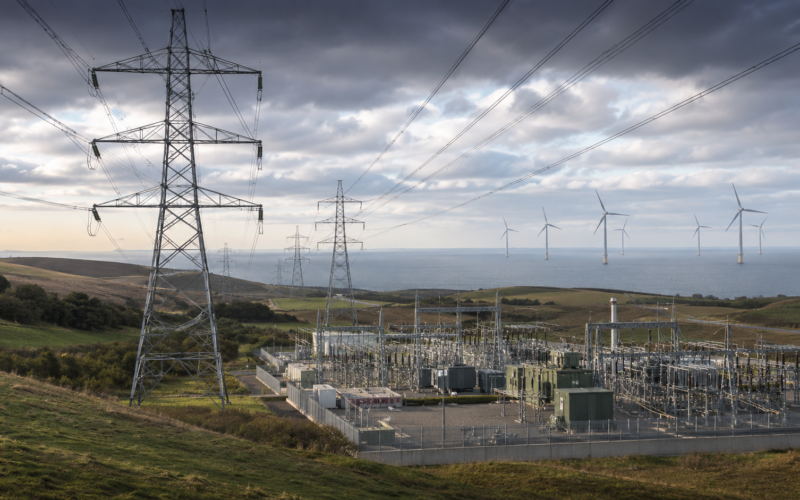
Bajel Projects Limited (NSE: BAJEL) has secured its first major win through the transmission-development platform created with National Investment and Infrastructure Fund (NIIF) after 26%-owned AnantGrid Projects One Private Limited received a Letter of Intent for the Lakadia Part-A interstate transmission scheme in Gujarat. NIIF owns the remaining 74% of the project company.
The scheme involves approximately 270 kilometres of 765 kV double-circuit transmission lines between Halvad and Vadodara, together with additional works at Halvad, Vadodara and South Olpad substations. The infrastructure is designed to support evacuation from Lakadia Phase II at 7.5 GW, Jam Khambhaliya Phase II at 5.5 GW and Jamnagar Phase I at 1 GW, giving a combined generation context of 14 GW.
One numerical clarification is important: the 270 figure disclosed by Bajel refers to kilometres of transmission line, not ₹270 crore of project value. Neither Bajel nor the available official bidding disclosure states the project consideration or winning annual transmission tariff, so assigning a rupee contract value would be unsupported.
Why is the Lakadia win different from Bajel Projects’ normal EPC orders?
The March collaboration between Bajel, NIIF and AnantGrid created a framework for jointly bidding and developing selected tariff-based competitive bidding transmission assets. Under that framework, Bajel is expected to hold 26% of selected project companies, while NIIF or its affiliates hold 74%. Bajel leads engineering, procurement, construction and execution, while NIIF focuses on funding and asset management and AnantGrid on business development and project management.
That model potentially gives Bajel two layers of exposure. It can participate in the construction activity associated with building transmission infrastructure while retaining an economic interest in the project vehicle rather than simply handing the completed asset to a third-party owner.
The distinction is strategically meaningful because traditional EPC revenue ends as projects are completed. Equity ownership in a transmission concession can provide longer-duration exposure to regulated or contracted transmission economics, although the eventual returns depend on funding, tariff terms and project execution.
How meaningful is a 26% interest when NIIF controls 74%?
A minority holding does not give Bajel control of AnantGrid Projects One, but 26% is large enough for the financial performance of successful projects to become economically meaningful if the platform scales. Bajel also brings the EPC capabilities required to turn winning bids into operating assets.
NIIF’s 74% position gives the structure substantially greater capital capacity than Bajel might have if it attempted to finance large transmission concessions alone. That can allow Bajel to participate in more capital-intensive TBCB opportunities without carrying the entire funding burden on its own balance sheet.
The trade-off is that Bajel receives only a minority share of ownership economics. Investors should therefore avoid adding the full project value or future transmission revenue to Bajel’s own order book unless the company separately receives and discloses an EPC contract.
Why did Bajel shares rise after the Letter of Intent?
Bajel shares jumped 4.32% to ₹188.50 following the announcement. The response appears more significant when viewed against the company’s recent financial performance: Q1 FY27 consolidated net profit increased 59.8% to ₹4.73 crore even though sales declined 7.1% to ₹558.63 crore.
The Lakadia award therefore adds a new growth signal during a quarter in which revenue was weaker. More importantly, it validates a partnership structure announced only in March, demonstrating that the Bajel-NIIF-AnantGrid arrangement can convert bidding activity into an actual winning transmission concession.
The market will eventually need more information than line length and generation capacity. Winning tariff, capital requirement, commissioning timetable and Bajel’s specific EPC economics will determine how much value the project creates.
Why does the 14 GW generation context matter?
The project is part of transmission infrastructure required to move electricity away from rapidly expanding generation zones in Gujarat. A combined 14 GW of associated generation illustrates the scale of grid reinforcement needed as India adds renewable and conventional power capacity faster than existing transmission networks can absorb it.
For Bajel, the opportunity extends beyond one 270-kilometre line. India’s transmission buildout increasingly requires private capital and competitive project development alongside traditional EPC capacity, which is precisely the gap the NIIF partnership was created to address.
The Lakadia win therefore matters less because of a project value that has not been disclosed and more because it moves Bajel into a different economic layer of the transmission market. The next evidence investors need is whether its 26% ownership position creates attractive recurring returns in addition to construction revenue.
Discover more from Business-News-Today.com
Subscribe to get the latest posts sent to your email.