



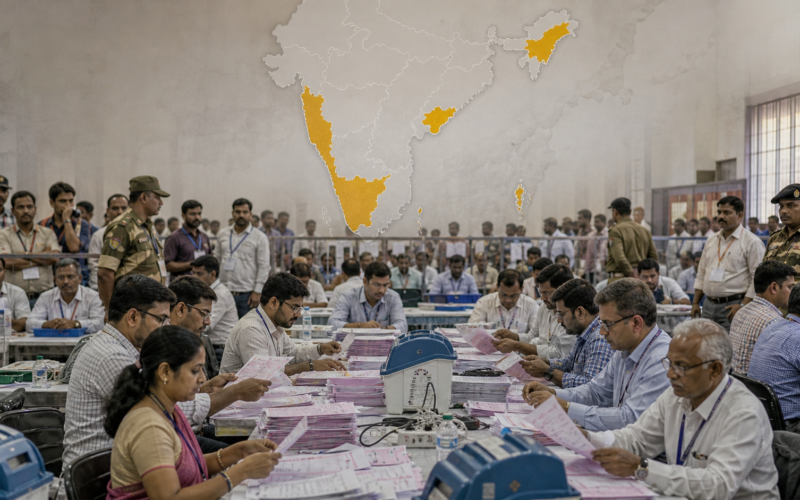
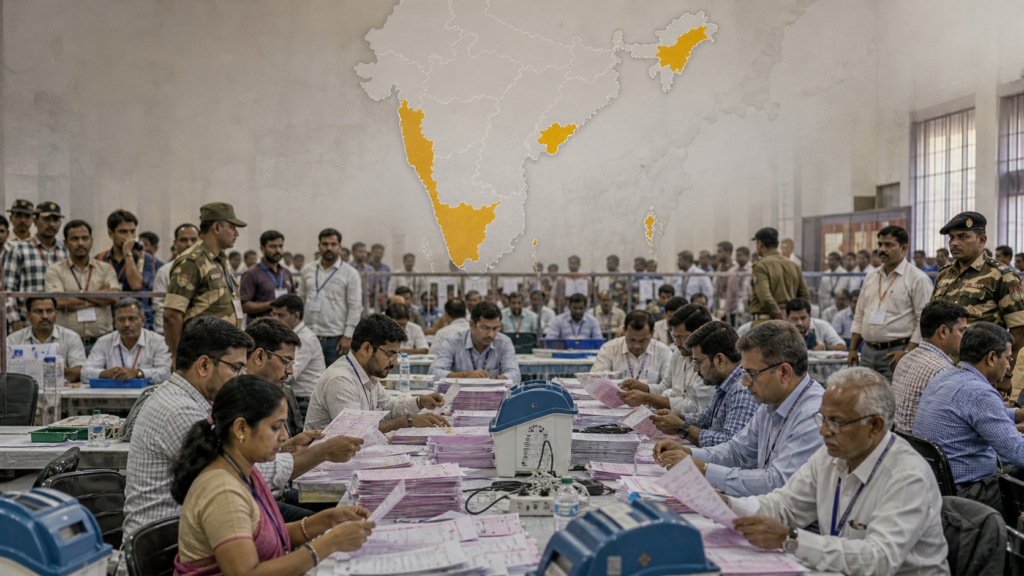
The Election Commission of India began counting votes on Monday, May 4, 2026, for legislative assembly elections held in Assam, Kerala, Tamil Nadu, West Bengal, and the union territory of Puducherry, with early trends pointing to one of the most disruptive verdicts in recent Indian electoral history. By late morning, the Bharatiya Janata Party had crossed the halfway mark in West Bengal, the Indian National Congress led United Democratic Front had moved decisively ahead in Kerala, and actor Vijay’s nascent Tamilaga Vettri Kazhagam had vaulted past both established Dravidian parties in Tamil Nadu, signalling a potential rupture in a political order that has held since 1967. The Bharatiya Janata Party led National Democratic Alliance was also tracking towards a third consecutive term in Assam under Chief Minister Himanta Biswa Sarma, while the All India N R Congress led alliance held a commanding lead in Puducherry.
Counting began at 8 am across the five jurisdictions covering 824 legislative seats in total. Polling had been conducted in single phase or two phase formats through April, and the verdicts were closely watched as the first major electoral test before the Lok Sabha general election due in 2029.
What does the early West Bengal trend mean for Mamata Banerjee and the Trinamool Congress?
The Bharatiya Janata Party crossed the 148 seat majority mark in the 294 member West Bengal Legislative Assembly within the first ninety minutes of counting and continued to extend its lead through the morning, with trends placing the saffron party ahead in 162 to 164 constituencies and the All India Trinamool Congress trailing in approximately 124 seats. If the trend converts into final results, it would end fifteen years of Trinamool Congress rule in the state and mark the first Bharatiya Janata Party government in West Bengal’s history.
In the symbolically charged Bhabanipur constituency, leads alternated repeatedly between Chief Minister Mamata Banerjee and Leader of the Opposition Suvendu Adhikari through the morning rounds, underlining the closeness of the personal contest at the top of the West Bengal ticket. Suvendu Adhikari attributed the wider Bharatiya Janata Party performance to what he described as Hindu consolidation, asserting that the traditional Muslim vote bank of the Trinamool Congress had also fragmented across alternative pro minority parties.
The West Bengal election was conducted under unusual conditions. The Election Commission of India recorded a turnout of 92.93 per cent, the highest ever in the state’s electoral history, surpassing even the 2011 verdict that first brought the Trinamool Congress to power. The campaign was overshadowed by the Special Intensive Revision of electoral rolls, an exercise that removed approximately 91 lakh names from the West Bengal voter list before the final addition of supplementary entries took the total to 6.83 crore voters. The Trinamool Congress alleged the revision had disenfranchised genuine voters, particularly minorities and migrant workers, while the Bharatiya Janata Party argued it had eliminated illegitimate entries. The Election Commission of India deployed more than 350,000 security personnel statewide for the polling phases, including the National Investigation Agency for the first time in a state election. Repolling has been ordered in fifteen booths across Magrahat Paschim and Diamond Harbour, and the entire Falta constituency will be repolled on May 21, with separate counting on May 24.
How is Vijay’s Tamilaga Vettri Kazhagam reshaping the Tamil Nadu political map?
In Tamil Nadu, the Tamilaga Vettri Kazhagam founded by actor Vijay was leading in 108 of 234 constituencies in early trends, ahead of both the All India Anna Dravida Munnetra Kazhagam led alliance on 75 seats and the ruling Dravida Munnetra Kazhagam led front on 51 seats, with the majority threshold standing at 118. The Bharatiya Janata Party was trailing across most of its contested seats, holding a lead in only one constituency in early counts.
If the trend holds, the verdict would represent the first non Dravidian party to come close to forming a government in Tamil Nadu since 1967, when Chief Minister C N Annadurai led the Dravida Munnetra Kazhagam to power and ended Indian National Congress dominance in the state. Vijay had repeatedly invoked both 1967 and the 1977 verdict that brought M G Ramachandran’s All India Anna Dravida Munnetra Kazhagam to power during his campaign, framing his political entry as a generational reset of the Dravidian movement.
Vijay contested from Perambur and Tiruchirappalli, both high visibility constituencies, and was leading in his early counting rounds. Tamilaga Vettri Kazhagam candidates were also ahead in Ponneri, Tiruvallur, Poonamallee, and Avadi, all in the Chennai metropolitan belt that has historically been a Dravida Munnetra Kazhagam stronghold. The trend suggests Tamilaga Vettri Kazhagam has cut across traditional caste and party loyalties, with strong support from urban voters and first time electors. For the Dravida Munnetra Kazhagam government led by Chief Minister M K Stalin, the early numbers represent a major setback ahead of what had been positioned as a referendum on five years of welfare delivery.
Why is the Kerala result a setback for the Left Democratic Front and Pinarayi Vijayan?
In Kerala, the Indian National Congress led United Democratic Front pulled decisively ahead of the ruling Communist Party of India (Marxist) led Left Democratic Front through the morning rounds. By 10:32 am, Election Commission of India trends showed the United Democratic Front leading in 86 of 140 seats, with the Left Democratic Front trailing on 46 seats, and the Bharatiya Janata Party led National Democratic Alliance leading in five seats. The majority mark in the Kerala assembly is 71.
The internal break up of the United Democratic Front lead showed the Indian National Congress at 55, the Indian Union Muslim League at 20, the Kerala Congress at five, the Revolutionary Socialist Party at three, and other smaller allies and independents accounting for the rest. Within the Left Democratic Front, the Communist Party of India (Marxist) was leading in 30, the Communist Party of India in eleven, and the Kerala Congress (M) in three.
If the trend holds, the Kerala verdict would end the historic continuity established in 2021, when the Left Democratic Front broke the state’s long standing pattern of alternating governments and won 99 seats out of 140, with Pinarayi Vijayan returning as Chief Minister for a second consecutive term. Twelve serving ministers in the current cabinet, including Veena George, M B Rajesh, O R Kelu, R Bindhu, J Chinchurani, P Rajeev, K B Ganesh Kumar, V N Vasavan, V Sivankutty, V Abdurahiman, A K Saseendran, and Roshy Augustine, were trailing in their respective constituencies in early counting. Communist Party of India (Marxist) State Secretary M V Govindan said the postal vote pattern aligned with internal expectations and maintained that the Left Democratic Front would still secure a victory once electronic voting machine counting concluded, though the gap shown in trends was widening rather than narrowing through the morning.
For the Bharatiya Janata Party, the Kerala numbers fell well short of the breakthrough scenario projected during the campaign, with the party in contention on a small handful of seats including the high profile Nemom contest involving state Bharatiya Janata Party president Rajeev Chandrasekhar.
What does a third Bharatiya Janata Party term mean for Assam under Himanta Biswa Sarma?
In Assam, the Bharatiya Janata Party led National Democratic Alliance crossed the 64 seat majority threshold in the 126 member assembly within the first hour of counting, with trends placing the alliance ahead on roughly 100 seats and the Indian National Congress trailing in approximately 22 seats. The Bharatiya Janata Party itself was leading in 71 constituencies in early counts, ahead of its allies the Asom Gana Parishad and the United People’s Party Liberal.
The trend tracks closely with the Matrize exit poll that had projected an 85 to 95 seat range for the Bharatiya Janata Party led alliance and a 25 to 32 seat range for the Indian National Congress led Mahajot. If the result holds, Himanta Biswa Sarma would secure a second consecutive term as Chief Minister and the Bharatiya Janata Party would record its third straight assembly victory in Assam, building on the 2016 breakthrough that broke the long Indian National Congress dominance and the 2021 verdict that consolidated saffron control of the state.
In the high profile Jalukbari constituency, Himanta Biswa Sarma was in a closer than expected contest with Indian National Congress challenger Bidisha Neog, although the Chief Minister’s 2021 margin in the seat had exceeded one lakh votes. Assam Congress chief Gaurav Gogoi was contesting from Jorhat and Akhil Gogoi of the Raijor Dal from Sivasagar, both seats being watched as bellwethers of opposition strength. Voter turnout in Assam had stood at 85.96 per cent in the April 9 polling phase.
How is the Puducherry mandate consolidating around the All India N R Congress alliance?
In the union territory of Puducherry, the All India N R Congress led National Democratic Alliance, which includes the Bharatiya Janata Party and the All India Anna Dravida Munnetra Kazhagam, was leading on 22 of the 30 elected seats in early Election Commission of India trends, while the Dravida Munnetra Kazhagam led front backed by the Indian National Congress and Left parties was trailing on six seats. The majority threshold in the Puducherry assembly stands at 16.
If the trend holds, Chief Minister N Rangasamy would return to office for a consecutive term, with the All India N R Congress retaining its position as the dominant partner within the alliance. Puducherry recorded a voter turnout of approximately 89 per cent, one of the highest figures in recent electoral cycles in the territory.
What are the broader implications of the May 4 mandate for national politics?
The combined verdict, if early trends translate into final tallies, would significantly redraw India’s political map ahead of the 2029 Lok Sabha election. The Bharatiya Janata Party would gain a foothold in West Bengal that has eluded it for decades, retain a stronghold in Assam, and remain part of the ruling alliance in Puducherry. The Indian National Congress would secure a major win in Kerala that ends a five year drought in southern state capitals. The Communist Party of India (Marxist) would lose its last major state government and face questions about long term organisational viability.
Most consequentially, the rise of the Tamilaga Vettri Kazhagam in Tamil Nadu introduces a third pole into a state that has operated as a binary contest between the Dravida Munnetra Kazhagam and the All India Anna Dravida Munnetra Kazhagam since the late 1960s. A non Dravidian, non national party government in Chennai would be without precedent in the post Annadurai era and would force both the Bharatiya Janata Party and the Indian National Congress to reassess their southern strategies.
The Special Intensive Revision of electoral rolls, conducted in all five jurisdictions before polling, will face renewed scrutiny in the days following the result. The exercise removed more than 9 million names in West Bengal alone before partial restoration through supplementary lists, and the methodology has already drawn legal and political challenges from opposition parties. The final voter exclusion data and its correlation with seat outcomes is expected to feature in post poll petitions and parliamentary debates.
The Election Commission of India has banned victory rallies and celebratory processions in West Bengal pending the formal declaration of results, citing the need to prevent post poll violence in a state that has historically seen significant unrest in the days following counting.
What are the key takeaways from the May 4, 2026 assembly election results across the five Indian jurisdictions?
- The Bharatiya Janata Party crossed the 148 seat majority mark in West Bengal in early trends, leading on 162 to 164 of the 294 assembly constituencies and putting the All India Trinamool Congress on course for its first state defeat since 2011.
- Tamilaga Vettri Kazhagam, the party founded by actor Vijay, was leading in 108 of 234 Tamil Nadu seats in early counting, ahead of the All India Anna Dravida Munnetra Kazhagam led front on 75 seats and the Dravida Munnetra Kazhagam led alliance on 51 seats.
- The Indian National Congress led United Democratic Front was leading in 86 of 140 Kerala seats by mid morning, with the Left Democratic Front trailing on 46 seats and twelve serving cabinet ministers behind in their constituencies.
- The Bharatiya Janata Party led National Democratic Alliance was ahead in approximately 100 of 126 Assam seats, putting Chief Minister Himanta Biswa Sarma on track for a second consecutive term and a third straight Bharatiya Janata Party victory in the state.
- The All India N R Congress led National Democratic Alliance was leading in 22 of 30 Puducherry seats, with Chief Minister N Rangasamy positioned to retain office and the Dravida Munnetra Kazhagam led front trailing on six seats.
Discover more from Business-News-Today.com
Subscribe to get the latest posts sent to your email.