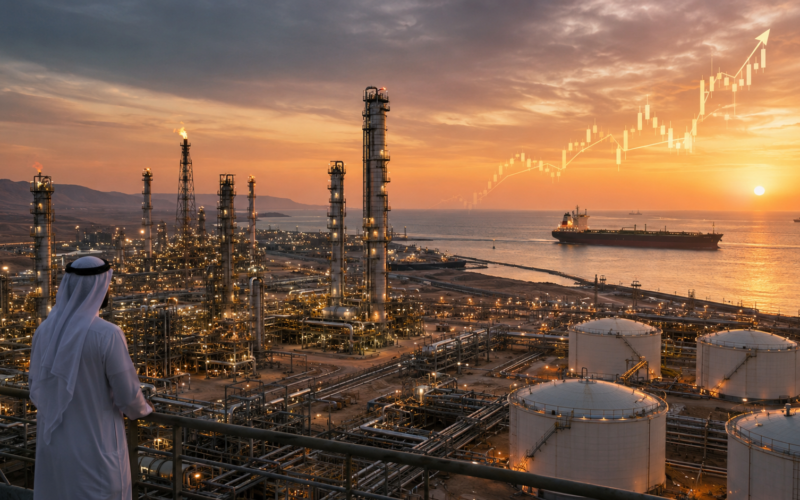
Saudi Arabian Oil Company (Aramco/Tadawul: 2222), the world’s largest oil exporter, reported adjusted net income of $33.6 billion for the first quarter of 2026, a 26 percent year-on-year increase that beat the company-provided analyst consensus of $31.2 billion by nearly 8 percent. Net income on an IFRS basis came in at $32.5 billion versus $26.0 billion a year earlier, with quarterly revenue rising to $124.6 billion. The Saudi Aramco share price closed at SAR 27.64 on May 11 on the Tadawul, sitting within striking distance of its 52-week high of SAR 27.96 and reflecting a market capitalisation of roughly $1.75 trillion. The result represents one of the strongest quarterly prints since the Iran war disrupted global energy flows, and it positions Aramco as the principal financial beneficiary of a Hormuz crisis that has reordered global crude logistics.
How did Saudi Aramco beat the analyst consensus for Q1 2026 adjusted net income despite the Strait of Hormuz blockade?
The headline beat of $2.4 billion against analyst expectations is, on its own, less interesting than what produced it. Aramco’s earnings did not rise because Brent prices rose, although they did, with realised crude averaging $76.9 per barrel against $76.3 in the prior-year quarter, a difference too small to explain a 26 percent jump in adjusted net income. The actual lift came from a 261 thousand barrels per day increase in liquids production to 10.56 million bpd, a step-up in downstream margins that delivered $5.0 billion in adjusted EBIT versus $1.4 billion a year ago, and the strategic ability to keep crude moving when peers could not.
The Strait of Hormuz, which normally carries roughly a fifth of global seaborne oil trade, was effectively closed from late February through mid-May after Iranian retaliation following the US-Israeli campaign against South Pars. Saudi Aramco was the only Gulf producer with material installed capacity to bypass the chokepoint at scale, and the company ramped its 1,200-kilometre East-West Pipeline to its full 7.0 million barrels per day capacity during the quarter. That infrastructure decision, made decades ago in the wake of earlier Gulf conflicts, generated the optionality that has now become the differentiator in a market where physical delivery commands a premium over OPEC+ quota mathematics.
The earnings reaction in the equity has been muted relative to the operational story. The Saudi Aramco share price moved up only 0.8 percent in the session following the results, which reflects two things. Markets had already priced in a Hormuz beneficiary trade through April, and the Saudi government’s 81.48 percent direct stake combined with PIF and Sanabil holdings keeps the effective free float near 1.5 percent, suppressing the price discovery that a beat of this magnitude would otherwise produce.
Why has the East-West Pipeline become the most strategically important piece of energy infrastructure in the Gulf?
For most of its operational history, the East-West Pipeline ran well below capacity, used primarily for blending logistics and Red Sea refining feedstock. The Hormuz crisis has changed its role permanently. CEO Amin H. Nasser told investors during the May 11 webcast that cumulative liquids supply losses from the Hormuz disruption exceeded 1.4 billion barrels through mid-May, and he warned that even a full reopening of the strait would not stabilise markets quickly. That admission, from the executive most directly positioned to know the underlying flows, signals a structurally tighter physical oil market through the second half of 2026 than current futures curves are pricing.
The pipeline carries approximately 5 million bpd of exportable crude to the Yanbu terminal on the Red Sea, with the balance feeding domestic refineries. Combined with Saudi Arabia’s domestic and international storage network, Aramco has created an effective workaround that gives Riyadh a unique seat at the geopolitical table. Iraq, Kuwait, the UAE and Qatar have no comparable trans-peninsular route at this scale, and the Habshan-Fujairah line carries far less volume. For institutional investors, this changes the long-term risk premium calculation on Aramco versus its Gulf peers. The company is not just a low-cost producer with the world’s lowest upstream carbon intensity, it is now also the only Gulf operator with a credible Hormuz-resistant export channel.
The competitive read-through extends to international oil companies. Aramco’s ROACE of 20.7 percent on a 12-month rolling basis remains close to double the average of integrated majors, and the upstream production cost of $3.5 per barrel of oil equivalent in 2025 sits roughly 50 percent below the IOC peer average. Those metrics were already a wide moat. The Hormuz episode adds a logistics dimension that ExxonMobil, Shell, BP, TotalEnergies and Chevron cannot replicate from their balance sheets.
What does the $15.8 billion working capital build tell investors about Aramco’s underlying cash generation in Q1 2026?
Free cash flow came in at $18.6 billion, slightly below the $19.2 billion recorded in Q1 2025 and well below the $27.5 billion in Q4 2025. The decline is almost entirely explained by a $15.8 billion working capital build during the quarter, driven by a $12.3 billion increase in trade receivables and a $6.4 billion build in inventories. Excluding the working capital movement, free cash flow rose roughly 62 percent year-on-year to $34.4 billion on management’s normalised basis, which is the figure analysts should anchor to when modelling the rest of the year.
The trade receivables build reflects the timing of cargoes in transit on alternative routes, including via the SUMED pipeline and Suez Canal, where settlement cycles are longer than the standard Arabian Gulf-to-Asia voyages. The inventory build reflects strategic positioning of crude and refined products at international storage facilities, which functions as both a commercial hedge and a customer service tool during the Hormuz disruption. Both are timing items rather than structural cash flow concerns, and both should reverse over Q2 and Q3 as receivables settle and storage drawdowns occur.
Capital expenditure was $12.1 billion in the quarter, slightly below the $12.5 billion run-rate from Q1 2025 and well below Q4 2025’s $13.4 billion. Aramco maintained its full-year capex guidance range of $50 billion to $55 billion, suggesting the back half of the year will see a heavier spend cycle as Jafurah Phase Two progresses toward 2027 completion, the Zuluf 600 thousand bpd crude increment moves through construction, and the Fadhili gas plant expansion advances.
How sustainable is the $21.9 billion Aramco base dividend after a quarter where free cash flow fell short of the payout?
The base dividend of $21.9 billion declared for Q1 2026, up 3.5 percent year-on-year, exceeded free cash flow of $18.6 billion by $3.3 billion. On paper this is a coverage gap, and gearing ticked up from 3.8 percent at end-2025 to 4.8 percent at March 31. That increase, however, sits well within management’s comfort zone, particularly given the strength of the underlying cash generation outside of the working capital build.
The dividend structure matters here. Aramco operates a base dividend plus a performance-linked dividend mechanism introduced in 2023 and tied to free cash flow. Management has guided to total 2026 dividend payments of roughly $87.6 billion, with the base dividend growing by approximately SAR 3 billion in full-year 2026 versus 2025. The performance-linked component was paused during 2025 as oil prices softened and has not yet been reinstated for 2026, which gives the company room to fund the base distribution from cash flow over the full year even if individual quarters show timing mismatches. With Brent currently elevated by the Hormuz risk premium, Q2 and Q3 free cash flow generation should comfortably bridge the gap created in Q1.
The $4.0 billion February bond issuance under the GMTN Programme, structured across four tranches with maturities from 2029 to 2056 and coupons from 4.0 percent to 6.0 percent, gives Aramco an additional layer of liquidity to defend the dividend if needed. The 5.7 percent average annualised capitalisation rate on borrowing costs for the quarter, and the term structure across 30 years, suggests the company is locking in long-duration funding at rates that look attractive against a backdrop where Treasury yields may rise further if Middle East risk persists.
What does the SABIC divestment program signal about Aramco’s downstream strategy and capital allocation discipline?
The Q1 print includes a further $46.9 million remeasurement loss on SABIC’s engineering thermoplastics business, which is being sold to subsidiaries of Mutares for an enterprise value of $500 million, including upfront cash and earnout arrangements. This follows the 2025 announcement of SABIC’s European petrochemicals divestment to AEQUITA at an enterprise value of $500 million, with that transaction targeted for Q4 2026 completion. Combined, the two transactions reduce SABIC’s exposure to structurally challenged European and American petrochemicals at a time when Chinese capacity has reset global olefins and polyolefins economics.
The strategic intent is clear. Aramco is concentrating downstream capital on Asian and Gulf-based petrochemicals integration, where feedstock cost advantage and proximity to growth markets justify continued investment. The European and Americas divestments take small absolute book losses in exchange for removing structural margin pressure from the consolidated picture. For investors, this is the cleanest signal in years that SABIC’s portfolio is being rationalised toward the geographies where Aramco’s crude-to-chemicals model actually works. The 51 percent downstream utilisation of Aramco’s crude oil production in Q1, against 56 percent in the year-ago quarter, reflects refining outages from regional disruptions rather than demand weakness, and should normalise as facilities return to full operations.
What are the technology and quantum computing milestones in the Q1 2026 report and why do they matter for upstream economics?
Aramco’s Q1 report flagged three technology developments that, while small in dollar terms, carry asymmetric upside for upstream productivity. First, the company announced a next-generation supercomputer deployment for upstream operations with seven times the compute capacity of its current infrastructure, scheduled for delivery in early 2027. The application is reservoir modelling and seismic data processing, where small percentage improvements in recovery factors translate into multi-billion dollar reserves uplifts at Saudi Arabia’s scale. Second, Aramco signed a memorandum of understanding with CrowdStrike in February to deploy AI-powered cybersecurity tailored to operational technology environments. Given the documented attacks on Aramco facilities through 2025 and into 2026, this is not a discretionary spend.
Third, and most strategically interesting, Aramco completed the network, software, optical alignment, and cloud integration milestones for its Pasqal quantum computer, with quantum computing as a service launch planned for Q2 2026. The use cases identified by management, including logistics optimisation, secure communications, and advanced simulation, map directly to the kind of problems where quantum advantage is most likely to materialise commercially within a five-year horizon. Aramco has stated it has captured $11.3 billion in technology-realised value since 2023, which puts a tangible number on what is otherwise easy to dismiss as press release material.
What are the key takeaways from Saudi Aramco’s Q1 2026 results for institutional investors and energy sector analysts?
- Adjusted net income of $33.6 billion beat the analyst consensus of $31.2 billion by nearly 8 percent, with the beat driven by higher upstream volumes and stronger downstream margins rather than crude prices, which were broadly flat year-on-year at $76.9 per barrel realised.
- The East-West Pipeline running at its full 7.0 million bpd capacity has emerged as a structural competitive advantage that no other Gulf producer can replicate at scale, materially repricing Aramco’s long-term geopolitical risk premium versus Iraqi, Kuwaiti, Emirati and Qatari peers.
- The $15.8 billion working capital build that suppressed Q1 free cash flow to $18.6 billion is a timing artifact of alternative routing and strategic inventory positioning, and should reverse in Q2 and Q3 as receivables settle and storage normalises.
- Gearing rising from 3.8 percent to 4.8 percent quarter-on-quarter reflects the dividend payment plus capex spend against a working capital build, not a deterioration in underlying balance sheet quality, with cash and equivalents still at $61.6 billion and total liquidity well above $75 billion.
- The $21.9 billion base dividend remains affordable through the cycle, supported by the $4.0 billion February bond issuance under the GMTN Programme and management’s full-year 2026 guidance for total dividends near $87.6 billion.
- ROACE of 20.7 percent on a 12-month rolling basis maintains Aramco’s wide moat against international oil company peers averaging closer to 10 percent, with upstream production costs of $3.5 per barrel of oil equivalent still 50 percent below the IOC peer average.
- The SABIC divestments of European petrochemicals to AEQUITA and engineering thermoplastics to Mutares signal genuine portfolio rationalisation, removing structurally challenged businesses at the cost of small book losses now and concentrating downstream capital on Asia-Gulf integration.
- Jafurah Phase Two remains on schedule for 2027 completion, with Phase One having exported its first condensate shipment in Q1, keeping the company’s 80 percent sales gas capacity expansion target by 2030 on track and underpinning the multi-decade gas growth thesis.
- Nasser’s warning that one billion barrels of cumulative supply has been lost over the past two months, and that markets will take time to stabilise even with a Hormuz reopening, signals management views the current oil price strength as structural for the medium term rather than a short-term geopolitical spike.
- The 1.5 percent effective free float, with the Saudi government holding 81.48 percent and PIF entities holding another 16 percent, continues to suppress price discovery in the Saudi Aramco share price, meaning fundamental beats translate into compressed share price moves and creating a structural valuation discount that index inclusion alone cannot resolve.
Discover more from Business-News-Today.com
Subscribe to get the latest posts sent to your email.