




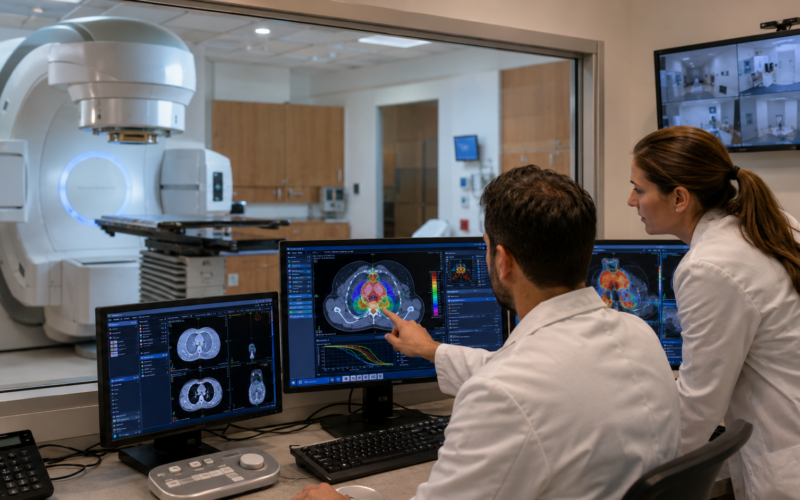
Accuray Incorporated (NASDAQ: ARAY) and the University of Wisconsin School of Medicine and Public Health have announced a 10-year strategic collaboration aimed at advancing personalized cancer treatment through Accuray Stellar adaptive radiation therapy. The Master Research Agreement expands a long academic-industry relationship that helped shape Accuray’s helical radiation delivery heritage through the TomoTherapy platform. For Accuray Incorporated, the agreement arrives at a strategically important moment because the company needs more than product messaging to rebuild investor confidence in a difficult radiotherapy equipment market. With Accuray stock trading near its 52-week low, the Wisconsin collaboration gives the company a research-led platform story, but commercial execution will decide whether that story travels from the clinic to the income statement.
Why does Accuray’s University of Wisconsin agreement matter for adaptive radiation therapy strategy?
The new agreement matters because it positions Accuray Incorporated around one of the most important shifts in radiation oncology: the move from static treatment planning toward adaptive radiotherapy that can respond more intelligently to patient anatomy, tumour change, and treatment-day variability. In simple terms, the strategic prize is not just delivering radiation accurately at the start of a treatment course. It is improving the ability of care teams to adjust treatment as the patient and tumour evolve, which is where personalization becomes more than a nice conference word.
That is important for Accuray Incorporated because radiotherapy vendors are competing in a market where hospitals are increasingly looking for clinical precision, operational efficiency, and workflow economics in the same system. Cancer centres do not buy complex radiation platforms merely because the physics is elegant. They buy them when the technology can support better outcomes, shorter planning cycles, more predictable workflows, and clearer value for overloaded clinical teams. If Accuray Stellar can become a credible adaptive radiotherapy platform for a wider range of departments, Accuray Incorporated could strengthen its relevance beyond niche high-complexity cases.
The University of Wisconsin School of Medicine and Public Health gives the collaboration more strategic weight than a standard vendor-sponsored research arrangement. The institution has historical links to technologies that eventually became part of Accuray’s commercial identity, including the helical radiation delivery platform associated with TomoTherapy. That history matters because it gives the new agreement a credible translational pathway: academic invention, clinical validation, workflow testing, training, and eventually commercialization. The risk, however, is equally clear. Academic collaboration can produce strong science without producing fast market adoption. Accuray Incorporated will need to show that research outputs can be converted into features, protocols, training models, and customer demand.

How could adaptive radiotherapy change Accuray’s competitive position in cancer treatment systems?
Adaptive radiotherapy is becoming a competitive battleground because it addresses a real clinical tension. Tumours can shrink, organs can move, patients can lose weight, and anatomy can shift across a treatment course. Traditional radiation planning can still be effective, but the more personalized oncology becomes, the more pressure vendors face to make treatment planning and delivery responsive to the individual patient rather than fixed around assumptions made before therapy begins.
For Accuray Incorporated, the opportunity is to sharpen its differentiation in a market that includes large radiation oncology equipment players with deeper balance sheets and broader hospital relationships. The company’s core products, including CyberKnife, Radixact, TomoTherapy, and Accuray Stellar, already sit in a precision-treatment narrative. The Wisconsin agreement can extend that narrative into adaptive workflows, translational research, and medical physics innovation, which are useful themes when competing for clinical attention against larger rivals.
The more interesting strategic question is whether Accuray Incorporated can make adaptive radiotherapy usable for departments of different sizes, not only elite academic cancer centres. Steve La Neve, Accuray’s President and Chief Executive Officer, framed the collaboration as a way to ground innovation in real-world clinical practice and extend advanced adaptive therapies to departments of different scales. That point matters because the commercial market is not made only of flagship institutions with large research budgets. If adaptive radiation therapy remains too complex, too expensive, or too labour-intensive, adoption could stay limited. If Accuray Incorporated can reduce workflow friction, it may have a more practical selling point.
Why is Accuray’s Wisconsin research history important for its next radiotherapy platform cycle?
Accuray Incorporated is not starting this collaboration from a blank page. In the late 1980s, University of Wisconsin-Madison Professor Thomas “Rock” Mackie and his team developed technology that later became commercialized through Accuray’s first helical radiation delivery platform, the TomoTherapy System. That history gives the new agreement a symbolic and strategic dimension because it reconnects Accuray Incorporated with a source of foundational innovation rather than positioning the deal as a purely transactional research partnership.
For the University of Wisconsin School of Medicine and Public Health, the agreement also reinforces the institution’s role as a translational engine in radiation medicine. Zachary Morris, professor and chair of human oncology, indicated that the school has innovators working across discovery science, translational research, and clinical practice, and that the agreement is intended to accelerate the movement of research into technologies that can better serve patients. Nita Ahuja, Dean of the UW School of Medicine and Public Health and Vice Chancellor for Medical Affairs at the University of Wisconsin-Madison, similarly positioned the framework as a way to deepen bench-to-bedside collaboration while creating research and training opportunities.
The history is useful, but history alone does not sell machines. Accuray Incorporated needs the next phase of collaboration to generate visible clinical and workflow evidence around Accuray Stellar adaptive radiation therapy. Investors will want to see whether the agreement supports product adoption, system upgrades, clinical publications, training pipelines, and hospital confidence. In other words, the old TomoTherapy origin story gives Accuray Incorporated credibility. The new Stellar story still has to earn commercial proof.
What does the agreement signal about the economics of radiation oncology platforms?
The agreement signals that radiotherapy equipment companies are increasingly competing on ecosystems, not just hardware. The machine still matters, but so do imaging quality, treatment planning, adaptive algorithms, clinician training, workflow integration, service reliability, and published clinical evidence. A strategic research alliance helps Accuray Incorporated strengthen several of those layers at once.
That is especially important because radiation oncology systems are large capital purchases. Hospitals and cancer centres must justify equipment decisions across clinical leadership, finance teams, procurement teams, and administrators. A 10-year research framework with a respected academic medical school can help Accuray Incorporated build evidence that speaks to more than product specifications. It can support education, protocol development, clinical confidence, and peer-led adoption, all of which matter in medical technology sales cycles.
The economic risk is that research-led differentiation may take longer to influence revenue than investors want. Accuray Incorporated is already operating under pressure, with its stock near the lower end of its 52-week range and market capitalization reflecting weak confidence. A long-term agreement can strengthen the strategic story, but it will not immediately solve order timing, geopolitical headwinds, product revenue pressure, or profitability concerns. In medtech, the lab can light the path, but the sales pipeline still has to walk it.
How does Accuray stock sentiment shape the market reading of this cancer research pact?
Accuray Incorporated shares closed at $0.2700 on May 15, 2026, close to the bottom of their 52-week range of $0.2650 to $2.1000. The company’s market capitalization stood at roughly $32.12 million, an unusually small valuation footprint for a global radiation oncology equipment business with trailing revenue above $400 million. That gap between revenue scale and equity value tells the real investor story: the market is not questioning whether Accuray Incorporated has technology, but whether it can convert that technology into durable profitability, growth, and balance sheet resilience.
Recent sentiment has also been pressured by operational and financial concerns. Accuray Incorporated reported fiscal 2026 third-quarter revenue of $104.8 million, down from the prior-year period, and the company has been navigating geopolitical disruption, macro headwinds, product revenue pressure, and a transformation plan designed to improve operating performance. Analyst sentiment has also cooled recently, with downgrades appearing around the stock after the fiscal third-quarter update. That makes the Wisconsin agreement strategically positive but not automatically valuation-changing.
The market reaction should therefore be read cautiously. A research agreement can improve Accuray Incorporated’s long-term clinical positioning, but investors are likely to demand harder signals before assigning meaningful upside. Those signals could include system orders linked to adaptive capability, new clinical evidence, improved gross margin visibility, stronger service revenue resilience, or proof that the company’s transformation plan is reducing the cash burn and restoring credibility. For now, ARAY looks less like a clean innovation rerating and more like a turnaround stock looking for a believable bridge between science and shareholder value.
What execution risks could limit the impact of Accuray’s adaptive radiotherapy collaboration?
The first execution risk is translation speed. A 10-year agreement sounds substantial, but investors and hospital customers will not wait a decade for proof points. Accuray Incorporated will need to demonstrate interim progress through research milestones, training programs, clinical workflow improvements, and tangible platform development around Accuray Stellar. The company must avoid letting the agreement become a broad scientific umbrella without visible commercial consequences.
The second risk is hospital adoption friction. Adaptive radiotherapy can require sophisticated imaging, planning, quality assurance, clinician training, and time-sensitive decision-making. If the workflow burden outweighs the clinical and operational benefit for smaller departments, adoption could remain concentrated in specialist centres. Accuray Incorporated’s challenge is to make advanced adaptive therapy feel deployable, not intimidating. The best technology in the room still loses if the room does not have the staff or economics to use it well.
The third risk is competitive response. Larger medtech and radiation oncology vendors have the resources to invest in adaptive radiotherapy, artificial intelligence-assisted planning, imaging integration, and software-led workflow tools. Accuray Incorporated can compete through specialization and research credibility, but it cannot assume that adaptive radiotherapy will remain a differentiated message by itself. The company has to turn the Wisconsin collaboration into a specific product advantage before broader industry language catches up and makes every platform sound adaptive, intelligent, and personalized.
Can the University of Wisconsin partnership help Accuray rebuild investor confidence?
The agreement can help, but only as part of a wider turnaround narrative. It gives Accuray Incorporated a credible innovation anchor, reinforces the company’s historical connection to Wisconsin-based radiotherapy research, and supports a future-facing platform strategy around Accuray Stellar. Those are meaningful positives at a time when the company needs to convince customers, clinicians, and investors that its product roadmap remains relevant.
However, investor confidence will not be rebuilt by research credibility alone. The stronger test is whether Accuray Incorporated can pair science with commercial discipline. That means clearer evidence of demand, better operating leverage, improved service economics, stronger customer conversion, and a credible path to profitability. The University of Wisconsin agreement strengthens the “why this technology matters” side of the story. The company still needs to answer the harder Wall Street question: when does it matter financially?
The most constructive reading is that Accuray Incorporated is trying to rebuild from the right end of the value chain. Instead of relying only on cost cuts, sales changes, or financial engineering, the company is investing in clinical differentiation and academic validation. That is the better long-term route for a medical technology company. The less comforting part is that long-term routes are not always kind to small-cap medtech stocks trading under heavy pressure. Accuray Incorporated now has a stronger innovation platform. It still needs a stronger market proof point.
Key takeaways on what Accuray’s University of Wisconsin agreement means for cancer care and ARAY stock
- Accuray Incorporated’s 10-year agreement with the University of Wisconsin School of Medicine and Public Health gives the company a credible research-led platform for advancing personalized cancer care through adaptive radiotherapy.
- The collaboration strengthens the strategic positioning of Accuray Stellar at a time when radiation oncology is moving toward treatment systems that can respond to patient-specific changes during therapy.
- The University of Wisconsin relationship carries historical weight because technologies developed by Professor Thomas “Rock” Mackie and his team helped shape the TomoTherapy platform later commercialized by Accuray Incorporated.
- The agreement could improve Accuray Incorporated’s clinical evidence pipeline, training ecosystem, and academic credibility, all of which matter in complex hospital purchasing decisions.
- The commercial upside depends on whether adaptive radiotherapy can be made practical for cancer centres of different sizes, not only large academic hospitals with deep staffing and research capacity.
- Accuray stock remains under pressure, trading near its 52-week low, which suggests investors are still focused on revenue pressure, profitability, execution risk, and balance sheet confidence.
- The agreement may improve long-term sentiment, but it is unlikely to trigger a durable rerating unless Accuray Incorporated links research progress to orders, margins, platform adoption, or service revenue growth.
- Competitive pressure remains significant because larger radiation oncology and medtech vendors are also investing in adaptive therapy, imaging, workflow software, and artificial intelligence-assisted treatment planning.
- The deal signals that radiotherapy vendors are increasingly competing on clinical ecosystems rather than hardware alone.
- For Accuray Incorporated, the Wisconsin agreement is a strategically smart move. The harder test is whether smart science can become commercial momentum before investor patience gets any thinner.
Discover more from Business-News-Today.com
Subscribe to get the latest posts sent to your email.

