

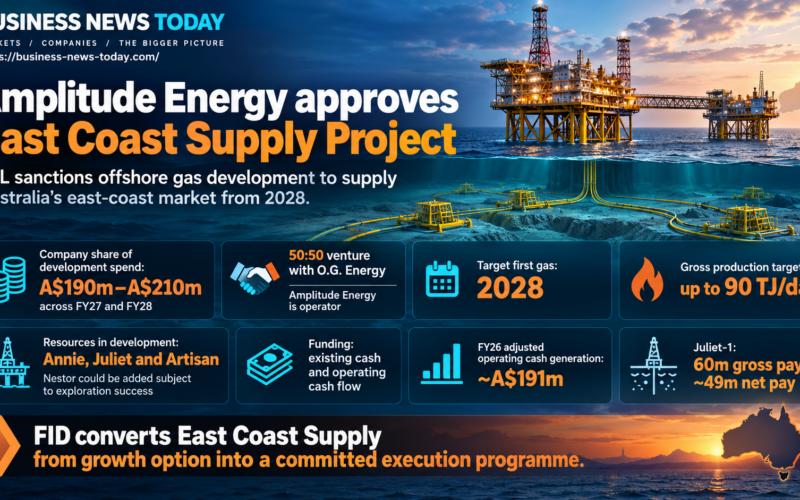
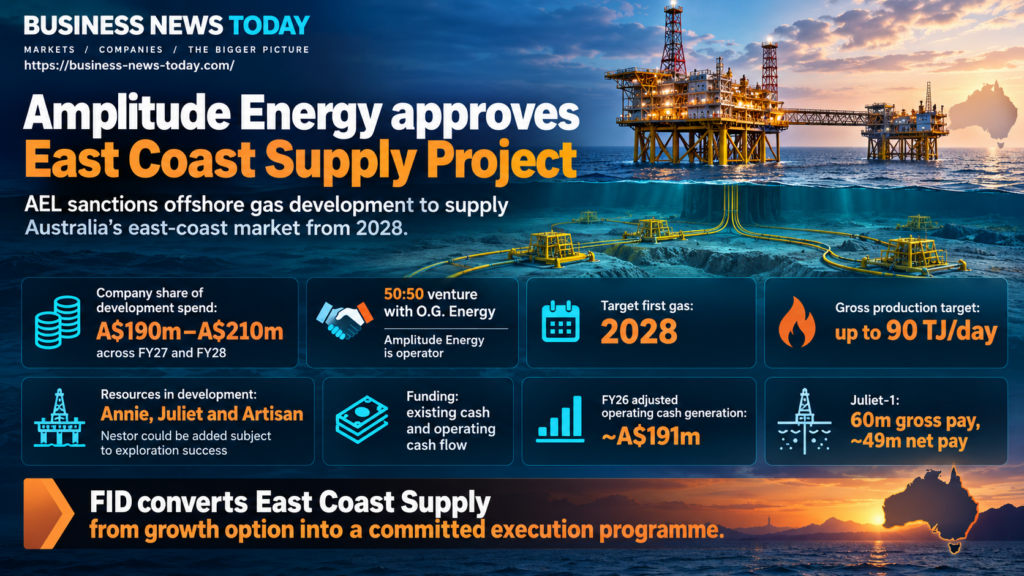
Amplitude Energy Limited (ASX: AEL) has taken a final investment decision on the development phase of its East Coast Supply Project, advancing an offshore gas programme designed to connect discovered resources to existing infrastructure and supply Australia’s east-coast market from 2028. The company expects to spend approximately A$190 million to A$210 million for its share of development expenditure across FY27 and FY28, with funding expected to come from existing cash and operating cash flow.
The project is being developed through a 50:50 venture with O.G. Energy, with Amplitude Energy acting as operator. The development incorporates the Annie, Juliet and Artisan resources, while the Nestor prospect could also be incorporated subject to exploration success. At full rates, the project is targeting gross production of up to 90 terajoules of gas per day, creating a potentially material new production stream for Amplitude Energy’s existing portfolio.
Why is the East Coast Supply Project FID important for Amplitude Energy?
The final investment decision converts the East Coast Supply Project from a development option into a committed execution programme. Amplitude Energy has spent recent periods building the resource base, drilling wells and preparing infrastructure plans, but FID is the point at which capital allocation becomes substantially harder to reverse and project economics move into the construction and delivery phase.
The development benefits from access to existing infrastructure, which is one of its central strategic advantages. Amplitude Energy already operates gas assets and processing infrastructure in southeastern Australia, including the Athena Gas Plant, allowing new offshore resources to be connected into an established operating system rather than requiring a completely new downstream network. That infrastructure-led model can reduce both capital intensity and development time compared with an entirely greenfield project.
For investors, the project also changes Amplitude Energy’s medium-term production profile. Rather than relying only on depletion management and incremental optimisation of existing fields, the company now has a sanctioned project that could deliver a new production step-up from 2028 if construction, drilling and commissioning remain on schedule.
How much will Amplitude Energy spend on the East Coast Supply Project?
Amplitude Energy expects its share of development spending to total between A$190 million and A$210 million during FY27 and FY28. Because the company owns 50% of the venture, the total project economics extend beyond that direct company contribution, but the disclosed range is the figure most relevant to Amplitude Energy’s own cash requirements.
The company plans to finance the programme using existing cash and operating cash generation rather than relying on a project-specific equity funding announcement alongside FID. That position is supported by a stronger FY26 operating base. Amplitude Energy reported record production, revenue, underlying EBITDAX and adjusted cash from operations for the year ended June 30, with adjusted operating cash generation reaching approximately A$191 million.
The comparison is useful because the project’s two-year capital requirement is substantial but not detached from the company’s existing cash-generating capacity. Even so, project spending will compete with exploration, existing-field investment, operating requirements and shareholder capital-management priorities, meaning free cash flow is likely to become a particularly closely watched metric through the build phase.
How does Juliet strengthen the East Coast Supply Project economics?
The September FID follows recent exploration success at Juliet. Amplitude Energy disclosed earlier in the month that Juliet-1 encountered at least 60 metres of gross pay, including approximately 49 metres of net pay, with preliminary information indicating strong reservoir characteristics and low carbon-dioxide content. The well was subsequently positioned for future development as part of the East Coast Supply Project.
Exploration success matters because greater resource confidence can improve infrastructure utilisation. Once pipelines, subsea systems and processing capacity are being installed or committed, additional nearby resource volumes can potentially generate stronger returns than standalone developments because they share portions of the same infrastructure.
Nestor adds further optionality, although it should not be treated as guaranteed project production. Amplitude Energy has included Nestor within the broader development concept subject to exploration success, which means future drilling results could either strengthen the project inventory or leave the sanctioned development more dependent on the resources already discovered.
How much gas could the project produce from 2028?
Amplitude Energy is targeting first gas in 2028 and gross production capacity of up to 90 terajoules per day. At that level, the East Coast Supply Project would represent a substantial production source relative to the company’s existing scale and could extend the utilisation of processing infrastructure already controlled by Amplitude Energy.
The significance is amplified by the nature of offshore gas economics. Once producing fields begin declining, operators need additional discoveries and tie-backs to keep expensive infrastructure working efficiently. The East Coast Supply Project provides Amplitude Energy with a pathway to feed new molecules through infrastructure that would otherwise face declining utilisation over time.
Production capacity is not the same as guaranteed annual output, however. Actual volumes will depend on reservoir performance, well deliverability, facility uptime, customer nominations and the timing with which individual fields are brought online. Investors should therefore distinguish the project’s design capacity from the eventual production profile reported quarter by quarter.
Why did Amplitude Energy shares trade lower after the FID?
Amplitude Energy shares were down roughly 2.3% at about A$1.675 during the September 30 session following the announcement. That reaction does not necessarily imply the market regards the project as strategically unattractive. It may instead reflect the transition from a potential growth project into a capital-intensive commitment with significant expenditure now scheduled over the next two financial years.
Resource-company valuations often respond differently to exploration discoveries and development sanctions. Discoveries add potential optionality, while an FID introduces construction spending, execution risk and a period in which cash that might otherwise accumulate on the balance sheet must be reinvested. The East Coast Supply Project now needs to demonstrate that its eventual production and margins justify that capital commitment.
The share-price movement is also modest relative to the long-term project horizon. With first gas targeted for 2028, quarterly progress on drilling, construction, contracting and budget performance is likely to shape sentiment more meaningfully than a single morning’s trading reaction.
What could go wrong with the East Coast Supply Project?
Schedule and cost control are immediate risks. Offshore developments involve specialised equipment, subsea installation, drilling, engineering and regulatory requirements, all of which can create cost escalation or delays. Amplitude Energy’s A$190 million to A$210 million company-share estimate therefore becomes an important benchmark against which later updates will be measured.
Reservoir risk remains relevant even where discoveries have already been made. Actual production performance can differ from pre-development models, and Nestor remains conditional on exploration success. A weaker-than-expected additional resource contribution could reduce the amount of gas available to utilise the new infrastructure.
Commodity pricing and contracting also matter. The project’s economics ultimately depend on the realised value of gas sold into the market as well as production costs and infrastructure utilisation. A project can meet its engineering targets while still generating weaker-than-expected shareholder returns if commercial conditions deteriorate.
What should investors watch next from Amplitude Energy Limited?
The first area to watch is project execution against the A$190 million to A$210 million spending envelope. Investors should expect future disclosures to clarify drilling activity, subsea construction, infrastructure installation and schedule progress toward 2028 first gas.
The second is exploration. Nestor could provide additional resource depth if successful, while further appraisal of the broader portfolio could extend the operating life of infrastructure created for the East Coast Supply Project. Exploration results therefore have the potential to change project economics even after FID.
Amplitude Energy has now crossed an important threshold. The East Coast Supply Project is no longer merely a future growth option. Capital is being committed, first gas has a target date and the company’s ability to convert its resource position into reliable production will increasingly determine whether the project becomes a meaningful new earnings platform.
Discover more from Business-News-Today.com
Subscribe to get the latest posts sent to your email.