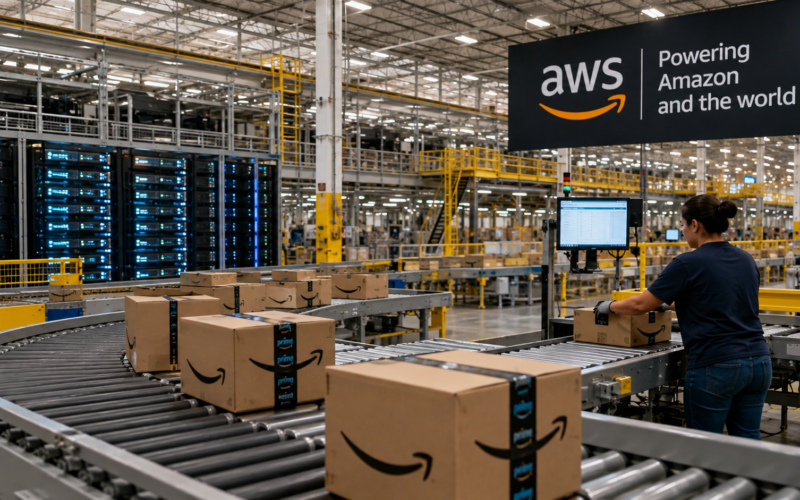
Amazon.com, Inc. (NASDAQ: AMZN) reported second-quarter 2026 results on July 30 that combined a record-scale quarter of operating profit with a headline net income figure heavily inflated by an unrealised gain on its equity stake in Anthropic. Net sales rose 20 per cent to $200.6 billion, operating income climbed 43 per cent to $27.5 billion, and Amazon Web Services accelerated to 36.7 per cent year-on-year growth, the fastest quarterly rate the cloud segment has posted in eighteen quarters. Reported net income of $62.6 billion, or $5.75 per diluted share, however, included $53.4 billion of non-operating pre-tax other income, primarily from the Anthropic investment. Chief Executive Officer Andy Jassy also disclosed that capital expenditure guidance for 2026 has been raised to approximately $220 billion from a prior figure of about $200 billion, citing rising memory prices. The central tension is that the operating quarter, and specifically the AWS re-acceleration, is genuinely strong, but the reported earnings figure and the escalating capex plan complicate how investors should read the underlying run rate.
What did Amazon’s second-quarter print actually deliver beneath the record headline profit
Amazon’s headline numbers are unambiguously large, and the underlying operating quarter is stronger than the reported profit alone suggests. Net sales of $200.6 billion compared with $167.7 billion in the same quarter of 2025, a 20 per cent year-on-year increase that was effectively unchanged on a constant-currency basis after adjusting for a $0.1 billion favourable foreign exchange contribution. Operating income of $27.5 billion sat 43 per cent above the prior year, and trailing twelve-month operating cash flow rose 33 per cent to $161.4 billion, from $121.1 billion in the equivalent period a year earlier.
Reported net income, however, sits meaningfully above the operating line. Amazon disclosed $62.6 billion of net income and $5.75 of diluted earnings per share, but the company also stated that the quarter included $53.4 billion of non-operating pre-tax other income, primarily attributable to its investments in Anthropic. That gain reflects a mark-to-market accounting treatment of Amazon’s equity interest in the artificial intelligence company, and it is a paper item rather than a cash inflow. For investors trying to estimate a normalised run-rate profit, the more analytically useful anchor is the $27.5 billion of operating income, generated by the actual retail, advertising and cloud operations. That distinction matters because the reported earnings figure is unusually sensitive to future revaluations of the same stake, in either direction, and does not scale with the underlying business.

How did AWS re-accelerate to 36.7% growth and what does the $169 billion run rate imply
The most consequential number in the release is AWS revenue growth of 36.7 per cent year-on-year to $42.2 billion, which Amazon described as its fastest quarterly growth in eighteen quarters. Andy Jassy told analysts that the segment now runs at a $169 billion annualised revenue rate, a scale that if it stood as an independent company would rank around twenty-fourth on the Fortune 500. Within that mix, Amazon said its AI and custom silicon businesses each exceeded run rates of more than $25 billion, indicating that the artificial intelligence workload build-out is now a material contributor to segment revenue rather than a rounding item.
The peer context sharpens the interpretation. Alphabet reported Google Cloud growth of 82 per cent in the same period, while Microsoft’s Azure grew 43 per cent in its fourth fiscal quarter. On percentage growth alone, AWS remains the slower of the three hyperscalers. Both smaller peers, however, grow off a materially smaller revenue base, and the absolute dollar addition at AWS remains larger in most quarters. What changed in the second quarter is the direction of AWS growth, which had been decelerating for several years and had raised concerns that the segment was structurally maturing. A single quarter does not settle that debate, but a 36.7 per cent print, up from lower rates in recent history, materially reduces the tail risk that AWS growth has permanently stepped down.
Chief Financial Officer Brian Olsavsky said AWS segment margins expanded by 650 basis points year-on-year, or approximately 520 basis points excluding a derivative accounting gain. That is a notable disclosure because it suggests AWS is still able to widen margins even as the company invests heavily in AI infrastructure. The margin story will be tested in the second half as depreciation on the elevated capital expenditure plan begins to flow through the segment cost base, and investors will look for continuity in the historically robust AWS margin range as capacity comes online.
Why does the $53.4 billion non-operating gain from the Anthropic stake dominate reported earnings
The $53.4 billion non-operating pre-tax other income line is the single largest driver of the gap between operating income and reported net income in the quarter. Amazon has stated that the amount primarily reflects gains on its investments in Anthropic. Under United States generally accepted accounting principles, equity investments in companies without a readily determinable fair value can be remeasured to reflect observable price changes, and Amazon’s holding in Anthropic has been marked upward through successive private-market funding rounds and reference transactions.
The important qualifications for investors are that the gain is not cash, that it is not repeatable, and that it can reverse in future periods if the reference valuation of Anthropic falls. In the second quarter, the accounting treatment lifted reported earnings per share to $5.75, but the operating engine of the business, comprising retail, advertising and AWS, generated the underlying $27.5 billion of operating profit. Business News Today analysis suggests that a cleaner run-rate earnings figure should exclude the Anthropic revaluation, both to compare quarters consistently and to avoid overstating the cash-generating capacity of the group.
The disclosure also puts Amazon in an unusual position of carrying a very large paper mark on a private artificial intelligence company whose valuation is set through occasional funding rounds. That means quarterly reported earnings will carry a discrete valuation-cycle risk that is exogenous to the operating business, and the direction of the mark will not necessarily coincide with the direction of Amazon’s own operating performance. Neither point is a negative in isolation, but both argue for looking through the reported figure to the operating one when building an investment case.
What does the $220 billion capital expenditure plan reveal about the memory-cost pressure and AI arms race
Amazon lifted its expectation for 2026 capital expenditure to approximately $220 billion from a prior figure of about $200 billion, with Andy Jassy attributing the roughly $20 billion increase to higher memory pricing. The revised figure represents a very large step up from prior-year levels and reflects the continuing build-out of AI-capable data-centre capacity, custom silicon, and networking infrastructure. It also indicates that the memory cost curve, particularly for high-bandwidth memory used in artificial intelligence accelerators, has moved against Amazon rather than in its favour.
The scale places Amazon at the top of the current hyperscaler capital cycle. Comparable 2026 plans from Alphabet, Microsoft and Meta Platforms have all trended significantly higher year-on-year, but Amazon’s $220 billion figure is the largest single-year capital commitment currently disclosed by a listed technology company. The strategic logic is straightforward. If AWS growth has re-accelerated because customers are moving artificial intelligence workloads onto Amazon’s infrastructure, then the marginal investment in additional capacity has a demonstrable revenue offset. If the growth were to stall, the incremental depreciation would compress AWS margins and free cash flow with less immediate revenue support.
For investors, the immediate consequence is that free cash flow will be compressed relative to operating cash flow through 2026 and into 2027 as capital deployment runs ahead of the associated depreciation cycle. Amazon’s trailing twelve-month operating cash flow rose 33 per cent to $161.4 billion, but headline free cash flow after the elevated capital expenditure will be materially lower. Management has consistently framed the current cycle as a period of forward investment, and the AWS re-acceleration provides some evidence that the spending is generating measurable demand response. The next test will be whether AWS growth holds above the low-thirty-per-cent range as the additional capacity comes online.
How did the North America and International retail segments perform and where is Amazon Business heading
Outside AWS, the North America segment delivered $116.2 billion of sales, 16 per cent above the prior year, and the International segment reported $42.2 billion, up 15 per cent year-on-year. Both numbers reflect double-digit growth at an operating scale that few global retailers can match, and they were achieved without meaningful support from foreign exchange. The performance across both retail segments indicates that the core Amazon marketplace remains a growing platform even as investor attention has shifted toward the cloud and artificial intelligence narrative.
Amazon disclosed that Amazon Business, the group’s business-to-business marketplace, has reached a $60 billion annualised gross sales rate, with selection expanded by nearly 30 per cent year-on-year, including same-day delivery of fresh groceries for businesses in more than 2,300 United States locations. The company also launched Amazon Supply Chain Services, a broader logistics offering that allows any business to move, store and deliver goods using the same infrastructure that supports Amazon’s own operations. Procter & Gamble, 3M, Lands’ End and American Eagle Outfitters were named as among the first customers, which anchors the launch with recognisable enterprise names and suggests early demand for third-party access to Amazon’s fulfilment network.
On the consumer side, Amazon highlighted rapid adoption of Alerts and Auto-Buy features, with active users close to doubling year-on-year and interactions rising more than fivefold. Those are early-stage engagement metrics rather than revenue figures, but they suggest that Amazon is finding traction in bringing artificial intelligence features to consumer shopping behaviour. Whether these translate into higher basket sizes or purchase frequency at group level will need to be observed over several quarters, but the direction of engagement is positive.
What does the third-quarter guidance signal about Amazon’s second-half trajectory and where does the setup leave the shares
Amazon guided third-quarter 2026 net sales to a range of $197.0 billion to $202.0 billion, which represents 9 to 12 per cent growth against the prior year. The company noted that, excluding the effect of Prime Day falling in different periods across the two years, the underlying growth rate would be almost 400 basis points higher, implying a like-for-like range closer to 13 to 16 per cent. The guidance also assumes an unfavourable foreign exchange impact of approximately 80 basis points. Operating income for the third quarter is expected to fall between $22.5 billion and $26.5 billion, compared with $17.4 billion in the same quarter of 2025, implying operating profit growth of approximately 29 to 52 per cent year-on-year across the range.
The midpoint of the operating income guidance, near $24.5 billion, sits marginally below the roughly $24.9 billion consensus estimate published by StreetAccount ahead of the release. The gap is small enough that Business News Today analysis does not regard it as a negative signal on its own, but it does indicate that the market had been positioned slightly ahead of what management was willing to commit to. The guidance also excludes any impact from energy derivative remeasurements, business acquisitions, restructurings or legal settlements, all of which have introduced volatility in prior quarters.
For the shares, the setup on results is constructive rather than transformative. The operating strength is clear, the AWS re-acceleration is the strongest positive catalyst the segment has produced in nearly five years, and the capital expenditure step-up is a signal of continuing customer demand rather than a defensive move. Against that, the paper Anthropic gain flatters the reported earnings figure and the third-quarter guidance introduces a small element of caution. The question for the second half of 2026 is whether AWS can hold above thirty per cent growth as additional capacity comes online, whether the North America and International retail segments can sustain double-digit growth against a strong prior-year comparison, and whether the elevated capital expenditure begins to translate into further margin expansion at AWS rather than compression.
What should investors track as Amazon converts AWS momentum into free cash flow through the second half of 2026
- Amazon.com reported second-quarter 2026 net sales of $200.6 billion, up 20 per cent year-on-year, and operating income of $27.5 billion, up 43 per cent, marking one of the strongest operating quarters in the group’s history.
- AWS revenue grew 36.7 per cent year-on-year to $42.2 billion, the fastest quarterly growth rate in eighteen quarters, taking the segment to a $169 billion annualised revenue run rate.
- Reported net income of $62.6 billion and diluted earnings per share of $5.75 included $53.4 billion of non-operating pre-tax other income, primarily reflecting a mark-to-market gain on the Anthropic investment, which should be excluded when estimating run-rate operating earnings.
- Chief Executive Officer Andy Jassy raised full-year 2026 capital expenditure guidance to approximately $220 billion from about $200 billion, attributing the increase to higher memory prices as the group builds AI-capable infrastructure.
- Chief Financial Officer Brian Olsavsky said AWS segment margins expanded 650 basis points year-on-year, or 520 basis points excluding a derivative gain, indicating that margin expansion is continuing even as investment intensifies.
- Amazon disclosed that its AI and custom silicon businesses each exceeded run rates of more than $25 billion, evidence that the artificial intelligence workload build-out is now a material revenue contributor rather than a small line item.
- Third-quarter guidance of $197.0 billion to $202.0 billion in net sales, 9 to 12 per cent growth, and $22.5 billion to $26.5 billion of operating income implies a midpoint slightly below the previously published consensus, with the Prime Day timing adjustment adding roughly 400 basis points to the underlying rate.
- The North America segment grew 16 per cent to $116.2 billion, International grew 15 per cent to $42.2 billion, and Amazon Business reached a $60 billion annualised gross sales rate, indicating continuing double-digit retail momentum alongside the cloud story.
- The Amazon Supply Chain Services launch, with Procter & Gamble, 3M, Lands’ End and American Eagle Outfitters among the first customers, opens an additional third-party fulfilment revenue stream that will need to be tracked for scale in subsequent quarters.
- The key second-half proof points are whether AWS growth sustains above the low-thirty-per-cent range, whether third-quarter operating income delivers toward the higher end of the guidance range, and whether elevated capital expenditure begins converting into free cash flow growth in 2027.
Discover more from Business-News-Today.com
Subscribe to get the latest posts sent to your email.