




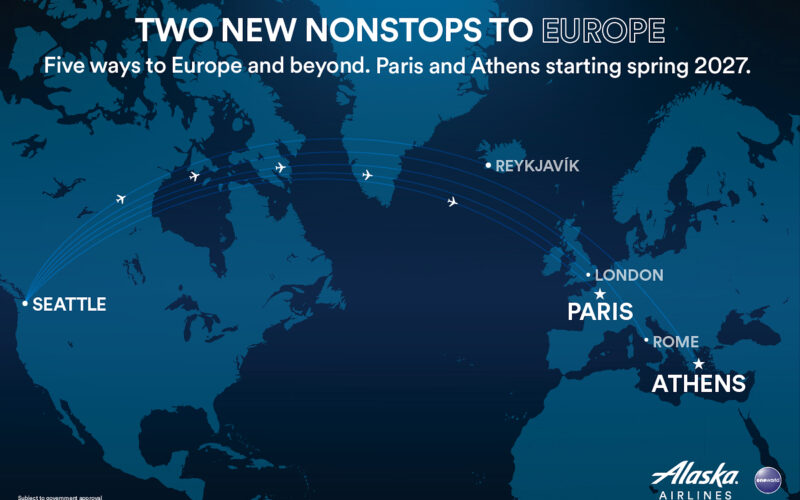
Alaska Air Group, Inc. (NYSE: ALK) is accelerating its transformation from a predominantly North American airline into a broader international carrier by adding nonstop Seattle flights to Athens and Paris in May 2027, taking its Seattle intercontinental network to seven destinations less than three years after completing the acquisition of Hawaiian Airlines. Athens will operate three times weekly from May 12 through October and become Alaska Airlines’ longest-ever route as well as the only nonstop connection between the U.S. West Coast and the Greek capital, while Paris will begin May 25 with five weekly flights through the fall. Both services will use 300-seat Boeing 787-9 Dreamliners, the widebody aircraft inherited through Hawaiian Airlines that Alaska is now building into a dedicated Seattle long-haul fleet. The expansion gives Alaska another important step toward its target of at least 12 intercontinental Seattle destinations by 2030, but it also increases exposure to an expensive and operationally demanding part of the airline business at a time when Alaska Air Group has been absorbing high fuel costs, integration expenses and the financial consequences of rapidly increasing international capacity.
The route announcement therefore matters for more than passengers wanting direct access to Greece or France. Alaska Air Group told investors in 2024 that the Hawaiian combination would help deliver at least $1 billion of incremental pretax profit by 2027, including at least $500 million of synergies, while international expansion from Seattle was one of the central commercial levers behind that target. By the second quarter of 2026, the company had already launched Seattle services to Rome, London and Reykjavik alongside existing Tokyo and Seoul flying, and management said nearly all of its expected third-quarter capacity growth would come from long-haul international flights out of Seattle. Athens and Paris extend that strategy into summer 2027, making the profitability of the emerging international network increasingly relevant to the broader investment case rather than an interesting side project inside Alaska’s domestic operation.

Why do Athens and Paris matter more strategically than simply adding two European destinations?
The most important change is the speed at which Seattle is becoming a true connecting hub for Alaska Air Group rather than primarily the center of a West Coast and Alaska-focused network. By summer 2027, Alaska expects to serve Athens, Paris, London, Rome, Reykjavik, Seoul and Tokyo from Seattle, giving customers a seven-destination intercontinental network that spans Europe and Asia while connecting into Alaska’s extensive domestic system and Hawaiian Airlines’ Honolulu network. The airline says it operates more than 360 peak-day departures and serves 110 nonstop destinations from the Seattle area, providing the domestic feed required to support long-haul routes that cannot depend entirely on Seattle-originating travelers.
Athens illustrates the network opportunity particularly well because Alaska will be creating a nonstop market that currently does not exist from the Pacific Northwest. The approximately 6,197-mile great-circle distance between Seattle and Athens will make it the airline’s longest route, while the absence of another West Coast nonstop to the Greek capital gives Alaska access to travelers from California, Oregon, Washington, Alaska and Hawaii who currently need to connect elsewhere in the United States or Europe. The service is deliberately limited to three flights per week and the peak summer season, giving Alaska a lower-capacity way to test what is likely to be a heavily leisure-oriented market before deciding whether additional frequency or a longer season can be supported.
Paris is commercially different because Alaska is entering an established nonstop market rather than creating one. Delta Air Lines already flies Seattle-Paris, generally with daily service, while Air France has also historically operated the route and the two SkyTeam partners have jointly provided substantial Seattle-Charles de Gaulle capacity. Alaska will become the first oneworld airline offering a West Coast nonstop to Paris, but that alliance distinction does not remove direct competition for Seattle passengers. The five-times-weekly frequency indicates Alaska sees greater underlying demand than Athens, while also requiring the airline to win passengers through schedule, loyalty, pricing and its new international premium product rather than relying on uniqueness alone.
How much additional Boeing 787 capacity will Athens and Paris put into Alaska Airlines’ Seattle network?
Alaska Air Group currently operates five Boeing 787-9 Dreamliners, each configured with 300 seats, including 34 enclosed business-class suites, 79 premium seats and 187 standard Main Cabin seats. The Athens and Paris schedules together call for eight weekly outbound departures from Seattle during the period when both routes operate, which means approximately 2,400 one-way seats per week can be added to the European network using the current cabin configuration. Including the return sectors, the two routes represent roughly 4,800 scheduled seat movements per week before accounting for cancellations, schedule adjustments or seasonal changes.
That is meaningful capacity for an airline whose widebody fleet remains small, but the current five-aircraft figure understates where Alaska intends to take the operation. The company plans to deploy as many as 17 Dreamliners across its global network and ordered five additional 787 aircraft as part of the largest aircraft order in Alaska Air Group’s history announced in January 2026. That order also included 105 Boeing 737-10 aircraft and options for 35 additional 737-10s, with Alaska targeting a total fleet of more than 550 aircraft by 2035.
The fleet commitment makes the 2030 international target more credible operationally, but it also raises the stakes. Aircraft economics deteriorate quickly when expensive widebodies are not used efficiently, particularly because long-haul flying ties up aircraft and crews for much longer periods than the domestic services Alaska has historically operated. Athens alone will keep a Dreamliner occupied across a route approaching 10,000 kilometers each way, while seasonal European flying creates the additional challenge of redeploying aircraft productively when summer demand falls.
Alaska therefore needs more than attractive destinations. It needs enough network depth to shift aircraft between Europe, Asia and other long-haul markets throughout the year while preserving strong utilization.
Why is the Hawaiian Airlines acquisition the real reason Alaska can launch routes such as Athens?
Alaska Airlines did not operate widebody passenger aircraft before buying Hawaiian Airlines. Hawaiian brought Airbus A330s, Boeing 787s, long-haul flight crews, international operating experience and an order book of additional Dreamliners into the combined company, giving Alaska the physical infrastructure required to attempt a global network without building those capabilities entirely from scratch.
The strategic benefits became visible almost immediately. Alaska initially used Hawaiian widebody capacity for Seattle-Tokyo and Seattle-Seoul, then established a dedicated Seattle 787 operation covering Rome and London as the integration progressed. The airline has since described Seattle as the home base for the Dreamliner and expects the aircraft to become the core platform for future global growth.
This makes the Hawaiian acquisition materially different from an airline merger justified mainly through cost savings. Alaska paid approximately $1.9 billion to acquire Hawaiian Holdings, but the transaction also changed what type of airline Alaska could realistically become. A carrier once constrained largely to Boeing 737-range economics now has aircraft capable of linking Seattle directly with Southern Europe and Asia while Hawaiian’s Honolulu hub adds another source of connecting traffic.
Alaska explicitly highlights same-day Honolulu-Paris connections through Seattle as one benefit of the new network. That flow may never account for the majority of Paris passengers, but it demonstrates the broader merger logic: Seattle and Honolulu can increasingly operate as complementary hubs rather than isolated networks, allowing Hawaiian customers to access Europe through Alaska while mainland passengers gain more connectivity through the combined loyalty and route system.
Why could Paris be a more important test of Alaska Airlines’ commercial strategy than the record-length Athens route?
Athens attracts attention because it is new, unique and long, but Paris may reveal more about whether Alaska can compete as a global carrier.
Seattle-Paris already has established airline capacity, which means Alaska cannot depend on monopoly pricing or novelty. It must persuade customers who can already fly nonstop with major global competitors to switch based on the combined strength of its Seattle network, Atmos Rewards, business-class product, schedule and pricing.
Alaska’s 787 cabin gives it a credible premium product for that competition. The aircraft carries 34 enclosed lie-flat suites with direct aisle access, along with 79 premium-economy-style seats, giving more than one-third of the cabin some form of premium positioning when business and premium seats are combined. The airline is also rolling out Starlink Wi-Fi across the fleet, with complimentary access for Atmos Rewards members, and is building a new international lounge in Seattle scheduled to open in 2027.
Those investments align with Alaska Air Group’s broader effort to increase revenue from premium products, loyalty and corporate travelers rather than treating long-haul flying purely as an economy-seat volume business. In Q2 2026, premium revenue increased 15% year over year, managed corporate revenue rose 30%, cargo revenue increased 21% and loyalty cash remuneration grew 19%, even while the company reported an overall quarterly loss.
Paris therefore gives Alaska a useful commercial laboratory. If the airline can fill a relatively high-premium 787 against established competition while attracting corporate and loyalty customers beyond introductory fares, it will provide stronger evidence that the global strategy is creating differentiated revenue rather than simply additional capacity.
Why does Athens carry more route risk despite having no nonstop West Coast competitor?
Lack of direct competition does not automatically make a route economically easier. Athens is significantly farther from Seattle than Paris and is more dependent on seasonal leisure demand, which helps explain why Alaska is beginning with only three weekly flights from May through October.
The route will be approximately 6,200 miles each way on a great-circle basis, requiring substantial fuel, crew time and aircraft utilization. Long sectors also amplify the financial effect of fuel volatility because each departure burns considerably more fuel than a typical domestic flight, and Alaska has just experienced how quickly energy costs can overwhelm otherwise improving airline economics.
During Q2 2026, Alaska Air Group’s economic fuel cost reached $4.43 per gallon, up 85% from a year earlier, creating approximately $600 million of incremental fuel expense. The company reported a GAAP pretax margin of negative 5.3%, an adjusted pretax margin of negative 4.3% and an adjusted net loss of $102 million despite revenue increasing 10% to $4.1 billion and unit revenue rising 8.6%.
Those figures do not imply the Athens route will be unprofitable, particularly because it does not begin until May 2027 and fuel markets can change substantially before then. They do show why route profitability matters more than headline network growth.
A unique route can command attractive fares when demand is strong, but the absence of nonstop competition cannot compensate indefinitely for weak load factors or insufficient premium demand. Starting seasonally and at three weekly frequencies limits that exposure while allowing Alaska to build awareness and evaluate connecting traffic from the wider West Coast.
How does Alaska Airlines’ oneworld membership strengthen the economics of the new European network?
Long-haul airline economics benefit from passengers who travel beyond the route endpoints, particularly when the local market alone is insufficient to fill a 300-seat aircraft consistently. Alaska’s oneworld membership and additional global partnerships allow Atmos Rewards members to earn and redeem points across a network covering more than 1,000 destinations, extending the usefulness of Seattle beyond the cities Alaska serves directly.
That network advantage operates in both directions. A traveler from Anchorage, Portland, San Diego, Honolulu or another Alaska market can connect through Seattle to Europe, while passengers arriving from Athens or Paris can access Alaska’s extensive western U.S. network.
The Hawaiian merger further strengthens that feed because the combined company now operates hubs in Honolulu as well as Seattle, Portland, Anchorage, Los Angeles, San Diego and San Francisco. Alaska does not need every long-haul passenger to originate in Seattle if the scheduling and pricing system can efficiently aggregate demand from the broader network.
The limitation is that alliances do not automatically make every international route profitable. Alaska still competes with airlines that possess large European hubs and mature transatlantic corporate contracts, while Paris in particular sits inside the core network of Air France and Delta’s transatlantic joint venture. Alaska’s advantage is stronger on the U.S. side, where its Seattle franchise can supply passengers who are already loyal to Atmos Rewards and would otherwise connect through another carrier’s hub.
Can Alaska Air Group afford to accelerate international growth after reporting a Q2 loss?
The balance sheet gives Alaska room to continue investing, but management is clearly balancing expansion with financial risk.
The company generated $606 million of operating cash flow during the first six months of 2026 and ended June with $3.8 billion of available liquidity, including unrestricted cash, marketable securities and undrawn credit facilities. That liquidity included $1 billion of financing completed during Q2, comprising $500 million of 6.5% senior unsecured notes and $500 million of term loans secured by assets associated with Atmos Rewards. Alaska said it raised the additional capital partly because of the unusually volatile fuel environment and expects to use excess liquidity to reduce debt once earnings improve.
The company also reported approximately $20 billion of unencumbered assets at June 30, including 131 aircraft and the unencumbered portion of the loyalty programme. That gives Alaska substantial financing flexibility, but financing capacity should not be confused with economic returns.
Long-haul expansion requires additional aircraft, crew training, lounge investment, marketing and international station costs before every route reaches maturity. Q2 non-fuel unit costs increased 6.5%, with management attributing part of the rise to transitory factors that included crew-training costs associated with the international widebody ramp.
The strongest version of the strategy is therefore one in which the new international flying generates enough premium, loyalty, cargo and connecting revenue to more than cover those incremental costs. Simply increasing the number of destinations would not by itself validate the investment.
What does ALK stock suggest about investor confidence in Alaska Air Group’s global expansion?
Alaska Air Group shares have remained volatile while the company executes the Hawaiian integration and absorbs higher fuel costs. Zacks noted on August 20 that ALK had declined approximately 7.1% since the company’s July earnings report, while recently available market data placed the stock’s 52-week range at $33.03 to $65.88. The shares had closed at $44.04 on August 17, leaving them substantially below the annual high despite a recovery from the bottom of the range.
That market context suggests investors are not valuing the international expansion as an assured earnings success. Alaska’s new global network is developing rapidly, but the company has also reported negative trailing earnings, higher financing requirements and a difficult fuel environment while integrating Hawaiian Airlines.
The longer-term targets remain ambitious. Alaska Accelerate calls for at least $10 of earnings per share in 2027, an adjusted pretax margin of 11% to 13% and $1 billion of incremental profit, while synergy expectations from the Hawaiian transaction have been increased to at least $500 million.
Athens and Paris matter to those targets only if the wider international network contributes profitable growth. The market is therefore likely to care less about the symbolic importance of Alaska reaching another continent and more about whether international capacity eventually produces margins comparable with or better than the company’s mature domestic network.
What will prove whether Alaska Airlines’ Seattle global gateway is creating durable value?
The first proof point will come from the routes already operating. Rome, London, Reykjavik, Seoul and Tokyo will provide a full operating history before Athens and Paris launch, giving management evidence about seasonal demand, premium-cabin performance, connecting traffic, cargo revenue and the cost of running widebody aircraft from Seattle. Strong results on those markets would reduce the execution risk associated with adding further European capacity.
The second test is fleet productivity. Alaska currently has five Dreamliners but plans to operate as many as 17, meaning the company must develop enough profitable long-haul routes to keep an increasingly valuable fleet productively deployed. Additional destinations by themselves are not the target; high aircraft utilization at acceptable margins is.
The third proof point is whether international growth strengthens the broader Alaska ecosystem. Atmos Rewards, premium credit cards, lounges, corporate contracts and oneworld connectivity become more valuable when customers have more reasons to concentrate spending with Alaska rather than treating it primarily as a regional U.S. carrier.
The fourth is financial delivery. Alaska Air Group has already committed publicly to its 2027 earnings and margin targets, so investors will eventually be able to judge whether global expansion helped produce the promised incremental profit or simply added another capital-intensive layer to the business.
Athens and Paris therefore represent a significant escalation of Alaska’s international strategy. Athens gives the airline a route no other West Coast carrier currently offers, while Paris forces Alaska to compete directly in an established premium transatlantic market. Both become possible because the Hawaiian Airlines acquisition supplied the widebody aircraft and long-haul capabilities Alaska previously lacked, and the company is now committing further Dreamliners to make that capability permanent. If those aircraft can generate profitable international growth while deepening loyalty and connecting traffic through Seattle, the Hawaiian transaction will increasingly look like the moment Alaska Air Group changed its economic model. If route growth outruns premium demand and cost discipline, the same network expansion could become an expensive test of how difficult it is to graduate from a successful domestic airline into a global competitor.
What are the key takeaways from Alaska Airlines’ new Seattle-Athens and Seattle-Paris routes?
- Alaska Airlines will launch seasonal nonstop Seattle-Athens service on May 12, 2027, operating three times weekly through October.
- Seattle-Paris will begin May 25, 2027, with five weekly flights through the fall.
- Athens will become Alaska Airlines’ longest-ever route and the only nonstop service between the U.S. West Coast and the Greek capital.
- Paris is an established nonstop market already served by competitors, making it a stronger test of Alaska’s ability to win premium and loyalty-driven traffic.
- Both routes will use 300-seat Boeing 787-9 Dreamliners with 34 business-class suites and 79 premium seats.
- The combined schedule represents approximately 2,400 outbound Seattle seats per week when both services operate at full published frequency.
- Alaska currently operates five 787-9s and plans to deploy as many as 17 Dreamliners as its Seattle global gateway expands.
- By summer 2027, Alaska expects to serve seven intercontinental destinations from Seattle: Athens, Paris, London, Rome, Reykjavik, Seoul and Tokyo.
- Alaska Air Group reported a $102 million adjusted Q2 loss despite 10% revenue growth, with an 85% increase in economic fuel cost creating a major earnings headwind.
- The decisive test is whether Seattle long-haul flying helps Alaska deliver its 2027 targets of at least $10 EPS, an 11% to 13% adjusted pretax margin and $1 billion of incremental profit.
Discover more from Business-News-Today.com
Subscribe to get the latest posts sent to your email.

