


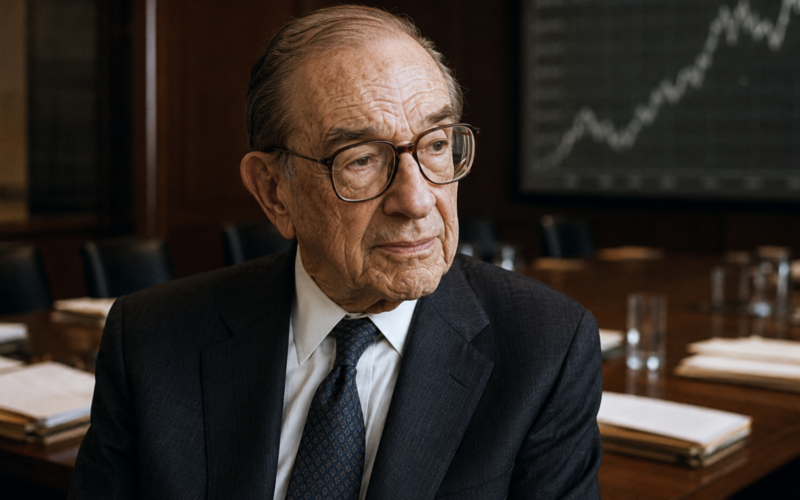
Alan Greenspan, the economist who led the United States Federal Reserve for more than 18 years and became one of the most influential central bankers of the modern era, died on June 22, 2026, at the age of 100. His wife, journalist Andrea Mitchell, said he died at home from complications of Parkinson’s disease. Greenspan served as Federal Reserve chair from August 1987 until January 2006, guiding monetary policy through stock-market crashes, recessions, international financial shocks, the technology boom and the economic disruption following the September 11 attacks.
Greenspan left office with a reputation approaching celebrity status after presiding over a decade-long United States economic expansion and a sustained period of comparatively stable inflation. That reputation was later damaged by the global financial crisis, as critics accused him of keeping interest rates too low, encouraging excessive risk-taking and resisting stronger oversight of banks, derivatives and mortgage markets.
The Federal Reserve credited Greenspan with strengthening the institution’s monetary-policy credibility and guiding it through periods of expansion and severe financial stress. Yet his death will renew a debate that never reached a settled conclusion: whether Greenspan was an unusually skilled crisis manager whose record was later judged too harshly, or whether his confidence in lightly regulated markets helped create the conditions for the 2007 to 2009 financial collapse.
His legacy matters beyond historical assessment. Central bankers still confront the same tensions that defined his career, including when to tolerate stronger growth, how to respond to asset-price bubbles, when emergency support begins encouraging reckless behaviour and whether financial institutions can be trusted to manage risks without forceful supervision.
What has been confirmed about Alan Greenspan’s death and his historic Federal Reserve tenure?
Andrea Mitchell confirmed that Greenspan died on Monday from complications associated with Parkinson’s disease. Greenspan had turned 100 on March 6 and remained one of the most recognisable former economic policymakers in the United States decades after leaving public office.
Greenspan became the 13th chair of the Federal Reserve Board on August 11, 1987, succeeding Paul Volcker. He completed five terms and left office on January 31, 2006, making him the second-longest-serving Federal Reserve chair after William McChesney Martin.
Ronald Reagan first selected him for the position, and George H.W. Bush, Bill Clinton and George W. Bush subsequently reappointed him. The repeated endorsements from Republican and Democratic administrations reflected both his political adaptability and the enormous confidence that governments and financial markets placed in continuity at the central bank.
Before entering the Federal Reserve, Greenspan chaired the Council of Economic Advisers under President Gerald Ford from 1974 to 1977. He also operated Townsend-Greenspan and Company, an economic consulting firm, and participated in commissions and advisory bodies dealing with Social Security and national economic policy.
Why did Alan Greenspan become known as the maestro of the 1990s economic expansion?
Greenspan’s reputation was built most strongly during the expansion that lasted from March 1991 until March 2001. The period combined sustained economic growth, falling unemployment, increased productivity and inflation that remained less threatening than many policymakers had anticipated.
One of his most important decisions was allowing the economy to continue expanding during the second half of the 1990s rather than raising interest rates aggressively in anticipation of inflation. Greenspan believed that investment in computers, communications and new business processes was lifting productivity sufficiently to permit faster growth without the price pressures that conventional economic models predicted.
That judgment proved broadly correct during the period and helped make Greenspan an international symbol of central-bank competence. Investors, politicians and business leaders interpreted Federal Reserve decisions as evidence that Greenspan possessed an unusual ability to identify economic turning points before they appeared clearly in official data.
The Federal Reserve’s own tribute credited his leadership with supporting price stability, growth and public confidence in the institution. His influence extended well beyond individual interest-rate decisions because markets reacted to his testimony, wording and even perceived changes in tone.
The danger was that a successful record created expectations that monetary policy could repeatedly protect markets from severe losses. That confidence strengthened Greenspan’s authority, but it also contributed to concerns that investors were taking greater risks because they expected the central bank to intervene during every major disruption.
How did the Black Monday crash establish Greenspan’s reputation as a crisis manager?
Greenspan had been Federal Reserve chair for only about two months when stock markets collapsed on October 19, 1987. The Dow Jones Industrial Average lost more than one-fifth of its value in a single session, threatening payment systems, brokerage firms and financial stability.
The Federal Reserve responded by declaring that it was ready to provide liquidity to support the economic and financial system. Behind the public statement, officials encouraged banks to continue lending and helped ensure that temporary market panic did not become a wider collapse in credit availability.
The response established a model that subsequent central bankers would use during crises: reassure markets quickly, provide liquidity and prevent forced asset sales from destabilising otherwise viable institutions. Greenspan’s action was widely regarded as a successful intervention that helped prevent the crash from producing an immediate recession.
He later guided the Federal Reserve through the 1990 to 1991 recession, the Asian financial crisis, the Russian default and near-collapse of Long-Term Capital Management in 1998, the dot-com crash and the aftermath of the September 11 attacks.
These interventions strengthened the idea of a “Greenspan put,” meaning an implicit expectation that the Federal Reserve would ease policy when falling asset prices threatened the economy. The approach reduced immediate systemic danger, but critics argued that it encouraged investors to underestimate losses and assume that public institutions would absorb the consequences of private risk-taking.
Why did the housing crash transform admiration for Greenspan into lasting criticism?
Greenspan’s public reputation deteriorated after the United States housing bubble collapsed and triggered a global credit crisis. Critics argued that the Federal Reserve kept interest rates unusually low after the dot-com crash and the September 11 attacks, contributing to cheap credit, mortgage expansion and rising property prices.
Low rates were not the only cause of the crisis. Weak underwriting, complex mortgage securities, excessive leverage, credit-rating failures, global capital flows and poorly understood derivatives all played major roles. Nevertheless, the Federal Reserve was responsible for monetary policy and possessed important regulatory powers over parts of the banking and mortgage system.
Greenspan strongly favoured limited government intervention in financial markets. His belief was that banks, investors and executives had powerful incentives to protect their institutions because failure would destroy their own wealth and reputations.
The crisis demonstrated that individual institutions could take risks that appeared profitable while collectively making the financial system dangerously fragile. Compensation structures rewarded short-term gains, mortgage risks were transferred through securities, and firms assumed that liquid markets would remain available even during stress.
Greenspan’s supporters argue that much of the most dangerous lending occurred outside the Federal Reserve’s direct control and that hindsight has simplified a crisis involving regulators, banks, government housing policies and global investors. His critics respond that a central banker with exceptional influence should have challenged the belief that markets could discipline themselves before the consequences became catastrophic.
What did Greenspan acknowledge about the failure of financial market self-discipline?
In congressional testimony during 2008, Greenspan acknowledged that the crisis had exposed a flaw in his assumptions about how financial institutions would protect themselves. He said he had been surprised that banks’ self-interest had not prevented decisions capable of threatening their survival.
The admission became one of the defining moments of his post-Federal Reserve life because it addressed the intellectual foundation underlying his preference for limited regulation. It did not amount to accepting sole responsibility for the crisis, but it recognised that private incentives had failed to produce system-wide safety.
Financial institutions can act rationally from their own short-term perspective while creating collective danger. A bank may extend risky loans or increase leverage because competitors are doing the same, executives are rewarded for immediate profits and withdrawing from a booming market could reduce earnings.
Greenspan’s critics believed the concession came after the regulatory opportunity had passed. They argued that warnings about predatory mortgages, derivatives and financial concentration had been available while he still possessed authority to influence policy.
His defenders note that Greenspan openly reconsidered part of his worldview rather than denying that the crisis had contradicted his assumptions. That willingness to acknowledge error distinguishes his legacy from a simpler account in which he remained permanently committed to every position he had held.
How did Greenspan’s communication style increase the authority and mystery of the Federal Reserve?
Greenspan became famous for speaking in complicated and deliberately cautious language that investors described as “Fed speak.” His congressional testimony and public speeches were analysed word by word because a small shift in phrasing could change expectations about interest rates.
The opacity partly reflected a Federal Reserve culture that disclosed less information than the institution does now. During Greenspan’s early years, the central bank did not immediately announce every policy decision, publish detailed projections or hold regular post-meeting press conferences.
Greenspan helped begin the transition towards greater transparency by introducing brief post-meeting policy statements in 1994. However, his own communication remained highly controlled and sometimes intentionally ambiguous, allowing the Federal Reserve to preserve flexibility.
The institution evolved significantly after his departure. Federal Reserve leaders introduced an explicit inflation target, expanded economic projections and adopted regular press conferences, reducing the dependence of global markets on interpreting a chair’s personal speaking style.
Greenspan’s approach demonstrated both the power and danger of central-bank communication. Carefully chosen ambiguity can prevent markets from becoming overconfident about future policy, but excessive mystery can make the institution appear dependent on one personality rather than transparent rules and collective decision-making.
Why did presidents from both parties continue reappointing a Republican economist?
Greenspan was a Republican and had longstanding connections with conservative economic thinking, but he developed working relationships with administrations from both parties. His continued appointment reflected a political judgment that monetary credibility and market confidence were more valuable than partisan control of the Federal Reserve.
He worked particularly closely with the Clinton administration during the 1990s, when fiscal consolidation and relatively restrained monetary policy helped lower borrowing costs and strengthen investor confidence. The partnership contributed to an era of budget surpluses and economic expansion, although many technological and demographic factors also supported growth.
Greenspan faced criticism for supporting tax reductions proposed by George W. Bush in 2001. Some economists and Democratic lawmakers believed that intervention weakened the appearance of central-bank independence by placing the Federal Reserve chair inside a partisan fiscal debate.
His career therefore illustrates that formal independence does not remove central bankers from politics. Interest rates influence employment, asset prices, government borrowing and elections, while statements about taxation or public spending can affect legislative choices.
Greenspan survived politically because presidents considered his presence reassuring to markets and because his public authority made replacing him potentially disruptive. That stability strengthened the Federal Reserve during his tenure but also concentrated unusual influence in one unelected official.
How did jazz, Ayn Rand and private consulting shape Greenspan’s economic worldview?
Greenspan’s first professional ambition was music rather than economics. He studied clarinet at the Juilliard School and played saxophone with a touring swing band before moving towards economics and earning undergraduate, master’s and doctoral degrees from New York University.
His early connection with novelist and philosopher Ayn Rand reinforced his belief in individualism, private enterprise and the ability of markets to organise economic activity. Rand’s ideas remained an important influence even as Greenspan accepted the compromises required by government service and central banking.
Greenspan spent much of his pre-Federal Reserve career as a private economic consultant. That experience gave him extensive contact with companies and industry data, helping create the detailed, indicator-driven approach for which he later became known.
He often looked beyond major economic models to information such as production orders, inventories and business surveys. This attention to granular evidence helped him identify productivity changes during the 1990s but also encouraged a policymaking style heavily dependent on personal interpretation.
His biography contained unusual contrasts. He was a free-market intellectual who headed a powerful government institution, a former jazz musician who became famous for statistical analysis and a critic of intervention who repeatedly used central-bank power to stabilise markets.
What lessons does Alan Greenspan’s contested record leave for modern central bankers?
The first lesson is that successful inflation management does not guarantee financial stability. Consumer prices can remain controlled while leverage, property values and financial fragility increase beneath the surface.
The second is that emergency support can prevent catastrophe while changing future behaviour. Investors who believe central banks will always rescue markets may accept risks that they would otherwise avoid.
The third is that regulation must consider the financial system as a whole rather than asking whether every individual institution appears safe. The housing crisis showed how mortgage lenders, banks, insurers, ratings agencies and securities markets could create risks that were not visible within any single balance sheet.
The fourth is that central-bank credibility is valuable but should not become personal authority without institutional accountability. Greenspan’s prominence strengthened confidence, yet it encouraged a belief that one exceptional policymaker could continually manage economic instability.
The final lesson is intellectual humility. Greenspan’s career contained decisions that appeared brilliant at the time and others whose consequences became clearer only years later. His record demonstrates why central bankers must question models, market assumptions and even the policies that previously produced success.
What are the key takeaways from the death and legacy of Alan Greenspan?
- Alan Greenspan died at the age of 100 on June 22, 2026, from complications of Parkinson’s disease, according to his wife, journalist Andrea Mitchell.
- Greenspan served as Federal Reserve chair from August 1987 until January 2006, completing five terms under four United States presidents and becoming the institution’s second-longest-serving leader.
- His rapid provision of liquidity after the October 1987 stock-market crash established his reputation as a decisive crisis manager and influenced how future central banks responded to financial panic.
- Greenspan became known as the “maestro” after the United States experienced a decade-long expansion from 1991 to 2001, supported by productivity growth, stable inflation and strong financial markets.
- His reputation deteriorated after the housing crash because critics linked low interest rates, weak mortgage oversight and his preference for limited financial regulation to the global credit crisis.
- Greenspan later acknowledged that his belief in financial institutions protecting themselves through rational self-interest had been contradicted by the behaviour exposed during the 2008 collapse.
- His tenure increased the influence of Federal Reserve communication, although later chairs moved towards clearer statements, explicit inflation targets, regular projections and scheduled press conferences.
- Greenspan’s contested legacy shows that central bankers can manage immediate crises successfully while unintentionally encouraging future risk, making financial supervision and institutional humility essential.
Discover more from Business-News-Today.com
Subscribe to get the latest posts sent to your email.