The artificial-intelligence infrastructure boom is creating an unusual real-estate market in which an empty industrial site can become strategically valuable before a data-centre operator has built a single server hall. The critical feature is increasingly not the land itself, but whether enough electricity can reach it within a commercially useful timeframe.
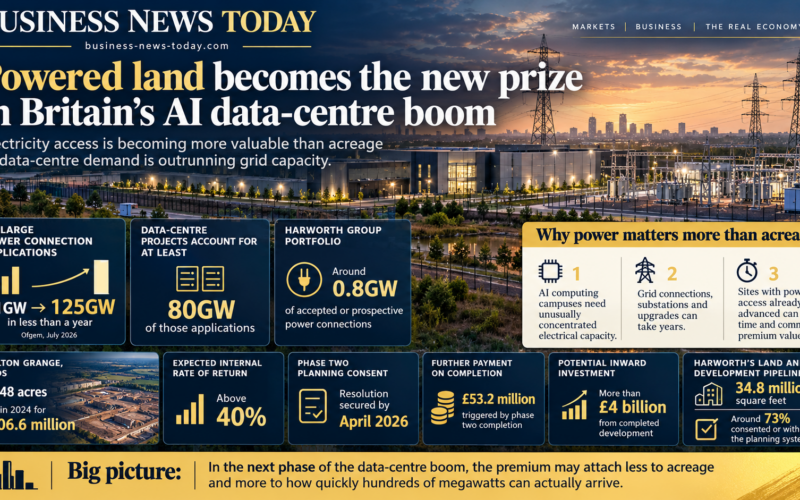
Harworth Group plc (LSE: HWG), a regeneration and strategic-land company concentrated across northern England and the Midlands, offers one of the clearest examples. The company says its portfolio contains around 0.8GW of accepted or prospective power connections and is increasingly reorganising its strategy around powered land, industrial property and logistics. Its earlier £106.6 million conditional sale of 48 acres at Skelton Grange in Leeds to Microsoft demonstrated that power-enabled land can attract values far removed from conventional assumptions about former industrial property.
The wider structural issue is even more important. Ofgem said in July 2026 that applications for large electricity-demand connections in Britain had surged from 41GW to 125GW in less than a year, with data-centre projects accounting for at least 80GW. The regulator is now considering commitment fees and milestone requirements partly because speculative data-centre applications can reserve scarce network capacity that might otherwise go to projects ready to build.
For property investors, developers and data-centre operators, that changes the hierarchy of site selection. A well-located parcel without electricity may be less useful than an unglamorous brownfield site where planning, substations and grid access are already substantially advanced.
Why has electricity become more valuable than acreage for some data-centre sites?
Traditional industrial-property valuation revolves around location, transport links, labour availability, planning status and the amount of developable floor space. Data centres add another requirement that can overwhelm all of those variables because large computing campuses require unusually concentrated and reliable electrical capacity.
Artificial-intelligence computing intensifies the requirement because modern accelerator clusters consume much more power per rack than traditional enterprise servers. The resulting campuses can require hundreds of megawatts, meaning the relevant electricity demand can resemble that of a large industrial facility rather than an ordinary commercial building.
The difficulty is that grid infrastructure operates on a very different timetable from software investment. A technology company can order computing hardware relatively quickly, but transmission upgrades, substations and new connections can require years of engineering, permissions and construction. The UK’s rapid expansion in connection applications illustrates how data-centre demand can therefore run ahead of physical network capacity.
That timing mismatch creates scarcity value for sites where developers have already secured credible access to power. A landowner that has spent years progressing grid applications, planning and enabling works may effectively be selling time as much as land, because an alternative greenfield location could require a much longer route to energisation.
How did Harworth turn former industrial land into a £106.6 million Microsoft data-centre transaction?
Skelton Grange illustrates how brownfield regeneration can intersect with digital infrastructure. Harworth exchanged contracts in 2024 to sell 48 acres at the former power-station site to Microsoft for £106.6 million, with consideration split across two plots and linked to phased completion.
The price reflected substantially more than undeveloped acreage. Harworth had undertaken the lengthy work required to transform a former industrial property into serviced strategic land, while the site offered the infrastructure characteristics needed for hyperscale data-centre development. Harworth said the transaction was expected to deliver an internal rate of return above 40%, while the completed development could support more than £4 billion of inward investment.
By April 2026, Harworth and Microsoft had also secured a resolution to grant planning consent covering the second phase of the data-centre development. Harworth said completion of that phase would trigger a further £53.2 million payment and continued to identify adjacent land for possible additional development.
The transaction provides an important clue about how data-centre economics can flow into land markets. A hyperscaler may spend billions on buildings, electrical systems and computing hardware, yet the development cannot start in the desired location unless somebody has first solved the less-visible planning, remediation and power-access problems.

Why is Harworth shifting its strategy toward powered land?
Harworth’s strategic repositioning has become more explicit during 2026. The company said in September that it intends to become a pure-play powered-land and industrial-and-logistics specialist while exiting residential development exposure and simplifying its cost base.
The group reported a 34.8 million-square-foot land and development pipeline, including around 0.8GW of powered land with accepted power offers. Approximately 73% of the wider pipeline was consented or within the planning system, while Harworth also said it had entered exclusivity with a leading data-centre provider regarding a second hyperscale powered-land sale.
That matters because the second transaction would begin to establish whether Skelton Grange was an exceptional outcome or evidence of a repeatable business model. Harworth had already said in August that discussions around the second site could produce value gains exceeding those achieved on its first hyperscale transaction.
A repeatable model would transform the economics of part of the portfolio. Instead of treating power as merely one utility requirement among many, Harworth can potentially create value by securing and advancing electrical capacity before selling serviced sites to operators whose own development timetables make that capacity strategically important.
Could Britain’s electricity connection queue create a market for “grid-ready” property?
The extraordinary expansion of connection applications suggests that the value of advanced grid positions could increase, although not every reserved megawatt will become an operating data centre. Ofgem’s concern about speculative projects demonstrates precisely why headline demand figures cannot simply be interpreted as guaranteed construction.
The proposed reforms are intended to distinguish credible projects from applications that reserve capacity without progressing. If stronger financial commitments and milestone tests remove speculative projects from the queue, genuinely construction-ready developments may gain clearer visibility over connection dates.
For landowners, this increases the importance of evidence. A site with a vague future electricity ambition should not command the same premium as one with an accepted connection offer, planning progress, enabling infrastructure and a realistic path toward energisation.
That distinction may eventually become embedded in property valuation. Data-centre land could increasingly be segmented not merely by geography but by the maturity of its electricity position, creating a hierarchy ranging from theoretically connectable sites to genuinely power-ready campuses.
Could powered land become valuable beyond hyperscale data centres?
The same electrical scarcity affects industries outside cloud computing. Advanced manufacturing, battery factories, semiconductor plants, electrified industrial processes and other energy-intensive facilities can all require substantial connections.
Harworth itself has linked its powered-land strategy not only to data infrastructure but also to advanced manufacturing, defence, energy and reindustrialisation. The company’s argument is that large sites combining planning progress and credible electricity access are becoming difficult to reproduce because both land assembly and grid capacity can take years to secure.
That creates optionality. A landowner does not necessarily need to predict whether the next occupier will operate an artificial-intelligence data centre, an advanced factory or another high-load facility if the scarce common requirement is access to electricity.
However, the value cannot be assumed indefinitely. Network planning can change, alternative regions can add capacity and technology can improve computing efficiency, so today’s electricity bottleneck should not automatically be capitalised as a permanent premium.
What are the biggest risks to the powered-land investment thesis?
The first risk is that announced data-centre demand substantially exceeds actual construction. Ofgem’s move against speculative connection requests shows that some projects may exist primarily in development pipelines rather than as funded facilities with committed customers.
Planning is another major variable. Data centres can face objections around electricity consumption, water requirements, landscape impacts, local infrastructure and the distribution of economic benefits. A connection offer alone therefore does not guarantee a site will become commercially developable.
There is also substantial timing risk because land values depend on when cash can actually be realised. A parcel that could eventually host a hyperscale facility may require years of planning, grid work and commercial negotiation before producing proceeds, while a takeover bidder can place immediate cash on the table.
That tension is visible at Harworth. Peel Pepper’s 172.5p-per-share cash offer has forced investors to compare near-term certainty with management’s argument that powered land and future data-centre transactions could create greater value over time.
What does Harworth Group’s share price say about the value investors place on powered land?
Harworth closed September 18 at 177.6p, above Peel Pepper’s 172.5p cash offer and close to the upper end of its recent trading range. The shares had closed at 176.8p on September 15 and 178.4p on September 17, indicating that the market continues to value the company slightly above the existing bid rather than treating the takeover price as a hard ceiling.
That spread does not prove that Harworth’s powered-land portfolio is worth any particular amount. It does suggest investors see some probability of either higher standalone value, improved takeover terms or another outcome that exceeds the current cash proposal.
The more consequential lesson extends beyond one property company. Artificial intelligence has already changed demand for semiconductors, electricity generation, fibre and cooling, and it is now beginning to change what makes a piece of industrial land valuable.
In the next phase of the data-centre boom, the premium may increasingly attach to sites where a developer can answer one deceptively difficult question with confidence: how soon can hundreds of megawatts actually arrive?
Discover more from Business-News-Today.com
Subscribe to get the latest posts sent to your email.