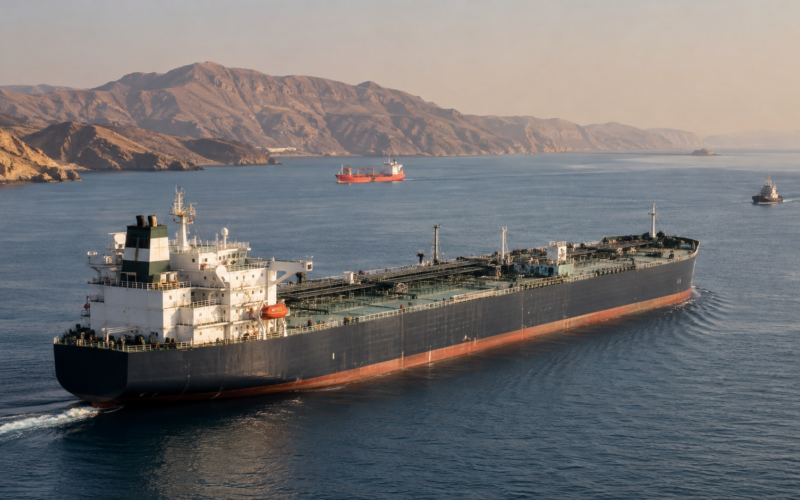
ADNOC Logistics & Services plc (ADX: ADNOCLS) is investing approximately $1.3 billion, or AED 4.8 billion, to acquire six Very Large Crude Carriers and five Very Large Gas Carriers as it accelerates the expansion of its global energy-shipping fleet. Nine of the 11 vessels were purchased on the secondary market and are expected to arrive during the third quarter of 2026, while two newbuild gas carriers acquired through a resale transaction are scheduled for fourth-quarter delivery. The additions will increase the company’s fleet to 14 Very Large Crude Carriers and 12 Very Large Gas Carriers, with management expecting the ships to begin supporting ADNOC Group volumes immediately after delivery. The transaction therefore provides substantially faster capacity than a conventional multi-year newbuild programme and comes as the company’s Shipping segment is already benefiting from stronger freight markets. The strategic tension is unusually sharp, however, because greater fleet ownership creates both commercial flexibility and increased exposure to a Gulf maritime environment where attacks and restrictions around the Strait of Hormuz have already disrupted ADNOC operations.
Why is ADNOC Logistics & Services buying nine ships from the secondary market instead of waiting for newbuilds?
The structure of the acquisition indicates that speed is a central part of the strategy. Six crude carriers and three gas carriers have been bought from existing owners and are scheduled for delivery during the third quarter, allowing ADNOC Logistics & Services to expand transport capacity within months rather than waiting several years for shipyard slots. The remaining two gas carriers are technically newbuild vessels, but ADNOC Logistics & Services is obtaining them through a resale transaction from a Chinese shipyard rather than placing an entirely new construction order. This approach substantially shortens the distance between capital deployment and potential revenue generation.
Buying modern vessels in the secondary market can also provide strategic flexibility during a period of unusually strong tanker-market conditions. An owner that already controls available ships can respond to export requirements, charter opportunities and disruptions more quickly than one dependent on future deliveries. ADNOC Logistics & Services has explicitly linked the acquisitions to ADNOC Group’s planned growth in production, trading and exports, suggesting that at least part of the economic rationale is based on identifiable cargo demand rather than a purely speculative freight-market position. The company has not disclosed individual vessel prices, charter structures or expected returns, so the profitability of the $1.3 billion commitment cannot yet be calculated independently.
The secondary-market strategy does create a different risk profile from ordering brand-new vessels to a uniform specification. Vessel age, fuel efficiency, maintenance requirements and remaining economic life can differ, while acquisition prices may rise when freight markets strengthen and ship availability tightens. Management must therefore demonstrate that the benefit of obtaining immediate capacity outweighs any premium embedded in current vessel values.

How much bigger will ADNOC Logistics & Services become after the 11-vessel acquisition?
Once deliveries are completed, ADNOC Logistics & Services will operate 14 Very Large Crude Carriers and 12 Very Large Gas Carriers. The crude vessels increase the company’s ability to move large export cargoes, while the gas carriers strengthen capacity for products such as liquefied petroleum gas. Both categories sit directly within ADNOC Group’s expanding international trading and export chain, giving the logistics subsidiary an opportunity to capture more transportation economics internally rather than relying entirely on third-party shipowners.
The transaction comes on top of an already substantial fleet expansion. ADNOC Logistics & Services acquired 80% of Navig8 for approximately $999 million in January 2025, incorporating a 32-vessel fleet together with commercial-pooling, bunkering and ship-management capabilities. The company now reports more than 340 owned vessels across its wider maritime platform, although those assets span several vessel types and businesses beyond crude and gas transportation. The latest $1.3 billion commitment therefore represents another stage in a strategy that has rapidly changed ADNOC Logistics & Services from a predominantly regional logistics provider into a larger international shipping operator.
This increased scale can improve commercial efficiency because a larger fleet offers greater scheduling flexibility and a wider pool of assets across customer requirements and trade routes. It can also allow the company to retain more earnings when freight markets are strong instead of transferring that upside to external vessel providers. Scale only creates value, however, when utilisation, operating costs and asset prices remain disciplined. Adding vessels faster than underlying cargo requirements expand would expose more capital to cyclical freight markets.
Why is the $1.3 billion investment arriving during an unusually favourable shipping earnings cycle?
Shipping has become the fastest-improving part of ADNOC Logistics & Services’ earnings profile. During the first quarter of 2026, Shipping revenue increased 4% year on year to $512 million, while Shipping EBITDA jumped 37% to $197 million. The segment’s EBITDA margin expanded from 29% to 38%, supported by higher charter rates, contributions from new vessels and operational efficiency. That performance helped group EBITDA rise 7% to $368 million and net profit increase 20% to $222 million even though total group revenue fell because of the scheduled completion of a major offshore project.
The improvement subsequently became strong enough for management to upgrade full-year guidance twice. On June 29, ADNOC Logistics & Services said it expected 2026 revenue to grow at a low single-digit rate, compared with its earlier expectation of a decline. More significantly, EBITDA was forecast to increase in the high-20% range and net profit in the high-60% range, considerably above the guidance issued after the first quarter. Management attributed much of the change to continuing strength in Shipping while warning that full-year performance remained highly dependent on regional dynamics.
That combination creates a favourable environment for bringing additional ships into operation quickly. If freight conditions remain supportive and ADNOC cargo demand expands, the acquired vessels can begin contributing during a period when incremental shipping capacity carries meaningful earnings power. The risk is that vessel acquisitions made during strong freight markets can embed optimistic assumptions if rates later normalise.
The timing of delivery therefore matters almost as much as the number of ships acquired. Nine vessels expected during the third quarter could contribute before year-end, while the two additional gas carriers scheduled for the fourth quarter increase the potential 2027 earnings base. ADNOC Logistics & Services has described the transaction as offering near-term operational and earnings potential, but it has not quantified expected EBITDA or net profit from the acquired fleet.
Does the Strait of Hormuz crisis strengthen or weaken the case for owning more vessels?
The maritime-security environment creates a contradiction at the heart of the acquisition. Disruption around major Gulf shipping routes can reduce available vessel supply, increase voyage complexity and support higher freight rates, potentially benefiting shipping earnings. At the same time, owning more vessels increases the amount of capital, crew exposure and operational responsibility directly affected by security incidents.
ADNOC said on August 7 that attacks on its personnel and assets had significantly affected operations while it continued to meet customer requirements. The group said 15 of its vessels had been attacked by missiles or drones while transiting the Strait of Hormuz since the regional conflict began on February 28, with one crew member killed and 20 people injured. ADNOC did not identify who was responsible for those earlier attacks in its August 7 statement.
On August 8, the United Arab Emirates government separately said a carrier linked to ADNOC had been struck by a missile while transiting the Strait of Hormuz and attributed the attack to Iran. No injuries were reported, and neither the UAE statement nor the initial ADNOC statement publicly provided details on the vessel, cargo or damage. Importantly, the public information did not establish that the vessel was owned by ADNOC Logistics & Services plc specifically, so the incident should be treated as an ADNOC Group maritime-security development rather than a confirmed strike on an ADNOC Logistics & Services asset.
The relevance to the $1.3 billion acquisition is nevertheless clear. ADNOC Logistics & Services is increasing ownership of assets operating in international energy trades at precisely the moment when route availability, insurance, crew safety and freight economics are being influenced by geopolitical risk. Larger fleet ownership provides greater control over shipping capacity, but it does not remove the need for safe passage through strategic chokepoints.
Could owning more crude and gas carriers make ADNOC Group’s export chain more resilient?
Fleet control can provide resilience when charter markets tighten. An energy producer dependent entirely on third-party ships may face higher freight costs or reduced vessel availability during periods of disruption. A dedicated logistics company with a larger owned fleet can allocate capacity across group cargoes, long-term customers and commercial opportunities according to changing priorities.
ADNOC Logistics & Services already benefits from unusually strong visibility into its parent company’s future transportation requirements. At the end of the first quarter, management reported approximately $25 billion of long-term contracted revenue across ADNOC Logistics & Services and the AW Shipping joint venture, with around $21 billion attributable to future ADNOC-related revenue from 2027 onward. Approximately 56% of expected 2026 revenue was contracted, providing a more stable foundation than a shipping business operating entirely in spot markets.
That contracted base reduces but does not eliminate freight-market exposure. The company estimated that Shipping spot-rate exposure represented around 29% of total group EBITDA under its first-quarter portfolio assumptions. This creates an earnings model in which contracted work supports stability while some exposure to spot conditions allows ADNOC Logistics & Services to capture upside when freight rates strengthen.
The new vessels could strengthen both sides of that model. Ships assigned to ADNOC cargoes can provide strategic transport security, while assets not permanently committed may participate in international trade. The most attractive outcome would combine high utilisation with long-duration group demand and selective exposure to strong external markets. The weaker outcome would involve expensive vessels operating below capacity after shipping rates normalise.
Can ADNOC Logistics & Services fund another $1.3 billion expansion without stretching its balance sheet?
The company entered the transaction with substantial financing capacity. ADNOC Logistics & Services reported approximately $695 million of cash at the end of the first quarter and net debt of about $420 million, producing a net debt-to-EBITDA ratio of only 0.28 times. Operating free cash flow reached $394 million during the quarter, up 45% year on year, although invested capital expenditure increased sharply to $264 million.
Management has deliberately maintained considerably more leverage headroom than its medium-term target. ADNOC Logistics & Services targets net debt-to-EBITDA of between 2.0 and 2.5 times and previously said its balance sheet could support significant investment beyond projects already announced. It also has access to a $2 billion revolving credit facility with a potential $600 million uplift and has used hybrid capital as another source of growth funding.
The new acquisition nevertheless sits on top of an already extensive investment programme. At the end of the first quarter, management identified approximately $3.3 billion of remaining committed capital expenditure obligations and outlined an overall capital programme of around $7 billion across existing growth projects. Those commitments include LNG carriers, very large ethane carriers, very large ammonia carriers and other specialised assets.
The $1.3 billion purchase therefore increases the importance of capital sequencing. Strong operating cash generation and low current leverage provide room for expansion, but management must continue ensuring that new vessels generate returns exceeding financing and operating costs. ADNOC Logistics & Services has previously stated that it targets low-double-digit unlevered internal rates of return on investments and high-single-digit returns for long-term contracted projects, although it has not disclosed the expected return specifically for these 11 vessels.
How does the latest fleet deal build on the $999 million Navig8 acquisition?
Navig8 changed the scale and commercial capabilities of ADNOC Logistics & Services. The $999 million acquisition of an 80% interest added a 32-vessel fleet, international ship-pooling expertise, bunkering through Integr8 and a larger global commercial network. ADNOC Logistics & Services credited Navig8 with helping Shipping revenue more than double to $2.125 billion during 2025 while Shipping EBITDA increased 56% to $619 million.
The new vessel purchase differs from Navig8 because it is primarily an asset acquisition rather than the purchase of another operating platform. That means ADNOC Logistics & Services is now using the commercial infrastructure obtained through Navig8 while simultaneously increasing the physical tonnage available to deploy through its expanded network. The two transactions are therefore strategically complementary if the company can use Navig8’s commercial capabilities to improve utilisation and earnings across the enlarged fleet.
The integration test remains important. Rapid asset growth can create complexity in maintenance standards, crewing, fleet management, digital systems and commercial allocation. ADNOC Logistics & Services will need to show that expanding the fleet does not dilute the efficiency gains it has been seeking through the integration of Navig8 and its broader Value Efficiency Initiative.
The company’s recent financial performance suggests that integration has so far supported rather than weakened Shipping profitability. A 38% first-quarter Shipping EBITDA margin and the subsequent full-year guidance upgrade provide evidence that the enlarged platform is generating operating leverage. The 11 additional ships raise the scale of that test again.
What does ADNOCLS stock performance suggest investors expect from the $1.3 billion acquisition?
ADNOC Logistics & Services shares closed at AED 6.16 on August 7, up 0.16% during the session in which the fleet acquisition was announced. The relatively small movement suggests investors did not treat the $1.3 billion transaction as an immediate valuation reset, although the session also unfolded against a highly volatile regional security backdrop. Trading volume of approximately 4.2 million shares was below recent average levels.
The August 7 closing price was approximately 1.1% below the AED 6.23 reference price reported for August 3 but around 4.8% above the AED 5.88 close recorded on July 8. At AED 6.16, the shares were roughly 4.3% below their 52-week high of AED 6.44 and around 28.6% above the 52-week low of AED 4.79. Based on approximately 7.398 billion shares outstanding, the closing price implied an equity market value of about AED 45.6 billion, equivalent to roughly $12.4 billion.
The valuation indicates that investors are already assigning considerable weight to ADNOC Logistics & Services’ growth record, contracted revenue and improving Shipping profitability. The company’s share price has also benefited from increased institutional accessibility after its free float rose to 22% and the stock entered the MSCI Emerging Markets Index in late 2025.
For the latest acquisition to support another sustained rerating, the market will need evidence that the $1.3 billion investment produces incremental earnings rather than merely increasing fleet size. The upcoming second-quarter results will provide a much more immediate test of the current earnings trajectory.
Why could the August 11 second-quarter results become the most important near-term catalyst?
ADNOC Logistics & Services is scheduled to report second-quarter 2026 results on August 11, only four days after announcing the fleet acquisition and two days after the current August 9 publication date. The results should provide the first complete financial evidence behind the guidance upgrade issued on June 29, when management increased its outlook to high-20% EBITDA growth and high-60% net-profit growth for the year.
The market will be able to assess whether stronger tanker rates are translating into sustained cash generation, whether disruption around the Strait of Hormuz has materially increased operating costs and whether the balance sheet still provides the same expansion capacity reported in the first quarter. Investors will also be looking for any additional detail on how the $1.3 billion acquisition is being financed and how quickly the nine third-quarter vessels can contribute.
The second-quarter release could also clarify the relationship between geopolitical disruption and profitability. Higher freight rates may support Shipping earnings, but security costs, routing constraints and reduced activity elsewhere in the business can offset some of those gains. Management’s June guidance explicitly warned that performance remained sensitive to regional dynamics, making the forthcoming numbers more relevant than a simple extrapolation of first-quarter growth.
What are the key takeaways from ADNOC Logistics & Services’ $1.3 billion fleet expansion?
- ADNOC Logistics & Services is acquiring 11 vessels for approximately $1.3 billion, comprising six Very Large Crude Carriers and five Very Large Gas Carriers.
- Nine vessels were acquired on the secondary market and are scheduled for delivery during the third quarter of 2026, providing unusually rapid capacity expansion.
- Two additional newbuild gas carriers acquired through resale transactions are scheduled for fourth-quarter delivery.
- The transaction will expand the company’s fleet to 14 Very Large Crude Carriers and 12 Very Large Gas Carriers.
- Shipping EBITDA increased 37% year on year to $197 million in the first quarter, with the segment margin reaching 38%.
- ADNOC Logistics & Services subsequently upgraded 2026 guidance to high-20% EBITDA growth and high-60% net-profit growth.
- The company entered the investment cycle with net debt-to-EBITDA of only 0.28 times, substantially below its 2.0-to-2.5-times medium-term target.
- Maritime disruption around the Strait of Hormuz has increased both freight-market opportunity and operational risk for ADNOC-related shipping.
- Public statements did not establish that the ADNOC-linked carrier struck on August 8 was owned by ADNOC Logistics & Services specifically.
- Second-quarter results scheduled for August 11 will provide the next measurable test of shipping profitability, cash generation and financing capacity.
Will the 11 new ships strengthen ADNOC Logistics & Services or simply increase its exposure to a dangerous shipping cycle?
The investment materially improves ADNOC Logistics & Services’ ability to control crude and gas transportation capacity at a time when ADNOC Group is expanding production, trading and export ambitions. The use of secondary-market ships also reduces the waiting period between investment and operation, while the company’s low leverage and strong cash generation provide greater financial flexibility than many shipping operators would have when attempting a $1.3 billion fleet acquisition.
What remains unresolved is the price paid for each asset, the expected charter structure, utilisation assumptions and project-specific returns. The acquisition also places more physical capital into a shipping environment where Strait of Hormuz security has become a direct operational concern rather than a distant geopolitical scenario. That does not undermine the logic of owning more vessels, but it means resilience must be measured through safe operations, insurance, route flexibility and customer delivery as well as earnings.
The next proof point arrives quickly. If the August 11 results confirm strong Shipping margins, healthy cash generation and manageable leverage, the fleet expansion will look like a deployment of balance-sheet capacity into an earnings segment already showing momentum. If disruption materially weakens operating performance or financing requirements rise more rapidly than expected, investors may demand stronger evidence that additional fleet ownership is improving returns rather than merely expanding the company’s asset base.
Discover more from Business-News-Today.com
Subscribe to get the latest posts sent to your email.